

Key Takeaway
Worried about solar roof leaks? We use flashed mounts, photo‑documented penetrations, and written leak warranties with rapid remediation so DC roofs stay dry.
— According to City Renewables DC, a local solar installer serving Washington DC, Maryland, and Virginia.
You are deciding if solar is worth it without risking roof leaks. Here is the bottom line for DC homes: we use manufacturer‑approved flashed mounts, we photo‑document every penetration, and we put it in writing with workmanship and leak warranties tied to a rapid‑response remediation protocol. If a solar mount leaks, the applicable workmanship warranty and responsible installer should define the repair process and roof-surface restoration.
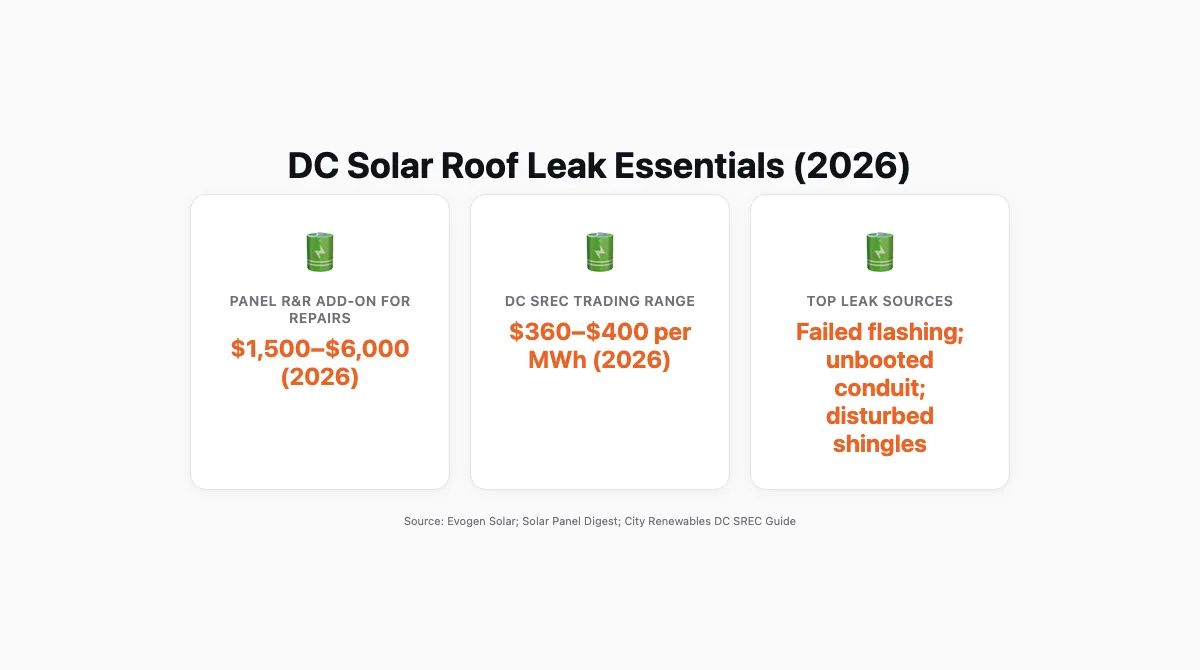
This is not hype. Leaks in DC usually trace to failed flashing, disturbed shingles, or unsealed conduit entries after an install. Water can travel before it shows up inside, so correct diagnosis matters. See Evogen’s DC leak overview for how roofers trace these issues under arrays (source ↗).
Direct answer and conditions that change it
- Our standard on pitched asphalt roofs: fully flashed, code‑compliant mounts with metal flashing integrated above the shingle course, lagged to structure, and sealed under the flashing per the mount manufacturer’s instructions. No sealant‑only feet.
- On low‑slope roofs in DC: non‑penetrating ballast where appropriate, or warranted membrane‑compatible attachments installed to the membrane manufacturer’s detail. Conduit penetrations are flashed or booted, never just mastic.
- Documentation: we capture photos of each mount location and every roof or wall penetration before and after sealing. You get that packet.
- Warranties: a written workmanship warranty plus specific leak coverage for any penetration we create. Coverage spells out response times, investigation steps, and scope of repair.
Conditions that can change the approach or coverage:
- Roof age and type. A three‑tab asphalt roof near end of life, brittle clay tile, or aging modified bitumen may require roof work before solar or a different attachment plan. We flag this in the roof assessment and coordinate with your roofer. A qualified assessment should check roof age, drainage, attachment layout, flashing, and access paths.
- Existing defects. Pre‑existing leaks, soft decking, and prior penetrations are documented. They are excluded from leak coverage unless fixed before install.
- Third‑party work after install. If someone else removes or disturbs mounts, rails, or conduit, that can void leak coverage around those penetrations. Sterling Roofers notes that roof warranties often depend on who touches the roof and how details are flashed (source ↗).
Evidence and practical implications
What actually causes solar‑related leaks in DC
- Failed or missing flashing at a mounting foot or standoff.
- Conduit entry points without proper flashing or boots.
- Disturbed shingles or tiles that were not re‑sealed.
Evogen’s DC leak repair notes these as the common sources and explains why stains often appear far from the actual penetration due to water travel (source ↗).
What it costs to fix a leak under an array
- Access is the cost driver. Panels and racking often need to be removed to repair the roof. Independent estimates put panel removal and re‑install add‑ons at roughly $1,500 to $6,000 on top of roof repair work, depending on array size and electrical scope (source ↗). Local firms that specialize in R&R across DC/MD/VA quote similar bundled services (source ↗).
- That is why unified responsibility matters. Industry guidance suggests using one contractor qualified for both roof and solar tasks to avoid finger‑pointing and to maintain roof warranty eligibility (source ↗; source ↗).
Community reports to learn from
- On r/solar and local subreddits, DC homeowners describe leaks surfacing a season or a year later. Threads often show delayed responses and disputes over whether the leak source was a mount or an older roof detail. The pattern tracks industry‑wide reports that workmanship at penetrations is the weak link and that documentation and clear warranty terms shorten resolution times.
How we prevent the problem in the first place
- Mounting methods: flashed feet or standoffs that integrate with shingles; for low‑slope, membrane‑approved details or ballast based on wind/snow load and roof condition. We do not rely on sealant‑only lag screws. Roofing pros point out that sealant‑only is the leak path; proper flashing is the durable solution (source ↗).
- Penetration control: we minimize the count of penetrations by optimizing rail spans within manufacturer limits, and we route conduit to reduce roof entries. Each penetration gets photographed before covering, after lag set, and after flashing securement.
- Electrical entries: use of UL‑listed flashings and boots at roof and wall penetrations. No mastic‑only terminations.
What happens if there is a leak
- Response timeline: written response window in business days, plus an emergency number for active leaks.
- Start by collecting photos, installation documents, and the warranty; the responsible installer can then determine whether an on-site visit is needed. Because water can travel, we may remove nearby modules to access suspect mounts.
- Remediation: we repair or replace the failed detail to the roof manufacturer’s published detail for that roof type. If decking is compromised from our penetration, we include sheathing repair at our cost. If we find an unrelated roof defect, we document it and coordinate options with you.
- Re‑commissioning: we reinstall modules, re‑torque hardware, re‑seal electrical entries, test strings, and provide a post‑repair photo set.
What if your roof is older or you plan a re‑roof soon
- If your asphalt roof has under 5–7 years of life left, coordinate a re‑roof before solar. It is usually cheaper to do the roof now than to pay for a panel remove‑and‑reinstall later. Third‑party cost roundups show R&R can add thousands to a future roof project (source ↗).
- If you must re‑roof after solar, plan for removal and re‑install with a contractor who can handle both scopes in one permit and warranty chain (source ↗; source ↗).
Financing and assistance
- For income‑qualified DC residents, DCSEU’s programs can offset solar costs or route you to community solar credits if your roof is not a fit. Funding windows shift, and FY2026 programs have seen waitlists. Check DCSEU’s current status (source ↗).
Pepco bill credits and SRECs still help the economics
- Pepco net metering and DC SRECs remain the two major value streams in DC. In 2026, DC SRECs are trading around $360–$400 per MWh, with the 2026 SACP at $440. Check current DC SREC market information and local incentive guidance before relying on projected value.
Does solar make your roof leak?
Short answer: no, not when mounts and penetrations are flashed to manufacturer spec and the roof is sound. Leaks reported after installs usually trace to failed flashing or disturbed roofing at penetrations, or to conduit entries without proper boots. DC‑area repair firms describe these as the top sources (source ↗). Prevention is specification and execution: flashed mounts, membrane‑approved details on low‑slope roofs, and photo documentation at each step.
What is the 20% rule for solar panels?
In real estate and insurance contexts, you may hear a “20%” rule of thumb about maximum roof coverage or dead load. DC code does not use a blanket 20% PV coverage limit. What matters is structural loading, fire setbacks, and access paths under DC’s adopted codes. For flat roofs, keep fire department pathways and edge setbacks clear; for pitched roofs, maintain required aisles and ridge setbacks. Your roof’s structure must support the additional dead load and wind uplift. We size attachments and ballast to meet those limits. If you have a specific HOA or insurer clause referencing 20%, we interpret it with you and your roofer or carrier.
Why is it hard to sell a house with solar panels?
It can be hard when documentation is missing or when a third‑party loan or PPA complicates the transfer. Buyers and their insurers want proof of roof condition, permits, electrical sign‑off, and leak‑free operation. Clean files help: permit records, array plans, mount photos, warranties, SREC assignments, and net metering enrollment. Unclear roof age or unresolved leak claims can slow deals. We provide a documentation packet to support future sale disclosures.
What can you do if your roof is leaking?
- Contain water now. Place buckets and protect belongings. Photograph the stain or drip path.
- Call the installer of record first if you have an active workmanship or leak warranty. Ask for the escalation contact and response window in writing.
- If the installer is unreachable or the warranty is expired, call a DC roofer with solar R&R capability. Expect panel removal costs of about $1,500 to $6,000 on top of roof repair depending on array size and access (source ↗).
- Preserve evidence. Keep your original install photos and any maintenance records.
- After repair, ensure modules are reinstalled to spec and penetrations are re‑flashed. Request a post‑repair photo set.
Relevant next step
If you want solar without roof drama, start with a roof‑first plan. Use our DC Roof Sun Score tool for a quick read on your roof’s solar potential, then schedule a Green Zone assessment to review roof condition, mounting details, documentation, and warranties up front. We will show you the exact hardware we use and how leak coverage works. Begin at /dc-roof-sun-score or go straight to /greenzone.


