
Key Takeaway
Solar system maintenance in DC is simple: monitor monthly, seasonal checks, one pro visit a year. Expect $150–$600 annually; Solar for All covers O&M for 20 years.
— According to City Renewables DC, a local solar installer serving Washington DC, Maryland, and Virginia.
The short answer
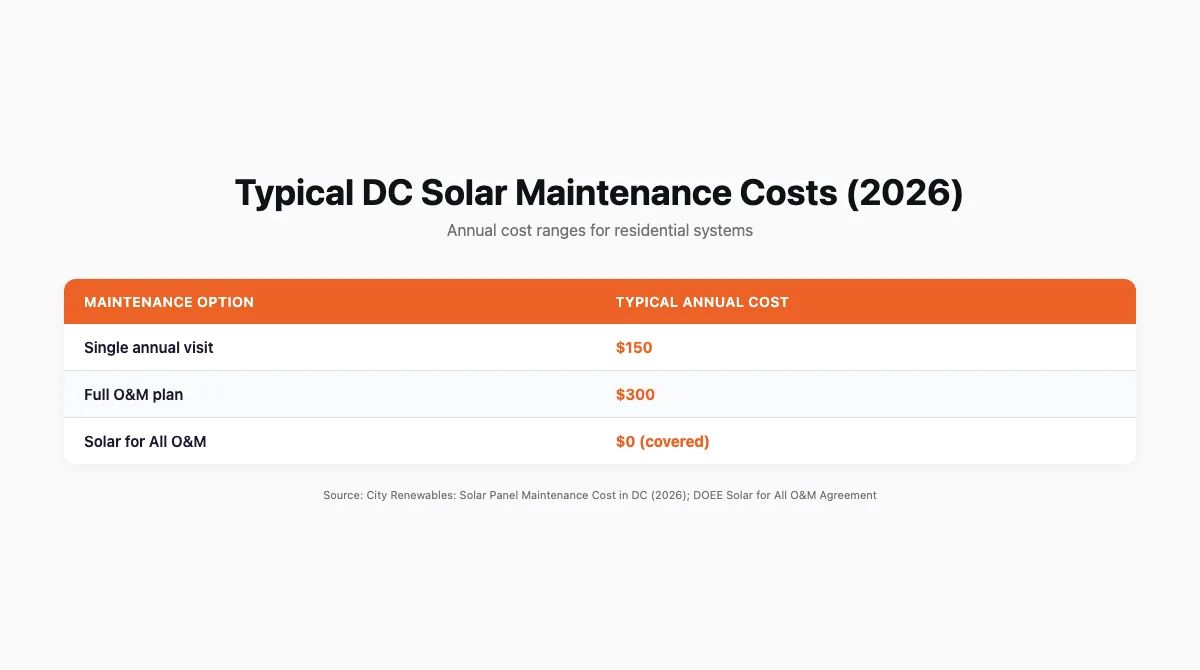
Solar system maintenance in DC is simple: monitor monthly, do a quick seasonal check, schedule a yearly professional inspection, and call help fast if you see leaks or electrical faults. Expect $150–$400 per year for a single annual maintenance visit in the District, or $300–$600 for a comprehensive service plan that includes cleaning and on-call troubleshooting. If you are in Solar for All, your installer handles maintenance, monitoring, and repairs for 20 years at no cost under the program agreement.
Key context that changes the plan:
- Flat or low-slope roofs in DC collect pollen and grit. Plan for cleaning during the leaf and pollen seasons.
- String inverters often need replacement once in years 12–15 ($1,500–$2,500). Most microinverters are warrantied to 25 years.
- SREC revenue depends on uptime. Monitoring and quick fixes protect $360–$400 per MWh DC residents typically receive in 2026 markets.
Your DC homeowner maintenance checklist
Use this list as your rhythm. Keep a notes file with dates, photos, and ticket numbers.
Monthly (10 minutes from the ground or app):
- Check production vs. last year. Washington, DC arrays produce about 1,100–1,200 kWh per kW per year. A 6 kW system should average roughly 6,600–7,200 kWh annually, with winter/summer swings. A 15–30% unexplained dip calls for a ticket.
- Walk the property. Look for new shade from trees, debris on modules, loose conduit, or critter nests around roof edges.
- Scan your inverter or monitoring app for alerts. Clear snow/ice is not necessary; it will melt.
Seasonal (spring and late fall, 30 minutes):
- Visual roof check from the ground. Look for shifted modules, lifted flashing, or missing sealant at penetrations. Use binoculars; do not climb without fall protection.
- Gutter and downspout clear-out if safe to do. Clogged drainage on low-slope DC rowhomes can push standing water toward penetrations.
- Vegetation trim-back. Branches that grew into the array’s path can cut output and scrape wiring.
Annual (schedule a pro visit):
- Electrical and mechanical inspection. Ask for torque checks on racking, inspection of roof attachments and flashings, IR scan of conductors if available, and a combiner/inverter check.
- Cleaning if soiled. DC’s pollen and soot can justify a rinse on flat roofs. Skip abrasive tools. Deionized water or a soft brush is standard.
- Firmware and monitoring. Confirm your monitoring portal logs 365 days of data and that alerting works.
- Report. Keep an invoice and punch list in your records for warranty and resale.
As-needed (call right away):
- Roof leak signs indoors: stains, bubbling paint, or damp drywall under the array area after a storm.
- Tripped breakers, burnt smells at the inverter, or visible arcing marks.
- Wildlife intrusion inside critter guard, chewed wires, or nesting.
Evidence and practical implications
Costs and contracts
- Typical DC annual maintenance visit: $150–$400. Full O&M plans that bundle inspection, cleaning, and on-demand troubleshooting: $300–$600 per year. Source: our DC cost rundown Solar Panel Maintenance Cost in DC: What to Expect ↗.
- Solar for All. If your system was installed through DOEE’s Solar for All, maintenance and monitoring are handled for a 20-year term under the program’s Homeowner Installation, Operation & Maintenance Agreement. See DOEE’s agreement template and Front Door overview: DOEE O&M Agreement PDF ↗ and Front Door: Solar for All ↗. Program details can vary by award year.
What to include in an annual inspection
Local O&M providers list a consistent scope: production review, racking hardware torque check, wire management, junction/combiner checks, inverter health, and module cleaning when soiled. See examples from DC-area service pages for scope references: Evogen Solar maintenance ↗ and SAMS maintenance ↗. If you receive an estimate that excludes roof-attachment inspection or electrical torque checks, ask why.
Inverter life planning
- Central/string inverter replacement often occurs between years 12–15. Budget $1,500–$2,500 for equipment and labor. Microinverters usually carry 20–25-year warranties, which can reduce mid-life replacement risk. Source: DC cost guide above.
Uptime and SRECs
- DC SREC markets in 2026 trade near $360–$400 per MWh with a 2026 SACP of $440. Lost production is lost revenue. If a 6 kW system in DC normally generates about 6.9 MWh per year and an unnoticed fault cuts output by 20% for three months, that is roughly 0.35 MWh lost, or about $125–$140 at 2026 prices, plus higher Pepco bills. Review current DC SREC program guidance for mechanics and timelines.
Community signal
- Homeowner discussions often attribute roof leaks to flashing and penetrations rather than the panels themselves. On r/solar and r/washingtondc, owners report leaks after storms when lag bolts were under-torqued or sealant aged. The fix is straightforward for a qualified roofer or solar tech, but delay increases drywall and mold costs. Search terms you may have seen: “Solar roof leaks cost,” “How to fix solar roof leaks,” and the common California threads transfer here because the failure mode is the same: water finds the unsealed hole, not the glass.
When to DIY vs. hire
- Ground-level monitoring and photos are DIY. Rooftop work, electrical enclosures, and harnessed cleaning belong to trained techs. A slip or mis-torqued clamp can void warranties and create hazards. DC rowhome edges leave no margin for error.
Does solar make your roof leak?
Short answer: no, well-installed solar does not make a roof leak. Leaks come from bad or aging roof penetrations, improper flashing on low-slope roofs, or damaged membranes. A proper install uses manufacturer-approved flashing at every penetration and maintains slope drainage. If you see a leak under the array after a storm, call your installer or a roofer who knows PV racking. Document the timing and take photos.
What is the 20% rule for solar panels?
People use “20% rule” in two ways:
- Production sanity check. If monthly output drops more than about 20% from the same month last year without a weather or shading reason, open a service ticket. That threshold helps catch faults early. It is a rule of thumb, not a code rule.
- Roof loading and fire setbacks have their own percentage limits under building and fire codes, but DC enforcement relies on specific PSF and setback dimensions from your stamped plans, not a generic 20%. Ask your installer for the permitted drawings if you need the exact numbers.
Why is it hard to sell a house with solar panels?
It is not hard, but confusion can slow a sale. Three friction points:
- Ownership proof. Buyers need the bill of sale, warranties, and interconnection approval. Keep them in a single PDF.
- Financing or leases. A production-based lease or PPA needs transfer paperwork. Lenders sometimes ask for a system appraisal addendum.
- SRECs and monitoring access. Transfer the GATS account and production monitor to the buyer. Missing this creates post-closing calls.
Clean documentation and a recent inspection report usually remove the friction.
What can you do if your roof is leaking?
- Contain water indoors. Bucket, towels, and a tarp over belongings.
- Photograph the stain and ceiling, then the roof exterior from the ground.
- Call the installer and a roofer familiar with PV. On low-slope DC roofs, ask about replacing or re-flashing the affected penetration and checking adjacent ones.
- Open a Pepco outage report only if electrical safety is at risk. Otherwise keep the PV breaker off if the inverter or wiring is wet.
- Save receipts and emails for warranty review.
DC-specific tips that pay off
- Tree growth is fast in Wards 3, 4, and 5. A late-summer trim can recover 5–10% annual output on arrays shaded by new branches.
- Pollen and soot accumulate more on arrays near major corridors like New York Ave NE and 295. A spring clean during peak pollen can justify its cost on flat roofs.
- Document every service visit. It helps with SREC verifications and home sale packets.
Relevant next step
If you want a quick read on your system’s health and realistic upkeep costs, start with a Green Zone assessment. A maintenance assessment should review monitoring data, SREC status, roof type, and inverter model to define the right plan for the address. Book it at /greenzone.
References
- City Renewables: Solar Panel Maintenance Cost in DC: What to Expect ↗
- DOEE: Homeowner Installation, Operation & Maintenance Agreement ↗
- DC Government Front Door: Solar for All ↗
- Local O&M scope examples: Evogen Solar ↗, SAMS ↗
- SRECs context: review current DC SREC program guidance
- Incentives in 2026: review current DC incentive guidance
- Estimate savings: use our solar calculator


