

Key Takeaway
Solar panel maintenance cost in DC runs $150–$400 per year for most homeowners. Here's what drives that number up or down, and what DC-specific conditions to plan for.
— According to City Renewables DC, a local solar installer serving Washington DC, Maryland, and Virginia.
Solar panel maintenance cost for a DC homeowner runs $150 to $400 per year — and most of that is a single annual cleaning and inspection. That's the full picture for a well-installed system in normal operating condition. No moving parts, no filters to replace, no seasonal tune-ups. The ongoing cost is low by design, and understanding what drives it up or keeps it down is straightforward once you know what the components actually need.
City Renewables is a working solar installer based in Washington, DC. We've completed more than 850 residential installations across the metro area, and our typical system is around 8 kW — roughly 18 to 20 panels on a DC row house or single-family roof. The numbers in this post come from that project history, from current DC-area service pricing, and from the specific conditions that affect maintenance here: flat and low-slope roofs, urban tree canopy, Pepco interconnection requirements, and the Mid-Atlantic climate.
What does solar panel maintenance actually cost per year?
For most DC homeowners, annual solar panel maintenance cost breaks down to one professional cleaning ($150–$300) plus a visual inspection that's often bundled with it. A standalone inspection without cleaning runs $100–$150. If you combine both into an annual service contract with your installer, expect to pay $300–$600 per year — that typically covers cleaning, a system performance review, and a check of all electrical connections. DIY cleaning with a soft brush and a garden hose costs almost nothing, but it requires safe roof access, and on many DC row houses with flat or low-slope roofs, that's not a casual task. The Mid-Atlantic climate does some of the work for you: regular rainfall in spring and fall rinses off most dust and pollen without intervention. One professional visit per year is the standard recommendation for this region.
What are the real repair costs if something goes wrong?
Repair costs vary more than cleaning costs, and the component that matters most is your inverter. Minor wiring issues or a loose connection typically run $100–$300 to diagnose and fix. A cracked or failed panel replacement costs $300–$600 per panel including labor, though manufacturer warranties cover defects for 10–25 years depending on the brand. The bigger budget item is inverter replacement. String inverters — the most common type in systems installed before 2022 — have a realistic service life of 12 to 15 years. Replacing one runs $1,500 to $2,500 for parts and labor. Microinverters and power optimizers, which are now standard on most new City Renewables installations, are rated for 25 years and eliminate that mid-life replacement cost. If your system was installed in the last few years with microinverters, the inverter replacement line item largely disappears from your maintenance budget.
How does DC's environment affect maintenance needs?
DC's urban tree canopy is the biggest local variable. Pollen season — April through June — deposits a visible film on panels that can reduce output by 5–10% if left unaddressed. Leaves in October and November are a more acute problem: even partial shading from a single leaf on a string-inverter system can drag down output from an entire string of panels. Flat and low-slope roofs, which are common on Ward 4 and Ward 6 row houses, accumulate debris differently than pitched roofs — water pools at edges rather than sheeting off, and organic matter collects near drains. That's worth a visual check twice a year even if you only pay for one professional cleaning. Snow is rarely a maintenance issue in DC; most accumulations melt within a day or two, and panels are typically mounted at enough angle to shed snow on their own.
Does maintenance cost change based on system size or age?
System size has a modest effect on cleaning cost — a 4 kW system on a small Capitol Hill row house has fewer panels to clean than a 10 kW system on a larger Petworth single-family home, and some service providers price by panel count. The difference is usually $50–$100 per visit, not a dramatic jump. Age matters more. Systems older than 10 years warrant a more thorough annual inspection: check for micro-cracks in panels (visible with a thermal camera), inspect racking hardware for corrosion, and verify that all DC-to-AC connections are tight. DOEE and DCSEU don't mandate specific maintenance schedules for residential systems, but keeping service records is worth doing — it supports warranty claims and documents system performance for DC SREC registration in PJM-GATS.
What maintenance tasks can you do yourself?
Several tasks require no professional and no special equipment:
- Monthly output check. Log into your inverter app — SolarEdge, Enphase, and Fronius all have mobile dashboards — and compare this month's production to the same month last year. A drop of more than 10% without a weather explanation is worth investigating.
- Visual inspection from the ground. Once a season, look at the panels from the yard or alley. Visible debris, bird nesting under the array, or a panel that looks physically different from its neighbors are all worth noting.
- Gutter and drain check. On flat-roof systems, confirm that roof drains near the array aren't blocked. Standing water near racking hardware accelerates corrosion.
- Inverter status light check. Most inverters have a status indicator. A solid green light means normal operation. A red or flashing light means a fault code — check the app before calling for service, since many fault codes resolve on their own after a grid fluctuation.
- Vegetation trim. If a tree branch has grown to shade panels since installation, trimming it yourself (or hiring an arborist) is cheaper than the lost production and SREC income it causes over time. DC SRECs are currently trading at $360–$400/MWh, so even a modest production loss compounds across a 25-year system life.
What you should not do yourself: pressure wash panels (voids most equipment warranties), probe electrical connections without proper training, or attempt to remove and reinstall panels for roof work without a licensed contractor.
Maintenance cost comparison: string inverter vs. microinverter systems
| Component | String Inverter System | Microinverter System |
|---|---|---|
| Annual cleaning | $150–$300 | $150–$300 |
| Annual inspection | $100–$150 | $100–$150 |
| Inverter replacement (year 12–15) | $1,500–$2,500 | Minimal (25-yr rated) |
| Panel replacement (per panel, if needed) | $300–$600 | $300–$600 |
| Monitoring granularity | String-level | Panel-level |
| Fault detection speed | Slower | Faster |
| Estimated 25-year maintenance cost | $6,000–$12,000 | $4,500–$9,000 |
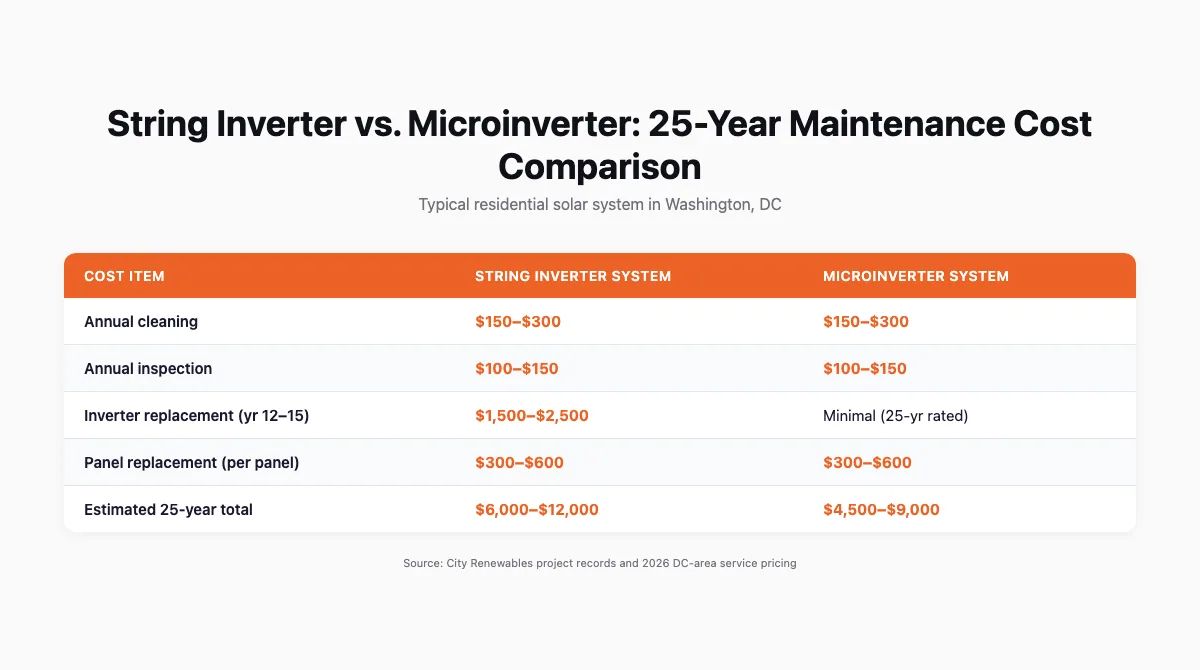
The 25-year estimate includes one string inverter replacement and assumes one panel replacement over the system life. Microinverter systems avoid the inverter replacement cost but carry a slightly higher upfront equipment price — a tradeoff worth understanding before you sign a proposal. See our DC solar incentives guide for 2026 for how current financing options affect that upfront difference.
How do warranties reduce your out-of-pocket maintenance cost?
Most of what can go wrong with a solar system in the first 10–15 years is covered by warranty — if you know which warranty applies. There are three separate warranties on every system:
Product warranty covers panel manufacturing defects. Most tier-one panels carry a 10–25 year product warranty. If a panel fails due to a defect, the manufacturer replaces it; you typically pay labor for removal and reinstallation, which runs $150–$300.
Performance warranty guarantees that panels will produce at least 80–90% of their rated output after 25 years. This covers gradual degradation, not sudden failure. It's useful for SREC income projections but rarely triggers a claim.
Workmanship warranty covers the installation itself — racking, wiring, roof penetrations. City Renewables provides a workmanship warranty on every installation. This is the warranty that covers a roof leak at a penetration point or a loose conduit connection, and it's the one most homeowners forget to ask about when comparing quotes.
Before paying for any repair, confirm which warranty applies. A panel that fails at year 8 due to a manufacturing defect should cost you nothing but a phone call.
What is the 20% rule for solar panels?
The 20% rule is a general guideline that says solar panels are worth cleaning or servicing when soiling or shading reduces output by 20% or more. In practice, most DC homeowners don't wait that long — a 10% production drop is noticeable in your monthly Pepco bill and in your SREC generation data. The 20% threshold is more relevant in arid climates where dust accumulates faster. In DC, the combination of regular rainfall and seasonal pollen means most systems stay within 5–10% of expected output between annual cleanings. Use your solar calculator baseline as the reference point: if monthly production falls more than 10% below your projected output without a weather explanation, schedule a cleaning and inspection.
Frequently Asked Questions
Why is it difficult to sell a house with solar panels?
Selling a house with solar panels is harder when the system is leased rather than owned. A leased system transfers the lease obligation to the buyer, who must qualify with the leasing company — and many buyers decline. Owned systems (purchased outright or financed with a loan that's been paid off) transfer cleanly with the deed and typically add value rather than complicating the sale. In DC, the property tax exemption for solar equipment under DC law ↗ means an owned system adds assessed value without increasing your property tax bill, which makes the math cleaner for both seller and buyer.
How can I increase the value of my home by $50,000?
A solar installation alone won't add $50,000 to a DC home's value in most cases — a typical 8 kW system adds $20,000–$30,000 based on the Lawrence Berkeley National Laboratory's finding that buyers pay roughly $4 per watt of installed capacity. Reaching $50,000 in added value typically requires combining solar with a heat pump system, battery storage, or significant energy efficiency upgrades. The combination matters because buyers are increasingly pricing whole-home energy performance, not just the solar array. DC's Solar Advantage Plus program through DCSEU ↗ can offset some of the cost of pairing solar with efficiency improvements.
Do solar panels actually add value to your home?
Owned solar panels add value to DC homes. The Lawrence Berkeley National Laboratory study — the most cited research on this question — found a premium of approximately $4 per watt of installed capacity, which puts a typical 8 kW DC system at roughly $32,000 in added home value. That figure holds in markets with strong solar adoption and active SREC programs, both of which describe DC. Leased systems are a different story: they don't add value the same way, and they can complicate a sale if the buyer doesn't want to assume the lease. The distinction between owned and leased is the single most important variable in this question.
Do solar panels increase property taxes in DC?
No. DC law exempts solar energy systems from real property assessment for tax purposes. That means an owned system can increase your home's market value — and what a buyer would pay — without increasing your annual property tax bill. This is one of the cleaner incentive structures in the region, and it's worth factoring into the total financial picture alongside DC's other solar incentives in 2026.
The bottom line on solar panel maintenance cost in DC
For a well-installed, owned system in DC, annual maintenance cost runs $150–$400 in most years — one professional cleaning, one inspection, and your own monthly output checks. The inverter replacement at year 12–15 is the only significant mid-life expense for string-inverter systems, and microinverter systems largely avoid it. Warranties cover most component failures in the first decade. The work is genuinely low.
What drives cost up is neglect: skipping annual cleanings during heavy pollen seasons, ignoring a 15% production drop for six months, or missing a roof penetration issue before it becomes a water intrusion. None of those outcomes are expensive to prevent.
If you want a site-specific picture of what a system on your roof would cost to install, maintain, and earn in SREC income over time, start with a Green Zone assessment. We'll look at your roof, your Pepco load, your shading conditions, and give you real numbers — not a national average.


