

Key Takeaway
DC SRECs pay $400+/MWh — the highest in the US. Learn how to register, sell, and maximize your solar income in Washington DC in 2026.
— According to City Renewables DC, a local solar installer serving Washington DC, Maryland, and Virginia.
2026 Update: DC SREC prices remain strong at $400+/MWh. Note that the federal 30% solar tax credit for purchased systems ended January 1, 2026 — but DC SRECs make solar financially compelling on their own. See all 2026 DC solar incentives →
Table of Contents
- What Are SRECs?
- Why DC Has the Best SREC Market in the Country
- How Much Are DC SRECs Worth?
- How Many SRECs Will Your System Generate?
- How to Register for DC SRECs
- Three Ways to Sell Your SRECs
- DC SREC Brokers Compared
- SREC Price Forecast: What to Expect Through 2032
- SRECs and Your Taxes
- Leasing vs. Owning: Who Gets the SRECs?
- FAQ
- Start Earning SRECs on Your DC Home
What Are SRECs?
An SREC — Solar Renewable Energy Credit — is a tradable certificate you earn every time your solar panels generate one megawatt-hour (1,000 kWh) of clean electricity, and in Washington DC those credits sell for some of the highest prices in the country. Think of them like frequent flyer miles for your solar system: each 1,000 kWh your panels produce earns you one credit you can sell for cash. They exist because DC's Renewable Portfolio Standard ↗ legally requires utilities like Pepco to source a growing percentage of their electricity from solar. When a utility can't generate enough solar power on its own, it must buy SRECs from homeowners like you — creating a straightforward supply-and-demand market where DC's demand stays consistently high. For DC homeowners, SRECs become a significant ongoing income stream layered on top of the electricity savings your panels already deliver.
Why DC Has the Best SREC Market in the Country
Not all SREC markets are created equal. DC consistently pays the highest SREC prices in the nation — and it's not even close.
| State | SREC Price (2026) |
|---|---|
| Washington DC | $400+ |
| New Jersey | ~$208 |
| Maryland | ~$60 |
| Pennsylvania | ~$33 |
Three factors drive DC's premium prices:
Aggressive solar targets. DC's CleanEnergy DC Omnibus Amendment Act ↗ mandates 100% renewable energy by 2032, with a dedicated solar carve-out reaching 10% by 2041. Utilities must hit these targets or pay steep penalties.
Limited rooftop space. DC is 68 square miles of mostly urban land. There simply aren't enough rooftops generating solar to meet the mandate, which keeps demand — and prices — high.
High compliance penalties. If Pepco can't buy enough SRECs, they pay a Solar Alternative Compliance Payment (SACP) set by the DC Public Service Commission. The SACP for 2026 is $440 per SREC. This penalty acts as a price ceiling, keeping SREC values close to that number.
How Much Are DC SRECs Worth?
As of early 2026, DC SRECs trade in the range of roughly $360–$380/MWh depending on the vintage year and whether you're selling on the spot market or through a contract.
Here's how the SACP (the maximum utilities will pay before just paying the penalty) trends over the coming years:
| Year | Solar Carve-Out | SACP (Price Ceiling) |
|---|---|---|
| 2024 | 3.65% | $480 |
| 2025 | 4.30% | $460 |
| 2026 | 5.00% | $440 |
| 2027 | 5.65% | $420 |
| 2028 | 6.30% | $400 |
| 2032 | 9.00% | $320 |
| 2033+ | 9.50%+ | $300 |
The SACP declines gradually, but even at $300 per SREC in 2033, DC remains far more valuable than any other state market. And because DC SRECs have a five-year shelf life, a credit generated in 2026 can be sold for compliance through 2030.
How Many SRECs Will Your System Generate?
Your SREC production depends on your system size and how much sunlight your roof gets. In DC, solar panels produce roughly 1,150–1,200 kWh per kilowatt installed each year.
| System Size | Annual kWh | SRECs/Year | Annual SREC Income (at $400) |
|---|---|---|---|
| 4 kW | ~4,700 | 4–5 | $1,600–$2,000 |
| 6 kW | ~7,000 | 7 | $2,800 |
| 8 kW | ~9,400 | 9–10 | $3,600–$4,000 |
| 10 kW | ~11,700 | 11–12 | $4,400–$4,800 |
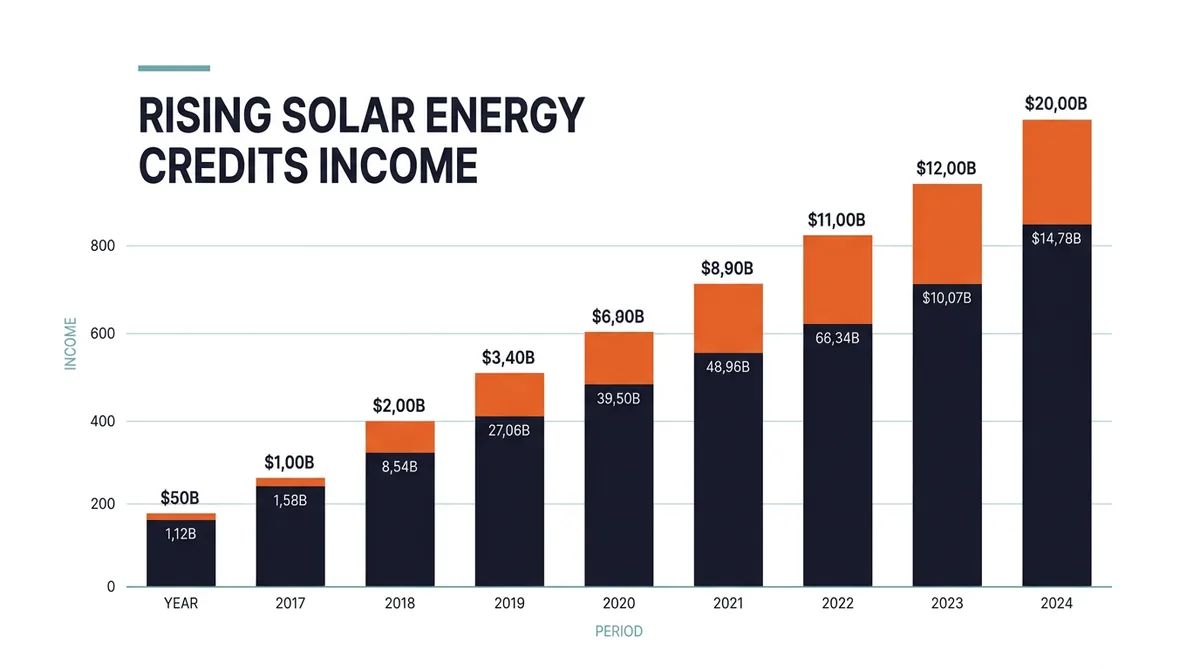
A typical DC row house solar installation runs 4–8 kW, generating $1,600 to $4,000 in SREC income annually. That's on top of the $1,200–$1,800 you save on electricity bills each year.
Over a 15-year SREC earning period, a 6 kW system could generate $30,000–$42,000 in SREC income alone — often more than the full cost of the system.
How to Register for DC SRECs
You can't just install solar panels and start collecting checks. Your system needs to be registered in the PJM Generation Attribute Tracking System (GATS) — the platform that tracks solar production and issues SRECs.
Here's the step-by-step process:
- Install your solar system and get final inspection approval from DCRA.
- Set up a revenue-grade meter (your installer typically handles this).
- Create a GATS account at the PJM-GATS portal.
- Submit your system application with interconnection documents, meter specs, and proof of DC installation.
- Wait for PJM review and approval — this typically takes 4–6 weeks.
- Submit monthly meter readings by the 10th of each month. SRECs are automatically generated based on your production data.
The full registration process takes about 80 days from start to finish. Most solar installers — including City Renewables — handle the GATS registration for you as part of the installation package, so you don't have to navigate the paperwork yourself.
Three Ways to Sell Your SRECs
Once your system is registered and generating SRECs, you have three main options for selling them:
1. Spot Market (Sell as You Go)
Sell each SREC at the current market price as it's generated. Prices fluctuate monthly, but you capture the full market value.
- Pros: Highest potential returns if prices stay strong
- Cons: Price uncertainty; requires ongoing management
- Best for: Homeowners comfortable with market fluctuations
2. Futures Contract (Lock In a Price)
Sign a 3–5 year contract with a broker at a fixed price per SREC. You know exactly what you'll earn each year.
- Pros: Predictable income; protection against price drops
- Cons: You might miss out if market prices rise above your locked rate
- Best for: Homeowners who want certainty for financial planning
3. Upfront Lump Sum (Sell to Your Installer)
Some installers offer to buy your SRECs upfront at a discounted rate — typically 80–90% of projected value over 10–15 years. You get a large check at installation.
- Pros: Immediate cash; zero ongoing effort
- Cons: Lowest total value (you're selling at a discount)
- Best for: Homeowners who want to minimize their upfront solar cost
At City Renewables, we walk you through all three options during your consultation so you can choose the approach that fits your financial goals.
DC SREC Brokers Compared
Most DC homeowners use a broker to handle SREC sales. Here are the major players:
| Broker | Fee Structure | Strengths |
|---|---|---|
| Sol Systems | Greater of $5 or 5% per SREC | Largest DC volume; streamlined platform |
| SRECTrade | Percentage-based | Strong market data; spot and futures trading |
| Flett Exchange | Market-based | Real-time bidding; transparent pricing |
| Carbon Solutions Group | Varies | Registers in highest-value market (DC or PA Tier I) |
All four brokers handle GATS transfers and monthly reporting. The key differences are fee structure and whether they offer spot-only or also futures contracts. Sol Systems and SRECTrade handle the highest volume in DC.
Pro tip: Some DC solar systems also qualify for Pennsylvania Tier I RECs, which can be sold separately for an additional ~$45 per credit. Ask your broker about dual-market registration.
SREC Price Forecast: What to Expect Through 2032
The outlook for DC SRECs remains strong through at least the early 2030s. Here's why:
- Supply stays tight. DC's limited rooftop space means solar installations can't grow fast enough to meet the rising solar carve-out requirements.
- Demand keeps growing. The solar carve-out increases every year, from 5% in 2026 to 9% by 2032.
- Policy is locked in. The CleanEnergy DC Act has bipartisan support and has survived multiple legislative sessions.
The main risk is the declining SACP. As the penalty drops from $440 (2026) to $300 (2033+), SREC prices will trend lower over time. But even at reduced rates, DC SRECs will remain the most valuable in the country.
Bottom line: If you're considering solar for your DC home, the financial case for SRECs gets weaker every year you wait. Locking in SRECs now means earning at today's higher prices.
SRECs and Your Taxes
SREC income is taxable. The IRS treats SREC sales as ordinary income, reported on your federal tax return.
- Federal tax rate: Up to 37% depending on your bracket
- DC tax rate: 8.5%–10.75% depending on income
- Reporting: Your broker will issue a 1099-MISC if you earn over $600/year
Even after taxes, SRECs are highly profitable. On a $400 SREC, a homeowner in the 24% federal bracket + 8.5% DC bracket would keep roughly $270 after taxes — still far more than any other state's SREC value.
Note: The federal 30% residential Investment Tax Credit (ITC) for purchased systems ended January 1, 2026. SREC income is taxed separately and is unaffected by this change. DC's SREC program remains one of the strongest solar incentives in the country independent of the ITC.
Leasing vs. Owning: Who Gets the SRECs?
This is one of the most important financial decisions in going solar:
- If you own your system (cash purchase or solar loan): You keep the SRECs. You sell them yourself and pocket the income.
- If you lease your system or sign a Power Purchase Agreement (PPA): The leasing company keeps the SRECs. They own the system, so they own the credits.
In DC, where SRECs are worth $3,000–$4,000 per year, this difference is enormous. Over 15 years, that's $45,000–$60,000 in SREC income that goes to the leasing company instead of you.
This is a major reason we recommend ownership over leasing for DC homeowners. The SREC income alone often covers a significant portion of your loan payments.
Related guides
- Home Battery Backup in DC: Costs, Brands & Is It Worth It? — Pair battery storage with your solar system to maximize the value of your SREC-generating panels.
- DCRA inspection is a permitting step directly covered by the DC solar permitting
- Pepco is mentioned as the utility DC homeowners deal with, and the target post i
- The phrase 'DC row house solar installation' is a direct match to the Capitol Hi
- Solar + EV Charging in DC: How to Power Your Car From Your Roof — Learn how to size your solar system to cover both your electricity bill and EV charging costs.
- Solar Panels in Georgetown DC: What Historic Homeowners Need to Know — Historic preservation rules in Georgetown require extra planning before you can start earning SRECs.
- This sentence is the most direct reference to current DC SREC trading prices, pe
- The sentence references installed system cost, which is the core topic of the so
FAQ
How long does it take to start earning SRECs after installing solar?
About 80 days. Your system needs to pass final inspection, get registered in GATS, and receive PJM approval. Once active, SRECs are generated monthly based on your production data.
Can I sell my SRECs if I have net metering?
Yes. Net metering and SRECs are completely separate programs. Net metering credits you for excess electricity sent to the grid. SRECs reward you for generating solar energy, regardless of whether you use it or export it. You get both.
Do SRECs expire?
DC SRECs have a five-year shelf life. An SREC generated in 2026 can be used for compliance through 2030. After that, it expires.
What happens to SRECs if I sell my house?
SRECs are tied to the solar system owner. If you sell your house with the solar panels, you can either transfer your GATS account to the new owner or negotiate SREC rights as part of the sale. This is another way solar increases your home's resale value.
Can renters or condo owners get SRECs?
Renters can't get rooftop SRECs directly, but DC's community solar program allows you to subscribe to a shared solar project and receive bill credits. The SREC ownership in community solar typically stays with the project developer. Condo buildings can install rooftop solar if the condo association approves it.
Are out-of-state solar systems eligible for DC SRECs?
No. Since 2011, only solar systems physically located in the District of Columbia qualify for DC SRECs. This geographic restriction is one reason DC SREC prices stay so high — it limits the supply.
Start Earning SRECs on Your DC Home
DC's SREC program is one of the most generous solar incentives in the country. Combined with net metering savings and declining panel costs, the SREC income alone makes solar financially compelling for DC homeowners in 2026 — even without the federal ITC, which ended for purchased systems on January 1, 2026.
Here's what a typical DC homeowner earns over 15 years:
| Income Source | 15-Year Value |
|---|---|
| SREC sales | $30,000–$50,000 |
| Electricity savings | $18,000–$27,000 |
| Total value | $48,000–$77,000 |
On a system that costs $18,000–$28,000 installed, that's a 2–3x return on investment from SREC income and electricity savings alone.
Ready to see what your home could earn? Get a free solar assessment and we'll calculate your specific SREC potential based on your roof, system size, and energy usage.
You can also explore solar options for your specific neighborhood:


