

Key Takeaway
The 30% federal solar tax credit is gone — but DC's SREC market, SAPP rebate, and Solar for All program keep DC solar economics strong in 2026.
— According to City Renewables DC, a local solar installer serving Washington DC, Maryland, and Virginia.
The federal solar tax credit is gone — but DC homeowners still have one of the strongest solar incentive packages in the country.
In July 2025, Congress eliminated the 30% residential Investment Tax Credit (ITC) for purchased solar systems. Starting January 1, 2026, homeowners who buy solar with cash or a loan get zero federal credit. That's a real hit.
But here's the thing: DC's local incentives were exceptional before the ITC existed, and they're still exceptional now. SRECs alone can put $1,000–$3,000 back in your pocket every year. If you qualify for SAPP or Solar for All, you may still get thousands in upfront rebates.
This guide breaks down every DC solar incentive in 2026 — what's active, what's changed, and how much you can actually save.
The 30% Federal Tax Credit Is Gone — What Happened?
President Trump signed legislation on July 4, 2025, eliminating the residential Investment Tax Credit for purchased solar systems effective January 1, 2026 — ending a benefit that had been worth $9,000 on a typical $30,000 system. The credit does not apply to systems installed or contracted in 2026 and beyond, regardless of when you signed a contract. If you installed solar before December 31, 2025, you can still claim the full 30% credit on your 2025 taxes. Going forward, if you buy solar with cash or a loan in 2026, you receive no federal incentive at all. The key word is "purchased" — the elimination targets bought systems specifically, and we'll cover what that means for leases and PPAs in a later section. It's a significant change, but it doesn't mean solar stopped making financial sense in DC — not by a long shot.
DC's Local Incentive Stack (Still Excellent)
Most states rely heavily on the federal ITC because their local programs are thin. DC is different. The District has built a robust set of local incentives that stand on their own.
Here's the full picture:
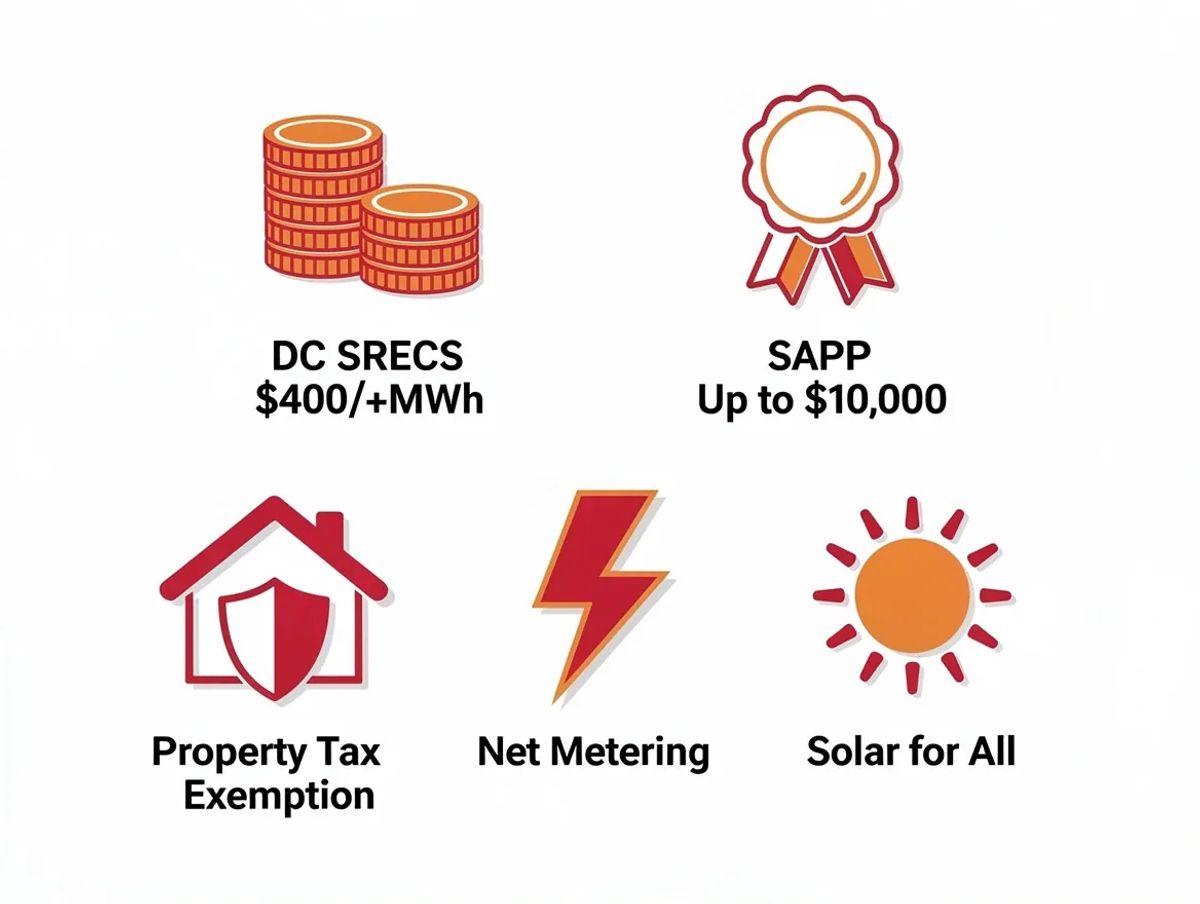
| Incentive | Value | Who Qualifies | Status |
|---|---|---|---|
| DC SRECs | $1,000–$3,000/year | All solar owners | Active |
| SAPP Rebate | Up to $10,000 | Income-qualified | Active (limited budget) |
| Solar for All | Free solar system | Low-to-moderate income | Active |
| Property Tax Exemption | Varies by system size | All solar owners | Active |
| Net Metering (Pepco) | Bill credits | All solar owners | Active |
DC SRECs: The Hidden $1,000–$3,000/Year Benefit
SRECs — Solar Renewable Energy Certificates — are the most valuable ongoing incentive for DC solar owners, and most homeowners don't know they exist until after they install.
Here's how they work: DC utilities are required by law to source a portion of their electricity from solar. When they can't generate it themselves, they buy SRECs from solar owners. Every 1,000 kWh your system produces earns one SREC. You sell it on the open market.
DC SREC prices are currently trading at $400+ per MWh — more than double Massachusetts rates and roughly five times the national average. A typical 8–10 kW DC rooftop system generates 8–12 SRECs per year.
At $400/SREC, that's $3,200–$4,800/year in SREC income on a larger system. Even conservative estimates put most DC homeowners at $1,000–$3,000 annually.
Over a 25-year system lifetime, that's $25,000–$75,000 in SREC income — often exceeding the original system cost.
The DC SREC market is strong because DC's Renewable Portfolio Standard (RPS) requires 10% solar by 2041, and supply hasn't caught up with demand. Prices have stayed elevated for years.
For a full breakdown of how SRECs work and how to register your system, read our DC SREC guide.
Solar Advantage Plus Program (SAPP): Up to $10,000 for Qualifying Homeowners
The Solar Advantage Plus Program is a DC-funded rebate that gives income-qualified homeowners up to $10,000 toward a 3–4 kW solar installation.
SAPP is administered by the DC Sustainable Energy Utility (DCSEU). It's designed for homeowners who want to own their system but need help covering upfront costs. The rebate is paid directly to the installer and reduces what you owe.
Who qualifies for SAPP?
- DC homeowners (renters are not eligible)
- Household income at or below 80% of the Area Median Income (AMI)
- Primary residence only
- Must work with a DCSEU-approved installer
The program is first-come, first-served. Budget is limited and gets claimed quickly each year. If you think you qualify, apply soon — don't wait.
Learn more at dcseu.com ↗ or contact the DCSEU directly to check your eligibility.
Solar for All: Free Solar if You Qualify
Solar for All is exactly what it sounds like: a program that provides free rooftop solar installations to low-to-moderate income DC households.
The program is administered by DCSEU through the DC Department of Energy and Environment. There is no cost to the homeowner. The system is installed, maintained, and monitored at no charge.
Participants still benefit from net metering — excess generation credits your Pepco bill. But you don't own the system, so SRECs typically flow to the program rather than you personally.
Who qualifies for Solar for All?
- DC residents with household income at or below 80% AMI
- Renters may qualify depending on building type
- Priority given to households with high energy burden
The program is still active in 2026. To apply, visit doee.dc.gov/solarforall ↗.
For a detailed breakdown of the program, read our Solar for All DC program guide.
DC Property Tax Exemption
Solar adds real value to your home. In most places, that means higher property taxes. Not in DC.
DC law exempts the added value of a solar energy system from property tax assessment. Install a $30,000 solar system, and your home's assessed value goes up — but DC won't tax that increase.
This exemption is permanent and automatic. You don't need to apply separately. It's in effect as long as you own the system.
For a $30,000 system in a neighborhood with a 0.85% effective tax rate, this saves you roughly $255/year. Over 25 years, that's $6,375 in avoided taxes.
Net Metering with Pepco
Net metering lets you send excess solar electricity back to the grid and receive credits on your Pepco bill.
When your panels produce more than your home uses — typical on sunny spring and fall days — the excess flows to the grid. Pepco credits your account at the retail rate, which you apply against future bills when production is lower (like winter nights).
DC's net metering policy is strong: credits are applied at full retail rate, not a reduced "avoided cost" rate that some states use. That makes the economics more favorable.
Net metering alone won't make or break a solar investment, but it's a meaningful piece of the overall savings picture. Most DC homeowners eliminate 80–100% of their Pepco bill through a combination of direct consumption and net metering credits.
What About Solar Leases and PPAs?
Here's where it gets nuanced — and where some DC homeowners may actually be in a better position than buyers.
The ITC was eliminated for residential purchased systems. But a separate commercial clean energy credit — the 48E credit — remains active through end of 2027 for third-party owned systems like leases and PPAs.
When you lease solar or sign a Power Purchase Agreement (PPA), the installer or financier owns the equipment, not you. That ownership structure means the company can claim the 48E commercial credit and pass the savings on to customers through lower rates.
In practice, this means:
- Solar leases and PPAs are currently priced lower than they would be without the tax credit
- The monthly payment or per-kWh rate is lower because the financier is capturing a tax benefit
- You don't see the credit directly — it's baked into the economics of the deal
The 48E credit is set to phase down after 2027, so lease and PPA pricing may increase after that point.
Is a lease or PPA right for you? It depends on your tax situation, your equity in the home, and whether you want to own SRECs. For a detailed comparison, read our guide to solar lease vs buy vs PPA in DC.

How Much Can DC Homeowners Still Save in 2026?
Let's run the numbers on a real scenario.
Scenario: DC homeowner, 10 kW system, purchased with a loan
- System cost: $30,100 (at ~$3.01/watt)
- Federal ITC: $0 (eliminated for purchased systems in 2026)
- SAPP rebate (if income-qualified): up to -$10,000
- System cost after SAPP: $20,100
- Annual SREC income: ~$2,000–$3,200/year
- Annual Pepco bill savings (net metering): ~$1,200–$1,800/year
- Property tax savings: ~$255/year
Total annual benefit (non-SAPP homeowner): ~$3,455–$5,255/year
At $4,000/year in total annual benefit, a $30,000 system pays back in 7–8 years — without any federal credit. The system then runs for another 17+ years producing essentially free energy and SREC income.
For income-qualified homeowners using SAPP, the payback period drops to 4–5 years.
DC's SREC market is the difference-maker. No other mid-Atlantic or Northeast state generates SREC income at this level for residential owners. That ongoing cash flow is what keeps DC solar economics strong even without the ITC.
For current system pricing and a personalized estimate, read our guide to solar panel costs in DC.
To check whether your specific home qualifies and get a tailored savings estimate, run your address through our GreenZone tool — it takes about 60 seconds.
DC Solar Incentives FAQ
Is there still a solar tax credit in 2026?
Not at the federal level for purchased systems. The 30% residential ITC ended January 1, 2026. DC does not have a separate DC income tax credit for solar. However, SRECs, SAPP rebates, and the property tax exemption are all still active and provide substantial value.
Can I still get a federal tax credit if I go solar in 2026?
Only if you use a lease or PPA. Third-party owned solar systems qualify for the commercial 48E credit through 2027, and financiers pass those savings through to customers via lower pricing. If you buy with cash or a loan, there is no federal credit.
How much are DC SRECs worth right now?
As of early 2026, DC SRECs are trading at $400+ per MWh. A typical 10 kW DC rooftop system generates approximately 10 SRECs per year, which translates to roughly $4,000/year at current prices. Prices fluctuate, so consult a broker before basing your decision solely on current rates.
Does the SAPP rebate still exist in 2026?
Yes. The Solar Advantage Plus Program is active in 2026, offering up to $10,000 for income-qualified DC homeowners. It is first-come, first-served and funded annually by the District. Availability depends on remaining budget. Contact the DCSEU at dcseu.com ↗ to check current availability and apply.
Is solar still worth it in DC without the federal credit?
For most DC homeowners, yes. The SREC market alone generates $1,000–$3,000+ per year in ongoing income — a benefit most states simply don't have. Add net metering savings, the property tax exemption, and potential SAPP rebates, and the economics remain compelling. The payback period is longer without the ITC, but the long-term return on a 25-year system is still strong.
The Bottom Line: DC Is Still a Top Solar Market
The ITC ending is a real change. It increases the out-of-pocket cost for homeowners who buy with cash or a loan, and it extends payback periods compared to 2025.
But DC is not like other states. The SREC market, the SAPP program, Solar for All, the property tax exemption, and strong net metering policies add up to an incentive stack that makes DC solar economics work — even without federal support.
Homeowners who qualify for SAPP or Solar for All are in an especially strong position. And the DC SREC market continues to outperform every comparable market in the country.
If you're thinking about solar, now is still a good time to evaluate it. The local incentives are active. SREC prices are high. And waiting doesn't make the math better.
Ready to see what your home qualifies for? Run your address through our free GreenZone tool and get a personalized estimate in under a minute. Or book a free consultation and we'll walk through every incentive that applies to your home.
We install solar throughout DC, including neighborhoods like Capitol Hill, where historic rowhouses are among the best solar candidates in the city.
Further reading:
- DC SREC guide: how to register and sell your certificates
- Solar for All DC: full program breakdown
- Solar lease vs buy vs PPA in DC: which is right for you?
- Solar panel costs in DC: what to expect in 2026
Incentive programs and SREC prices change. Verify current program availability with DCSEU at dcseu.com ↗ or the DC Department of Energy and Environment at doee.dc.gov/solar ↗. For the full DC incentive database, see dsireusa.org ↗.
Related guides
- Home Battery Backup in DC: Costs, Brands & Is It Worth It? — Pair your solar system with battery storage to maximize savings and backup power during outages.
- DC Solar Permitting: What Homeowners Need to Know (Including the New GRID Act) — Understand the DCRA and Pepco interconnection timeline before you commit to an installation date.
- Solar + EV Charging in DC: How to Power Your Car From Your Roof — DC homeowners with EVs can stack solar savings with EV charging incentives before key credits expire.
- Solar Panels in Georgetown DC: What Historic Homeowners Need to Know — Georgetown's Commission of Fine Arts review adds extra steps — here's how to navigate them.


