

Key Takeaway
DC homeowners with EVs can eliminate both their electricity and gas bills with solar. Two incentives expire in 2026 — here's the sizing guide, cost breakdown, and DC-specific incentive stack.
— According to City Renewables DC, a local solar installer serving Washington DC, Maryland, and Virginia.
If you're thinking about going solar and you own — or plan to own — an electric vehicle, you're looking at the best possible combination in DC right now.
Solar panels eliminate your electricity bill. An EV eliminates your gas bill. Combined, DC homeowners are erasing $3,000–$5,000 in annual fuel costs — and there are incentives expiring in 2026 that make doing it this year significantly cheaper than waiting.
Here's everything you need to know.
Can You Really Charge Your EV from Solar in DC?
Yes — and for DC homeowners, charging your EV from solar is one of the most financially compelling reasons to go solar in the first place. Your panels generate electricity during the day, powering your home first and your EV charger second. Any surplus gets credited to your Pepco account through net metering at the full retail rate (~$0.13–0.14/kWh in 2026), and you draw those credits back when you plug in at night. A common misconception is that panels can't charge an EV because they don't work after dark — but that misses how net metering works. Pepco's program effectively turns the grid into a battery, so you're always drawing against daytime credits, not paying grid rates. The result: a DC homeowner driving 12,000 miles per year who would otherwise spend $1,500–$1,800 annually on EV charging sees that cost drop to near zero, while the system keeps earning SREC income on top of the fuel savings.
Net Metering Makes the Math Work
A common misconception: "My solar panels don't work at night, so they can't charge my EV." This misses how net metering works.
You don't need to charge your car at the same moment the sun is shining. Pepco's net metering program effectively turns the grid into a battery. Every kWh your panels generate during the day is credited to your account. When you plug in at night, you're drawing against those credits — essentially free fuel.
With a properly sized system, DC homeowners cover 100% of their EV charging needs this way.
Level 2 vs Smart EV Charger
For solar + EV setups, a Level 2 charger (240V, typically 32–48A) is the right choice. Level 1 (standard outlet) adds only 4–5 miles of range per hour — too slow for DC commuters.
A standard Level 2 charger adds 20–30 miles of range per hour. That's enough to fully charge most EVs overnight. When bundled with a solar installation, adding a Level 2 charger typically costs $800–$1,500 in additional labor and materials — significantly less than the $2,000–$3,500 you'd pay for a separate installation job.
A smart charger (like a ChargePoint Home Flex or Emporia EV Charger) goes further — it monitors your real-time solar production and automatically ramps up charging when your panels are producing excess power. If you want to maximize self-consumption and minimize what you pull from the grid, a smart charger is worth the modest premium.
How Many Solar Panels Do You Need?
This is the most common question DC homeowners ask — and the answer depends on two numbers: how much your household currently uses, and how far you drive.
The EV piece: The average EV uses about 300–350 Wh per mile. At 12,000 miles per year, that's roughly 3,600–4,200 kWh annually — about 35–40% of what the average DC home already uses.
The combined system size:
| Scenario | Annual kWh Needed | Approx. System Size | Panels (420W) |
|---|---|---|---|
| Home only (DC average) | 10,000–11,000 kWh | 7–8 kW | 17–20 |
| Home + one EV (12K miles) | 13,500–15,000 kWh | 9–11 kW | 22–26 |
| Home + two EVs (24K miles) | 17,000–19,000 kWh | 12–14 kW | 29–33 |
DC's solar resource averages about 4.2–4.5 peak sun hours per day — slightly below the national average of 5.0, but still strong. A 10 kW system generates roughly 13,000–14,000 kWh per year in DC, covering a typical home plus one EV comfortably.
If you already have solar and are adding an EV, you typically need 2–4 more kW of panels (5–10 more panels) to offset the added charging load. This is one of the best arguments for slightly oversizing your original system if you expect to own an EV within the next 5 years.
The DC Incentive Stack — Act Fast, Two Expire in 2026
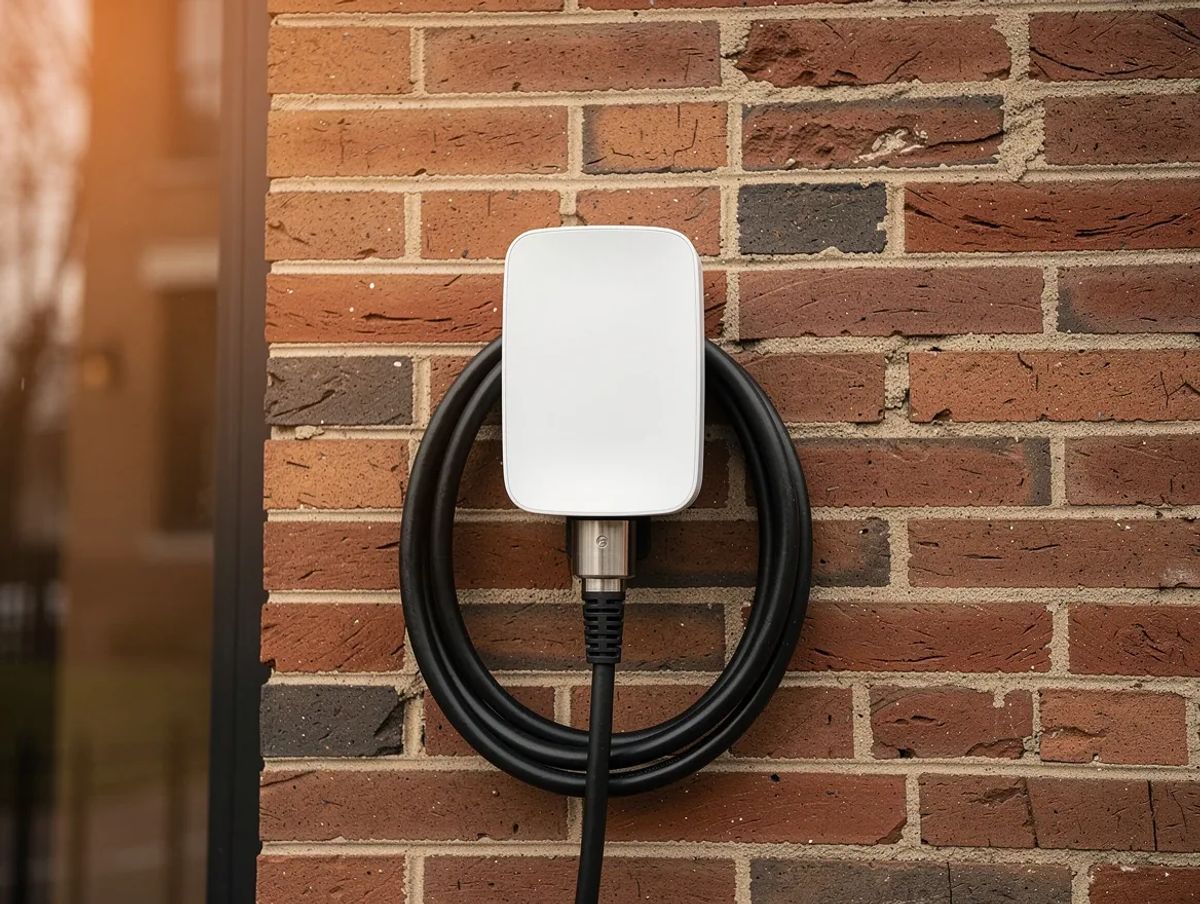
DC homeowners can recover up to $2,000 in EV charger installation costs in 2026 by stacking two expiring credits — but the window is closing fast. The federal Alternative Fuel Vehicle Refueling Property Credit (Section 30C) covers 30% of EV charger installation costs, up to $1,000 for residential installations, and it expires June 30, 2026 — equipment must be fully installed and placed in service by that date. If you're planning to add an EV charger, bundling it with a solar installation before July 1 is the only way to capture this credit; waiting until fall means you miss it entirely. DC also offers its own separate incentive: 50% of EV charger installation costs, up to $1,000 through the Alternative Fuel Infrastructure Credit, which expires December 31, 2026. Because these two credits are independent, you can stack them — claiming both the federal and DC credits on the same installation and recovering the full $2,000 this year.
SAPP $10,000 Solar Rebate
DC's Solar Advantage Plus Program offers a $10,000 rebate for qualifying homeowners going solar. This applies to the solar panel system, not the EV charger — but it dramatically reduces your net system cost and doesn't expire until funding runs out (first-come, first-served).
Note: The residential federal solar Investment Tax Credit (Section 25D) is no longer available for most purchased systems as of January 1, 2026 — see the full DC solar incentives 2026 breakdown for what remains. DC's SAPP rebate, SREC income, net metering credits, and the property tax exemption on added solar value are now the primary incentive stack for solar in DC.
Pepco EVsmart TOU Rate
Pepco offers a Time-of-Use (TOU) rate specifically for EV owners. Under TOU pricing, electricity is cheaper during off-peak hours (typically overnight). This pairs well with solar: your panels cover daytime consumption and SREC generation, while TOU pricing reduces the cost of any remaining nighttime grid draw.
For most DC solar homeowners, the combination of net metering credits + TOU off-peak charging effectively eliminates EV fuel costs entirely.
What Does a Solar + EV System Cost in DC?
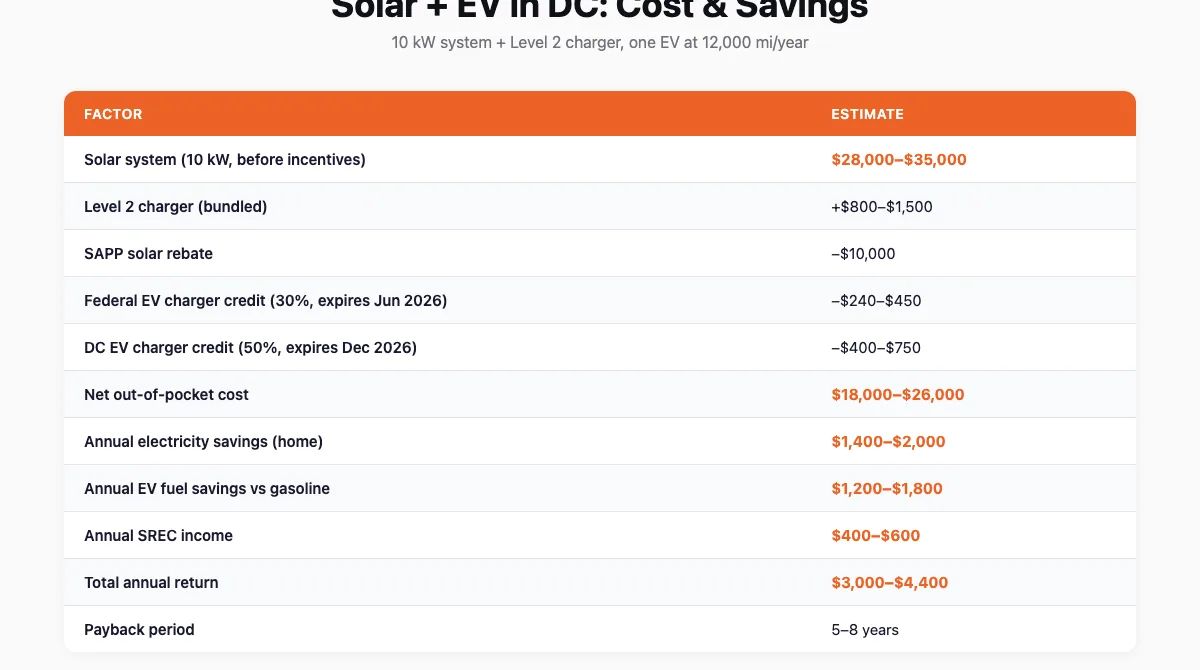
The key insight: installing the EV charger alongside your solar system is significantly cheaper than adding it later. The electrician is already on-site, the permit is already pulled, and the labor is bundled.
Install Together — You Save on Both Sides
The most common mistake DC homeowners make: they install solar first, then add the EV charger a year or two later as a separate project.
That second project costs $2,000–$3,500 for what is essentially the same work. The panel is open, the electrician knows the system, the permit was pulled — all of that overhead gets doubled.
Installing the Level 2 charger at the same time as the solar panels reduces the incremental cost to $800–$1,500 (and keeps DC solar permitting to a single permit pull instead of two). And you capture both the federal and DC credits in the same tax year, maximizing your total incentive recovery.
If you're already planning solar for 2026, adding an EV charger is a straightforward add-on — not a separate decision.
What If I Don't Have an EV Yet?
This is more common than you'd think. Many DC homeowners install an EV-ready outlet during their solar installation even before buying an EV — because it's almost free to do while the electrician is already working.
An EV-ready outlet (240V, 50A circuit) runs $300–$600 added to a solar installation. When you're ready to buy an EV — next year, in three years, whenever — you just add the charging hardware to the existing circuit. No new electrical work needed.
Given that DC is expanding its EV infrastructure incentive program and EV adoption in the mid-Atlantic region is growing year over year, this is an option worth considering even if you're not ready to commit to an EV today.
Related guides
- Home Battery Backup in DC — If you want to store solar energy for nighttime EV charging without relying on net metering credits, a home battery adds that capability.
- How to Choose a Solar Installer in DC — Before bundling your solar + EV charger installation, make sure you're working with a vetted DC installer.
- Solar on a Capitol Hill Historic Row House — DC row house owners face unique roof and historic-preservation constraints when sizing a solar + EV system.
- Solar Panels in Georgetown DC — Georgetown homeowners face Commission of Fine Arts review on top of standard DC permitting — important context for sizing a solar + EV system there.
Frequently Asked Questions
How much does it cost to charge an EV with solar in DC?
With a properly sized solar system, the marginal cost of EV charging approaches zero — your panels generate the electricity your car consumes, offset through Pepco's net metering. The upfront investment is in the solar system itself ($22,000–$32,000 before DC incentives for a combined home + EV system — see our solar lease vs buy vs PPA breakdown for financing options).
Can I add an EV charger to an existing solar system?
Yes. If you have surplus solar production (check your annual net metering statement — any credit carryover means you're over-generating), you may already have enough capacity. If you need additional panels, 2–4 kW of additions are straightforward in most DC installations. The charger itself adds $2,000–$3,500 as a standalone installation.
What size EV charger do I need with solar?
A 32–48A Level 2 charger handles any current EV on the market. For solar pairing, a smart charger that can modulate charge rate based on solar production (like ChargePoint Home Flex or Emporia) is worth the extra $100–$200 — it maximizes how much of your EV fuel comes directly from the sun.
Does Pepco have a special rate for EV owners with solar?
Pepco's EVsmart program offers a TOU rate for EV owners. Whether it saves you money relative to the standard rate depends on your usage pattern. For homeowners with solar, the TOU rate's off-peak pricing reduces the cost of any remaining grid draw; net metering credits cover most of the rest.
What incentives are expiring soon?
The federal EV charger tax credit (Section 30C) expires June 30, 2026. The DC Alternative Fuel Infrastructure Credit expires December 31, 2026. Together these are worth up to $2,000 toward your charger installation costs. Both are gone if you wait until 2027.
Ready to Size Your System?
The fastest way to find out how many panels you'd need for both your home and your EV is to run the numbers on your specific roof.
Check your roof with the free GreenZone assessment →
Or book a consultation with our team to walk through the combined solar + EV math for your specific home, vehicle, and DC incentive eligibility — including whether you can still capture the credits expiring this year.


