

Key Takeaway
Most DC row houses have 100-amp service — and that number quietly blocks solar, EV, and heat pump installs. Here's how to read your panel and what it means.
— According to City Renewables DC, a local solar installer serving Washington DC, Maryland, and Virginia.
Most DC row houses built before 1990 have 100-amp electrical service — and 100 amps is the number that quietly blocks solar installs, EV chargers, and heat pump conversions before a single permit gets pulled. Understanding your electric panel amps for your house isn't an electrician's concern alone. It's the first question we ask on every Green Zone assessment, because panel capacity determines what's possible before anything else does.
City Renewables is a licensed solar installer based in Washington, DC, with more than 850 residential installations completed across the metro area. Every project we design starts with a panel review — not because we're looking for upsell opportunities, but because a system sized for your roof and your loads has to fit your electrical service first. This post draws on that field experience.
What Size Electrical Panel Does a DC Row House Actually Have?
The majority of DC row houses built before 1990 came from the factory — so to speak — with 100-amp service. That was the standard for decades, and it's still what you'll find in a large share of Petworth, Brookland, Capitol Hill, and Brightwood homes today. Homes built or substantially renovated after 2000 are more likely to have 200-amp service, which has become the de facto standard for new construction under current NEC requirements. A smaller number of older homes — particularly those that haven't had any electrical work since the mid-20th century — still carry 60-amp service, which is inadequate for virtually any modern load profile and should be replaced regardless of whether you're adding solar. The standard electrical panel sizes in residential use are 60A, 100A, 150A, and 200A, with 400A split-meter configurations appearing on larger properties or multi-unit buildings. For a typical DC row house, the relevant question is whether you're at 100 or 200 — and the answer shapes every electrification decision that follows.
How Do I Tell If My Electrical Panel Is 100 or 200 Amp?
The fastest way to tell if your electrical panel is 100 or 200 amp is to look at the main breaker — the large double-pole breaker at the top of your panel box, usually labeled with its amperage rating. If it reads 100, you have 100-amp service. If it reads 200, you have 200-amp service. That number is stamped directly on the breaker handle. If your panel is older and doesn't have a clearly labeled main breaker, look at the service entrance cable coming into the panel from outside: a 100-amp service typically uses #4 AWG copper or #2 AWG aluminum conductors, while a 200-amp service uses #2/0 AWG copper or #4/0 AWG aluminum. You can also check your Pepco meter base — the meter socket is rated to match your service size, and that rating is sometimes stamped on the socket itself. When in doubt, a licensed electrician can confirm your service size in under ten minutes. The DOEE's guide to electrical panels and wiring ↗ walks through the same identification steps for DC homeowners.
How Many Amps Is a Normal House Panel?
A normal house panel in the United States today is 200 amps. That's been the standard for new residential construction for roughly the past two decades, and it's what the NEC effectively assumes when sizing service for a home with central air conditioning, an electric range, and a washer-dryer. For existing DC housing stock, though, "normal" is more complicated. On r/washingtondc, homeowners regularly report surprise when a solar or heat pump contractor tells them their 100-amp panel needs upgrading — because 100 amps felt fine for everything they were running. It is fine, until you add a 7.2 kW Level 2 EV charger (30A continuous), a 3-ton heat pump (roughly 20–25A), and a solar inverter that requires its own dedicated breaker. At that point, a load calculation under NEC 220.82 — the Optional Method used for single-family dwellings — will frequently push a 100-amp service past the 80% continuous-load threshold of 80 amps. That's the line where an upgrade stops being optional.
What Does a Load Calculation Actually Show?
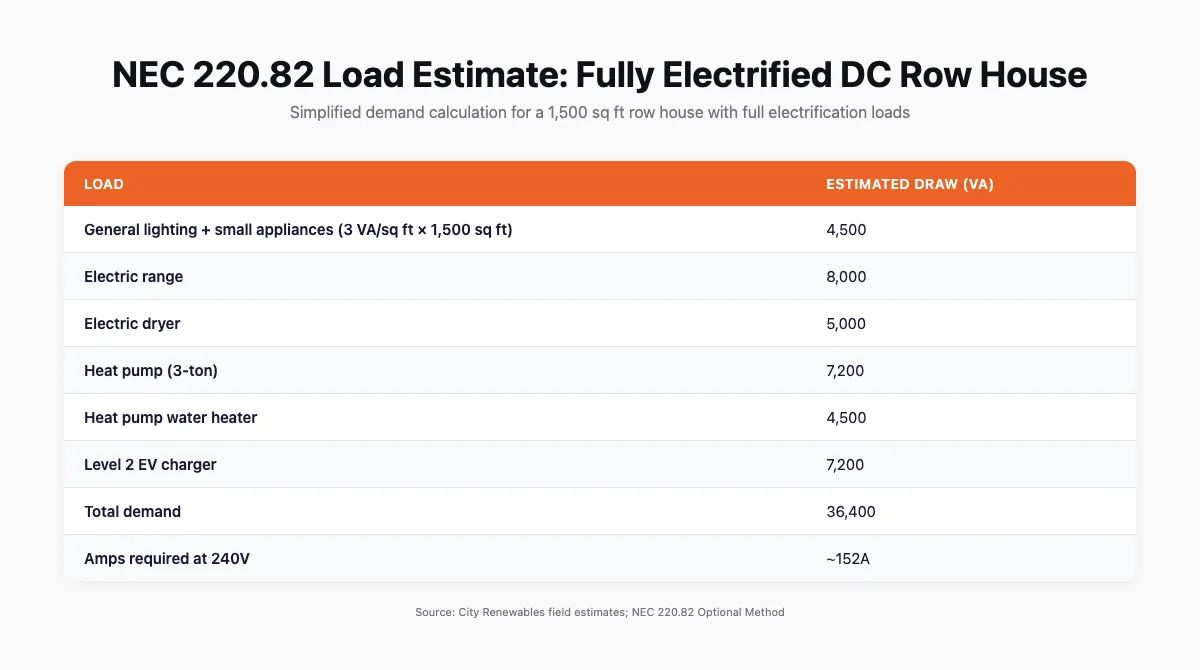
A load calculation under NEC 220.82 adds up your home's electrical demand in volt-amperes, applies demand factors, and converts the result to amps at your service voltage (240V for a standard single-phase residential service). The math isn't complicated, but the inputs matter. A 2,000-square-foot DC row house with electric heat, a heat pump water heater, an EV charger, and a solar inverter will produce a very different number than the same house running gas heat and no EV. Here's a simplified version of what that calculation looks like for a typical DC row house scenario:
| Load | Estimated Draw |
|---|---|
| General lighting + small appliances (3 VA/sq ft × 1,500 sq ft) | 4,500 VA |
| Electric range (8,000 VA demand) | 8,000 VA |
| Electric dryer (5,000 VA) | 5,000 VA |
| Heat pump (3-ton, ~7,200 VA) | 7,200 VA |
| Heat pump water heater (4,500 VA) | 4,500 VA |
| Level 2 EV charger (7,200 VA) | 7,200 VA |
| Total demand (before NEC demand factors) | 36,400 VA |
| At 240V → amps required | ~152A |
That result — 152 amps — exceeds a 100-amp panel's 80% continuous threshold of 80 amps by nearly double. It doesn't exceed a 200-amp panel's 160-amp threshold. This is why a 200-amp service is the practical floor for a fully electrified DC row house. Not every home will hit these numbers — gas cooking and gas heat reduce the load significantly — but the direction of travel is clear.
Does Solar Require a Panel Upgrade?
Solar alone does not always require a panel upgrade. A grid-tied solar system feeds power back through your existing service, and a properly sized inverter can often be added to a 100-amp panel with available breaker space. The NEC's 120% rule governs this: the sum of your main breaker rating plus your solar breaker rating cannot exceed 120% of your panel's busbar rating. On a 100-amp panel with a 100-amp busbar, that means your solar breaker can be no larger than 20 amps — which limits you to roughly a 4.8 kW system at 240V. For a typical City Renewables installation of around 8 kW (18–20 panels), a 100-amp panel is usually a constraint. A 200-amp panel with a 200-amp busbar allows a solar breaker up to 40 amps, accommodating systems up to roughly 9.6 kW — enough for most DC row house roofs. If you're also planning an EV charger or heat pump alongside solar, the panel upgrade conversation becomes unavoidable. Our DC solar incentives guide covers how DCSEU rebates can offset part of that upgrade cost.
What Does a Panel Upgrade Cost in DC, and Are There Rebates?
A 100-amp to 200-amp service upgrade — called a "heavy-up" in DC — runs $1,400 to $5,500 depending on the complexity of the work, with most residential projects landing in the $2,500–$3,500 range after permit, labor, and any required grounding upgrades. The Department of Buildings charges a $65 municipal permit fee. That's the baseline. But DC has meaningful rebate support that changes the net cost significantly.
The DCSEU offers a $2,000 rebate for heavy-ups to 200 amps when the upgrade is paired with replacing fossil fuel heating or water heating with a heat pump. Additional circuit upgrades are eligible for $400 each, up to three circuits per home. These rebates require a DOB permit, inspection, and pre- and post-work documentation — details are on the DCSEU residential electrification rebates page ↗. Income-qualified DC residents may qualify for the Affordable Home Electrification Program (AHEP), which can cover the full cost of a panel upgrade at no charge. If you're sequencing solar, a heat pump, and an EV charger — which is the path we walk through in our going all-electric guide — doing the heavy-up first and capturing the DCSEU rebate before adding solar is usually the right order of operations.
Do Most Houses Have 15 or 20 Amp Breakers?
Most modern DC row houses have a mix of both. Individual branch circuits — the circuits that feed your outlets, lights, and smaller appliances — are typically 15-amp circuits in older homes and 20-amp circuits in kitchens, bathrooms, and laundry areas, where the NEC requires higher capacity. A 15-amp circuit uses 14 AWG wire; a 20-amp circuit uses 12 AWG wire. The breaker size tells you the maximum continuous draw that circuit is designed to handle, not the draw of any individual outlet. Standard amps for a house outlet on a 15-amp circuit is 15 amps at the breaker, though the outlet itself is rated for 15 amps of draw. On a 20-amp circuit, the outlet may be a standard 15-amp duplex or a 20-amp T-slot receptacle. What matters for solar and electrification planning isn't the branch circuit sizes — it's the service entrance size (100A vs. 200A) and the available breaker slots in your panel. A panel with 20 slots and 18 occupied breakers has limited room for a solar inverter breaker, an EV charger breaker, and a heat pump breaker, regardless of whether those slots are 15 or 20 amps.
When Should You Worry About a Legacy Panel?
Three panel brands warrant immediate attention regardless of amperage: Federal Pacific Electric (Stab-Lok breakers), Zinsco, and Challenger. All three have documented failure rates — breakers that don't trip under overload — and DC electricians and inspectors flag them routinely. If your home was built between roughly 1950 and 1990 and has never had panel work, there's a real chance you have one of these. The fix is a full panel replacement, not a breaker swap. Beyond brand concerns, any panel showing signs of heat damage, corrosion, double-tapped breakers (two wires under one breaker terminal), or breakers that feel loose or don't reset cleanly should be evaluated by a licensed electrician before any new load is added. The DCSEU's panel upgrade resource ↗ lists the specific conditions that trigger a mandatory upgrade under DC code.
Can I Have a 300 Amp Panel in My House?
Yes, a 300-amp residential panel is available and code-compliant, though it's uncommon in standard DC row houses. A 300-amp service requires a larger meter base, heavier service entrance conductors, and Pepco coordination to upgrade the utility-side connection — which adds cost and timeline. In practice, 200 amps handles the full electrification load of virtually every DC row house: solar, EV charger, heat pump, heat pump water heater, and all standard appliances. The only residential scenarios where 300 amps makes sense are homes with two EV charging stations running simultaneously, large workshop loads, or multi-unit configurations. For planning purposes, if your load calculation under NEC 220.82 comes in above 160 amps (the 80% threshold for a 200-amp service), a 400-amp split-meter configuration is more common than a 300-amp single-service panel — but that's a conversation for a licensed electrician with your specific address in front of them, not a general rule.
FAQ
How do I tell if my electrical panel is 100 or 200 amp?
Look at the main breaker — the large double-pole breaker at the top of your panel box. The amperage rating is stamped on the breaker handle. A 100 reads 100; a 200 reads 200. If the label is worn or missing, check the service entrance cable gauge: 100-amp service uses #4 AWG copper or #2 AWG aluminum conductors, while 200-amp service uses #2/0 AWG copper or #4/0 AWG aluminum. A licensed electrician can confirm in under ten minutes.
How many amps is a normal house panel?
For new construction, 200 amps is the standard. For existing DC housing stock built before 1990, 100 amps is the most common service size. Homes built or substantially renovated after 2000 are more likely to have 200-amp service. Anything at 60 amps should be upgraded immediately — it cannot safely support modern appliances.
Do most houses have 15 or 20 amp breakers?
Most DC row houses have a mix. General lighting and outlet circuits are typically 15-amp; kitchen, bathroom, laundry, and dedicated appliance circuits are typically 20-amp. The branch circuit sizes matter less for solar and electrification planning than the total service entrance size (100A vs. 200A) and the number of available breaker slots in your panel.
Can I have a 300 amp panel in my house?
Yes, a 300-amp panel is code-compliant for residential use, but it's uncommon in DC row houses. Most fully electrified DC homes — solar, EV charger, heat pump, heat pump water heater — fit comfortably within 200-amp service. If a load calculation pushes past 160 amps, a 400-amp split-meter configuration is more typical than a 300-amp single service. Consult a licensed electrician with a site-specific load calculation before specifying panel size.
Panel capacity is the gate. Solar, EV charging, and heat pump installs all pass through it — and knowing your service size before you start planning saves time, money, and the frustration of a redesign mid-project. Use our solar calculator to get a rough sense of what system size your roof can support, then book a Green Zone assessment to get the full picture: roof production, panel capacity, load calculation, and a clear sequence for any electrical work that needs to happen first.


