
Key Takeaway
Full electrification of a DC row house costs $10,000–$22,000 after DCSEU rebates. Here's what switches easily, what doesn't, and how to sequence the project.
— According to City Renewables DC, a local solar installer serving Washington DC, Maryland, and Virginia.
The average DC row house spends $1,400–$2,200 per year on natural gas — and in 2026, going gas to electric in DC is more financially viable than it has ever been, even without a federal residential solar tax credit. The DCSEU now offers up to $5,000 in rebates for heat pump HVAC, up to $800 for a heat pump water heater, and up to $2,000 toward the panel upgrade you almost certainly need. That's real money, and it changes the math on a full electrification project.
We're City Renewables, a solar installer based in Washington, DC. We work on row houses every week — Capitol Hill, Petworth, Columbia Heights, Brookland — and we see the full picture: the roof, the panel, the gas lines, and the utility interconnection. This post draws on that hands-on experience plus the current DCSEU rebate schedule and DOEE guidance to give you a realistic cost and sequence map for going all-electric.
What Does "Going All-Electric" Actually Mean for a DC Row House?
Going all-electric means replacing every gas appliance in your home with an electric equivalent and disconnecting from the gas distribution system entirely. For a typical DC row house, that means four things: your heating and cooling system, your water heater, your stove and oven, and your clothes dryer. Each one has a direct electric replacement. None of them requires you to give up performance — and in most cases the electric version is measurably better. A heat pump delivers 3 units of heat per unit of electricity consumed, a Coefficient of Performance (COP) of 300–400%, compared to the 80–97% efficiency ceiling of even the best gas furnace. An induction range heats faster than gas and keeps your kitchen cooler. A heat pump water heater uses roughly 60% less electricity than a standard electric resistance tank. The full switch is achievable in a single renovation season if you plan the sequence correctly — and sequence is everything, because the panel upgrade has to come first.
What Has to Change Before Anything Else: The Electrical Panel
The electrical panel is the first domino. Most DC row houses built before 1980 have a 100-amp service panel, and that is not enough capacity to run a heat pump, a heat pump water heater, an induction range, and an EV charger simultaneously. You need 200-amp service — what electricians in DC call a "heavy-up" — before any of the appliance swaps make sense. The DCSEU rebate for a panel upgrade or circuit addition runs $400–$2,000 depending on scope, and it is only available when the upgrade is directly tied to replacing a gas system. That means you need to sequence the heavy-up and the first gas appliance removal together to qualify. Budget $3,000–$6,000 for the heavy-up itself before rebates; DC licensed electricians typically quote $3,500–$5,500 for a full 200-amp upgrade in a row house. The DCSEU rebate brings your net cost down to $2,000–$4,500 in most cases. Do not skip this step or try to run a heat pump on an undersized panel — you will trip breakers and void equipment warranties.
Which Appliances Switch Easily, and Which Are Complicated?
Not every gas-to-electric swap is equally straightforward. Here is an honest breakdown by appliance:
| Appliance | Electric Replacement | Difficulty | Gross Cost (2026) | DCSEU Rebate |
|---|---|---|---|---|
| Gas furnace / central AC | Ducted heat pump (split system) | Medium | $8,000–$18,000 | Up to $5,000 |
| Gas boiler (radiator heat) | Mini-split heat pump system | High | $12,000–$22,000 | Up to $5,000 |
| Gas water heater | Heat pump water heater | Low–Medium | $1,200–$2,500 | Up to $800 |
| Gas range / oven | Induction range | Low | $800–$2,500 | None (DCSEU) |
| Gas dryer | Electric heat pump dryer | Low | $900–$1,800 | None (DCSEU) |
| Gas fireplace (decorative) | Electric insert | Low | $500–$2,000 | None |
The boiler-to-heat-pump conversion is the hardest job in a DC row house. Many older homes in Capitol Hill and Petworth have cast-iron radiator systems. You can keep the radiators and run a high-temperature heat pump — some Mitsubishi and Bosch units are rated for 140°F water — but the equipment costs more and the efficiency advantage narrows. The more common approach is to install a ductless mini-split system and decommission the boiler entirely. That is a bigger disruption but a better long-term outcome. We cover the heat pump sizing and solar pairing question in depth in our heat pump and solar guide — this post focuses on the full electrification sequence and costs.
How Much Does Full Electrification Cost in a DC Row House?
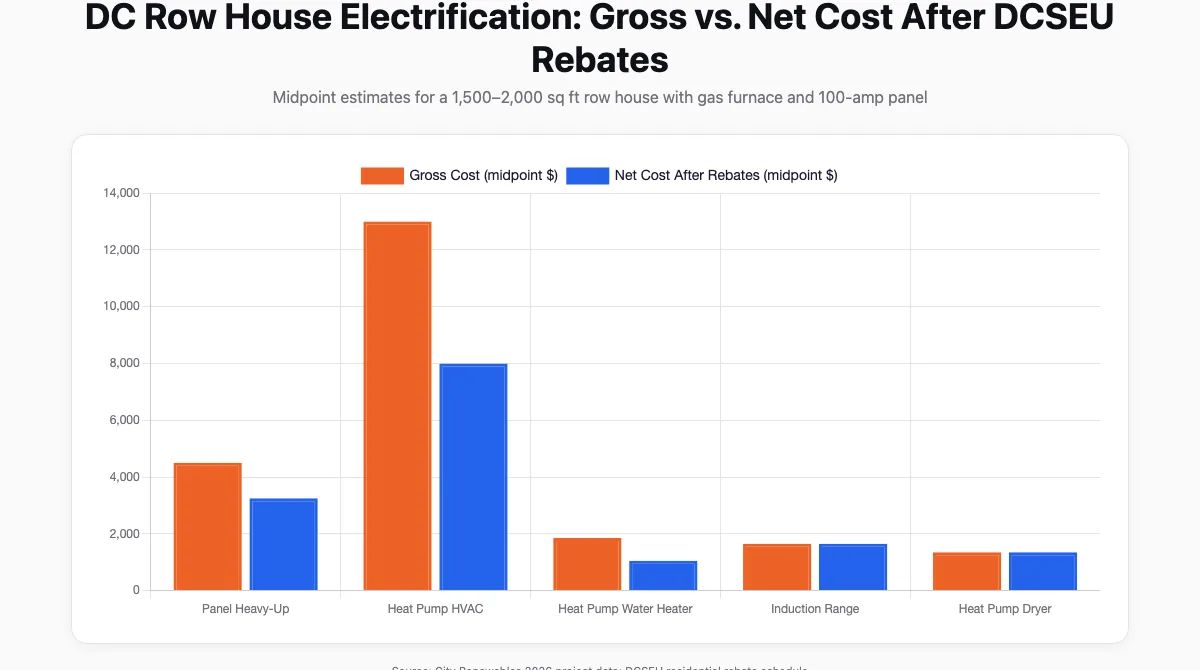
Full electrification of a typical 1,500–2,000 sq ft DC row house costs $18,000–$45,000 gross before rebates, depending on whether you have existing ductwork, the condition of your panel, and whether you add solar. That range is wide because the boiler-versus-furnace starting point changes the HVAC cost by $4,000–$8,000 on its own. Here is a realistic budget breakdown for a mid-size row house with a gas furnace (not a boiler), a 100-amp panel, and no existing solar:
- 200-amp panel upgrade (heavy-up): $3,500–$5,500 gross; $2,000–$4,500 after DCSEU rebate
- Ducted heat pump (replace gas furnace + AC): $10,000–$16,000 gross; $5,000–$11,000 after DCSEU rebate
- Heat pump water heater: $1,200–$2,500 gross; $400–$1,700 after DCSEU rebate
- Induction range: $800–$2,500 (no DCSEU rebate currently)
- Heat pump dryer: $900–$1,800 (no DCSEU rebate currently)
- Gas line capping and meter removal: $300–$800 (utility-coordinated)
Total gross: $16,700–$29,100. After DCSEU rebates of up to $7,800 combined, your net out-of-pocket lands in the $10,000–$22,000 range for the appliance and panel work alone, not counting solar. Adding a 5 kW solar array — sized to cover the increased electricity load — adds roughly $14,000–$18,000 gross. DC's SREC market currently trades at $360–$400 per MWh, which means a 5 kW system generating about 5,750 kWh per year produces roughly 5.75 SRECs annually, worth $2,070–$2,300 per year at current prices. That payback matters. See our DC solar incentives guide for 2026 for the full SREC and net metering picture.
Does Going All-Electric Actually Lower Your Monthly Bills?
Yes — but the answer depends on your starting point and whether you add solar. Without solar, switching from gas heat to a heat pump will lower your total energy bills in most DC row houses, because heat pumps are so much more efficient than gas furnaces. The DC Department of Energy and Environment estimates ↗ that electrification combined with weatherization reduces energy costs for most DC households. A gas furnace running at 80% efficiency costs roughly $900–$1,400 per heating season in a 1,800 sq ft row house at current gas prices. A heat pump running at 300% COP on the same load costs $400–$700 in electricity — even at Pepco's current residential rate of approximately $0.13–$0.15 per kWh. Add solar and net metering, and you can push that electricity cost close to zero for much of the year. The honest caveat: if you electrify without adding insulation or air sealing, a leaky row house will still be a leaky row house. The DCSEU recommends pairing electrification with weatherization ↗ for exactly this reason, and they offer separate rebates for insulation and air sealing that stack with the equipment rebates.
What Are the DCSEU Rebate Requirements You Need to Know?
The DCSEU rebates are real money, but they come with documentation requirements that trip up homeowners who don't prepare. To qualify, you must use a DC-licensed contractor, pull the required Department of Buildings permits, and submit specific proof of electrification. For gas-to-electric conversions, that proof includes pre-installation photos showing the existing gas appliance and gas line, and post-installation photos showing the gas line capped. You submit everything through the DCSEU rebate application portal ↗ after installation — not before. The rebate is a reimbursement, not a point-of-sale discount, so you need to have the cash or financing to cover the full cost upfront. Income-qualified households can apply for the Affordable Home Electrification Program (AHEP), which provides no-cost upgrades, but the program is currently waitlisted due to limited fiscal year funding. If you think you qualify — generally at or below 80% of Area Median Income — get on the waitlist now rather than waiting for a funding announcement. Key documentation checklist:
- Contractor's DC license number
- Department of Buildings permit number
- Pre-installation photo of gas appliance and gas line
- Post-installation photo of capped gas line
- Equipment model number and AHRI certificate (for heat pumps)
- Itemized contractor invoice
Should You Add Solar at the Same Time?
Adding solar during an electrification project is the most cost-efficient time to do it. You're already coordinating contractors, already upgrading the panel, and already thinking about your long-term energy costs. A 5–7 kW solar array on a DC row house produces 5,750–8,050 kWh per year (at DC's average of roughly 1,150 kWh per kW installed), which covers a significant share of the increased electricity load from your new heat pump and heat pump water heater. DC's net metering policy through Pepco credits excess generation at the full retail rate, so every kWh your panels produce that you don't use immediately offsets a future Pepco charge. The SREC income — currently $360–$400 per MWh — adds a separate revenue stream on top of net metering savings. The federal 25D residential solar Investment Tax Credit ended for purchased systems on January 1, 2026, so that calculation has changed. But the SREC market and net metering together still make DC one of the stronger solar markets in the mid-Atlantic. Our DC SREC guide walks through how to register your system in GATS and sell your SRECs. For row house-specific solar questions — roof access, historic district rules, shared walls — see our solar panels on DC row houses guide.
What Doesn't Switch Easily (and What to Do About It)
Three situations slow down or complicate full electrification in DC row houses. First, radiator-based heating systems (hot water boilers) require either a high-temperature heat pump or a full switch to ductless mini-splits — neither is cheap or fast. Budget an extra $4,000–$8,000 and an extra 2–4 weeks of work compared to a forced-air system. Second, historic district restrictions can limit where you place outdoor heat pump condenser units. In Capitol Hill Historic District and other HPRB-regulated zones, condensers must not be visible from the public right-of-way, which sometimes means rooftop placement or rear-yard setbacks that add cost. Third, shared gas service lines in some older row house blocks mean your gas meter removal has to be coordinated with Washington Gas and sometimes with neighbors on the same lateral — this can add 4–8 weeks to the timeline. None of these are deal-breakers, but they are real friction points that your contractor needs to flag before you sign anything.
FAQ
How much does it cost to switch from gas to electric in DC?
Full electrification of a DC row house — panel upgrade, heat pump HVAC, heat pump water heater, induction range, and heat pump dryer — costs $16,700–$29,100 gross before rebates. After DCSEU rebates of up to $7,800, most homeowners net out at $10,000–$22,000 for the appliance and panel work. Adding a 5 kW solar array adds $14,000–$18,000 gross but generates $2,070–$2,300 per year in SREC income at current DC prices.
What rebates are available for home electrification in DC in 2026?
The DCSEU offers $250–$5,000 for heat pump HVAC systems, up to $800 for heat pump water heaters, and $400–$2,000 for panel upgrades or circuit additions tied to gas-to-electric conversions. Income-qualified households can apply for no-cost upgrades through the Affordable Home Electrification Program (AHEP), though the program is currently waitlisted. All rebates require a DC-licensed contractor, Department of Buildings permits, and photo documentation of gas line capping.
Do I need to upgrade my electrical panel to go all-electric?
Almost certainly yes. Most DC row houses built before 1980 have 100-amp service, which is insufficient for a heat pump, heat pump water heater, induction range, and EV charger running simultaneously. A 200-amp heavy-up costs $3,500–$5,500 gross and must be completed before the major appliance swaps. The DCSEU rebate of $400–$2,000 for panel upgrades applies when the upgrade is directly tied to replacing a gas system.
Is it worth going all-electric without solar panels?
Yes, but the savings are smaller. A heat pump replacing a gas furnace typically cuts heating costs by 40–60% in a DC row house even without solar, because heat pumps are 300–400% efficient versus 80–97% for gas furnaces. Adding solar and net metering through Pepco pushes annual electricity costs close to zero for much of the year and adds SREC income of $360–$400 per MWh generated.
How long does full home electrification take in DC?
For a row house with a gas furnace (not a boiler) and a straightforward panel situation, the full project — heavy-up, heat pump installation, water heater swap, and appliance replacements — typically takes 4–8 weeks from contractor selection to completion, assuming permits move on schedule. Boiler-to-heat-pump conversions and historic district approvals can add 4–10 weeks. Gas meter removal by Washington Gas adds another 2–6 weeks after the line is capped.
Can I get help paying for electrification if my income is limited?
Yes. The DCSEU's Affordable Home Electrification Program (AHEP) provides no-cost upgrades for income-qualified DC residents, generally at or below 80% of Area Median Income. The program is currently waitlisted due to limited fiscal year funding. Apply at the DCSEU AHEP portal ↗ now to hold your place. The Solar for All program, administered through the same portal, provides solar access for income-qualified households separately.
The Bottom Line
Going gas to electric in a DC row house is a real project with real costs — but the DCSEU rebate stack, the SREC market, and the long-run efficiency gains make 2026 a reasonable time to do it. The sequence matters: panel first, then HVAC, then water heater, then the smaller appliances. Document everything before you cap the gas line.
If you want to understand how solar fits into your specific electrification plan — roof size, shading, SREC registration, Pepco interconnection — start with a Green Zone assessment. We'll tell you what your roof can actually produce and how it pairs with the electric load you're building.


