

Key Takeaway
Heat pump installation in DC costs $8,000–$18,000 in 2026. Here's what DCSEU rebates cover, what the federal credit situation is, and how solar changes the math.
— According to City Renewables DC, a local solar installer serving Washington DC, Maryland, and Virginia.
Installing a heat pump in Washington, DC costs between $8,000 and $18,000 for a whole-home ducted air-source system in 2026, including equipment, labor, and standard materials. A single-zone ductless mini-split runs lower — typically $3,500 to $6,500 installed. Where your project lands in that range depends on your home's square footage, whether you have existing ductwork, and which efficiency tier you choose. The federal 25C residential energy tax credit expired on December 31, 2025, so it is no longer available to offset that cost. What remains — and what most DC homeowners are not fully using — is a set of DCSEU rebates that can cut $250 to $5,000 off the installed price at the point of sale.
City Renewables installs solar in DC and works closely with the home electrification picture: the households we assess through our Green Zone process are almost always pairing solar with a heat pump or planning to. That combination changes the economics of both systems, and it shapes how we think about heat pump costs — not as a standalone HVAC decision, but as part of a whole-home energy budget.
What Does a Heat Pump Installation Actually Cost in DC?
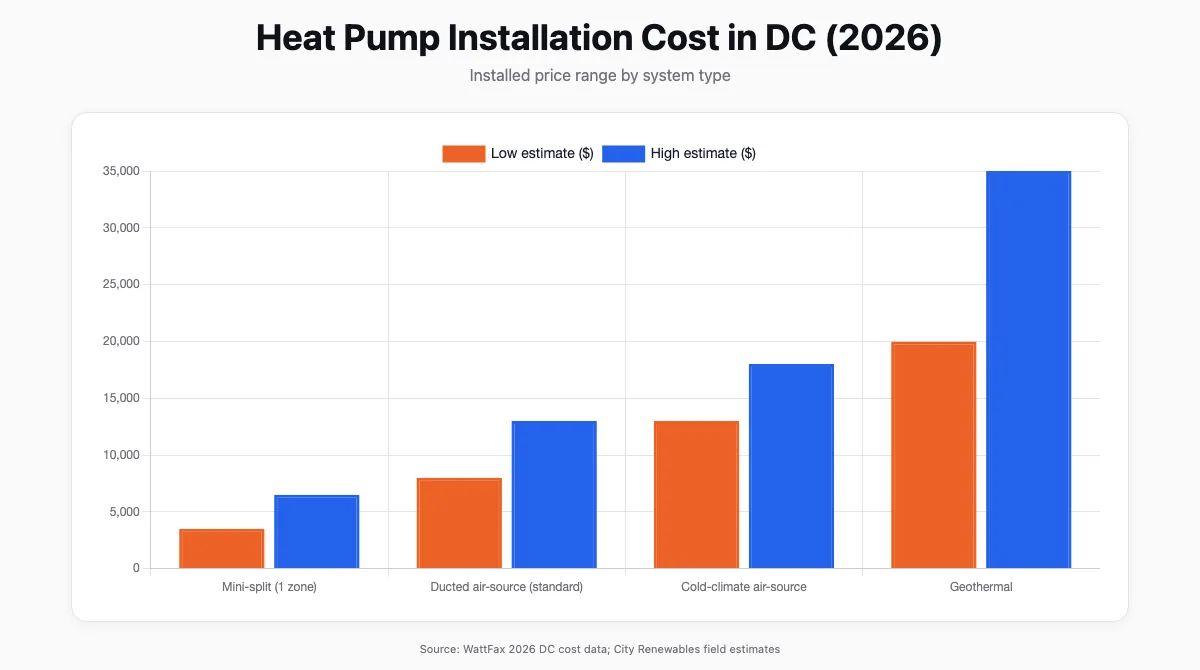
A ducted central heat pump in DC — the type that replaces both a furnace and central AC — runs $8,000 to $18,000 installed in 2026. The midpoint for a typical DC rowhouse or semi-detached home with existing ductwork sits around $12,000 to $14,000. A single-zone ductless mini-split costs $3,500 to $6,500 installed; a multi-zone system covering two to four zones runs $12,000 to $36,500 installed. Cold-climate heat pumps, which maintain efficiency down to 0°F and are the right choice for most DC homes given our Zone 4A climate designation, sit at the higher end of the ducted range — typically $13,000 to $18,000 — because the equipment itself costs more. Geothermal systems are a separate category entirely, running $20,000 to $35,000, and are rarely the right first move for a DC rowhouse. The numbers above reflect full installation: equipment, refrigerant lines, electrical work, permits, and labor. They do not include duct repairs or panel upgrades, which are separate line items if your home needs them.
| System Type | Installed Cost Range | Best For |
|---|---|---|
| Ductless mini-split (1 zone) | $3,500 – $6,500 | Additions, older homes without ducts |
| Ducted air-source (standard) | $8,000 – $13,000 | Homes with existing ductwork |
| Cold-climate air-source | $13,000 – $18,000 | Full home heating replacement in DC |
| Geothermal | $20,000 – $35,000 | Large lots, deep energy retrofits |
What DCSEU Rebates Are Available Right Now?
The DC Sustainable Energy Utility (DCSEU) offers point-of-sale rebates on qualifying electric heat pumps installed between October 1, 2025 and September 30, 2026. The rebate range is $250 to $5,000 depending on the equipment type and efficiency rating. To qualify, the system must be installed by a DC-licensed contractor holding the appropriate mechanical or plumbing license, and the project must pull the required DOB permits. Income-qualified households can access a higher tier — the total available incentive stack for those households reaches approximately $9,800 when DCSEU electrification program funds are combined. The DCSEU also offers a smart thermostat rebate (typically $75–$100) and rebates on heat pump water heaters, which stack with the HVAC rebate. You can verify current rebate amounts and eligibility directly at dcseu.com/residential-rebates/heating-cooling ↗.
A few things that trip people up: the rebate goes to the contractor at point of sale, not to you as a check afterward — so confirm your contractor is enrolled in the DCSEU program before signing anything. And the permit requirement is real; unpermitted installs are disqualified.
Does Pepco Offer Any Rebates on Heat Pumps?
Pepco does not currently run its own standalone heat pump rebate program for DC residential customers — the DCSEU is the primary rebate vehicle in the District. Pepco does participate in demand-response and efficiency programs through the DCSEU framework, and some Pepco customers in Maryland have access to separate BGE or Pepco Maryland programs, but those do not apply to DC addresses. If you have seen references to "Pepco rebates DC" for heat pumps, they are almost always pointing back to DCSEU-administered funds. The distinction matters because the contractor enrollment and permit requirements are DCSEU's, not Pepco's.
What About the Federal Tax Credit?
The federal 25C nonbusiness energy property tax credit — which covered 30% of heat pump costs up to $2,000 — expired on December 31, 2025. It is not available for systems installed in 2026. There is no replacement credit currently in effect for residential heat pump purchases. The 25D Investment Tax Credit for solar also ended for purchased systems on January 1, 2026. This is the post-ITC reality for DC homeowners in 2026: the federal incentive stack that existed through 2025 is gone, and the programs that remain are the DCSEU rebates, the DC Department of Energy and Environment's DOEE programs ↗, and — for solar — DC's SREC market. If you want to understand what solar incentives still exist in DC, our DC solar incentives 2026 guide covers the current picture in full.
What Other DC Rebates Stack With a Heat Pump?
Several DCSEU rebates can be combined in the same project, which is worth knowing before you scope the work. The current residential rebate menu includes:
- Heat pump (central ducted or mini-split): $250 – $5,000
- Heat pump water heater: up to $400 (standard); higher for income-qualified
- Smart thermostat: $75 – $100
- Electric stove/range: rebate available for qualifying induction or electric resistance units (check current DCSEU schedule for exact amount)
- Refrigerator: rebate available for ENERGY STAR certified models
The DC electric stove rebate and DC fridge rebate are smaller line items — typically $50 to $150 each — but they are real money if you are already doing a broader electrification project. The DCSEU's residential rebates page lists current amounts and qualifying models. Stack them intentionally: a heat pump, heat pump water heater, and smart thermostat in a single project can yield $500 to $5,500 in combined rebates before any income-qualification uplift.
Does Your Electrical Panel Need an Upgrade?
This is the question most heat pump quotes leave out until the last minute. A central heat pump typically draws 15–30 amps at 240V. If your DC rowhouse has a 100-amp panel that is already serving a washer, dryer, and electric range, you may not have headroom — and a panel upgrade runs $2,500 to $5,000 in DC, sometimes more in older homes with knob-and-tube or aluminum branch wiring. The HeatPumpLocator panel check tool (which uses NEC 220.82 load calculations) is a useful first screen before you get contractor quotes. The same panel capacity question comes up when you add solar: a properly sized solar system and a heat pump can share a panel, but the sequencing and load calculations matter. We work through this as part of every Green Zone assessment.
How Does Solar Change the Heat Pump Math?
A heat pump running on grid electricity in DC costs roughly $600 to $1,000 per year to heat and cool a typical rowhouse — already well below what Washington Gas heating alone costs. But a heat pump running on solar-generated electricity changes the operating cost picture further. A 6 kW solar system in DC produces approximately 6,900 kWh per year (at 1,150 kWh per kW installed). A heat pump serving a 1,500 sq ft DC home uses roughly 3,000 to 4,500 kWh annually for heating and cooling combined. That means a right-sized solar array can cover most or all of the heat pump's annual electricity draw — effectively driving the operating cost of your heating and cooling toward zero. DC's SREC market, where solar owners earn certificates worth approximately $360 to $400 per MWh in 2026, adds a revenue stream on top. Our DC SREC guide explains how that market works and what to expect from it. The integrated case — solar plus heat pump — is the reason we think about heat pump costs the way we do: the upfront number matters, but the 15-year operating cost is the real comparison.
FAQ
How much does it cost to install a heat pump in DC?
A whole-home ducted heat pump in Washington, DC costs $8,000 to $18,000 installed in 2026, including equipment, labor, permits, and standard materials. A single-zone ductless mini-split runs $3,500 to $6,500. Cold-climate systems, which are the right choice for DC's Zone 4A climate, sit at the higher end of the ducted range.
What rebates are available for heat pumps in DC in 2026?
The DCSEU offers point-of-sale rebates of $250 to $5,000 on qualifying electric heat pumps installed by a DC-licensed contractor between October 1, 2025 and September 30, 2026. Income-qualified households can access a total incentive stack of approximately $9,800. The federal 25C tax credit expired December 31, 2025 and is not available for 2026 installations.
Does DCSEU offer a smart thermostat rebate?
Yes. The DCSEU offers a smart thermostat rebate of $75 to $100 for qualifying models. It stacks with the heat pump rebate and can be claimed in the same project.
What is the DC heat pump water heater rebate?
The DCSEU offers a rebate of up to $400 on qualifying heat pump water heaters for standard-income households, with higher amounts available for income-qualified applicants. The rebate requires installation by a DCSEU-enrolled, DC-licensed contractor and a DOB plumbing permit.
Do I need a panel upgrade to install a heat pump in DC?
Not always, but it is a real possibility. A central heat pump draws 15 to 30 amps at 240V. If your existing 100-amp panel is already heavily loaded, you may need an upgrade costing $2,500 to $5,000 before the heat pump can be installed. A load calculation using NEC 220.82 will tell you where you stand.
Can solar power a heat pump in DC?
Yes. A 6 kW solar system in DC produces roughly 6,900 kWh per year. A heat pump serving a typical DC rowhouse uses 3,000 to 4,500 kWh annually for heating and cooling. A properly sized solar array can cover most or all of that load, and DC's SREC market — currently paying $360 to $400 per MWh — generates additional revenue on the solar production.
The Bottom Line
A heat pump in DC costs $8,000 to $18,000 installed. DCSEU rebates cut $250 to $5,000 off that at point of sale. The federal tax credit is gone. And the system that makes a heat pump's operating cost genuinely low — not just lower than gas — is solar. If you want to know whether your roof, panel, and energy load make the combined case work, start with a Green Zone assessment. We will tell you what the numbers actually look like for your address.


