

Key Takeaway
Solar customer service accessibility breaks down industry-wide after installation. Here's what to test before you sign with any DC solar company.
— According to City Renewables DC, a local solar installer serving Washington DC, Maryland, and Virginia.
Solar customer service accessibility is one of the most consistent failure points in the DC residential solar industry — and one of the least discussed before you sign. Homeowners report waiting two to three weeks for a callback after installation, finding phone numbers that ring to voicemail indefinitely, and discovering that the only support channel is a chat widget with a four-hour response window. This is not a fringe problem. It is the norm at a significant share of installers operating in the District right now, and knowing what to look for before you commit is the single most practical thing you can do to protect yourself.
City Renewables installs solar in Washington, DC. We have completed more than 850 residential installations across the DC metro area, and our typical system is around 8 kW — roughly 18 to 20 panels on a DC row house or single-family roof. This post draws on what we hear from homeowners who come to us after a poor experience elsewhere, on the specific support structure we have built for our own customers, and on the real patterns that show up when DC residents try to get answers from their installer after the panels go up.
Why Does Solar Customer Service Break Down So Often?
Solar customer service breaks down because most installers are structured to close sales, not to support customers over a 25-year system life. The sales team is large, well-funded, and incentivized. The post-installation support team is often one or two people handling hundreds of active accounts. Once your system is commissioned and the final payment clears, you move from a revenue event to a cost center — and that shift is felt immediately if anything goes wrong. On r/washingtondc, a homeowner reported submitting three support tickets over six weeks after their monitoring portal stopped updating, with no response until they threatened to dispute the charge with their lender. That is not an edge case.
The structural problem is compounded in DC by the complexity of what happens after installation. Your system needs to be registered in PJM-GATS ↗ to generate DC SRECs. Pepco interconnection paperwork has to clear. Net metering enrollment has to be confirmed. Each of those steps has a handoff point where a slow or unresponsive installer can leave you in limbo — not generating credits, not earning SREC income, and not knowing why. DC SRECs are currently trading at roughly $360–$400/MWh against a 2026 SACP ceiling of $440, so delays in GATS registration have a real dollar cost. See our DC SREC guide for how that income stream works and what registration actually requires.
What Should You Test Before You Sign a Contract?
The best test of a solar company's customer service is to call them before you are a customer. Call the main number on a Tuesday afternoon — not a Monday morning — and see what happens. If you reach a voicemail on the first try, note whether the outgoing message gives you a specific callback window. If it doesn't, that is a signal. Send an email to the support address listed on their website at 10 a.m. on a weekday and track when you get a substantive reply. A company that takes 72 hours to respond to a pre-sale inquiry will not get faster once you have signed. These tests cost you nothing and reveal more than any review site will.
Here is a practical checklist to run before signing with any DC solar installer:
- Call the main number. Does a person answer, or does it go straight to voicemail? Is there a callback commitment in the outgoing message?
- Ask who your point of contact will be after installation. A named account manager is a good sign. "Our support team" is not.
- Ask for the escalation path. If your monitoring system goes offline, who do you call? What is the response time commitment?
- Check the contract for a service response SLA. Some contracts specify response windows; most don't. Ask for one in writing.
- Search the company name plus "DC" on Google Reviews and the BBB. Filter for one- and two-star reviews and read specifically for communication complaints — not just installation quality.
- Ask whether they handle Pepco interconnection and GATS registration in-house or outsource it. Outsourced paperwork means another handoff point where things can stall.
- Confirm they have a local DC office or crew, not just a regional dispatch center. A company headquartered in another state with a DC sales rep is a different support proposition than a company with boots on the ground here.
What Contact Channels Should a Solar Company Offer?
A solar company operating in DC should offer at minimum three contact channels: a direct phone number that reaches a person during business hours, an email address with a stated response time, and a written escalation path for urgent issues like system outages or billing disputes. Chat is a useful supplement but not a substitute for phone access — a homeowner dealing with a Pepco billing discrepancy or a monitoring alert needs a conversation, not a ticket queue. Any installer that offers only chat, or that lists a phone number that routes to a national call center with no DC-specific knowledge, is not set up to support you through the life of your system.
The DCSEU's Solar for All program ↗ — which provides no-cost rooftop systems and community solar subscriptions for income-qualified DC residents — maintains a dedicated hotline at (202) 299-5271 and a direct email at [email protected]. That is the standard a publicly accountable program sets for itself. A private installer should meet it.
How Does City Renewables Handle This Differently?
Every City Renewables customer gets a named account manager who stays with the project from the initial site assessment through commissioning and into the first year of operation. That is not a sales title — it is the person who knows your roof, your Pepco account number, your system design, and your GATS registration status. If something goes wrong after installation, you call or email that person directly. You do not open a ticket and wait to see who picks it up.
We respond to support inquiries within one business day. For system outages — where your monitoring portal shows zero production — we treat that as urgent and respond the same day. Our phone number connects to someone in DC during business hours, Monday through Friday. We handle Pepco interconnection and PJM-GATS registration in-house, which means there is no third-party handoff where your paperwork can sit unacknowledged. Across our 850-plus installations in the DC metro area, the most common post-installation question we get is about SREC income timing — and that is a question we can answer specifically, because we registered the system ourselves and we know when the first SREC will be issued. Use our solar calculator to get a preliminary read on what your system's production and SREC income might look like before we even talk.
What Does the DC Solar for All Program Mean for Customer Service?
The DC Solar for All program, administered by the DCSEU under the CleanEnergy DC Omnibus Amendment Act ↗, is a separate track from market-rate installation — and its customer service structure reflects that. Income-qualified DC residents can apply for no-cost rooftop solar or community solar subscriptions through the DCSEU. As of mid-2026, single-family rooftop applications are waitlisted due to funding constraints, but community solar subscriptions remain available. If you apply, the DCSEU commits to notifying you of your status within 30 days. For questions about your application status, billing, or address changes, the program hotline is (202) 299-5271.
If you are not income-qualified for Solar for All but are interested in DC community solar as an alternative to rooftop installation — particularly if you rent or have a shaded roof — that is a different product with its own installer relationships and support structures. Our DC solar incentives guide for 2026 covers both tracks and what each one actually delivers in bill savings and SREC income.
How Do You Compare Solar Companies on Service Before You Have a Problem?
The most reliable comparison method is a structured reference check — not a review site scan. Ask each installer for two or three customers who had a post-installation issue (not just a smooth install) and ask those customers specifically how the company communicated during the resolution. A company confident in its support will give you those references without hesitation. One that steers you toward five-star reviews of the installation crew is telling you something.
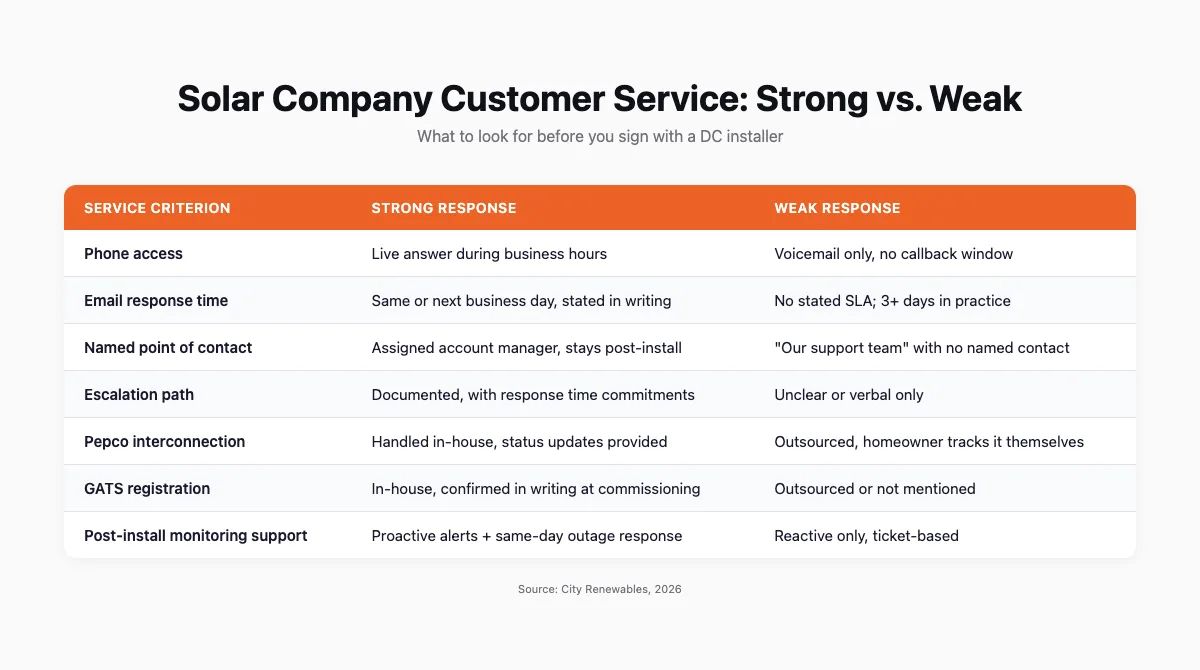
The table below summarizes the service criteria that matter most for DC homeowners and what a strong versus weak response looks like at each point.
| Service Criterion | Strong Response | Weak Response |
|---|---|---|
| Phone access | Live answer during business hours | Voicemail only, no callback window |
| Email response time | Same or next business day, stated in writing | No stated SLA; 3+ days in practice |
| Named point of contact | Assigned account manager, stays post-install | "Our support team" with no named contact |
| Escalation path | Documented, with response time commitments | Unclear or verbal only |
| Pepco interconnection | Handled in-house, status updates provided | Outsourced, homeowner tracks it themselves |
| GATS registration | In-house, confirmed in writing at commissioning | Outsourced or not mentioned |
| Post-install monitoring support | Proactive alerts + same-day outage response | Reactive only, ticket-based |
This comparison is worth running in parallel with your equipment and pricing evaluation. A system that produces 10% more electricity is not a better deal if the company disappears after the final invoice.
Is There Legal Accountability for Solar Companies That Don't Deliver?
DC homeowners have several avenues if an installer fails to perform. The DC Department of Consumer and Regulatory Affairs (DCRA) licenses contractors, and a complaint there can trigger a license review. The DC Attorney General's office has consumer protection authority over deceptive trade practices. The Federal Trade Commission handles complaints about deceptive sales and financing disclosures at the national level. None of these are fast — but documenting your communication attempts (screenshots, email timestamps, call logs) from day one gives you a record that matters if you need to escalate.
On the financing side, if you used a solar loan and the system was never properly commissioned or registered, you have grounds to dispute the loan with the lender directly. That is a lever worth knowing about. Our DC solar incentives guide covers the financing landscape in more detail, including what questions to ask lenders before you sign.
FAQ
What is accessibility in customer service?
Accessibility in customer service means that a customer can reach support through multiple channels — phone, email, and chat at minimum — during reasonable hours, with a stated response time commitment for each channel. In the solar context, it also means that the person you reach has specific knowledge of your system, your Pepco account, and your DC incentive registrations — not just a generic script. A toll-free number that routes to a national call center with no DC-specific knowledge does not meet this standard for a DC homeowner managing net metering, SREC income, and Pepco interconnection.
Is there a class action lawsuit against solar companies?
Yes. Several class action lawsuits have been filed against solar companies in the United States in recent years, typically alleging deceptive sales practices, misrepresentation of savings projections, or failure to deliver promised systems. In DC specifically, the Solar for All program has faced scrutiny and community complaints — search "Solar for All lawsuit" or "Solar for All cancellation" and you will find coverage of disputes between program administrators and applicants who were waitlisted or had subscriptions terminated. These cases are distinct from private installer disputes, but they reflect the same underlying issue: homeowners who were promised a specific outcome and received something different, with no clear path to resolution.
What is the 33% rule in solar panels?
The 33% rule in solar sales is a high-pressure tactic in which a salesperson claims that only 33% of homes in your area qualify for solar — or that a special rate or program is available to only a limited number of households — to manufacture urgency and push you toward a same-day decision. It is not a technical standard or an engineering guideline. It is a closing technique. If a solar salesperson tells you that your home is "one of the few that qualifies" or that a program is closing soon, that is a signal to slow down, not speed up. A legitimate installer will give you time to review the contract, check references, and compare quotes.
What solar panel company is under investigation?
Several large national solar companies have faced regulatory investigations or enforcement actions in recent years, including actions by state attorneys general and the FTC related to deceptive sales practices and misrepresented savings projections. Rather than name specific companies — which changes as cases open and close — the more useful question is whether the company you are evaluating has active complaints with the DC DCRA, the BBB, or the DC Attorney General's consumer protection division. Those are searchable. A company with a pattern of unresolved complaints in DC specifically is a more relevant signal than a national headline about a company that may not operate here.
The Bottom Line
Choosing a solar company in DC is a 25-year relationship. The panels on your roof will outlast the sales rep who sold them to you, the financing company that funded them, and probably the brand name on the inverter. What matters over that span is whether someone answers when you call — and whether that person knows your system well enough to actually help.
If you want to start with a company that will still be reachable in year ten, schedule a Green Zone assessment. We will look at your roof, your Pepco load, your shading, and your eligibility for DC incentives — and we will tell you exactly who your account manager will be before you sign anything.


