

Key Takeaway
Best solar Washington DC: compare quotes by gross $/W, DC-grounded kWh, SREC ownership, and real warranties. 2026 pricing $3.00–$3.40/W, SRECs ~$360–$400/MWh. No 30% credit.
— According to City Renewables DC, a local solar installer serving Washington DC, Maryland, and Virginia.
The short answer
In Washington, DC in 2026, the “best” solar company is the one that gives you a transparent gross price per watt, a DC-grounded production model, clear ownership of SRECs, and a written workmanship-and-roof warranty that matches DC’s 25-year panel life. Expect fair pricing around $3.00–$3.40 per watt installed for rooftop residential systems and SRECs trading about $360–$400 per MWh. The federal 25D purchase credit ended on January 1, 2026, so quotes should not include a 30% credit line.
What changes the answer: your roof layout and shade, whether you want to own or sign a PPA, and whether you qualify for DOEE income-based programs. Pepco net metering and DC SRECs still carry the economics. See DC incentives in 2026 ↗.
How to read DC solar quotes in 2026
Use these checkpoints before you compare brands.
- Gross price per watt: Insist on a pre-incentive number. DC’s fair range is roughly $3.00–$3.40/W installed for typical rowhouse roofs in 2026. Source: Cost of Solar Per Watt in DC 2026 ↗.
- Production model: Look for a DC weather file (e.g., NSRDB/Typical Meteorological Year for DCA) and a shade study. DC homes typically produce about 1,100–1,200 kWh per kW per year depending on shade and tilt.
- SRECs: One SREC per 1,000 kWh. Market range in 2026 is about $360–$400 per MWh. Confirm who owns them and who registers your system in PJM GATS. Sources: DC incentives 2026 ↗, fair price guide ↗.
- Net metering: Pepco credits excess at the retail rate. That lowers your bill, separate from SREC income. See the DOEE overview and the DC incentives guide ↗.
- Federal credit: The 25D residential solar tax credit for purchases is gone in 2026. A $0 line item is correct for new purchases. Do not accept a quote that counts 30% for payback math. Source: DC incentives 2026 ↗.
- Financing: If you own (cash or loan), you typically keep SRECs. PPAs usually transfer SRECs to the provider. Read the assignment clause. Source: Solar financing options in DC 2026 ↗.
Warranties that matter in DC
Three layers, each doing different work:
- Equipment warranties: Panels commonly carry 12–25 years product and 25 years performance. Inverters 10–25 years depending on model. Read exclusions for flat-roof heat exposure common on DC rowhouses.
- Workmanship/labor: You want at least 10 years. This is what pays for troubleshooting and reinstalling if a roof penetration leaks or a conduit run fails.
- Roof warranty coordination: If your roof is under warranty, get written sign-off that solar attachments do not void it. If you plan to re-roof within five years, sequence it first or ensure detach-and-reset terms are in writing.
Ask for: a single-page warranty summary listing terms, years, and the paying party. If the installer offers a production guarantee, require the DC weather file name, baseline kWh by year, and the remedy mechanics.
What a fair DC quote looks like (worked example)
This is hypothetical and uses 2026 market figures for a Ward 5 rowhouse with minimal shade.
- System size: 8 kW
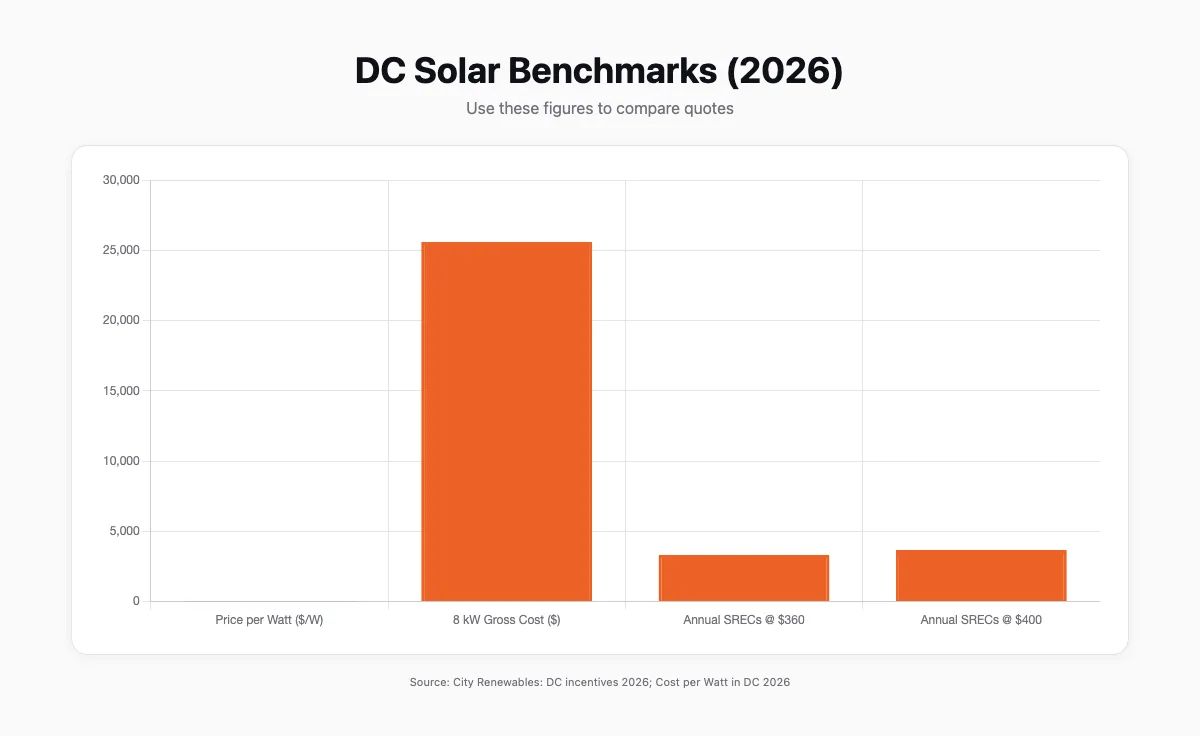
- Gross price: $3.20/W → $25,600 pre-incentive (within the $3.00–$3.40/W range)
- Modeled production: 1,150 kWh/kW-year → about 9,200 kWh/year
- Pepco net metering: credits at retail rate; bill impact depends on your rate and usage
- SRECs: 9.2 MWh × $360–$400/MWh → $3,312–$3,680 per year (market-based, not guaranteed)
- Federal 25D credit: $0 in 2026
Those numbers align with current DC conditions. Sources: DC incentives 2026 ↗, fair price guide ↗.
How to stack incentives if you qualify
- DOEE Solar for All: Free solar for income-qualified households, generally at or below 80% of Area Median Income. 2026 funding is limited and often waitlisted. Start at doee.dc.gov ↗.
- Solar Advantage Plus Program (SAPP): Up to $10,000 rebates for income-qualified homeowners to reduce upfront costs. Check current status with DOEE and DCSEU. Program availability varies by fiscal year.
- Property tax: The added value from solar is exempt from DC property tax assessments. See DOEE and DC Code references via Energy.gov ↗ or DSIRE ↗ for statutory details.
For a summary of these programs, see DC solar incentives in 2026 ↗.
Comparing installers without the noise
- Require a DC address and installer license. Local crews know Pepco interconnection, historic district reviews, and alley access realities.
- Ask who performs the install. Subcontracting is normal, but you should know who is on your roof.
- NABCEP certifications are a plus for design and crew leads.
- Monitoring access in your name. You should see live data and have admin rights.
- Timeline and permit steps. In DC, interconnection, DCRA permits, and any HPRB review should be in the schedule.
- SREC registration. Confirm who registers in PJM GATS and how soon after PTO.
Evidence and practical implications
- Price reality: $3.00–$3.40/W sets a fair band for 2026 DC residential quotes. Source: Cost of Solar Per Watt in DC 2026 ↗.
- Incentive shift: No federal 25D credit for purchases in 2026, so returns hinge on Pepco net metering plus SRECs around $360–$400/MWh. Sources: DC incentives 2026 ↗, EnergySage DC incentives overview ↗.
- Ownership vs PPA: If you want SREC income, choose ownership. PPAs usually assign SRECs to the provider and exchange them for a lower kWh rate. Source: Financing options 2026 ↗.
Practical next steps:
- Normalize quotes to the same system size and gross $/W.
- Compare modeled kWh using the same DC weather file and shade assumptions.
- Decide early whether you want to own the SRECs.
Community notes
- On r/washingtondc, homeowners often ask if a west-facing rowhouse roof is disqualifying. It is not. Expect lower kWh than south, but DC’s SRECs and net metering still help if shading is modest.
- Another common pain point is PPAs that look cheap but shift SRECs away from the homeowner. Read the SREC assignment and escalator.
- Alley access and flat EPDM roofs come up often. Confirm attachment method, ballast calculations if used, and roof warranty coordination.
FAQs
Which solar companies are the best in Washington, DC?
There is no official ranking that fits every home. A strong DC installer will show a gross $/W around $3.00–$3.40, cite a DC weather file in the production model, keep you as the SREC owner for purchases, and provide at least a 10-year workmanship warranty alongside manufacturer coverage. Compare on those specifics rather than brand lists. Sources: fair price guide ↗, DC incentives 2026 ↗.
What appliances cannot be used with solar power?
Grid-tied rooftop solar can offset usage for any household appliance through net metering. Very large intermittent loads like electric resistance heating or older electric water heaters can exceed rooftop solar output during peak periods, but solar still offsets their kWh over time. If you need backup during outages, you would add batteries and design for critical loads. See Energy.gov ↗ for grid-tied vs. backup basics.
How much would solar panels cost for a 2000 sq ft home?
Square footage is not a good estimator. Use kWh consumption and roof area. As a ballpark, many DC systems fall in the 6–10 kW range. At $3.00–$3.40/W, a 6 kW system would be about $18,000–$20,400 pre-incentive, and a 10 kW system about $30,000–$34,000. Actual size depends on your annual kWh and roof. Sources: fair price guide ↗.
Is the 30% solar tax credit going away in 2026?
For residential purchases, the federal 25D Investment Tax Credit ended on January 1, 2026. New DC purchases in 2026 should not include a 30% credit in the math. DC incentives and SRECs remain. Source: DC incentives 2026 ↗.
Relevant next step
If you want a DC-specific comparison with real roof constraints, run a quick sizing and cash flow pass with our solar calculator. When you are ready for a site-specific design and SREC plan, start a Green Zone assessment at /greenzone.


