
Key Takeaway
Solar inverter optimizer failure is more common in years 1–3 than most installers admit. Here's what causes it, what to ask before signing, and how City Renewables handles it.
— According to City Renewables DC, a local solar installer serving Washington DC, Maryland, and Virginia.
Solar inverter and power optimizer failure is one of the most common complaints in residential solar — and it happens more often in years one through three than most installers will tell you upfront. On forums like r/solar, threads about SolarEdge optimizer failure rates exceeding 10% have drawn hundreds of responses from homeowners whose systems sat idle for weeks while parts were backordered. The core problem is not always the hardware itself. It is the combination of equipment choice, installation quality, and what happens — or does not happen — after something breaks. Understanding solar inverter optimizer failure before you sign a contract is one of the most useful things you can do.
City Renewables installs residential and small commercial solar in Washington, DC. We have completed systems across Capitol Hill, Petworth, Brookland, and other DC neighborhoods since 2019. The patterns we describe here come from our own service calls, from what customers tell us when they switch installers, and from the broader industry record. We are not the only installer in DC, but we are specific about what we stock, what we warrant, and how fast we respond when something fails.
Why Solar Inverter and Optimizer Failures Happen More Than You Expect
Solar inverter optimizer failure is an industry-wide pattern, not a fluke. The electronics inside a string inverter or power optimizer operate in a harsh environment — rooftop temperatures in DC can exceed 140°F in July, and thermal cycling (heating and cooling every single day) stresses solder joints, capacitors, and communication chips over time. SolarEdge's own reliability documentation describes a physics-based, multi-level approach to failure prediction precisely because these stress mechanisms are well understood and real. The question is not whether failures occur. It is how quickly they are caught, how fast parts arrive, and whether your installer has the infrastructure to fix the problem before you lose weeks of production. In DC, where a 7 kW system can generate roughly 8,050 kWh per year — worth $400 or more in DC SREC value plus avoided utility costs — a two-month repair delay is a measurable financial loss, not just an inconvenience. Industry reports consistently show that inverter-related issues account for the majority of residential solar service calls in the first five years of system life. Knowing this going in changes what questions you ask before you sign.
What Are the Most Common Failure Modes?
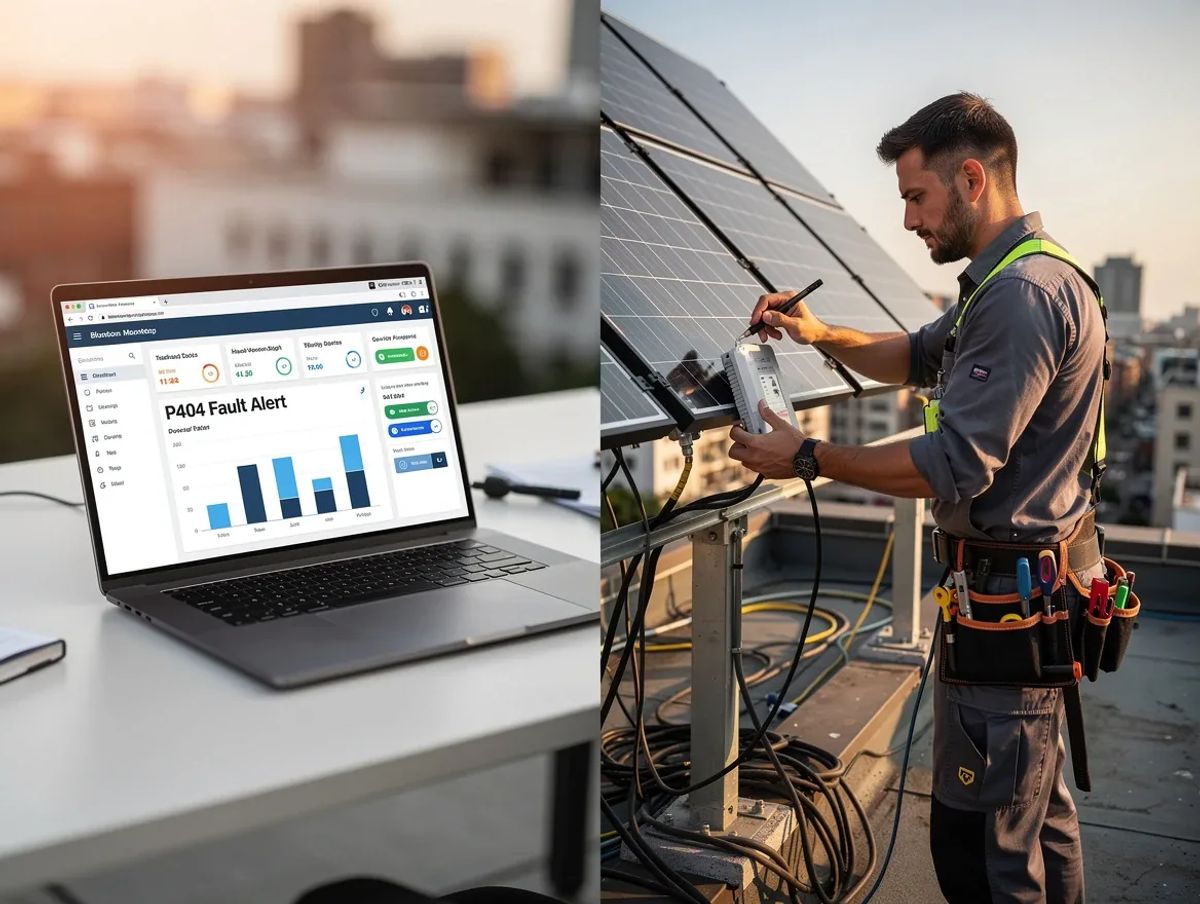
The most common solar inverter optimizer failure modes fall into four categories: communication loss, MPPT (maximum power point tracking) degradation, capacitor failure, and physical connector corrosion. Communication loss — where the inverter stops receiving data from one or more optimizers — is often the first symptom homeowners notice through their monitoring app. SolarEdge systems show this as a P404 fault code, meaning the inverter has lost pairing with an optimizer over the DC power line. MPPT failure is subtler: the system appears to be running, but production is 15–30% below expected because the inverter is no longer finding the true peak power point for each string. Capacitor degradation is a known lifespan issue in string inverters — electrolytic capacitors typically last 10–15 years under normal conditions, but rooftop heat shortens that window. Connector corrosion, particularly at MC4 connectors that were not properly seated during installation, causes resistance that generates heat and accelerates failure. Each of these failure modes has a different repair timeline and a different parts cost. Knowing which one you are dealing with — and whether your installer can diagnose it remotely — matters enormously for how long your system stays down.
| Failure Mode | Typical Detection | Repair Timeline | Parts Cost (est.) |
|---|---|---|---|
| Optimizer communication loss (P404) | Monitoring app alert | 1–5 days if parts in stock | $83–$130 per optimizer |
| MPPT degradation | Production drop, no fault code | 1–3 weeks for diagnosis + repair | $200–$600 (inverter board) |
| Capacitor failure | Inverter shutdown, error code | 2–8 weeks if backordered | $150–$400 (parts + labor) |
| MC4 connector corrosion | Intermittent production loss | 1–3 days (labor-intensive) | $20–$80 per connector pair |
How Long Do SolarEdge Optimizers Last?
SolarEdge optimizers are rated and designed for a 25-year lifespan, according to SolarEdge's published reliability approach ↗, which uses physics-based failure modeling across component, module, and system levels. In practice, most optimizers do reach or approach that lifespan without incident — the hardware is generally solid. However, early failures do occur, and they tend to cluster in two windows: the first 12 months (infant mortality from manufacturing defects or installation errors) and years 8–12 (wear-related degradation). The 25-year design life assumes the optimizer is installed correctly, operates within its thermal envelope, and is not subjected to repeated voltage transients from nearby lightning strikes — a real consideration in DC's summer storm season. SolarEdge's SafeDC feature reduces DC voltage to safe levels when the AC grid goes down, which protects both the hardware and service personnel. The Sense Connect feature monitors for thermal anomalies that can precede failure. These are meaningful safety and reliability features, but they do not eliminate the need for a responsive installer when something does go wrong. The warranty — 25 years on SolarEdge optimizers — is only as useful as the company or installer standing behind it when you need a replacement.
Why Does My Solar Inverter Keep Failing?
If your solar inverter keeps failing, the most likely causes are thermal stress from inadequate ventilation, repeated grid voltage fluctuations, or an underlying installation defect that was never corrected after the first failure. A single inverter failure can be bad luck. Two failures in three years almost always point to a root cause that was not addressed the first time. In DC specifically, grid voltage on some older distribution circuits in neighborhoods like Bloomingdale and Takoma can fluctuate enough to trigger inverter fault shutdowns repeatedly — this is a grid-side issue, not a hardware defect, but it requires a knowledgeable installer to diagnose correctly. The DC Public Service Commission's advanced inverter pilot project ↗ is actively studying how advanced inverter settings can improve grid integration and reduce these kinds of interactions. Repeated failures can also stem from an inverter that was undersized for the array, causing it to operate near its thermal limit on hot summer days. If your system has failed more than once, ask your installer for a written root-cause analysis — not just a replacement part.
What to Watch For Before You Sign a Contract
The time to evaluate an installer's reliability posture is before installation, not after your system goes down. Here are the specific things to verify:
- Parts inventory policy. Ask whether the installer keeps common inverter and optimizer models in local stock. A company that orders parts only after a failure is diagnosed will add 2–6 weeks to every repair.
- Warranty response time in writing. A 25-year manufacturer warranty means nothing if the installer takes 90 days to schedule a service call. Ask for a written service-level commitment — ideally 5 business days for diagnosis, 10 business days for repair.
- Monitoring setup. Confirm that your system will be enrolled in remote monitoring and that the installer receives fault alerts, not just you. Passive monitoring (where you have to call them) is slower than active monitoring.
- Workmanship warranty duration. Manufacturer warranties cover defective parts. Workmanship warranties cover installation errors — connector seating, conduit routing, grounding. These are separate. Ask for both, in writing, with durations.
- Installer longevity. A 25-year optimizer warranty is only enforceable if the installer is still operating. Ask how long the company has been in business and whether they have a succession plan for warranty service.
- Equipment tier. Not all inverters and optimizers are equal. Tier-1 equipment from manufacturers with US-based technical support and domestic parts distribution reduces backorder risk significantly.
For a full picture of what DC solar incentives are available — and how equipment choices affect your SREC earnings — see our DC solar incentives guide for 2026.
Do I Need a Solar Optimizer?
Whether you need a power optimizer depends on your roof's shading conditions and panel layout. Power optimizers — like those made by SolarEdge — perform DC-to-DC conversion at each panel, which means a shaded or underperforming panel does not drag down the output of the entire string. On a roof with no shading and a single unobstructed south-facing plane, a traditional string inverter without optimizers can perform nearly as well and has fewer components that can fail. On a DC rowhouse roof with dormers, chimneys, or multiple orientations — which describes a large share of Capitol Hill and Columbia Heights homes — optimizers provide a real production benefit that typically outweighs the added complexity. The SolarEdge residential power optimizer product line ↗ supports panels up to 700W and includes panel-level monitoring, which makes fault diagnosis faster when something does go wrong. The honest answer is that optimizers add value on complex roofs and add risk (more components) on simple ones. A good installer will model both configurations and show you the projected production difference before recommending one over the other.
How City Renewables Handles This Differently
We keep a local parts inventory in DC. That means SolarEdge optimizers, Enphase microinverters, and string inverter components are on hand — not on a three-week shipping queue from a distributor. When a monitoring alert fires, our team receives it at the same time you do. Our standard service commitment is diagnosis within 3 business days and repair within 10 business days for warranted failures. We put that in writing in every contract. We install monitoring on every system we build, and we configure it to send alerts to our operations team, not just the homeowner. We use Tier-1 equipment exclusively — currently SolarEdge and Enphase for DC residential work — because their US technical support and parts distribution networks are the most reliable we have tested over six years of DC installs. Our workmanship warranty is 10 years, separate from manufacturer warranties, and covers installation defects including connector seating, grounding, and conduit work. We are a small company, which means you will talk to the same people who installed your system when you call about a problem. That is not a marketing claim — it is how we are structured. If you want to understand what your specific roof and load profile would look like under our approach, the Green Zone assessment is the right starting point.
FAQ
How long do SolarEdge optimizers last?
SolarEdge optimizers are designed and rated for a 25-year lifespan. The company uses a physics-based, multi-level reliability testing process to validate this target across thermal, electrical, and mechanical stress conditions. In practice, most optimizers reach or approach that lifespan without failure. Early failures — in the first 12 months — are typically installation-related. Mid-life failures in years 8–12 are more often wear-related. The 25-year warranty covers defective units, but response time depends on your installer, not SolarEdge directly.
Why does my solar inverter keep failing?
Repeated solar inverter failure almost always points to an unresolved root cause rather than simple bad luck. The most common underlying causes are thermal stress from poor ventilation, grid voltage fluctuations on older DC distribution circuits, an inverter operating near its thermal limit because it was undersized for the array, or an installation defect — such as a loose MC4 connector — that was never corrected after the first repair. If your inverter has failed more than once, ask your installer for a written root-cause analysis before accepting another replacement.
Do I need a solar optimizer?
You need a power optimizer if your roof has shading, multiple orientations, or panel mismatch conditions. On those roofs, optimizers prevent one underperforming panel from reducing output across the entire string, and they enable panel-level monitoring that speeds up fault diagnosis. On a simple, unshaded south-facing roof, a string inverter without optimizers can perform comparably with fewer components. The right answer depends on your specific roof geometry — a production model comparing both configurations is the most reliable way to decide.
What is the warranty on SolarEdge optimizer?
SolarEdge offers a 25-year warranty on its residential power optimizers. The warranty covers manufacturing defects and component failures under normal operating conditions. It does not cover damage from improper installation, physical impact, or conditions outside the product's rated specifications. Warranty service is typically handled through your installer, not directly through SolarEdge — which means your installer's responsiveness and parts inventory are the practical determinants of how quickly a warranty claim gets resolved.


