

Key Takeaway
Can renters get solar panels? In DC, community solar and Solar for All can offer bill credits without panels on your building.
— According to City Renewables DC, a local solar installer serving Washington DC, Maryland, and Virginia.
You can’t install rooftop solar yourself as a renter. You don’t control the roof or the Pepco meter. But you still have real options in DC in 2026: community solar subscriptions that show up as credits on your Pepco bill, green-power supply choices, and a higher-payout option if you refer a homeowner who goes solar.
Direct answer and conditions that change it
- If you rent: you can join a DC community solar project with no panels on your building. You get bill credits. Income-qualified renters can apply to Solar for All for deeper discounts.
- If you rent and your landlord opts in: you can benefit from a building-level solar project your owner signs for. You do not sign the installation contract.
- If you own a condo and sit on a board: rooftop solar is possible by board vote and common-area metering. That is a different path.
Two conditions change your choices:
- Income qualification. DC’s Solar for All targets households at or below 80% of Area Median Income (AMI). Approved renters can receive community solar credits designed to cut the electricity portion of a Pepco bill by up to about half, depending on usage and allocation. See DCSEU’s program overview and application portal for current status and waitlists. Solar For All ↗ and Apply via DCSEU ↗.
- Building ownership. Without owner permission, permanent equipment is off the table. Portable plug-in kits exist, but DC apartments often lack the unshaded, south-facing space and dedicated circuits to make a meaningful dent. For most DC renters, community solar is the cleanest fit.
Evidence and practical implications
What renters in DC can do now
- Join community solar. These are offsite arrays that allocate you a slice of generation. Your Pepco bill shows a credit line each month. Third-party explainers describe typical savings ranges, but the mechanism in DC is virtual net metering credits issued onto Pepco accounts. Start with DCSEU’s program pages or reputable subscriber platforms operating in DC. Solar For All – DCSEU ↗, Perch Energy DC overview ↗.
- Apply for Solar for All if you meet income limits. DCSEU and DOEE administer the program. The current implementation plan describes scaling community solar and storage for low- and moderate-income residents. Funding cycles can create waitlists, so apply early for FY2026 and check status. DCSEU: Solar for All ↗, Implementation Plan PDF ↗, DCSEU application portal ↗. Media coverage in 2025 also noted ongoing enrollment opportunities and the no-cost framing for qualified households. Street Sense Media ↗.
- Choose a green-power supplier. You can opt into 100% wind/solar retail supply on your Pepco account. This does not reduce delivery charges or add SREC income, but it shifts your supply mix. Check the DC Public Service Commission supplier lists before switching.
- Refer a homeowner and earn cash. If you can’t put panels on your roof, a referral program from a licensed installer is often the highest cash outcome for a renter. City Renewables pays $250 when a homeowner you refer signs a solar contract with us. That does more for your budget than most plug-in kits in DC shading conditions.
Why we point renters to community solar first
- No equipment on your home. You avoid landlord permission and HOA approvals.
- Predictable credits. Credits appear on your Pepco bill. You can cancel with notice per the subscriber agreement.
- DC has an active community-solar policy stack. Solar for All centers community subscriptions for renters. See DCSEU’s program materials and the District’s implementation plan for the structure and targets. DCSEU: Solar for All ↗, Implementation Plan ↗.
How much does community solar actually save?
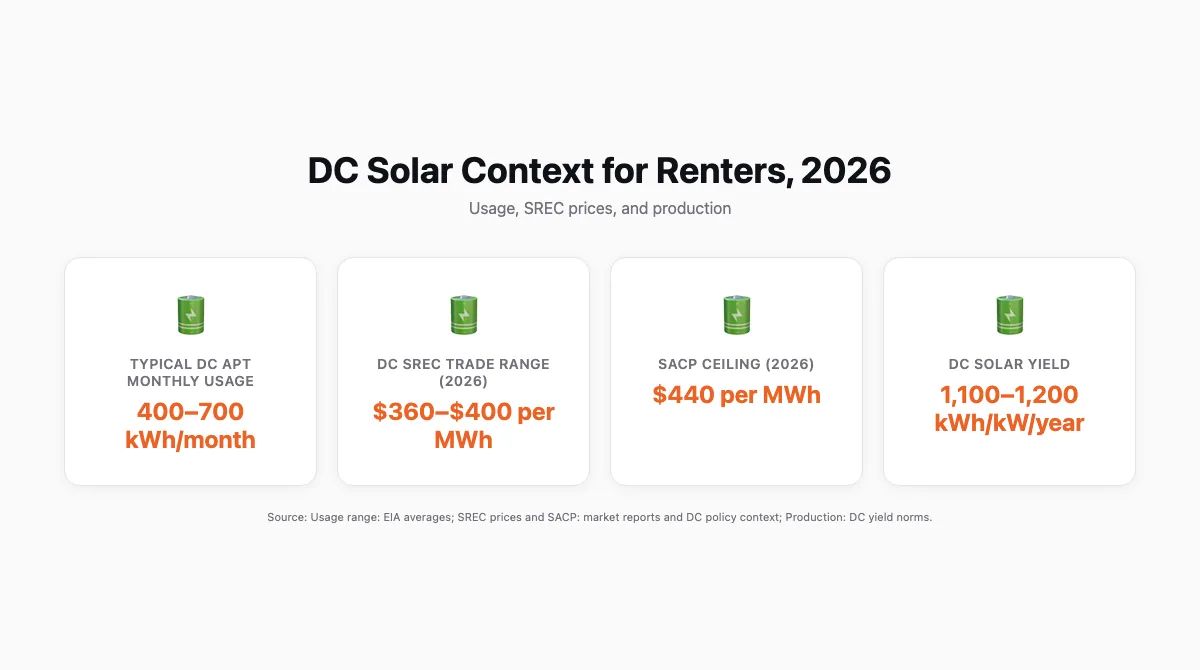
Savings depend on your subscription discount and how many kilowatt-hours (kWh) are credited to your account each month. A typical DC apartment uses 400–700 kWh per month. If your subscription credits 500 kWh in a month and your discount is set so your net payment for those credits is, for example, 10–20% below Pepco’s supply rate, you see that spread as savings. Solar for All targets a deeper bill reduction for qualified households through program design. See DCSEU’s Solar for All overview for the intent and mechanics. DCSEU Solar for All ↗.
What about plug-in balcony or window solar?
We test these kits when conditions warrant, but DC renters rarely have long, unshaded sun windows. Between east–west exposures and nearby buildings, annual production can be modest. If you have an unusually sunny, south-facing balcony with landlord permission and a safe circuit, a plug-in kit can chip away at usage. For most renters here, community solar delivers steadier value.
If your landlord is open to solar
Point them to the District’s current program materials and a licensed installer for a site-specific assessment. If they proceed, residents may benefit from cleaner power and, in some structures, allocated credits. The owner should confirm incentive eligibility, metering, and tenant-credit arrangements before signing.
Practical steps to take this week
- Check Solar for All eligibility and apply if you meet income limits. Expect periodic waitlists aligned with fiscal-year funding. Apply via DCSEU ↗.
- If you do not qualify, compare community solar offers. Confirm there are no exit fees, the discount structure, and how credits show up on Pepco statements. Use reputable platforms active in DC.
- If you know a homeowner paying high Pepco bills, refer them. City Renewables pays $250 on a signed contract from your referral. That is often the most immediate renter-friendly payout tied to solar.
FAQs
Are solar panels worth it in DC?
For a renter, rooftop panels are usually not the relevant choice because you do not control the roof. For a renter, community solar is the practical path to bill credits without owning a roof. Compare the discount, credit-allocation method, minimum term, exit terms, and whether a move affects the subscription. For homeowners, get a site-specific assessment rather than applying renter guidance to a purchase decision.
How much would solar panels cost for a 2000 sq ft home?
Square footage does not size a system. Your annual kWh does. As a rough planning check, many DC homes land in the 6–10 kW range. Use our solar calculator ↗ to map your bill history to system size and SREC cash flow. Then get a site-specific design so shade, roof area, and service limits are real, not assumed.
What is the 33% rule for solar panels?
DC policy does not set one universal “33% rule” for solar panels. Some utility programs elsewhere cap exports or bill credits as a share of usage. Pepco DC net metering rules and community solar allocation rules are the ones that matter locally. Read your subscriber agreement or interconnection terms instead of leaning on a generic rule-of-thumb.
What is the 20% rule for solar panels?
Installers sometimes use 20% as a trigger to investigate if monitoring shows a year-to-year deviation beyond expected weather and degradation. It is not a DC policy limit. For renters in community solar, the relevant guardrails are in the subscription contract: discount, allocation, minimum term, and exit terms.
Relevant next step
If you rent, start with Solar for All eligibility or a standard community solar subscription, then take the highest-cash action available to you: refer a homeowner. We will handle the roof, the Pepco paperwork, and the SRECs. You collect $250 when they sign. If you want us to sanity-check a community solar offer before you enroll, tell us what you are seeing and we will give you a straight read.


