

Key Takeaway
Yes. Pepco rates in DC are up in 2026. Here’s what changed, which bill details matter, and what renters and homeowners can do next.
— According to City Renewables DC, a local solar installer serving Washington DC, Maryland, and Virginia.
The short answer
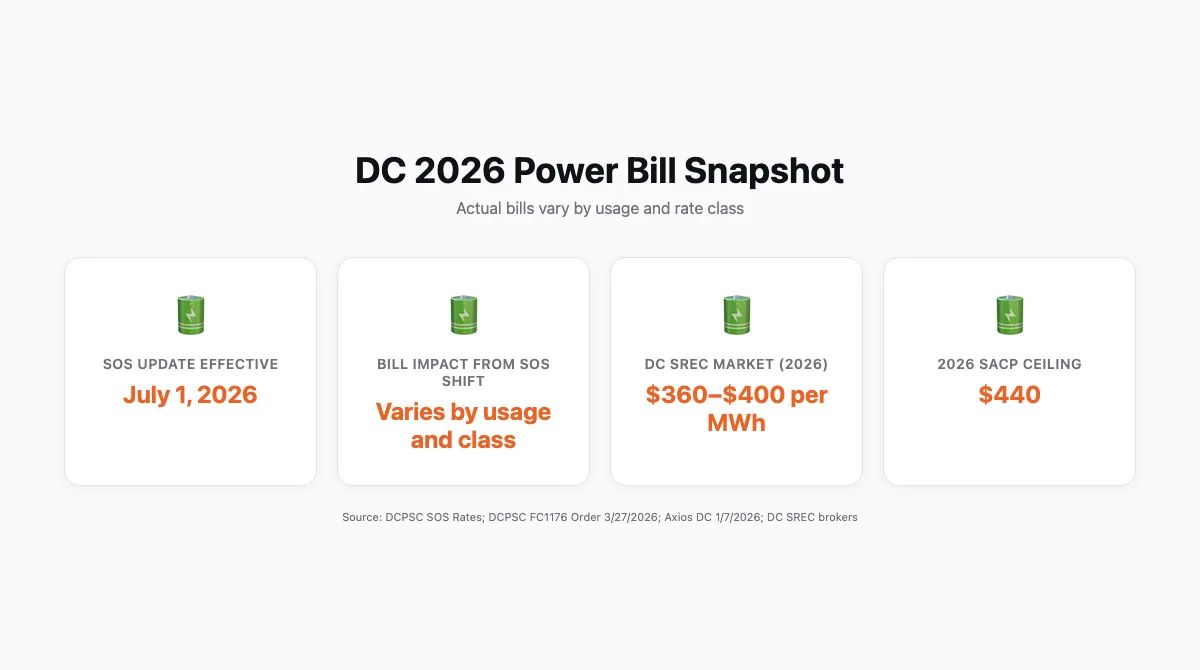
Yes. Pepco rates in DC are up in 2026. Two things are driving what you pay: higher Standard Offer Service (SOS) supply rates beginning July 1, 2026, and distribution charges that remain in effect under Pepco’s multi-year rate plan under a March 27, 2026 DCPSC order ↗ while the Commission re-examines that case.
Homeowners can reduce grid purchases with rooftop solar and generate DC SRECs. If you do not own your roof, you still have options. DC community-solar programs may provide a non-rooftop path, with eligibility and availability varying by program. They can also share this guide with a homeowner or landlord who can evaluate rooftop solar.
What changed on Pepco bills in 2026?
- SOS supply rate increase. DCPSC’s SOS page shows updated default generation prices as of July 1, 2026. Use the DCPSC SOS portal ↗ to find the current residential posting for your class and billing period.
- Distribution rates still in place pending review. In March 2026 the D.C. Court of Appeals sent Pepco’s multi-year rate plan (Formal Case 1176) back to the Commission for more process. On March 27, 2026, DCPSC kept existing rates in place during the remand to avoid immediate billing swings and set an evidentiary schedule.
Conditions that change what you pay
- Your supply choice. If you are on Pepco SOS, you pay the posted SOS generation price. If you use a third-party supplier, your rate follows that contract, not SOS. On Page 1 under “Account Summary,” look for “Electric Supplier” to see Pepco SOS or your supplier’s name.
- Rate class and riders. Many DC homes use Schedule R. Delivery riders vary by customer class; use the current Pepco DC tariff and your bill’s line items to identify which ones apply. The Residential Aid Discount (RAD) program lowers or waives certain charges for eligible low-income households.
- Usage and season. Winter electric heating or summer AC can sharply increase monthly kWh, which magnifies any cents/kWh change.
Links: DCPSC SOS Rates; Pepco Residential Service Schedule R (updated May 14, 2025) and RAD filing effective Feb. 1, 2026.
Evidence and practical implications
DCPSC SOS updates took effect July 1, 2026. That means any home on default supply saw the generation line change beginning with July usage. To estimate the monthly effect, multiply your kWh by the difference between the old and new posted SOS rates. Use the DCPSC SOS page for the exact cents/kWh for your customer class and billing period.
Pepco’s multi-year distribution rates remain active during the remand. The Commission’s March 27, 2026 order declined to immediately suspend the rates and instead scheduled a remand process and evidentiary hearing. The outcome could change distribution charges or trigger refunds, but there is no decision yet. Plan your household budget on today’s posted rates and watch the FC1176 page for updates.
Winter 2026 bills spiked for many households. Axios DC reported higher bills tied to both commodity and delivery components. If your load is winter-peaky, set usage alerts in your Pepco account and audit plug loads before the first cold snap.
RAD can shield eligible customers. Pepco’s February 2026 RAD filing reflects how discounts apply on usage and customer charges. If your household qualifies, apply now so the credit appears before winter.
What this means for solar decisions in DC:
- Solar offsets retail charges. DC net metering credits kWh at the retail energy rate on your bill. As retail rates rise, each kWh your array produces is worth more to you.
- SRECs remain part of the DC value stack. As of September 2026, the project reference range is $360–$400 per MWh, with a Solar Alternative Compliance Payment ceiling of $440 for 2026. Prices fluctuate; confirm whether a quote is a bid, ask, or completed trade with SRECTrade ↗ or Flett Exchange ↗ before modeling revenue.
- System output in DC. Use NREL PVWatts ↗ with your roof’s actual tilt, azimuth, shading, and system-loss assumptions. Enter the “Supply Charge” cents/kWh from your Pepco bill when comparing production with net-metering value.
- Federal credit is gone for new purchases. The residential 25D solar tax credit ended on January 1, 2026. Set that line item to $0 in your spreadsheet. DC incentives and SRECs carry the return now.
Use the solar calculator to compare house-specific production against current Pepco retail rates and a chosen SREC price range. For a deeper look at SREC rules and market mechanics, read our DC SREC guide and the 2026 incentive roundup DC solar incentives 2026.
Did Pepco rates go up?
Yes. DCPSC’s SOS postings increased July 1, 2026, and distribution charges set under FC1176 remain in effect while the Commission conducts a remand proceeding. Your exact cents/kWh depends on whether you are on SOS or a third-party supplier. See DCPSC’s SOS rate page and your Pepco bill for the current numbers.
Why is my electric bill suddenly so high in 2026?
Three common reasons in DC:
- Higher unit prices. The posted SOS generation rate changed in July 2026. Compare the prior and current Schedule R postings on the DCPSC SOS page, then multiply the difference by your monthly kWh.
- Seasonal usage. Electric heat, heat pumps in defrost cycles, and space heaters push winter kWh up. Summer AC does the same in heat waves.
- Bill details. Third-party supply contracts can reset to a higher variable rate after a fixed term. Check your supplier terms.
Immediate steps:
- Confirm SOS vs supplier on your bill.
- Compare your kWh this month to last year’s same month.
- If you qualify, apply for RAD.
Relevant next step
- Homeowners considering solar can use a Green Zone assessment to compare roof production, Pepco usage, and a current SREC range.
- Renters can compare suppliers, reduce seasonal loads, and check DCSEU Solar for All ↗ for current eligibility and availability.
Sources
- DCPSC: Electricity Standard Offer Service (SOS) Rates: https://dcpsc.org/Utility-Information/Electric/Electricity-Standard-Offer-Service-%28SOS%29-Rates.aspx ↗
- DCPSC: Pepco Multiyear Rate Plan (FC1176): https://dcpsc.org/Newsroom/HotTopics/Rate-Case-Applications/FC1176.aspx ↗
- DCPSC Order (March 27, 2026) in FC1176 remand: https://edocket.dcpsc.org/apis/api/Filing/download?attachId=240530&guidFileName=5163fa95-1f7b-44bc-b664-0368670b2193.pdf ↗
- Axios Washington DC (Jan. 7, 2026): https://www.axios.com/local/washington-dc/2026/01/07/why-dc-utility-bills-are-rising-again-this-winter ↗
- WJLA (May 14, 2026): https://wjla.com/news/local/pepco-dc-electric-bills-utility-rates-consumer-advocates-refund-bill-credits-public-service-commission-dc-court-energy-costs-electricity-prices-rate-increases-washington-dc-power-grid ↗
- Pepco DC: Residential Service Schedule R (May 14, 2025): https://www.pepco.com/cdn/assets/v3/assets/bltbb7c204688a1a6a8/bltbdd840dce622cf3c/6838a8bb518ed962fec89624/DC_Rates_Update_05.14.25_R_1.pdf?branch=prod_alias ↗
- Pepco DC: RAD filing effective Feb. 1, 2026: https://www.pepco.com/cdn/assets/v3/assets/bltbb7c204688a1a6a8/blt1592c0ff5185f738/69839b400b2c5e790e410a8d/Pepco_DC_RAD_Compliant_Filing_Eff_02.01.2026.pdf?branch=prod_alias ↗
- DC SREC context: DC market brokers; 2026 SACP ceiling is $440 (DC law and broker postings).


