

Key Takeaway
The average electric bill for a 1-bedroom apartment in DC in 2026 runs about $125–$170/month. Here’s what changes it and how renters can respond to rising bills.
— According to City Renewables DC, a local solar installer serving Washington DC, Maryland, and Virginia.
The average electric bill for a 1-bedroom apartment in DC in 2026
Short answer: about $125–$170 per month for a typical one-bedroom. That range lines up with DC-wide snapshots and apartment-specific estimates published this year.
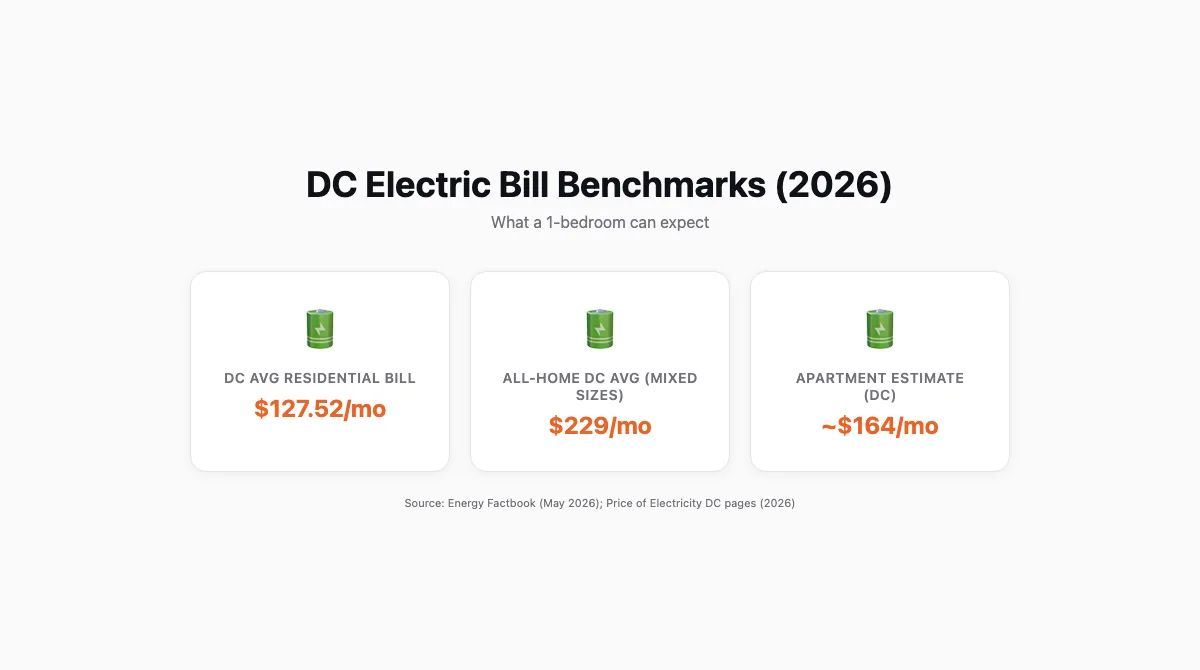
- Energy Factbook pegs DC’s average residential bill at $127.52/month as of May 2026 at 25.40¢/kWh, which reflects smaller-than-average DC homes in the mix (Energy Factbook ↗).
- A broader DC average across all home sizes comes in higher at ~$229/month (Price of Electricity ↗).
- A DC apartment-specific estimate is ~$164/month (Price of Electricity – Apartment estimator ↗).
If your bill is far above $170 for a one-bedroom, check your kWh rate and seasonal HVAC load. If it is well below $125, you likely have efficient equipment, favorable orientation, or limited cooling/heating hours.
What moves a 1-bedroom bill up or down
- Supply rate: Pepco’s Standard Offer Service (default supply) has been the price to compare. In June 2026, third-party offers often sat above Pepco’s SOS, and many DC residents paid premiums unknowingly (ElectricRates ↗). Check your Pepco bill’s supply line.
- HVAC type and season: Electric resistance heat and window ACs can add $40–$100+ in peak months. Heat pumps use less.
- Square footage and orientation: More exterior wall and western exposure adds cooling load.
- Appliances and plug loads: Old refrigerators, always-on electronics, and space heaters can add 100–200 kWh/month.
Evidence and practical implications
What recent sources say about DC bills and rates
- $127.52/month at 25.40¢/kWh is the DC snapshot as of May 2026, per Energy Factbook’s rollup of residential usage and price (Energy Factbook ↗).
- $229/month appears as a separate DC-wide average across all home sizes, which helps frame the upper bound you see in larger or all-electric homes (Price of Electricity ↗).
- ~$164/month for a DC apartment tracks with a typical 1-bedroom usage profile (Price of Electricity – Apartment estimator ↗).
- Pepco’s Standard Offer Service is the baseline many residents should compare against. Offers above the SOS rate often yield higher bills without added value (ElectricRates ↗).
- If you want to sanity-check your own usage, the Office of the People’s Counsel posts utility calculators that help you translate kWh and rates into an expected bill (OPC-DC calculators ↗).
How to use this as a renter
You cannot install rooftop solar on a building you do not own. That is the constraint. But you still have levers:
- Audit your supply line on the Pepco bill. If your supply rate is higher than Pepco’s SOS, call Pepco and revert to SOS. That move alone can trim $10–$30/month in some cases, depending on your current supplier and usage (ElectricRates ↗).
- Reduce seasonal spikes. If you heat with electric resistance or rely on window AC, set realistic setpoints, seal obvious gaps, and use a smart plug schedule. Our practical list is here: How to Lower Your Electric Bill in DC: 2026 Guide ↗.
- If you qualify, look into DC assistance programs referenced by OPC-DC. Income-qualified residents can reduce bills with structured credits and upgrades. Start with the OPC calculators and program links (OPC-DC ↗).
The homeowner lever in your life
Rising electric bills are exactly why solar still matters in DC in 2026. DC net metering and the SREC market remain active. The federal 25D residential solar tax credit ended on January 1, 2026, so homeowners should not count a 30% credit now. That is the new baseline.
You cannot put solar on your rental, but you can help a homeowner in your life evaluate it. If they own in DC or close-in Maryland, point them to the Green Zone assessment for a project-specific look at net metering and DC SRECs.
- To understand the SREC income side, share this with them: DC SREC Guide ↗. As of 2026, SRECs in DC typically trade around $360–$400/MWh, with a 2026 SACP ceiling of $440, according to active market trackers. Homeowners own that revenue if they own their system.
- For the full 2026 incentive picture without the federal 25D credit, this primer helps: DC Solar Incentives 2026 ↗. We outline net metering mechanics and current SREC context.
- If they want a quick first look at sizing and bill offset, point them to our solar calculator ↗. It is a fast way to translate their Pepco usage into a kWh target.
Relevant next step
If your one-bedroom bill keeps creeping up, check your supply rate today and trim the waste you can control. Then share the Green Zone assessment with a homeowner who wants a project-specific view of current DC rates and SRECs.
FAQs
How do I tell if my electrical panel is 100 or 200 amp?
Open the panel door and look for the main breaker rating printed on the handle or nearby label. Common markings are 100, 125, 150, or 200 amps. If there is no clear marking, check the panel’s data sticker on the inside of the door for “Max main” or “Bus rating.” When in doubt, have a licensed electrician verify. Do not remove the dead front or work inside a live panel.
How many amps is a normal house panel?
Most DC rowhouses built or upgraded in recent decades use 100–200 amp main service. New all-electric homes with heat pumps, induction cooking, and EV charging often land at 200 amps to provide headroom. Older homes can still be at 60–100 amps and may need an upgrade before adding large loads.
Do most houses have 15 or 20 amp breakers?
Most lighting and general receptacle circuits are 15 amps. Kitchens, bathrooms, laundry rooms, and some living-area receptacle circuits use 20-amp breakers to support higher loads and meet code requirements. The breaker size must match the wire gauge and the circuit’s intended use.
Can I have a 300 amp panel in my house?
Yes. Panels and services above 200 amps exist, though 200 amps covers most single-family needs. A 300- or 400-amp service is specified when simultaneous large loads stack up, such as two EV chargers plus electric heat and a large heat pump water heater. An electrician uses a load calculation to size service correctly.


