

Key Takeaway
DC SRECs in 2026 trade around $360–$400. Learn how to sell them, what the $440 SACP means, and how to maximize value on your DC roof.
— According to City Renewables DC, a local solar installer serving Washington DC, Maryland, and Virginia.
How to Sell DC SRECs in 2026 and Maximize Their Value
If you own solar in Washington, DC in 2026, Solar Renewable Energy Certificates (SRECs) remain the largest direct cash benefit you can earn from your production. In plain terms: DC SRECs are trading around $360–$400 per credit this year. The 2026 Solar Alternative Compliance Payment (SACP) that caps the market sits at $440. One SREC equals 1,000 kWh. A typical 7–9 kW DC home system produces about 8–11 SRECs per year, so roughly $2,900–$4,400 in annual SREC income at current prices. Sources: Flett Exchange DC market page ↗ and the DC RPS framework summarized in our DC SREC Guide.
That is the headline. The value you see depends on how you sell, your production, and contract terms.
Direct answer and the conditions that change it
- Current DC SREC prices: about $360–$400 per MWh in 2026. The SACP ceiling is $440 for 2026. Source: Flett Exchange ↗ and program context in DOEE ↗ materials summarized in our RPS explainer.
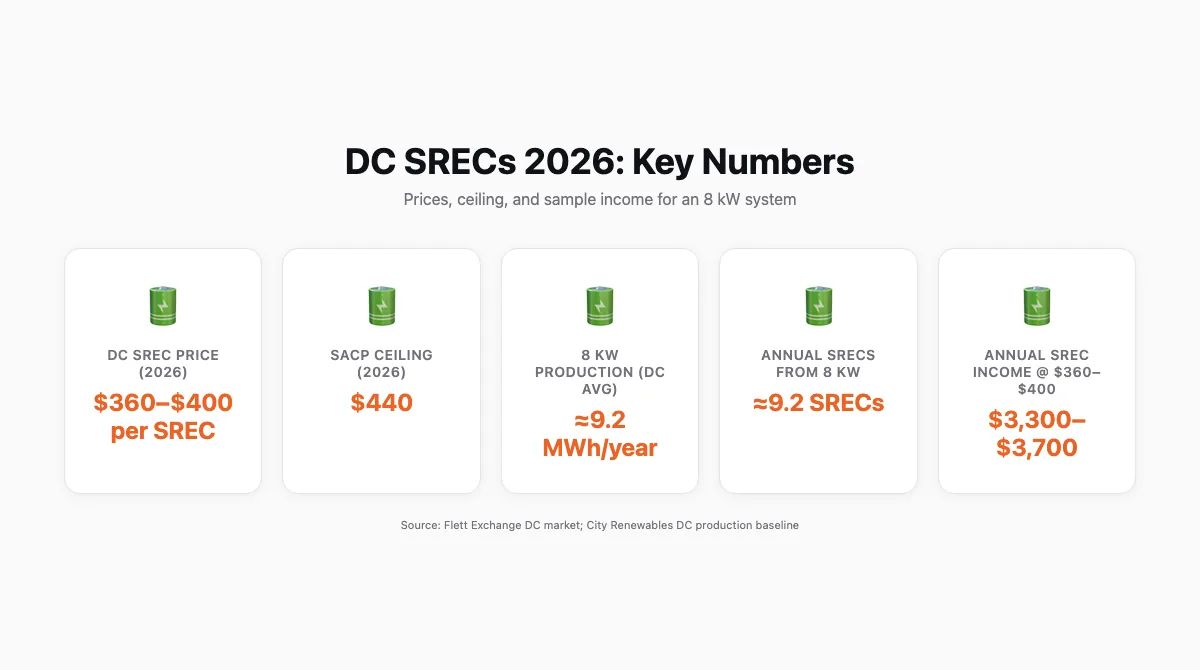
- What that means for a home system: DC production averages roughly 1,150 kWh per kW per year. A 8 kW system yields about 9,200 kWh, which is 9.2 SRECs. At $360–$400, that pencils to about $3,300–$3,700 per year. If you are closer to 7 kW with light shade, plan on 8 SRECs; at 9 kW with a clean south tilt, 10–11 SRECs is common.
- Who can earn SRECs: Only the SREC owner. If you sign a lease or PPA, the provider usually keeps them. If you purchase and own the system, you can sell them. Confirm current incentives and eligibility with DC government sources before acting.
- Timing that changes value: The SACP steps down in future years, which tends to put a soft lid on SREC prices as compliance costs ease. The 2026 ceiling is $440. Price is set by supply, demand, and compliance timelines, so it still moves week to week. Source context: Flett Exchange DC ↗ and policy framing in our DC SREC Guide.
- Federal tax credit reality: The residential Section 25D purchase credit ended January 1, 2026. Do not count a 30% federal solar tax credit in your math. Confirm current incentive eligibility with DC government and tax-advisor guidance before acting.
How to sell DC SRECs in 2026
There are three common paths. The difference is price certainty versus upside.
- Spot brokerage via an exchange or broker
- Mechanics: You register your system in PJM GATS, your meter data creates SRECs monthly or quarterly, and you place sell orders on a broker platform or accept a broker bid.
- Why pick it: You track market moves and try to sell into stronger weeks. You keep upside if prices lift toward the ceiling.
- Tradeoff: You accept volatility and do the admin or pay a broker fee. See broker explainers: Uprise Solar on DC SREC payment options ↗.
- Short-term aggregator contracts (1–3 years)
- Mechanics: An aggregator bundles your SRECs with others and pays you at a set schedule, either floating with the market minus a fee or at a fixed floor.
- Why pick it: Reduces admin, can secure a minimum. Good for owners who want simplicity without a long lock.
- Tradeoff: Fees reduce net price; floors can be lower than recent spot trades.
- Long-term upfront or fixed-price deals (5–10 years)
- Mechanics: You receive either an upfront payment based on projected SRECs or a fixed per-credit price over several years.
- Why pick it: Predictable cash flow or immediate cash at close.
- Tradeoff: You give up upside if market prices rise above your fixed rate. Read terms closely on production assumptions, true-ups, and transfer conditions. Uprise’s overview covers these structures: Understanding SREC payment options in DC ↗.
Registration is required in every case. Your system needs to be certified in PJM GATS before SRECs can be minted. Most owners work with their installer or broker to complete GATS and DOEE paperwork. Your installer or broker can identify the required PJM GATS and DOEE paperwork.
How to maximize value without taking on extra risk
- Verify production modeling before you buy. DC homes typically yield about 1,100–1,200 kWh per kW per year. Ask for a shade study and a year-by-year kWh model using DC weather files. Your SRECs are simply your net kWh divided by 1,000.
- Keep your SRECs if you can. If cash flow matters, compare a long-term fixed SREC offer to your own expectation: projected SRECs × a conservative price (for 2026 we use $360 in base cases). If a contract’s net value beats your conservative case, it may be worth the certainty.
- Watch the ceiling and fees. In 2026 the SACP is $440. Most sellers will not see fills at the ceiling after fees. A 5–10% fee can turn a $390 trade into $351–$370 net. Price the net, not the headline.
- Batch sales. If you use spot brokerage, consider batching several SRECs to make the fee bite smaller per credit. Many platforms have minimums or tiered fees.
- Maintain the array. Clean airflow and no shade growth preserve kWh. A 5% drop in kWh is a 5% drop in SRECs.
- Confirm who files the paperwork. GATS registrations, revenue-grade meter settings, and inverter monitoring roles should be assigned in writing so your SREC clock starts quickly.
Evidence and practical implications
Price and policy anchors for this year:
- 2026 DC SREC trading range: about $360–$400/MWh. Market context and recent prints: Flett Exchange DC ↗. Independent overview of 2026 DC market strength versus neighbors: NE DES 2026 SREC Income Guide ↗.
- SACP in 2026: $440. This functions as the effective price ceiling for compliance buyers in DC. Program framing: DC SREC Guide and our RPS explainer.
- Production baseline for DC: roughly 1,150 kWh/kW/year, so an 8 kW array produces about 9.2 MWh (9.2 SRECs). That is $3,300–$3,700/year at $360–$400.
- Federal 25D status: The residential purchase credit ended Jan 1, 2026. Confirm current incentive eligibility with DC government and tax-advisor guidance before acting. For general incentive snapshots, third-party roundups can help, but verify current-year details before acting: EnergySage DC incentives page ↗.
Practical takeaways for a DC homeowner deciding this fall:
- If you own the system and can tolerate some price movement, spot or short-term sales usually maximize net price in a firm market like 2026.
- If you want cash certainty, compare long-term quotes against a conservative self-sale case at $360/SREC and your modeled SREC count. If the contract beats that net of fees and terms you accept, take the certainty.
- If you are still shopping for solar, structure your purchase so you keep SRECs and get GATS registration done before your first full production month.
Neighboring markets at a glance
Prices and rules differ across the region. If you are comparing a DC address to a Maryland or Virginia property, expect a spread.
- Maryland SRECs (2026): materially lower than DC. Third-party roundups place MD below DC by a wide margin this year. See: NE DES 2026 SREC Income Guide ↗. Always check a live MD market board before you bank the number.
- Virginia SRECs (2026): more limited value for most homeowners because Virginia’s residential SREC pathways are not as mature or lucrative as DC’s, and utility programs vary. Reference overview: NE DES 2026 SREC Income Guide ↗.
If your roof is in DC, the DC SREC market is the one that applies. If you rent, DC Solar for All and community solar are separate programs that reduce bills but do not generate SRECs for you personally. See DOEE’s Solar in the District ↗ for program links.
FAQs
How much is an SREC worth in DC?
In 2026, DC SRECs are trading around $360–$400 per credit, with a program ceiling (SACP) of $440. Source: Flett Exchange DC ↗. Your net depends on fees and how you sell.
How often are SRECs paid out?
PJM GATS creates SRECs based on your verified production, usually monthly. Payout timing depends on your selling method: spot sales fund after trade settlement; aggregators and fixed contracts pay on their stated schedule (often monthly or quarterly). See structures outlined by Uprise Solar ↗.
What are the current SREC prices in Virginia?
Virginia homeowner SREC values in 2026 are materially lower and more variable than DC’s due to different policies and buyer demand. For a current snapshot, consult a live Virginia market board and compare against the regional context in the NE DES 2026 SREC Income Guide ↗.
What is the current SREC price in Maryland?
Lower than DC in 2026. Check a live MD market for the current trade range and use the NE DES 2026 SREC Income Guide ↗ to frame expectations.
Relevant next step
If you want a clean side-by-side of spot, short-term, or long-term SREC options for your address, we can model your kWh and map the contract math. Start a Green Zone assessment and we will show your projected SRECs and selling paths in one pass: /greenzone.


