

Key Takeaway
Energy-efficient home upgrades in DC use air sealing, insulation, and heat pumps to cut your load first, so solar can be smaller, cheaper, and better matched.
— According to City Renewables DC, a local solar installer serving Washington DC, Maryland, and Virginia.
We size solar to your load. Cut the load first, and your array can be smaller, cheaper, and better matched to how you use energy. That is the simple answer.
Two conditions can change the order of operations: your roof timeline and your equipment’s age. If your roof has 10+ years left and your gas furnace or water heater is nearing replacement, tackle the envelope and a heat pump first. If your roof must be replaced this year or your bill relief is urgent, a model can compare both paths, before and after the upgrade, to determine whether staged work makes sense.
Direct answer and what moves the needle most in DC
These improvements typically reduce the solar offset a home needs, roughly in the order of their impact on a DC Pepco bill:
- Air sealing and insulation upgrades (attic, rim joists, party-wall gaps): 10–25% whole-home usage reduction is common after a well-scoped job in older DC rowhouses. Start here because it lowers both heating and cooling loads year-round. See Electrify DC’s start-here guidance on sequencing envelope before equipment changes. Source ↗
- Heat pump for space heating and cooling (replacing an older AC + gas furnace): Cuts heating energy use by moving heat instead of making it. In DC in 2026, DCSEU lists rebates for high-efficiency heat pumps. The right-sized unit paired with air sealing can trim annual kWh versus an old SEER AC and reduce gas spend to near zero for space heat. DCSEU HVAC rebates ↗
- Heat pump water heater: Water heating is often 15–20% of household energy. Swapping a gas or standard electric tank to a heat pump water heater can halve or better your water heating energy.
- Induction range and ventilation: Small on kWh, big on indoor air quality. Plan the circuit now if a panel upgrade is on the table.
- Smart controls and setpoints (thermostats, water heater scheduling): Low-cost, persistent savings when paired with envelope fixes.
Why this order matters for solar: every 1,000 kWh you do not need is about 0.9 kW less PV in DC, using a production yield near 1,100–1,200 kWh per kW per year. A planning model can use about 1,150 kWh/kW/year for a typical unshaded DC roof, then adjust for orientation and shading.
A quick, DC-specific example
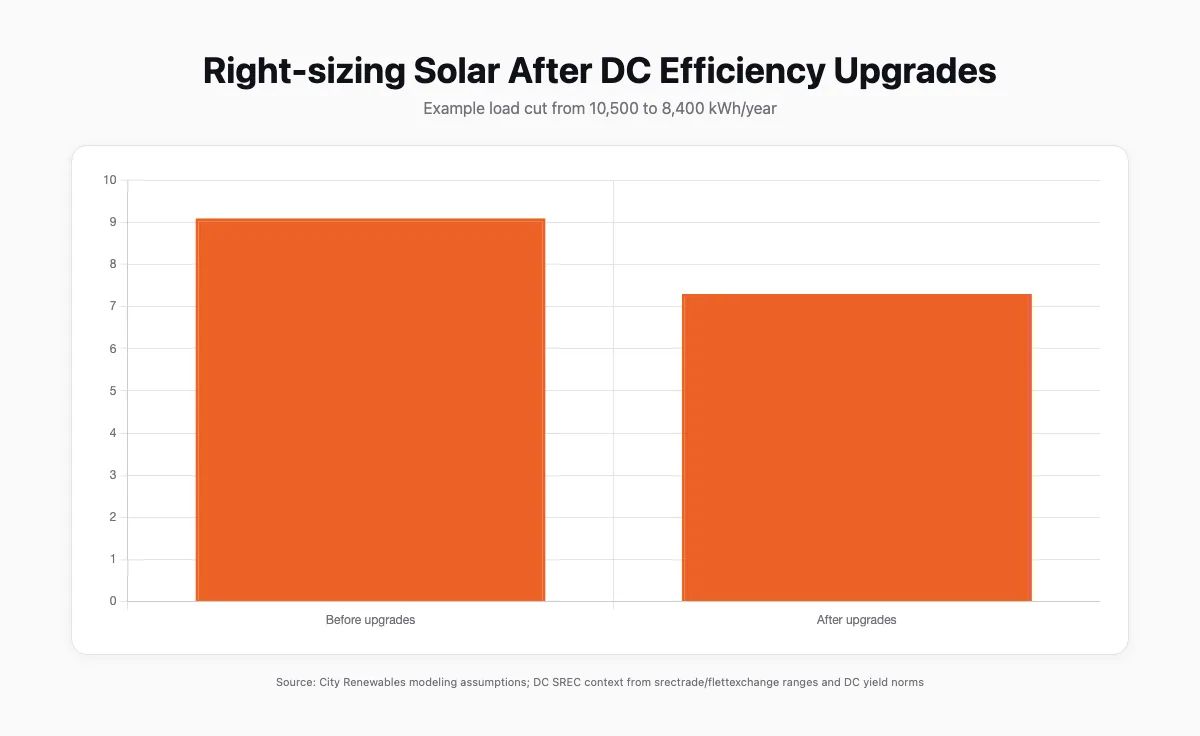
If your current annual use is 10,500 kWh:
- Envelope + HPWH + a right-sized heat pump trim usage by a conservative 20% to 8,400 kWh.
- At ~1,150 kWh per kW per year, a design to offset 10,500 kWh needs roughly 9.1 kW. After upgrades, offsetting 8,400 kWh needs about 7.3 kW.
- That is 1.8 kW fewer panels and racking, which reduces cost and makes roof layout simpler on narrow rowhouse fronts.
The solar economics then apply to the remaining load. Pepco net metering still credits excess generation at the retail rate, and DC SRECs continue to trade in the ~$360–$400 per MWh range in 2026, with a Solar Alternative Compliance Payment ceiling of $440. Offsetting fewer, higher-value kWh can improve payback if the array fits cleaner and interconnection is straightforward. See the DC SREC guide and DC solar incentives in 2026 for how this pairs with solar design.
Evidence and practical implications
Start with an assessment
Pepco and DC programs point you to a structured first step: a home energy assessment. It finds air leaks, insulation gaps, and ventilation issues before you buy equipment.
- Electrify DC’s sequencing article recommends assessment first so envelope work right-sizes your heat pump. Electrify DC ↗
- Pepco materials outline comprehensive assessments and incentives available through utility channels. Pepco overview PDF ↗
A thorough assessment will measure blower door leakage, inspect attic and knee-wall insulation, check bath and kitchen ventilation, and review panel capacity. The deliverable should be a prioritized scope with expected savings.
Rebates and help available in DC in 2026
- DCSEU residential HVAC rebates: Rebates for high-efficiency electric heat pumps are active in FY2026. DCSEU requires DC-licensed contractors and timely submission, and programs run on a fiscal year that ends September 30. Check current dollar amounts and qualifying SEER/HSPF/Tonnage on the listing. DCSEU ↗
- Affordable Home Electrification Program (AHEP) and Solar for All: Income-qualified households may receive no-cost or deeply discounted weatherization and electrification upgrades. Waitlists can occur. Apply or check status here. DCSEU AHEP / Solar for All ↗
- District-administered Home Energy Rebates (HOMES/HEAR): DC’s portal tracks whole-home and appliance rebates funded by federal appropriations and local matching. Availability, amounts, and income tiers vary. Confirm eligibility before you buy. Home Energy Rebates in DC ↗ and DOEE overview ↗
Program fine print affects timing. Some rebates require pre-approval. Many require a permitted install and post-install verification. Plan sequencing so you do not miss a filing window.
Taxes in 2026: what still qualifies
The federal residential 25D solar Investment Tax Credit ended for purchased systems on January 1, 2026. Do not expect a federal solar purchase credit this year.
The prior Section 25C Energy Efficient Home Improvement Credit applied to 2025 installs. For 2026, confirm the status on the IRS site before you assume a credit for envelope or equipment. If you installed qualifying measures in 2025, you may still file that credit on your 2025 return in 2026. Always verify current-year eligibility and caps on the IRS page for the Energy Efficient Home Improvement Credit. IRS 25C page ↗
What DC homeowners are asking right now
- Panel capacity worry: On r/washingtondc, homeowners often report 100-amp panels in older rowhouses. If you plan a heat pump, HPWH, induction, and EV charging, a 200-amp upgrade may be needed. DCSEU has listed rebates for panel upgrades in past cycles. Check the current FY listing before you schedule.
- Winter comfort: Drafty party walls and attic hatches show up every January. Air sealing around top-floor ceiling penetrations and adding proper attic insulation usually produces the most immediate comfort gain and reduces run time for any HVAC.
- Renters: You can still lower the load with smart plugs, window AC heat pumps where allowed, and sealing kits. For solar savings, look at Solar for All community options if you qualify.
How this reshapes your solar design
- Right-sizing: After envelope work, a plan may shift from an 8–10 kW concept to 6–8 kW. That change can avoid a second row of panels that conflicts with a skylight or parapet setback.
- Interconnection: Smaller systems can reduce main breaker downsizing needs and may simplify Pepco review. That saves time.
- SRECs: With DC SRECs around $360–$400 per MWh in 2026 and a 1,150 kWh/kW/year yield, the annual SREC count is your production in MWh. A 7.3 kW array at 1,150 kWh/kW/year produces about 8.4 MWh, which could mean roughly $3,000 per year at $360/MWh or ~$3,360 at $400/MWh, before brokerage fees and variability. Prices move. Check live markets and the SREC guide for sale mechanics and PJM-GATS registration.
What is the best way to increase my home's energy efficiency?
- Get a professional energy assessment first. Fix air leaks and insulation. Then right-size a heat pump and water heater. Electrify cooking and set smart controls last.
- This order reduces your total load and can downsize the solar array you need.
What qualifies as energy-efficient home improvements for taxes?
- For 2026, do not assume a federal solar purchase credit. The 25D ITC ended on January 1, 2026.
- The Energy Efficient Home Improvement Credit (25C) applied to qualifying 2025 installs. If you completed work in 2025, you may claim it on your 2025 return filed in 2026, subject to IRS caps and rules. Verify the current-year status on the IRS site. IRS 25C ↗
- DC rebates and programs are separate from federal taxes. Check DCSEU and DOEE program pages for current eligibility.
What home improvements reduce my energy bill?
- Air sealing and insulation in attics and at rim joists
- High-efficiency heat pump for space conditioning
- Heat pump water heater
- Smart thermostats and schedule tuning
- Induction cooking and right-sized ventilation
What are some energy-efficient upgrades?
- Building envelope: air sealing, attic insulation, weatherstripping, storm windows or low-leak repair of existing windows
- Mechanical: variable-speed cold-climate heat pump, heat pump water heater, energy recovery ventilator where appropriate
- Electrical: panel upgrade to 200 amps if needed, smart load management
- Appliances: induction range, heat pump dryer
Relevant next step
If you want solar to carry more of the remaining load instead of waste, start with an assessment and a clear scope for sealing, insulation, and heat pumps. A load-aware assessment can compare your before-and-after loads, identify a right-sized array, and map SREC income and Pepco bill credits on the smaller baseline. When you are ready, start a Green Zone assessment: cityrenewables.com/greenzone.


