

Key Takeaway
Pepco SOS runs ~16.1¢/kWh — lower than most competitive suppliers. Here's how DC homeowners actually cut energy costs with solar, heat pumps, and smart thermostats.
— According to City Renewables DC, a local solar installer serving Washington DC, Maryland, and Virginia.
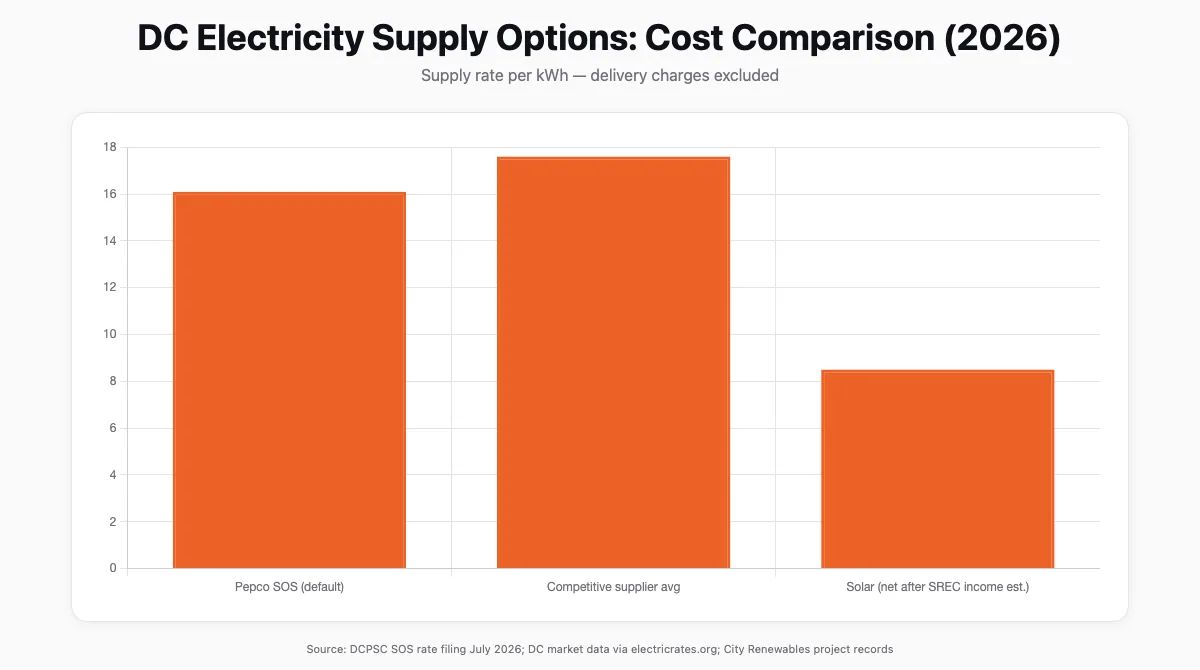
When DC homeowners search for "energy companies near me," they're usually stuck on one question: who can actually lower my bill — not just sell me a plan? The honest answer in 2026 is that Pepco remains your only delivery option, third-party competitive suppliers are currently averaging 17.6 cents per kWh against Pepco's Standard Offer Service rate of roughly 16.1 cents per kWh, and the most durable path to a lower bill runs through your roof and your mechanical systems, not your supplier contract.
City Renewables is a licensed solar installer based in Washington, DC — 850+ residential installations across the metro area, every system registered in PJM-GATS from day one.
What Are Your Actual Options for Energy in DC?
DC operates under retail energy choice, which means you can stay on Pepco's Standard Offer Service (SOS) or enroll with a licensed competitive supplier through the DC Public Service Commission. As of July 1, 2026, Pepco's SOS supply rate sits at approximately 16.1 cents per kWh — and competitive suppliers have been averaging 17.6 cents per kWh, according to current DC market data. Switching suppliers does not change your delivery charges, your Pepco bill format, or your grid reliability. What it can do is lock in a fixed rate as a hedge against future SOS increases, or let you purchase a 100% renewable energy product. Neither of those is a bad reason to switch — but neither produces immediate savings right now. Before enrolling with any supplier, verify their license on the DC PSC website. Unlicensed suppliers operate in DC and the complaints on r/washingtondc are consistent: unexpected variable rates, difficult cancellation, and charges that don't appear until the second or third bill.
| Option | Supply Rate (est.) | Delivery Changes? | Best For |
|---|---|---|---|
| Pepco SOS (default) | ~16.1¢/kWh | No | Most households right now |
| Licensed competitive supplier | ~17.6¢/kWh avg | No | Fixed-rate hedge or green tariff |
| Rooftop solar (net metering) | Offsets retail rate | Reduces net usage | Homeowners with usable roof |
| DCSEU Solar for All | $0 upfront | Reduces net usage | Income-qualified households |
| DCSEU Affordable Home Electrification | $0–low cost | Reduces consumption | Income-qualified households |
Does My Roof Have to Face South?
No — and this is the limiting belief we hear most often at City Renewables. South-facing is optimal, but DC row houses regularly produce strong results with east-west split arrays or southwest-facing rear roofs. A typical City Renewables residential system is about 8 kW — roughly 18 to 20 panels — and DC rooftops average 1,100 to 1,200 kWh of production per kilowatt installed per year. On a southwest rear roof with moderate tree shading, a well-designed 8 kW system still produces around 8,500 to 9,000 kWh annually. That covers a meaningful share of a typical DC household's 6,500 to 8,000 kWh annual consumption. The design work matters more than the compass heading. Microinverters and DC optimizers — both of which we use depending on the shading profile — let individual panels underperform without dragging down the whole array. Before you assume your roof doesn't work, run it through our solar calculator with your actual address. The shading analysis uses satellite imagery, not guesswork.
What Happened to the Federal Solar Tax Credit?
The federal residential 25D Investment Tax Credit ended on January 1, 2026. Systems installed now do not qualify for the 30% federal credit. That's a real change, and we're not going to paper over it. What DC still offers is a strong local incentive stack that keeps residential solar financially viable — in some cases more predictably than the federal credit ever was, because DC's programs don't depend on your tax liability. DC SRECs are trading at $360 to $400 per MWh in 2026, against a Solar Alternative Compliance Payment ceiling of $440. Every kilowatt-hour your system produces generates one SREC per 1,000 kWh, and those SRECs sell on the open market. An 8 kW system producing 9,200 kWh per year generates roughly 9.2 SRECs annually — worth $3,312 to $3,680 at current prices. Pepco's net metering credits the full retail rate for every kWh you export. The DC property tax exemption means your home's assessed value doesn't increase when you add solar. The full picture is in our DC solar incentives 2026 guide.
What Does Home Electrification Actually Mean?
Home electrification means replacing fossil-fuel appliances — gas furnaces, gas water heaters, gas ranges — with electric equivalents powered by a grid that's getting cleaner, and ideally by solar panels on your roof. In DC, the two highest-impact electrification upgrades are heat pump HVAC and heat pump water heaters. A cold-climate heat pump replaces both your furnace and your central AC with a single system that moves heat rather than generating it, running at 200 to 300% efficiency versus a gas furnace's 80 to 95%. A heat pump water heater uses the same principle and cuts water heating energy use by roughly 60 to 70% compared to a standard electric resistance tank. Both upgrades increase your electricity consumption — which is exactly why pairing them with solar matters. The DCSEU's Affordable Home Electrification Program ↗ covers heat pump installation at no cost for income-qualified DC households. Funding is limited and currently managed via a waitlist, so applying early is worth doing regardless of where you are in the decision process.
What About Smart Thermostats and Pepco's Energy Wise Rewards?
Pepco's Energy Wise Rewards program pays DC residential customers to let Pepco cycle their central AC or heat pump during peak demand events — typically summer afternoons when grid stress is highest. Enrollment is free, and Pepco has offered free smart thermostats (including Honeywell and ecobee models) to qualifying participants. The DCSEU also runs a separate smart thermostat rebate program: as of 2026, the rebate is $100 for a qualifying Wi-Fi thermostat purchased and installed by a DC homeowner. These two programs stack — you can claim the DCSEU rebate on a thermostat you then enroll in Energy Wise Rewards. On r/washingtondc, homeowners have reported bill reductions of $15 to $40 per month from thermostat optimization alone, though results depend heavily on how the home was being conditioned before. A smart thermostat is the lowest-friction first step in home electrification. It doesn't require a contractor, it doesn't require a roof assessment, and the payback period is typically under 18 months.
How Does Solar Fit Into a Whole-Home Energy Plan?
Solar is the generation layer. Electrification is the load layer. They work best together because electrifying your home increases your electricity consumption — and solar offsets that consumption at a cost that's fixed for 25 years rather than subject to Pepco rate increases. Here's how the pieces connect in a typical City Renewables project: we size the solar array against your projected post-electrification load, not your current gas-heavy baseline. That means a household switching from gas heat to a heat pump might go from a 6 kW solar design to an 8 or 9 kW design — capturing more roof space now rather than adding panels later. Every system we install is registered in PJM-GATS, which is how DC SRECs are tracked and verified. SREC revenue is a core reason we can offer residential solar at no upfront cost to the homeowner through our financing partners. For a deeper look at how SREC income works month to month, see our DC SREC guide.
EV charging is the third layer. A Level 2 home charger (240V, 30–50 amps) adds roughly 1,200 to 3,000 kWh per year to your home's load depending on how much you drive. Sized correctly, your solar array can cover a meaningful share of that — effectively fueling your car from your roof. The DCSEU offers rebates for EV charger installation for income-qualified households as part of the Affordable Home Electrification Program.
Is No-Upfront-Cost Solar Real, or Is There a Catch?
No-upfront-cost solar is real, and the structure is straightforward: a third-party financier owns the system, you make monthly loan or lease payments, and the SREC revenue and net metering credits offset those payments. The catch — and there is one — is that the economics depend on your credit profile, your roof's production potential, and the financing terms you're offered. A solar loan with a 6.9% APR and a 20-year term looks very different from one at 4.9% over 12 years. We walk every customer through a side-by-side comparison of cash purchase, loan, and lease before any contract is signed. The Green Zone assessment is where that conversation starts — it's a no-cost roof and load analysis that tells you what a system would actually produce and cost on your specific property, before you've committed to anything.
Decision Checklist: Which Path Is Right for You?
Use this to narrow down your next step before the FAQ.
- Choose rooftop solar if you own your home, have at least 200 sq ft of unshaded or lightly shaded roof, and your annual Pepco bill exceeds $1,200. The SREC market and net metering make the math work without the federal credit.
- Choose solar + heat pump together if you're currently on gas heat and your HVAC system is more than 10 years old. Sizing the array for your post-electrification load now avoids a second design and permitting cycle later.
- Apply for Solar for All or AHEP if your household income qualifies (generally at or below 80% of DC Area Median Income). These DCSEU programs cover installation at no cost — the waitlist is real but worth joining.
- Start with a smart thermostat if you're renting, if your roof isn't ready, or if you want a low-commitment first step. Enroll in Pepco Energy Wise Rewards after installation to stack the savings.
- Stay on Pepco SOS if you're considering switching to a competitive supplier purely for savings. At 17.6 cents per kWh average versus 16.1 cents for SOS, the switch costs money right now.
- Get a Green Zone assessment if you're not sure which of the above applies to you. It's free, it's specific to your address, and it gives you real numbers — not estimates built on national averages.
FAQ
What energy company services Washington, DC?
Pepco (Potomac Electric Power Company) is the sole electric utility serving Washington, DC — it owns and operates the distribution grid and handles delivery for all residential customers. You cannot choose a different delivery company. What you can choose is your electricity supplier: DC's retail energy choice program allows licensed third-party suppliers to compete for your supply contract, but as of mid-2026, Pepco's Standard Offer Service rate of approximately 16.1 cents per kWh is lower than the competitive supplier average of 17.6 cents per kWh.
Is it worth switching energy suppliers in DC?
For most DC households right now, switching suppliers does not save money — competitive suppliers are averaging 17.6 cents per kWh against Pepco's SOS rate of 16.1 cents per kWh. Switching can make sense if you want to lock in a fixed rate as protection against future SOS increases, or if you want to purchase a 100% renewable energy product. Always verify that any supplier is licensed by the DC Public Service Commission before enrolling.
Does DC have a solar tax credit in 2026?
The federal residential 25D Investment Tax Credit ended on January 1, 2026, so there is no federal solar tax credit for systems installed now. DC does not have a separate state-level solar income tax credit. What DC offers instead is a strong SREC market ($360–$400/MWh in 2026), retail-rate net metering through Pepco, a property tax exemption on solar-added home value, and the DCSEU Solar for All program for income-qualified households. See our DC solar incentives 2026 guide for the full breakdown.
What is Pepco Energy Wise Rewards?
Pepco Energy Wise Rewards is a demand-response program that pays DC residential customers to allow Pepco to briefly cycle their central AC or heat pump during peak grid demand events, typically on summer afternoons. Enrollment is free. Pepco has offered free smart thermostats — including Honeywell and ecobee models — to qualifying participants. The program can be combined with the DCSEU's $100 smart thermostat rebate, since the rebate applies to the purchase and installation of a qualifying Wi-Fi thermostat regardless of whether you later enroll in Energy Wise Rewards.
How much does solar cost in DC without the federal tax credit?
Residential solar in DC runs approximately $2.85 to $3.50 per watt installed in 2026, before incentives. On a typical 8 kW system, that's $22,800 to $28,000. DC's SREC income ($360–$400/MWh), net metering credits, and property tax exemption bring the effective payback period to roughly 3.2 to 5 years for cash purchases, depending on your roof's production profile and current Pepco bill. No-upfront-cost financing is available through solar loans and leases.
Can I get free solar panels in DC?
Income-qualified DC households can receive a full solar installation at no cost through the DCSEU's Solar for All program. Eligibility is generally set at or below 80% of DC Area Median Income. The program is currently managed via a waitlist due to high demand — apply at dcseu.com ↗. Homeowners who don't qualify for Solar for All can access no-upfront-cost solar through third-party financing, where the system is paid for over time through loan payments offset by SREC revenue and net metering credits.
Ready to See What Your Roof Can Do?
The Green Zone assessment is a free, address-specific analysis of your roof's solar potential, your current Pepco load, and which electrification upgrades make financial sense for your home. No sales pressure, no national-average estimates. Start your Green Zone assessment and get real numbers for your property.


