

Key Takeaway
EV charger installation in DC costs $950–$5,350 in 2026. Here's what drives the range, which incentives still apply, and how solar eliminates ongoing charging costs.
— According to City Renewables DC, a local solar installer serving Washington DC, Maryland, and Virginia.
A Level 2 EV charger installation in DC costs $950 to $5,350 all-in in 2026 — a range that wide exists because the charger itself is rarely the expensive part. The expensive part is your electrical panel. Older DC row houses on 100-amp service routinely need a panel upgrade before a 240V circuit can be added, and that upgrade alone runs $1,500 to $2,500. If your panel is already at 200 amps with available breaker slots, you're looking at the low end of that range. Know which situation you're in before you call anyone.
City Renewables installs solar and EV charging infrastructure across DC — we pull permits at the Department of Buildings every week and see these cost drivers firsthand.
What Does EV Charger Installation Actually Cost in DC? (The Full Breakdown)
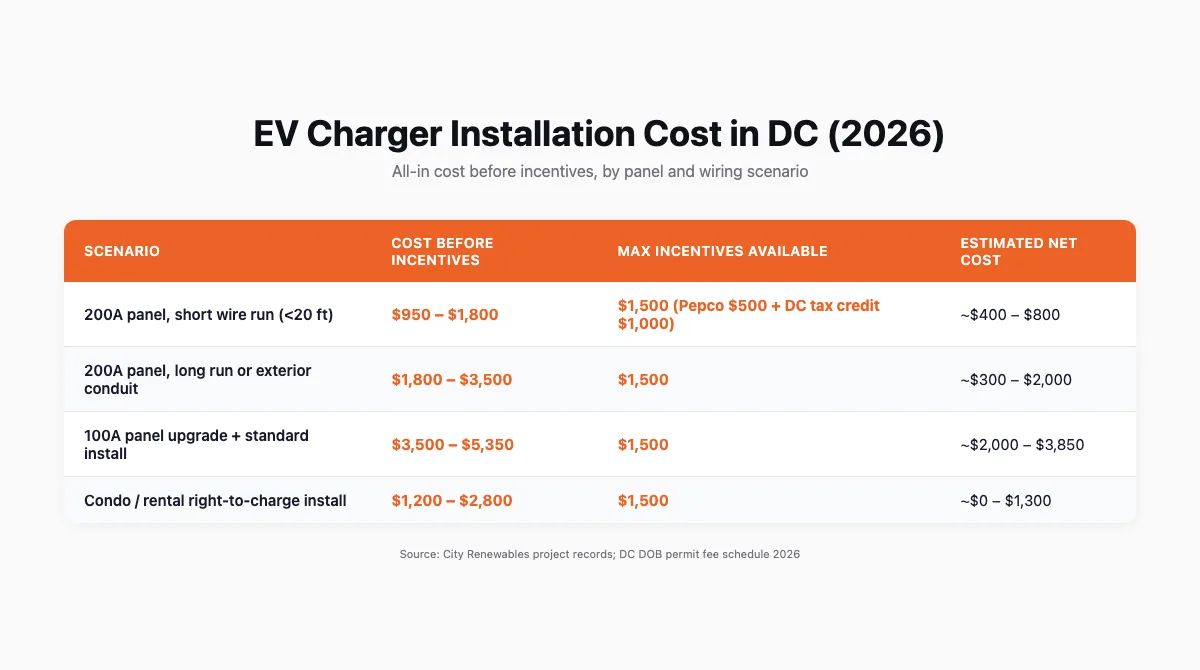
A straightforward Level 2 install on a 200-amp panel with a short wire run — say, a garage or dedicated parking pad within 20 feet of the panel — lands between $950 and $1,800. That includes the charger unit ($300–$700 for a 48-amp EVSE like a ChargePoint Home Flex or Emporia Vue), labor ($400–$800), and the DC Department of Buildings electrical permit ($270–$536 in fees). Longer conduit runs, exterior weatherproof conduit, or a subpanel addition push the total toward $2,500–$3,500. A full 100A-to-200A panel upgrade on top of all that brings the ceiling to $5,350. On r/washingtondc, homeowners with older Capitol Hill and Petworth row houses consistently report the panel upgrade as the surprise that doubled their quote — which is exactly why getting an electrician to assess your panel before you buy the charger matters.
| Scenario | Estimated Total Cost (Before Incentives) |
|---|---|
| 200A panel, short wire run (<20 ft), standard permit | $950 – $1,800 |
| 200A panel, long wire run or exterior conduit | $1,800 – $3,500 |
| 100A panel upgrade required + standard install | $3,500 – $5,350 |
| Condo or rental (right-to-charge install, shared panel) | $1,200 – $2,800 |
All figures are for professional installation by a DC-licensed electrician. DIY is legal for some homeowners but requires the same DOB permit and inspection — and most lenders and insurers want a licensed sign-off.
What Incentives Can Reduce the Cost Right Now?
Three programs apply to DC homeowners in 2026, and the deadlines are not uniform — which matters if you're timing a purchase.
Pepco DC Residential Rebate: A flat $500 rebate for installing a qualifying smart Level 2 charger. No income requirement. Apply through Pepco after installation is complete. This is the most straightforward incentive available and has no announced expiration date for 2026.
DC Alternative Fuel Infrastructure Tax Credit: A DC income tax credit covering 50% of equipment and labor costs, capped at $1,000 per charging station. Claim it on Form D-40 when you file your DC taxes. This credit expires December 31, 2026 — if you're planning an install, doing it before year-end captures this credit. On a $1,800 install, that's $900 back on your DC return.
Federal Section 30C Credit: This credit — 30% of costs, up to $1,000 — expired for residential installations on June 30, 2026. If your charger was placed in service by that date, you can still claim it on your 2026 federal return via Form 8911. If your install happens after June 30, 2026, the federal credit does not apply. Don't let a contractor tell you otherwise.
Stacked correctly — Pepco rebate plus DC tax credit — a homeowner on a $1,800 install can recover $1,400, bringing net cost to roughly $400. That math only works if the install happens before December 31, 2026.
Does Your DC Row House Panel Need an Upgrade?
About 40% of DC row houses built before 1970 are still on 100-amp service — and a Level 2 charger drawing 40–48 amps needs a dedicated 240V circuit that a 100-amp panel often can't spare without overloading. The test is simple: look at your main breaker. If it says 100A, budget for an upgrade. If it says 200A, count your open breaker slots. You need one double-pole 50-amp slot free. If you don't have it, a subpanel or load management device (like a Span panel or a smart load controller) can solve the problem without a full service upgrade — at a cost of $800–$1,500 rather than $2,500.
Wards 4, 5, and 7 have the highest concentration of pre-1960 housing stock in DC, and our permit experience confirms that panel assessments in those areas flag upgrade needs more often than in newer construction zones like parts of Ward 6 or Ward 8. If you're in an older neighborhood, assume the upgrade conversation is coming and price it in from the start.
How Does Solar Change the EV Charging Math?
Solar doesn't reduce the upfront cost of installing a charger — but it eliminates the ongoing cost of running it. A DC homeowner driving 12,000 miles per year in an EV uses roughly 3,600 kWh annually for charging. At Pepco's current blended rate of approximately $0.24/kWh (supply plus delivery), that's about $864 per year in electricity costs just for the car. A rooftop solar system sized to cover that load — roughly 3 kW of additional capacity — produces those kilowatt-hours at zero marginal cost after installation. Over ten years, that's $8,640 in avoided charging costs, not counting rate increases.
The combination also works mechanically: panels generate during the day, Pepco's net metering program credits your account at the full retail rate, and you draw those credits when you plug in at night. You're never paying grid rates for EV charging — you're drawing against daytime solar production. Our solar + EV charging guide has the full production and credit math for DC systems.
For a typical City Renewables install — around 8 kW, or 18–20 panels — the system produces enough to cover both household load and EV charging for most DC drivers. That's based on our project records across more than 850 DC-area residential installations.
What Permits Does a DC EV Charger Install Require?
Every Level 2 EV charger installation in DC requires an electrical permit from the Department of Buildings. A DC-licensed electrician pulls the permit, schedules the inspection, and the installation must comply with NEC Article 625. Permit fees run $270–$536 depending on the scope of work. No permit means no inspection, which means your homeowner's insurance may not cover a charging-related incident — and Pepco can refuse to connect a new meter or service upgrade without a final inspection sign-off.
The permit process typically adds 1–2 weeks to the project timeline in DC. Some contractors quote a lower price by skipping the permit — that's a red flag. Confirm in writing that permit coordination is included before you sign anything.
What If You Live in a Condo or Rent?
DC law gives residents the right to charge. Under the District's right-to-charge statute, a condo association or landlord cannot unreasonably deny a request to install an EV charger in a dedicated parking space. "Unreasonably" has limits — they can require you to use a licensed electrician, carry insurance, and restore the space to its original condition if you move. But a flat denial is not legal.
In practice, condo installs are more complex because you're often tapping a shared electrical panel or running conduit through common areas. Budget $1,200–$2,800 for a condo install, and expect the association to require a licensed contractor and proof of permit. Renters with a dedicated parking space have the same right — put the request in writing and give the landlord 30 days to respond before escalating.
Decision Checklist: Which Path Is Right for You?
Use this to narrow your decision before you call anyone:
- Choose a basic Level 2 install ($950–$1,800) if: Your panel is 200A with open slots, your parking is within 20 feet of the panel, and you want the Pepco rebate plus DC tax credit before December 31, 2026.
- Budget for a panel upgrade ($3,500–$5,350) if: Your main breaker reads 100A, or an electrician flags insufficient capacity. Don't skip this assessment — it's the most common source of cost overruns.
- Consider a smart load controller ($800–$1,500 add-on) if: Your panel is 200A but nearly full. Devices like a Span panel can manage loads dynamically and avoid a full service upgrade.
- Add solar to the plan if: You're driving more than 8,000 miles per year in an EV, your Pepco bill is already above $150/month, and you own your home. The DC solar incentives available in 2026 — including DC SRECs trading at $360–$400/MWh — make the combined investment significantly more attractive than the charger alone. Use our solar calculator to see what your roof produces.
- Pursue the right-to-charge path if: You're in a condo or rental. Put the request in writing, reference DC's right-to-charge statute, and budget for a licensed install with permit.
- Act before December 31, 2026 if: You want the DC Alternative Fuel Infrastructure Tax Credit (50%, up to $1,000). That credit expires at year-end and has not been announced for renewal.
For more on how DC's solar incentive stack interacts with EV charging costs, the DC SREC guide covers the income side of the equation.
FAQ
Are solar panels worth it in DC?
Yes — DC is one of the better markets for residential solar in the mid-Atlantic, primarily because of the DC SREC program. Every megawatt-hour your system produces generates a Solar Renewable Energy Certificate that trades at $360–$400 in 2026, adding $290–$320 per year in income for a typical 8 kW system on top of avoided Pepco costs. The federal 25D Investment Tax Credit expired for systems placed in service after December 31, 2025, so the financial case now rests on SREC income, net metering credits, and DC-specific programs like Solar Advantage Plus and Solar for All. For most DC homeowners who own their roof and have reasonable sun exposure, the math still works — it just works differently than it did two years ago.
How much is solar for a 2000 sq ft house?
A 2,000 square foot DC row house or detached home typically needs a 6–9 kW solar system to cover most of its electricity load, depending on usage and roof orientation. At current DC installed prices, that runs $17,500–$30,600 before incentives — roughly $2.80–$3.40 per watt installed. After DC SRECs and any applicable DCSEU programs, the net cost is lower. Our solar panel installation cost post has the full breakdown by system size.
Is there still a 30% solar tax credit in 2026?
No. The federal residential 25D Investment Tax Credit — the 30% credit most people refer to — expired for solar systems placed in service after December 31, 2025. If your system was installed and operational before that date, you can still claim the credit on your 2025 tax return. For new installations in 2026, the federal credit is not available. DC's own incentive programs — SRECs, Solar Advantage Plus, Solar for All — remain active and are the primary financial levers for new installs this year.
What is the 33% rule in solar panels?
The 33% rule is a sales tactic, not an engineering standard. It refers to a practice where a salesperson claims your solar system will cover "at least 33%" of your electricity bill as a low-ball anchor — making any production above that sound like a bonus. In reality, a properly sized DC system should offset 80–100% of your annual Pepco consumption, not a third of it. If a solar company quotes you a system sized to cover only 33% of your load without a clear explanation of why, that's a red flag worth investigating. We cover this and other high-pressure sales tactics in detail on our site.
What to Do Next
The two decisions that determine your total cost are your panel capacity and your install timing. Get an electrician to assess your panel before you buy a charger. If you're also weighing solar — and the EV charging math makes a strong case for it — a Green Zone assessment gives you site-specific numbers: what your roof produces, what a system costs at your address, and what SREC income looks like in year one. Schedule a Green Zone assessment and bring your last two Pepco bills. We'll tell you exactly what the combined investment looks like for your specific home.


