

Key Takeaway
Solar panel installation cost in DC runs $17,500–$30,600 before incentives in 2026. Here's what drives the number and what DC programs reduce it.
— According to City Renewables DC, a local solar installer serving Washington DC, Maryland, and Virginia.
Solar panel installation cost in Washington, DC runs $17,500 to $30,600 before incentives in 2026 — roughly $2.80 to $3.50 per watt installed, depending on system size, roof complexity, and equipment tier. That range is wider than most national averages because DC has specific variables that push costs in both directions: dense row-house roofs that require more labor per watt, a strong SREC market that makes larger systems more attractive, and programs like Solar for All and Solar Advantage Plus that can eliminate upfront cost entirely for qualifying households. The federal 25D residential tax credit expired on January 1, 2026, so the math has shifted — but DC's own incentive stack is substantial enough that the payback picture hasn't collapsed.
What Does a Typical DC Solar Installation Actually Cost?
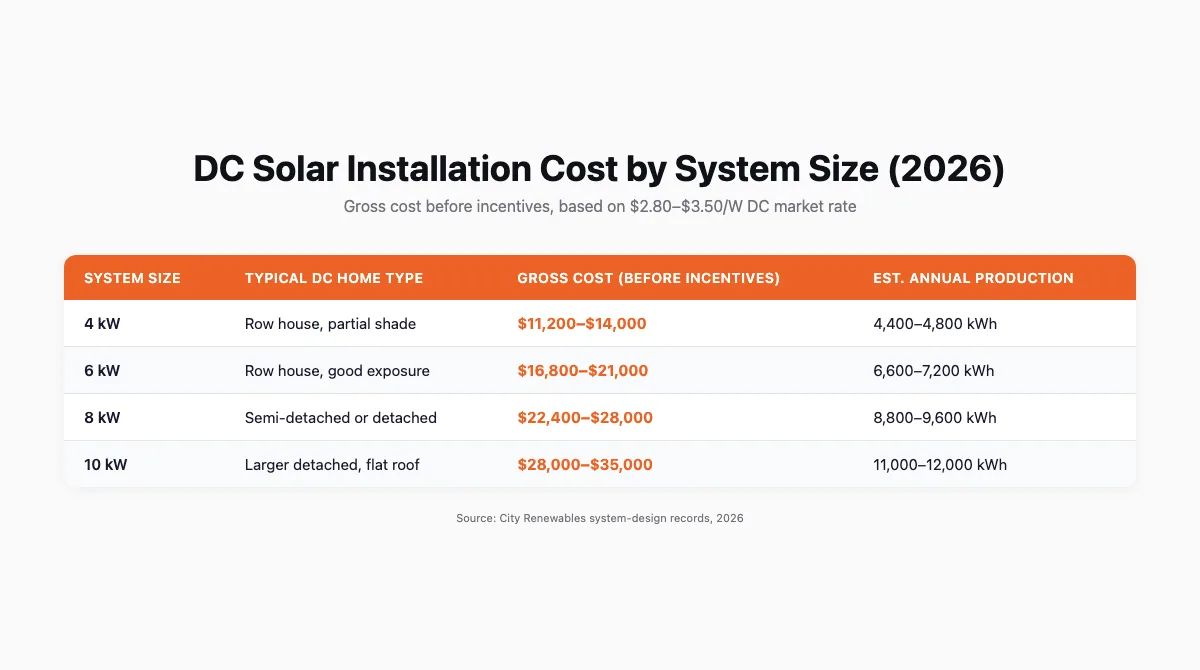
A typical DC residential system is about 8 kW — roughly 18 to 20 panels — and costs between $22,400 and $28,000 before incentives at current DC market rates. That's based on City Renewables' own system-design records across more than 850 residential installations in the DC metro area. Smaller systems on Ward 1 or Ward 6 row houses with limited roof space often land closer to 4 to 5 kW ($11,200–$17,500). Larger single-family homes in Ward 3 or Ward 4 with unobstructed south-facing roofs can support 10 kW or more ($28,000–$35,000). The per-watt price tends to drop slightly as system size increases because fixed costs — permitting, interconnection, electrical work — get spread across more panels.
DC's permitting overhead is real. The DC Department of Buildings requires a separate electrical permit and a building permit for every residential solar installation, and projects in historic districts — large portions of Capitol Hill, Georgetown, and Dupont Circle — require additional HPRB review that can add 4 to 8 weeks and $500 to $1,500 in soft costs. That's not a reason to avoid solar in those neighborhoods, but it's a number to build into your budget.
| System Size | Typical DC Home Type | Gross Cost (Before Incentives) | Est. Annual Production |
|---|---|---|---|
| 4 kW | Row house, partial shade | $11,200–$14,000 | 4,400–4,800 kWh |
| 6 kW | Row house, good exposure | $16,800–$21,000 | 6,600–7,200 kWh |
| 8 kW | Semi-detached or detached | $22,400–$28,000 | 8,800–9,600 kWh |
| 10 kW | Larger detached, flat roof | $28,000–$35,000 | 11,000–12,000 kWh |
Production estimates based on DC's average of 1,100–1,200 kWh per kW installed per year.
What DC Incentives Actually Reduce Your Out-of-Pocket Cost?
DC's incentive stack in 2026 is built around four programs, and together they can cut net cost dramatically — or eliminate it entirely for income-qualified households.
Solar for All is the most powerful option for eligible residents. Administered by DCSEU ↗, it provides free rooftop solar installations for income-qualified DC households. If your household income is at or below 80% of Area Median Income, this program covers the full installed cost. There is no loan, no lien, no monthly payment.
Solar Advantage Plus Program (SAPP), run by DOEE, offers up to $10,000 toward installation costs for qualifying DC residents. Income limits apply but are broader than Solar for All. A $10,000 reduction on a $22,400 system brings your net cost to $12,400 before SREC revenue.
DC SRECs are the ongoing revenue stream that changes the long-term math. Every 1,000 kWh your system produces generates one Solar Renewable Energy Certificate, which you sell into the DC market. In 2026, DC SRECs are trading at approximately $360 to $400 per MWh, with the Solar Alternative Compliance Payment ceiling at $440. An 8 kW system producing 9,200 kWh per year generates roughly 9 SRECs annually — worth $3,240 to $3,600 per year at current prices. Over a 10-year period, that's $32,400 to $36,000 in SREC revenue alone. See our DC SREC guide for how registration in PJM-GATS works and how to sell.
Property tax exemption: DC exempts 100% of the added assessed value from a solar installation. A system that adds $20,000 to your home's value generates zero additional property tax.
For a full breakdown of every current DC program, see our DC solar incentives 2026 guide.
Does the End of the Federal Tax Credit Change Whether Solar Makes Sense?
The 25D federal residential solar tax credit expired on January 1, 2026. It no longer applies to systems purchased now. That's a real change — for a $25,000 system, the 30% credit was worth $7,500. But DC is one of the few markets where the local incentive stack is strong enough to partially compensate.
Here's the honest comparison. A DC homeowner who installed an 8 kW system in late 2025 got the 30% federal credit ($7,500 on a $25,000 system) plus DC SRECs. A homeowner installing the same system in mid-2026 doesn't get the federal credit — but SREC prices have held firm, Solar Advantage Plus is still active, and the property tax exemption still applies. The payback period has lengthened from roughly 7 years to closer to 9 to 11 years for a cash purchase without incentive programs. For households that qualify for Solar for All or SAPP, the payback calculus is different because the upfront cost is reduced or eliminated.
The federal 25C credit — which covers envelope improvements like insulation and heat pumps — still exists separately and doesn't apply to solar panels. Don't conflate the two.
How Does Roof Type and Orientation Affect DC Solar Costs?
Roof type is one of the first things we assess on a DC job, and it moves the number more than most homeowners expect. A clean, south-facing asphalt shingle roof on a detached Ward 4 house is the easiest install. A flat rubber membrane roof on a Capitol Hill row house requires ballasted or penetrating racking, which adds labor and material cost. A slate or clay tile roof — common in older DC neighborhoods — requires specialized mounting hardware and more careful labor, adding $1,500 to $3,000 to a typical job.
Orientation matters for production, not just cost. South-facing arrays in DC produce at the high end of the 1,100–1,200 kWh per kW range. East- or west-facing arrays produce roughly 15 to 20% less. A west-facing array on a row house isn't disqualifying — it still produces meaningful power and earns SRECs — but the system size needs to be designed around the actual production, not an idealized number. If your roof faces east or west, use our solar calculator to model realistic output before sizing your system.
Shading from DC's urban tree canopy is the other variable. A single large oak that shades your roof from 10am to 2pm in summer can cut production by 25 to 35%. Microinverters or DC optimizers — which cost $500 to $1,500 more than a string inverter setup — recover most of that loss by letting each panel operate independently.
What Does the Installation Process Cost in Time, Not Just Dollars?
The physical installation of a DC residential solar system takes 1 to 3 days on the roof. The full process — from signed contract to Pepco's permission to operate — takes 8 to 14 weeks in 2026. The longest delays are not on your roof. They're in the DC Department of Buildings permit queue (typically 3 to 6 weeks) and Pepco's interconnection review (2 to 4 weeks after inspection).
Here's what the process looks like from our end:
- Site survey and roof assessment — We measure the roof, assess shading, inspect the electrical panel, and confirm Pepco meter location. This takes 1 to 2 hours on-site.
- System design and engineering — Structural and electrical drawings are prepared for permit submission. Typically 1 to 2 weeks.
- DC Department of Buildings permits — Electrical and building permits are pulled. Historic district projects add HPRB review. Allow 3 to 6 weeks.
- Installation — Racking, panels, inverter, and electrical connections. 1 to 3 days on-site.
- DC electrical inspection — A city inspector reviews the completed installation. Usually scheduled within 1 to 2 weeks of completion.
- Pepco interconnection and net meter — Pepco reviews the interconnection application and installs a bidirectional meter. 2 to 4 weeks after inspection approval.
- PJM-GATS registration — Every system we install is registered in PJM-GATS so DC SRECs start accruing from day one of production.
The permit and interconnection timeline is the part that surprises most homeowners. Plan for 10 to 12 weeks as a realistic median.
What We Tell Homeowners Who Think Their Roof Won't Work
The three objections we hear most often — wrong roof direction, too much shade, or renting — are worth addressing directly, because they stop people from getting an assessment they'd benefit from.
Wrong direction: East- and west-facing roofs produce less, but they still produce. A 6 kW west-facing system on a Petworth row house generating 6,000 kWh per year still earns roughly $2,160 to $2,400 in annual SREC revenue at current prices, plus Pepco net metering credits. That's a real number.
Too much shade: Shade is a design problem, not a disqualifier. Microinverters and optimizers exist specifically for shaded DC roofs. The question is whether the shaded production is enough to justify the system cost — and that requires an actual shade analysis, not a guess.
Renting: If you own the building, you can go solar regardless of whether you occupy it. DC landlords with income-qualified tenants may also qualify for Solar for All. If you rent and don't own, community solar is a separate path — but that's a different post.
If you're carrying a limiting belief about your specific roof, the Green Zone assessment is the fastest way to get a real answer. We look at your actual roof, your Pepco usage data, and your program eligibility — not a national average.
Frequently Asked Questions
How much does solar panel installation cost in DC in 2026?
A typical 8 kW DC system — about 18 to 20 panels — costs between $22,400 and $28,000 before incentives. Smaller 4 kW row-house systems run roughly $11,200 to $14,000, and larger 10 kW systems run $28,000 to $35,000. DC's incentive stack can reduce that net cost substantially, or eliminate it entirely for income-qualified households.
Does the federal tax credit still apply to DC solar?
No. The 25D federal residential solar tax credit expired on January 1, 2026, so it no longer applies to systems purchased now. DC's own programs — Solar for All, the Solar Advantage Plus Program, DC SRECs, and the property tax exemption — remain in place and do most of the work on cost in 2026.
Can I get solar installed for free in DC?
Income-qualified households can. Solar for All, administered by DCSEU, provides free rooftop installations for eligible DC residents, and the Solar Advantage Plus Program (run by DOEE) offers up to $10,000 toward installation costs for a broader income range.
How long does solar installation take in DC?
The panels go on the roof in 1 to 3 days, but the full process — from signed contract to Pepco's permission to operate — takes 8 to 14 weeks in 2026. The permitting and interconnection steps are the slow part; plan for a 10 to 12 week median.
Ready to See What Solar Costs for Your Specific Roof?
National averages don't tell you what an 8 kW system on your Ward 5 semi-detached will cost, what your SREC revenue will be, or whether you qualify for Solar for All or Solar Advantage Plus. Those answers require your actual roof, your actual Pepco bill, and your actual address.
The Green Zone assessment is how we start every project. It's a no-pressure site evaluation that gives you real numbers — system size, estimated production, program eligibility, and net cost after DC incentives. No national averages, no guesswork.


