

Key Takeaway
The average DC house uses about 25 kWh per day — 770 kWh per month. Here's how that number drives solar system sizing, Pepco bill math, and DC incentives.
— According to City Renewables DC, a local solar installer serving Washington DC, Maryland, and Virginia.
The average DC house uses about 25 kWh per day — that's 770 kWh per month, divided across 30 days. That single number is the input every solar estimate starts from: how much electricity does your home consume, and how much of it can panels on your roof replace? At Pepco's current Standard Offer Service supply rate of 16.1 cents per kWh, 25 kWh per day costs roughly $4.03 in supply charges alone, before delivery fees. Knowing your daily kWh figure lets you size a system, project SREC income, and decide whether solar pencils out — which is exactly what this post walks through.
City Renewables is a licensed solar installer based in Washington, DC — 850+ residential installations across the metro area, every system designed around a homeowner's actual Pepco usage data.
How Much Electricity Does a DC House Use Per Day?
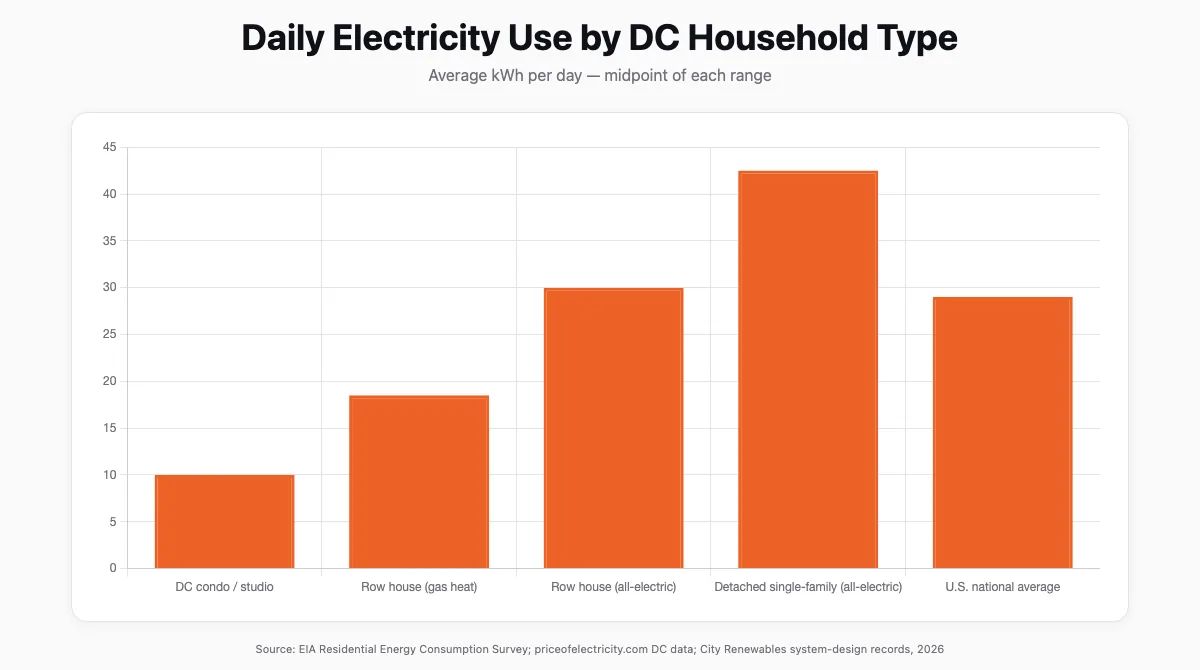
A typical DC household uses 25 to 26 kWh per day, based on the District's average monthly consumption of 750 to 770 kWh. That's meaningfully lower than the U.S. national average of roughly 28 to 30 kWh per day, for two reasons: DC homes skew toward row houses and condos rather than large detached single-family homes, and the District's relatively mild winters reduce electric heating loads compared to colder northern states. But that average masks a wide spread. A two-bedroom Capitol Hill row house with gas heat and no central air might use 12 to 15 kWh per day in spring. The same house after electrification — heat pump, heat pump water heater, induction range — can run 30 to 40 kWh per day in January. Heating and cooling account for 45 to 50 percent of total household electricity use, so the season you're looking at matters as much as the house itself. The most reliable way to find your own number is to pull 12 months of interval data from Pepco's My Usage dashboard, which breaks consumption down by hour.
| Household type | Typical daily kWh | Monthly kWh | Annual kWh |
|---|---|---|---|
| DC condo or studio | 8–12 kWh | 240–360 kWh | 2,900–4,300 kWh |
| DC row house, gas heat | 15–22 kWh | 450–660 kWh | 5,400–7,900 kWh |
| DC row house, all-electric | 25–35 kWh | 750–1,050 kWh | 9,000–12,600 kWh |
| Detached single-family, all-electric | 35–50 kWh | 1,050–1,500 kWh | 12,600–18,000 kWh |
| U.S. national average (EIA) | 28–30 kWh | 850–900 kWh | 10,500 kWh |
Sources: EIA Residential Energy Consumption Survey; priceofelectricity.com DC data; City Renewables system-design records, 2026.
What Drives Daily kWh Use Up or Down in DC?
The biggest single variable in a DC home's daily electricity use is whether heating and cooling run on electricity or gas. A row house on a gas furnace and central AC might average 18 kWh per day across the year. Switch that same house to an air-source heat pump and the annual average climbs to 28 to 32 kWh per day — but the gas bill disappears entirely, and the net energy cost often drops. After HVAC, the next largest loads are water heating (electric resistance tanks draw 3 to 5 kWh per day), refrigeration (1.5 to 2 kWh per day for a modern unit), and lighting. Electric vehicles add another 8 to 12 kWh per day if charged at home overnight. That's not a reason to avoid EVs — it's a reason to size your solar system to cover them. Our DC solar incentives guide for 2026 covers how DCSEU rebates interact with electrification loads when you're sizing a system.
Home size matters, but less than most people expect. A 2,000 square foot DC row house and a 2,000 square foot detached home in Ward 4 can have wildly different usage profiles depending on insulation quality, window area, and what's plugged in. The square footage benchmarks below are a starting point, not a ceiling.
How Much Electricity Should a 2,000 Sq Ft House Use?
A 2,000 square foot house in DC uses roughly 20 to 30 kWh per day, depending on whether it's all-electric or gas-assisted. That translates to 600 to 900 kWh per month. A well-insulated 2,000 sq ft row house with a heat pump, LED lighting, and an efficient refrigerator can land at the low end of that range. An older detached home with electric resistance heat, an aging water heater, and a second refrigerator in the basement will push toward the top. The EIA's Residential Energy Consumption Survey ↗ puts the national average for homes in the 1,500 to 2,499 sq ft range at roughly 10,000 to 11,000 kWh per year — about 27 to 30 kWh per day. DC homes in that size band tend to run slightly below that national figure because the District's building stock is denser and better shielded from wind than suburban detached homes. If you want a precise figure for your address, the Office of the People's Counsel utility calculators ↗ let you estimate usage by appliance without logging into Pepco.
How Does Daily kWh Use Translate Into a Solar System Size?
Solar system size in DC is calculated by dividing your daily kWh target by the average peak sun hours your roof receives — roughly 4.0 to 4.5 hours per day for a south-facing DC roof. A home using 25 kWh per day needs a system capable of producing 25 kWh on an average day, which works out to a 5.5 to 6.5 kW system before accounting for shading losses and inverter efficiency. In practice, DC residential systems are sized to offset 80 to 100 percent of annual consumption rather than hitting 100 percent every single day — net metering with Pepco lets you bank summer surplus against winter shortfalls. A typical City Renewables residential installation runs about 8 kW, or 18 to 20 panels, with real designs ranging from 4 kW on smaller row houses to over 10 kW on larger single-family roofs. At 1,150 kWh of annual production per kW installed — the DC average for a well-oriented system — an 8 kW system produces roughly 9,200 kWh per year, or about 25 kWh per day. That lines up almost exactly with the District's average household consumption. Use our solar calculator to run your own numbers before any conversation with us.
Is 40 kWh a Day a Lot?
40 kWh per day is above average for a DC household but not unusual for an all-electric home with an EV charger. The District's average is 25 to 26 kWh per day, so 40 kWh puts you about 55 percent above that baseline. At Pepco's current blended rate — supply plus delivery — that works out to roughly $200 to $220 per month in electricity costs. The most common reasons a DC home reaches 40 kWh per day are electric resistance heat (baseboard or old heat strips), a Level 2 EV charger running nightly, an electric water heater on a large tank, or a home office with multiple workstations and monitors running eight or more hours daily. None of those are wasteful by definition — they're just loads that solar can offset. A 10 kW system producing 11,500 kWh per year covers roughly 79 percent of a 40 kWh/day home's annual consumption. The remaining 21 percent comes from the grid, typically in winter months when production dips and heating loads peak.
How Much Electricity Does a 2 Person Household Use a Day?
A two-person household in DC uses roughly 15 to 22 kWh per day, or 450 to 660 kWh per month. That range assumes a gas-assisted row house or condo with standard appliances and no EV. Two-person households tend to run 20 to 30 percent below the District average because occupancy is the second-largest driver of consumption after HVAC — more people means more hot water, more cooking, more devices charging simultaneously. If a two-person household has switched to all-electric systems, that range shifts up to 22 to 30 kWh per day. The practical implication for solar sizing: a two-person household in a DC row house with gas heat is often well-served by a 4 to 6 kW system, which is also the size range where per-watt installation costs are highest. Our DC SREC guide explains how SREC income — currently trading at $360 to $400 per MWh — helps offset those fixed costs regardless of system size.
What Does Your Daily kWh Number Actually Cost on a Pepco Bill?
Pepco bills have two main components: supply and delivery. Supply — the cost of the electricity itself — runs at Pepco's Standard Offer Service rate of 16.1 cents per kWh as of June 2026. Delivery — the cost of moving that electricity over the grid — adds roughly 8 to 10 cents per kWh on top of that, bringing the all-in blended rate to approximately 24 to 26 cents per kWh. At 25 kWh per day, that's $6.00 to $6.50 per day, or $180 to $195 per month in variable charges before fixed fees. The District's average monthly bill lands around $196, which tracks. Solar offsets the supply portion directly — panels produce electricity that would otherwise be purchased at 16.1 cents per kWh. Net metering credits are applied at the full retail rate, so every kWh your system produces and uses on-site is worth the full blended rate, not just the supply component. That's the mechanism that makes DC solar economics work even after the federal 25D residential tax credit ended January 1, 2026.
Decision Checklist: What Your Daily kWh Number Tells You About Solar
Before scheduling a site assessment, run through this list. Your daily kWh average is the anchor for every item.
- Pull 12 months of Pepco data. Log into Pepco's My Usage dashboard and download your interval data. You want the annual total and the monthly highs and lows — not just last month's bill.
- Identify your biggest loads. HVAC, water heating, and EV charging together account for 60 to 70 percent of most DC homes' consumption. If any of those are gas today, factor in what electrification would add before sizing a solar system.
- Divide annual kWh by 1,150. That gives you the system size in kW needed to offset 100 percent of your current consumption. A 9,200 kWh/year home needs roughly an 8 kW system.
- Check your roof orientation and shading. South and west-facing slopes in DC produce the most. A heavily shaded north-facing roof may only justify a smaller system — or point toward community solar instead.
- Run the SREC math. At $360 to $400 per MWh and 1,150 kWh per kW per year, an 8 kW system generates roughly 9.2 SRECs annually — worth $3,300 to $3,680 per year at current prices. See our DC solar incentives guide for 2026 for how that income is structured.
- Choose this if your daily average is 20+ kWh: A rooftop system almost certainly pencils out. The payback math works, and the SREC income accelerates it.
- Choose community solar if your daily average is under 15 kWh or your roof is shaded: A subscription to a local solar farm delivers bill credits without installation. No roof required.
- Choose to electrify first if you're on gas heat: Sizing solar to cover a gas-heated home and then adding a heat pump later means undersizing the system. Plan for the full electric load from the start.
FAQ
Is 40 kWh a day a lot?
40 kWh per day is above the DC average of 25 to 26 kWh per day, but it's a normal figure for an all-electric home with an EV charger or electric resistance heat. At Pepco's blended rate of roughly 24 to 26 cents per kWh, 40 kWh per day costs approximately $200 to $220 per month in variable charges. A 10 kW solar system producing 11,500 kWh per year offsets about 79 percent of that load.
How much electricity does a 2 person household use a day?
A two-person household in DC uses roughly 15 to 22 kWh per day with gas-assisted systems, or 22 to 30 kWh per day if fully electric. That's 20 to 30 percent below the District's average, primarily because occupancy drives hot water and cooking loads. A 4 to 6 kW solar system typically covers 80 to 100 percent of a two-person row house's annual consumption.
How much does it cost to run a TV for 8 hours?
A modern 55-inch LED TV draws roughly 80 to 100 watts. Running it for 8 hours uses 0.64 to 0.80 kWh. At Pepco's blended rate of approximately 25 cents per kWh, that's 16 to 20 cents per day — about $5 to $6 per month if you watch 8 hours daily. Television is a minor load compared to HVAC, water heating, or EV charging.
How much electricity should a 2000 sq ft house use?
A 2,000 square foot house in DC should use roughly 20 to 30 kWh per day, or 600 to 900 kWh per month. The lower end applies to a well-insulated row house with a heat pump and LED lighting. The upper end applies to an older detached home with electric resistance heat or a large water heater. The EIA national average for homes in the 1,500 to 2,499 sq ft range is approximately 27 to 30 kWh per day.
Get a Site-Specific Read on Your Roof
Your daily kWh average tells you what size system you need. Your roof tells you what size system you can fit. Those two numbers don't always match — and the gap between them determines whether rooftop solar, community solar, or a combination makes the most sense for your address. Schedule a Green Zone assessment and we'll map your actual consumption against what your specific roof can produce, including shading analysis, system sizing, and a projection of SREC income at current DC market prices.


