

Key Takeaway
Level 1 EV charger installation in DC costs $0–$475. Here's when it's enough — and when the Level 2 upgrade math makes more sense in 2026.
— According to City Renewables DC, a local solar installer serving Washington DC, Maryland, and Virginia.
Installing a Level 1 EV charger in DC costs between $0 and $475 — but that low number is misleading. If you already have a grounded 120V outlet in your garage or carport, Level 1 charging costs nothing to set up. If you need a new dedicated circuit pulled, a DC-licensed electrician will charge $135–$475 depending on panel distance and conduit runs. That's the cheap part. The expensive part is what Level 1 costs you over time: at 3–5 miles of range per hour of charging, a 40-mile daily commute takes 8–13 hours to recover. For a plug-in hybrid, that's manageable. For a full battery-electric vehicle, it's a daily constraint that most DC homeowners quietly regret.
We're City Renewables, a solar installer based in Washington, DC. We install panels, Level 2 chargers, and battery storage for DC homeowners — and we pull permits with the Department of Buildings every week. This post draws on what we see in the field: the actual permit costs, the Pepco rebate process, and the math on why the Level 1 vs. Level 2 decision is almost always settled by how much you drive.
How Much Does a Level 1 Charger Cost to Install?
A Level 1 charger installation in DC costs $0 if you use an existing 120V outlet, or $135–$475 if a new dedicated circuit is required. Level 1 charging uses a standard household outlet — the same 120-volt, 15- or 20-amp circuit your refrigerator runs on. The charger itself (the EVSE, or Electric Vehicle Supply Equipment) typically ships in the box with your car. So in the simplest case, you plug in and you're done. No permit. No electrician. No cost beyond the car.
The cost enters when your nearest outlet isn't on a dedicated circuit, or when it's too far from where you park. A dedicated 20-amp, 120V circuit — the safer and more reliable setup — runs $135–$475 installed in DC, depending on how far the electrician needs to run wire from your panel. Older row houses in Capitol Hill or Petworth sometimes require conduit through finished walls, which pushes toward the top of that range. The Department of Buildings does not require a permit for a standard 120V outlet installation, which keeps the process simple. But simple doesn't mean optimal — and for most full EV owners, Level 1 is a stopgap, not a solution.
What Does Level 1 Charging Actually Deliver?
Level 1 charging delivers roughly 3–5 miles of range per hour, drawing about 1.4 kW from a standard 120V/12A circuit. That means a 60 kWh battery (common in vehicles like the Chevy Equinox EV or Nissan Ariya) takes 40–50 hours to charge from empty. In practice, you're never charging from empty — but you're also rarely recovering a full day's driving in a single overnight session if you drive more than 40 miles.
On r/washingtondc, homeowners with full EVs consistently report the same frustration: Level 1 works fine in winter when they're driving less, then becomes a problem in summer when longer trips leave them starting the day at 60% charge. The math is straightforward. DC's average commute is about 30 miles round-trip. At 4 miles per hour of Level 1 charging, you need 7.5 hours to recover that — which works if you plug in the moment you get home and don't touch the car until morning. Add one errand, one late arrival, and you're starting tomorrow short.
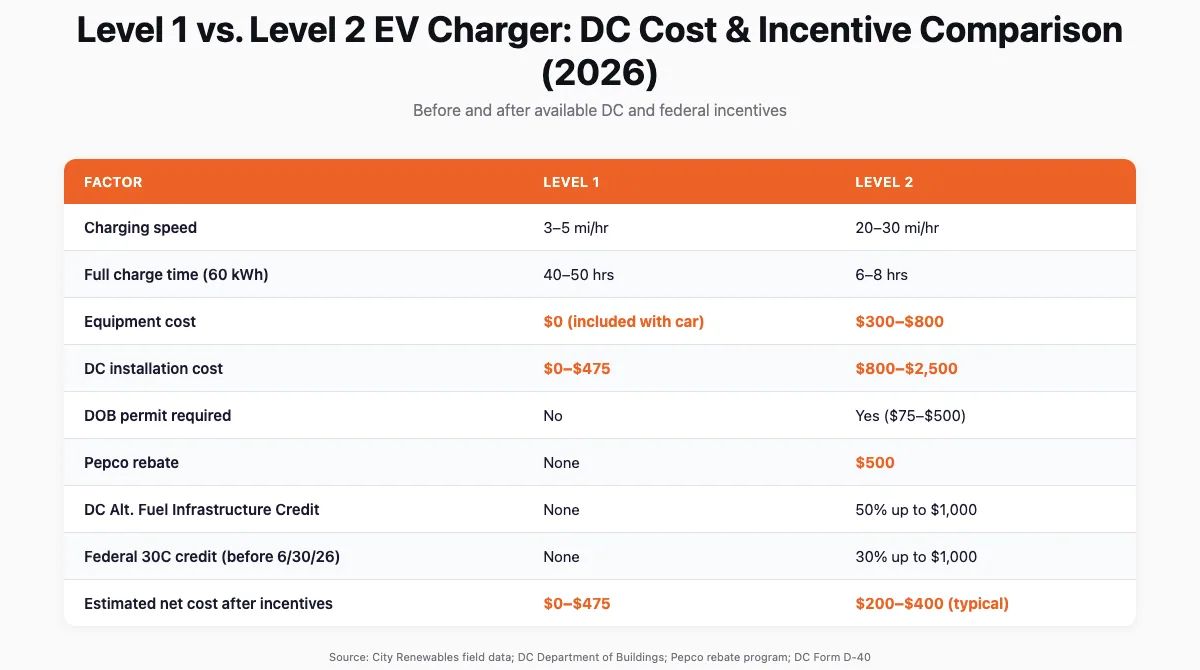
Level 1 vs. Level 2: What's the Real Cost Difference in DC?
| | Level 1 | Level 2 |
|---|---|---|---|
| Outlet voltage | 120V | 240V |
| Circuit amperage | 15–20A | 30–50A |
| Charging speed | 3–5 mi/hr | 20–30 mi/hr |
| Full charge time (60 kWh) | 40–50 hrs | 6–8 hrs |
| Equipment cost | $0 (included with car) | $300–$800 |
| DC installation cost | $0–$475 | $800–$2,500 |
| DOB permit required? | No | Yes ($75–$500) |
| Pepco rebate available? | No | $500 (smart charger) |
| DC Alt. Fuel Infrastructure Credit | No | 50% up to $1,000 |
| Federal 30C credit (before 6/30/26) | No | 30% up to $1,000 |
The gap in upfront cost is real — Level 2 runs $800–$2,500 all-in before incentives. But after the Pepco $500 rebate, the DC Alternative Fuel Infrastructure Credit (50% of equipment and installation, capped at $1,000, claimed on DC Form D-40), and the federal Section 30C credit (30% of installation costs, up to $1,000, for projects completed before June 30, 2026), a $1,500 Level 2 installation can net out to $200–$400 out of pocket. That's a meaningful shift in the calculus.
What Are the Permit Requirements for EV Charger Installation in DC?
In DC, Level 2 charger installation requires a Department of Buildings electrical permit, and the work must be performed by a DC-licensed master electrician. The permit fee runs $75–$500 depending on the scope of work. Level 1 installations using an existing outlet require no permit. A new 120V dedicated circuit technically falls under electrical work but sits in a gray zone — most inspectors don't flag it, but pulling a permit is the cleaner path if you're selling the home later.
For Level 2, the permit process is non-negotiable. The Department of Buildings requires an electrical permit application, a licensed master electrician's signature, and a final inspection before the charger can be energized. Permitmint's 2026 DC guide ↗ lays out the exact steps if you want to verify the current requirements. In practice, a good electrician handles the permit filing as part of the job — it's not something you manage separately. What you do manage is choosing an electrician who actually pulls the permit rather than skipping it to save time. Unpermitted Level 2 work creates problems at resale and can void your homeowner's insurance coverage for EV-related incidents.
Is It Expensive to Charge Your Car with a Level 1 Charger?
Charging with a Level 1 charger is not expensive per kilowatt-hour — Pepco's residential rate runs approximately $0.13–$0.14/kWh in 2026, and Level 1 draws the same electricity at the same rate as Level 2. The cost difference isn't in the price of electricity. It's in the opportunity cost of time and the risk of under-charging. A full EV owner who relies on Level 1 and occasionally can't recover a full charge overnight may top up at a public DC fast charger — where Level 3 DCFC rates run $0.35–$0.50/kWh or higher. Do that twice a week and you've erased the savings from home charging entirely.
The honest answer: Level 1 is inexpensive if your driving patterns fit it. It's expensive if they don't — not because the electricity costs more, but because the workarounds do. Plug-in hybrid owners with 20–30 miles of electric range are the best fit for Level 1. Full EV owners driving more than 40 miles daily are not.
What Is the 80% Rule for EV?
The 80% rule for EVs refers to the standard practice of setting your daily charging limit to 80% of battery capacity rather than 100%. Most EV manufacturers — and DC fast charger networks — recommend this because lithium-ion batteries degrade faster when held at full charge for extended periods. Charging to 80% also allows the battery management system to accept regenerative braking energy without hitting the ceiling. The practical implication for Level 1 owners is significant: if your usable daily range is already limited by slow charging speed, capping at 80% shrinks it further. A 60 kWh battery at 80% gives you 48 kWh of usable capacity — roughly 150–170 miles in a mid-range EV. That's fine for most DC commutes, but it means your Level 1 charger needs to recover 48 kWh overnight, which takes 34–40 hours. You're not recovering that in one night. The 80% rule is good battery hygiene, but it makes the Level 1 math even tighter for full EV owners.
Can I Install a Level 1 Charger at Home?
Yes — any homeowner can install a Level 1 charger at home without a permit or a licensed electrician, provided they're using an existing 120V outlet. The EVSE (the charging cable and control box) comes with the vehicle. You plug it in. That's the installation. If you want a new dedicated 20-amp circuit for cleaner, safer operation, you'll need an electrician for that circuit work, but the charger itself requires no special installation. Renters in DC can also use Level 1 charging from any accessible outlet — no landlord approval needed for the charger itself, though running new wiring is a different conversation. The barrier to Level 1 is essentially zero. The question is whether zero barrier is worth the daily charging constraint.
The DC Case for Skipping Level 1 Entirely
For DC homeowners with a full battery-electric vehicle, the Level 1 question is usually settled quickly: the charging speed doesn't match the driving pattern, and the incentive stack for Level 2 is strong enough in 2026 that the upgrade cost is lower than it looks. The federal Section 30C credit expires June 30, 2026 — that's a hard deadline, not a soft one. After that date, the 30% federal credit on installation costs disappears. The Pepco $500 rebate and the DC Alternative Fuel Infrastructure Credit on Form D-40 remain, but the federal piece is gone.
The smarter long-term move — the one we see DC homeowners make when they're thinking two steps ahead — is pairing a Level 2 charger with a solar installation. Your panels generate electricity during the day, your Level 2 charger recovers your EV overnight, and the net metering credits from Pepco cover the difference. We've written the full sizing guide for that combination in our post on solar and EV charging in DC. The short version: a 6–8 kW solar system in DC produces enough electricity annually to cover both household load and 12,000 miles of EV driving, while generating SREC income at $360–$400/MWh in 2026.
The federal residential solar tax credit (Section 25D) ended for purchased systems on January 1, 2026 — so that piece of the incentive picture has changed. But DC's own incentive programs remain intact. The DC solar incentives that carry into 2026 — SRECs, net metering, and the Solar for All program for income-qualified households — still make the economics work for most DC rooftops. If your roof faces south, southeast, or southwest with reasonable clearance, the combination of Level 2 charging and solar is the most cost-effective path for a DC EV owner right now.
How to Get a Level 2 Charger Installed in DC: Step by Step
- Confirm your panel capacity. A Level 2 charger on a 40-amp circuit draws 32 amps continuously. If your panel is already near capacity, you may need a panel upgrade ($1,500–$3,500) before the charger can be added. An electrician will assess this on-site.
- Choose a smart charger from Pepco's approved list. The Pepco $500 rebate applies only to smart chargers — devices with Wi-Fi connectivity and load management capability. Confirm your model is on the current approved list before purchasing.
- Hire a DC-licensed master electrician. The Department of Buildings requires a master electrician's license for the permit. Get at least two quotes; the range in DC is wide.
- Have the electrician pull the DOB electrical permit. Permit fees run $75–$500. This is not optional for Level 2 work.
- Schedule the DOB inspection. After installation, a city inspector signs off before the charger is energized. Your electrician coordinates this.
- File for your incentives. Submit the Pepco rebate application within 90 days of installation. Claim the DC Alternative Fuel Infrastructure Credit on Form D-40 for the tax year of installation. File for the federal 30C credit on your federal return — but only if installation is complete before June 30, 2026.
FAQ
How much does a level 1 charger cost to install?
A Level 1 charger costs $0 to install if you use an existing 120V outlet — the charging cable comes with the vehicle. If you need a new dedicated 120V circuit, a DC electrician will charge $135–$475 depending on panel distance and wall conditions. No permit is required for a standard 120V outlet in DC.
What is the 80% rule for EV?
The 80% rule means setting your EV's daily charge limit to 80% of total battery capacity to reduce long-term battery degradation. Most manufacturers recommend it because lithium-ion cells held at 100% charge for extended periods lose capacity faster. For Level 1 owners, the 80% limit further tightens the overnight recovery window — a 60 kWh battery at 80% takes 34–40 hours to fully charge on Level 1, which is more than one overnight session.
Can I install a level 1 charger at home?
Yes. Any homeowner — or renter with outlet access — can use a Level 1 charger at home without a permit or electrician. The EVSE plugs into a standard 120V outlet and requires no installation beyond plugging in. If you want a new dedicated circuit for safer, more reliable operation, that circuit work requires a licensed electrician but still no permit in DC.
Is it expensive if you charge your car with a level 1 charger?
Charging on Level 1 costs the same per kilowatt-hour as Level 2 — Pepco's residential rate is approximately $0.13–$0.14/kWh in 2026. The electricity itself is not more expensive. The hidden cost is when slow Level 1 charging forces you to top up at public DC fast chargers, where rates run $0.35–$0.50/kWh or higher. Full EV owners who regularly can't recover overnight on Level 1 often spend more on public charging than they would have on a Level 2 installation.
The Bottom Line
Level 1 charging costs almost nothing to set up and works well for plug-in hybrid owners or anyone driving under 40 miles daily. For full EV owners in DC, it's a constraint that compounds — and the incentive window to upgrade affordably is closing. The federal 30C credit expires June 30, 2026. After that, the net cost of a Level 2 installation goes up by $300–$1,000 depending on your project.
If you're weighing a Level 2 upgrade and want to understand whether pairing it with solar makes sense for your specific roof and driving pattern, start with a Green Zone assessment. We'll tell you what your roof can produce, what a combined solar and Level 2 installation would cost after DC incentives, and whether the numbers work — without pressure to move forward until they do.


