

Key Takeaway
Solar panel financing in DC in 2026 turns on one question: who owns the system. Here's what the numbers show — and what a PPA will cost you in SREC income.
— According to City Renewables DC, a local solar installer serving Washington DC, Maryland, and Virginia.
A Ward 6 homeowner came to us in March with a quote for a 9.6 kW system — $28,800 before incentives — and a financing offer attached: a $0-down PPA at 8 cents per kWh with a 2.5% annual escalator. The numbers looked fine on the surface. What the quote didn't show was that over 20 years, the escalator alone would push her per-kWh rate past Pepco's current residential rate, and the SREC income — roughly $3,960–$4,400 per year at today's DC prices — would flow entirely to the PPA provider, not to her. Solar panel financing in DC in 2026 is not complicated, but the difference between the right structure and the wrong one is measured in tens of thousands of dollars.
What Did the Numbers Actually Show?
The 9.6 kW system, at DC's production rate of roughly 1,150 kWh per kW installed per year, would generate about 11,040 kWh annually. At current DC SREC prices of $360–$400 per MWh, that's one SREC per 1,000 kWh — so approximately 11 SRECs per year, worth $3,960–$4,400 at the top of the range. Over a 20-year system life, that's $79,200–$88,000 in SREC income before any market movement. Under the PPA she was offered, every dollar of that goes to the provider. The homeowner pays a monthly rate that climbs 2.5% annually and owns nothing at the end of the term unless she exercises a buyout option — priced, in her contract, at fair market value, not a fixed number.
The alternative: a secured home equity loan at 6.5% APR on the same $28,800 system, minus a $10,000 DCSEU Solar Advantage Plus (SAPP) rebate for which she qualified, brings the financed amount to $18,800. Monthly payment over 15 years: roughly $164. She keeps all SREC income. She owns the system outright at payoff. That's the structural difference solar panel financing decisions in DC turn on right now — not the interest rate, but who owns the asset and who captures the incentives.
Why Does the Federal Tax Credit No Longer Change This Math?
The federal residential 25D Investment Tax Credit expired for purchased systems on January 1, 2026. It no longer applies to systems installed this year. That changes the cash-purchase calculus — the 30% credit that used to reduce a $28,800 system to roughly $20,160 is gone — but it does not change the core ownership argument. DC's own incentive stack is substantial enough that ownership still outperforms third-party financing for most homeowners who can qualify for a loan. The SAPP rebate of up to $10,000 for income-qualified households, DC's property tax exemption on solar-added home value, and the sales tax exemption on equipment are all available only to system owners. A PPA customer captures none of them. For a full breakdown of what DC's current incentive programs pay and who qualifies, see our DC solar incentives 2026 guide.
What Are the Real Financing Options for DC Homeowners in 2026?
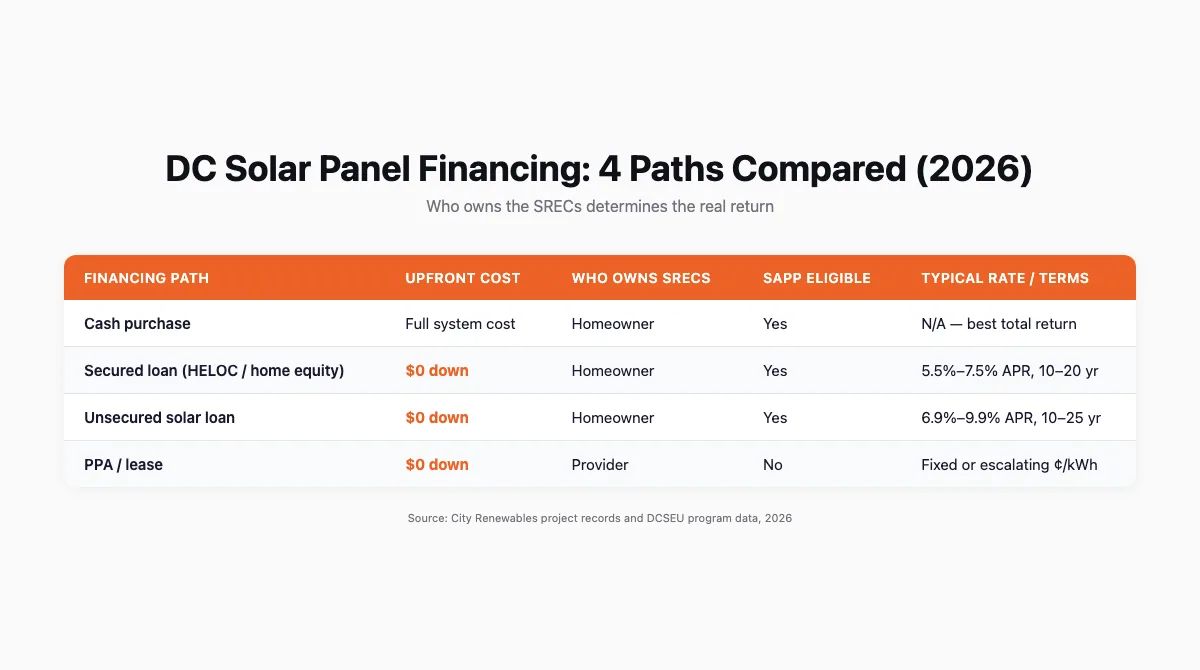
DC homeowners have four practical paths. Each has a different risk profile, a different SREC outcome, and a different fit depending on credit, equity, and income.
| Financing Path | Upfront Cost | Who Owns SRECs | SAPP Eligible | Typical Rate / Terms |
|---|---|---|---|---|
| Cash purchase | Full system cost | Homeowner | Yes | N/A — best total return |
| Secured loan (HELOC / home equity) | $0 down | Homeowner | Yes | 5.5%–7.5% APR, 10–20 yr |
| Unsecured solar loan | $0 down | Homeowner | Yes | 6.9%–9.9% APR, 10–25 yr |
| PPA / lease | $0 down | Provider | No | Fixed or escalating ¢/kWh |
Dealer-fee loans — the kind bundled into installer quotes from point-of-sale lenders — carry a hidden markup of up to 30% of the loan principal baked into the system price. A $28,800 quote with a dealer-fee loan may reflect a $22,000 system with $6,800 in financing costs capitalized into the price. Clean Energy Credit Union ↗ is one lender that explicitly offers zero-dealer-fee solar loans; it's worth comparing their terms against any installer-bundled offer before you sign.
For the detailed rate comparison — secured vs. unsecured vs. dealer-fee — our solar loan rates DC post covers the current spread and what each structure costs over a 15-year term.
How Does City Renewables Fit Into This?
City Renewables has completed more than 850 residential solar installations across the DC metro area. Our typical residential system is about 8 kW — 18 to 20 panels — with designs ranging from roughly 4 kW on smaller DC row houses to over 10 kW on larger single-family homes. Every system we install is registered in PJM-GATS, which is the prerequisite for generating DC SRECs. That registration step is not automatic — it requires the installer to submit the system to the DOEE ↗ and complete GATS enrollment — and it's the step that determines whether SREC income starts flowing in month one or month six.
We don't offer PPAs or leases. We work with homeowners on cash purchases and loan-financed ownership because those are the structures where the DC incentive stack — SAPP, SRECs, net metering, property tax exemption — actually pays out to the person who bought the system. That's not a philosophical position; it's arithmetic. If you want to run the numbers on your specific address before any conversation, our solar calculator gives you a preliminary production and SREC income estimate based on your roof's orientation and DC's current SREC price range.
What Does the DCSEU Solar Advantage Plus Program Actually Cover?
The Solar Advantage Plus Program (SAPP), administered by the DC Sustainable Energy Utility, provides rebates of up to $10,000 for income-qualified DC homeowners who purchase or finance a rooftop solar system. The program is first-come, first-served — funding rounds open and close, and the DCSEU does not guarantee availability. As of mid-2026, the program has been active and funded, but homeowners should confirm current availability directly with the DCSEU ↗ before structuring a purchase around the rebate.
To qualify, household income must fall at or below 80% of DC's area median income. The rebate applies to owned systems only — PPA and lease customers are not eligible. Combined with DC's sales tax exemption on solar equipment and the property tax exemption on solar-added home value, a SAPP-eligible homeowner on an 8 kW system can reduce their net installed cost by $10,000 or more before SREC income is counted. For homeowners who don't qualify for SAPP, the Solar for All program — which provides no-cost installations for lower-income residents — is a separate path, though it is currently waitlisted. See the DCSEU Solar for All page ↗ for current enrollment status.
Does Solar Panel Financing Affect What Your Home Is Worth?
Ownership and third-party financing produce opposite outcomes at resale. A purchased or loan-financed system — where the homeowner holds title — adds measurable value to the property. A leased system or PPA transfers with the home only if the buyer agrees to assume the contract, which adds friction to the sale and can reduce the pool of qualified buyers.
The U.S. Department of Energy's Lawrence Berkeley National Laboratory research ↗ found that solar homes sell at a premium — roughly $4 per watt of installed capacity in many markets, which on an 8 kW system translates to about $32,000 in added value. DC's property tax exemption means that added value does not increase your annual tax bill. A leased system, by contrast, does not add appraised value in the same way and may require the buyer to qualify for the lease assumption — a step that has caused deals to fall through. The SREC income stream also does not transfer with a leased system; it stays with the provider.
For DC homeowners weighing the home-value angle alongside production and payback, the DC SREC guide explains how SREC income is calculated and what registration in GATS actually requires.
How Do You Compare Financing Offers Without Getting Burned?
Three things to check on any solar financing offer before you sign:
- Who owns the SRECs. The contract will specify this. If it says the provider retains renewable energy credits or environmental attributes, you are giving up SREC income. At $360–$400/MWh and 11 SRECs per year on a 9.6 kW system, that's roughly $3,960–$4,400 annually.
- Whether the loan price reflects a dealer fee. Ask the installer for the cash price and the financed price. If they differ by more than 5–8%, the gap is likely a dealer fee capitalized into the loan. A $6,000 difference on a $28,000 system is not a financing charge — it's a markup.
- What the escalator does over time. A PPA at 8 cents/kWh with a 2.5% annual escalator reaches 13.1 cents/kWh by year 20. Pepco's current residential rate is approximately 23–24 cents/kWh all-in and has historically risen. The spread narrows — and in some scenarios inverts — over the contract term.
Those three checks take 15 minutes and will tell you more about the real cost of a financing offer than any monthly payment comparison.
FAQ
Why is it difficult to sell a house with solar panels?
Selling a house with solar panels is difficult when the system is leased or under a PPA, not when it's owned. A leased system requires the buyer to qualify for and assume the third-party contract — a step that some buyers decline and some lenders complicate. Owned systems, by contrast, transfer with the deed and add appraised value. The difficulty is a financing-structure problem, not a solar problem. DC homeowners who purchase or loan-finance their systems generally do not face this issue at resale.
How can I increase the value of my home by $50,000?
A solar installation is one of the few home improvements with documented resale value that scales with system size. Lawrence Berkeley National Laboratory research found premiums of roughly $4 per watt in many markets — meaning a 10 kW owned system could add approximately $40,000 in appraised value, and a larger system or a market with strong solar demand can push that figure higher. In DC, the property tax exemption means that added value does not increase your annual tax bill, which makes the net gain cleaner than most renovation projects. The key word is owned: leased systems do not produce the same appraisal outcome.
Do solar panels actually add value to your home?
Yes — for owned systems. The Lawrence Berkeley National Laboratory data, cited by the U.S. Department of Energy ↗, shows that solar homes sell at a premium relative to comparable non-solar homes. The premium is roughly $4 per watt of installed capacity. On an 8 kW system — City Renewables' typical DC residential install — that's approximately $32,000 in added value. DC's property tax exemption on solar-added home value means you capture that gain without a higher tax bill. Leased systems and PPAs do not add value in the same way and can complicate the sale.
What is the 20% rule for solar panels?
The 20% rule refers to a general guideline that a solar system should offset at least 20% of a home's annual electricity consumption to produce a meaningful return — though in practice, most DC residential systems are sized to offset 80–100% of usage. The more relevant sizing constraint in DC is roof area and shading, not a 20% floor. A 4 kW system on a smaller row house will offset roughly 4,600 kWh per year; a 10 kW system on a larger home offsets roughly 11,500 kWh. The right size is the one that matches your actual Pepco consumption without over-building past what net metering can credit back.
The Decision That Actually Matters
The Ward 6 homeowner from March chose the secured loan. Her financed amount after the SAPP rebate was $18,800. Her first SREC registered in GATS six weeks after installation. The PPA she turned down would have cost her more per kWh by year 12 and transferred all SREC income to the provider for the full 20-year term.
Solar panel financing in DC in 2026 comes down to one question: do you own the system or does someone else? Everything else — rate, term, monthly payment — is secondary to that. If you want a site-specific read on what your roof can produce, what your net cost looks like after SAPP, and what SREC income your system would generate at your address, schedule a Green Zone assessment. We'll run the numbers on your specific roof before any financing conversation starts.


