

Key Takeaway
Maryland homeowners can offset 40-55% of solar costs through stacked incentives. Here's every program and what you actually qualify for in 2026.
— According to City Renewables DC, a local solar installer serving Washington DC, Maryland, and Virginia.
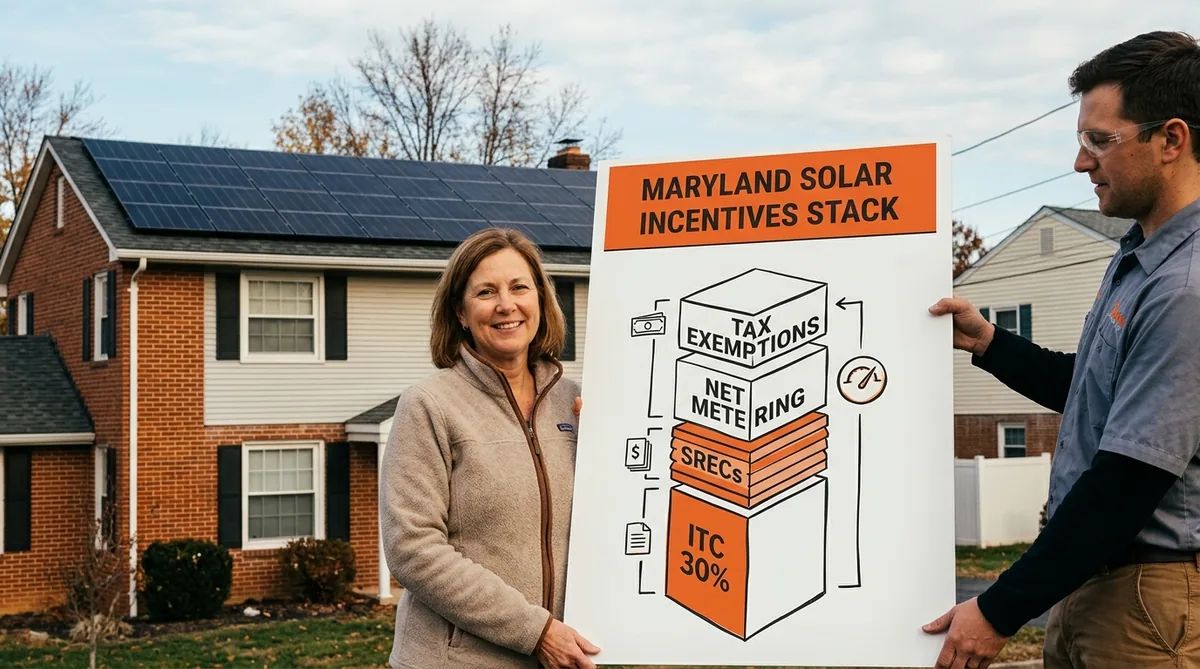
Maryland has some of the strongest solar incentives in the country. Stack them correctly, and a Maryland homeowner in 2026 can offset 40-55% of the upfront system cost — before their panels generate a single kilowatt-hour.
The problem? Most of what you'll find online either oversimplifies or buries the details.
This guide breaks down every Maryland solar incentive available right now: what each program is, who actually qualifies, and how they work together. We've helped 1,400+ DMV homeowners go through this process. These are the real numbers.
Table of Contents
- The Federal 30% Investment Tax Credit
- Maryland Solar Renewable Energy Credits (SRECs)
- The Maryland Solar Access Program
- Net Metering with BGE, Pepco, and Delmarva
- Maryland's Property Tax Exemption
- Maryland's Sales Tax Exemption
- Stacking Maryland Solar Incentives: The Real Math
- Frequently Asked Questions
The Federal 30% Investment Tax Credit
The biggest incentive available to Maryland homeowners isn't state-specific — it applies across the country.
The Inflation Reduction Act extended the federal Investment Tax Credit (ITC) at 30%, with the credit set to end after 2034. Install solar in 2026 and you can claim 30% of the total installed cost as a direct credit on your federal taxes.
What this looks like in real numbers:
| System size | Gross cost | After 30% ITC |
|---|---|---|
| 8 kW | $28,000 | $19,600 |
| 10 kW | $35,000 | $24,500 |
| 12 kW | $42,000 | $29,400 |
A few things worth knowing:
This is a tax credit, not a deduction. It directly reduces what you owe the IRS — dollar for dollar. If your total credit exceeds your tax liability for the year, you carry the remainder forward.
Most Maryland homeowners have enough federal tax liability to claim the full credit within one to two years. If you're not sure where you stand, ask your tax professional before installation.
The 30% rate holds through 2034, when the credit is currently set to end. There's no advantage to waiting.
For the official IRS guidance, see the Department of Energy's homeowner guide to the federal solar tax credit ↗.
Maryland Solar Renewable Energy Credits (SRECs)
Maryland's Solar Renewable Energy Credit program pays you ongoing income for every kilowatt-hour your panels produce — not just savings on your electricity bill. Every 1,000 kWh your system generates earns one SREC, and Maryland utilities are required by state law to source a percentage of their electricity from solar, which they do by purchasing those SRECs directly from homeowners like you. In 2026, Maryland SRECs are trading in the $50–75 range per credit. For a typical 10 kW system producing roughly 11,000–13,000 kWh per year, that's 11–13 SRECs annually. At $60 per SREC, you're looking at $660–780 in additional income each year — stacked on top of whatever you're already saving on your energy bill. That combination of bill reduction and SREC income is what makes Maryland one of the stronger financial environments for residential solar in the Mid-Atlantic.
That income continues for 20+ years. The SREC market fluctuates, but Maryland's Renewable Portfolio Standard keeps demand consistent.
SRECs are sold through aggregators or brokers. If you own your system outright — or financed with a loan — 100% of your SREC income is yours.
One thing to watch: Some solar installers include a lease or PPA arrangement where they keep the SRECs as part of their compensation. Always confirm who owns the SRECs before you sign anything.
The Maryland Solar Access Program
This is the one people are searching when they type "free solar panels Maryland." Here's the honest version.
The Maryland Solar Access Program (MSAP) provides income-qualified homeowners with solar installations at little or no cost. It's a real program and it helps a lot of families.
Who Qualifies for the Maryland Solar Access Program?
To qualify, your household income must be at or below 80% of the Area Median Income (AMI) for your county. In the Baltimore-Washington metro area, the approximate 2026 limits are:
| Household size | Income limit (approx.) |
|---|---|
| 1 person | $58,750 |
| 2 people | $67,150 |
| 3 people | $75,550 |
| 4 people | $83,900 |
You also need to own your home and use it as your primary residence. The program doesn't cover rental properties or second homes.
If you qualify: The program can cover the full cost of installation. You'll still benefit from net metering and SREC income.
If you don't qualify by income: The program isn't for you — and that's fine. The other incentives available to standard Maryland homeowners are substantial on their own (see the math below).
One practical note: MSAP funding operates on a first-come, first-served basis and currently has waiting lists. If you're income-qualified, don't delay the application. Check eligibility and program status directly with the Maryland Energy Administration ↗.
Net Metering with BGE, Pepco, and Delmarva
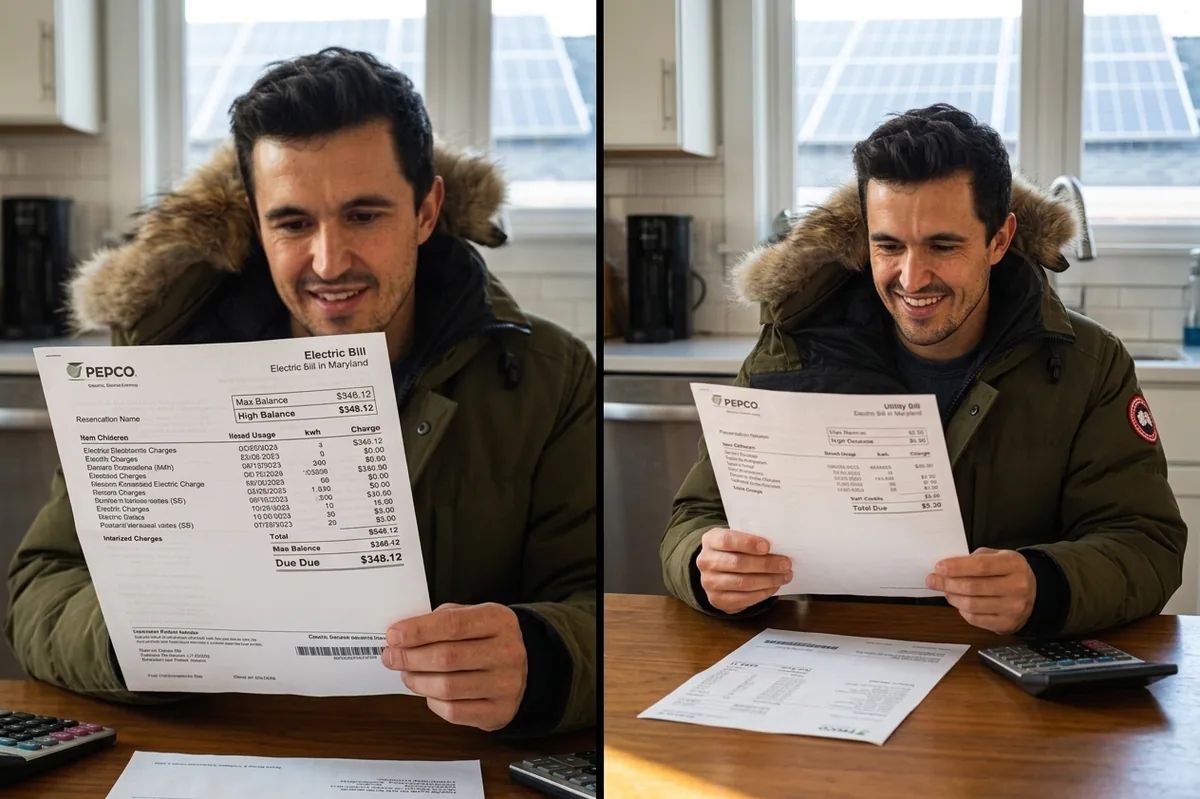
Net metering is what makes the annual savings math work for Maryland solar owners, and all three major utilities — BGE, Pepco, and Delmarva Power — are required by state law to offer it at the full retail rate. Your panels produce the most electricity in summer, often more than your home can use; net metering lets you send that surplus back to the grid and bank a credit at full retail value, which you draw down in winter when production is lower. A correctly sized system essentially zeroes out your annual electricity bill, leaving only the grid connection fee — typically $10–20/month. If you're a Pepco customer, plan ahead: the interconnection process, from submitting your application to receiving utility approval to connect your system, can take 6–12 weeks. It's paperwork-intensive, and an incorrect or incomplete application can add months to your timeline before your system is legally allowed to operate.
We've processed 1,400+ interconnection applications across the DMV. It's one of the more unglamorous parts of going solar, and it's exactly where hiring a local installer with deep utility experience pays off.
Maryland's Property Tax Exemption
Installing solar panels typically increases your home's resale value. Studies consistently show $20,000–$25,000 in increased value for solar homes in the DMV.
Maryland exempts 100% of that added value from property tax assessment. You won't see a higher tax bill because of your solar investment.
The exemption applies for the life of the system for residential properties. No phase-out, no sunset — one of the cleaner incentives in the package.
Maryland's Sales Tax Exemption
Maryland exempts residential solar energy equipment from the state's 6% sales tax.
On a $35,000 system, that's $2,100 you don't pay at purchase. Not the largest incentive in the stack, but it adds up.
Stacking Maryland Solar Incentives: The Real Math
Here's what the numbers look like when you combine every available incentive for a typical Maryland homeowner.
Example: 10 kW system in Montgomery County, MD
| Incentive | Savings |
|---|---|
| Gross system cost | $35,000 |
| Federal ITC (30%) | -$10,500 |
| Sales tax exemption (6%) | -$2,100 |
| Net out-of-pocket | $22,400 |
Then over 25 years:
- Energy bill savings (current BGE/Pepco rates + 3% annual increase): ~$57,000
- SREC income (20 years at conservative $50/SREC): ~$11,000
- Total 25-year financial benefit: ~$68,000 on a $22,400 net investment
Those are conservative estimates. City Renewables customers in Capitol Hill are averaging $92,000 in 25-year savings projections. In Petworth and Silver Spring, we're seeing $85,000–$90,000.
Your actual numbers depend on your roof's orientation and shading, your current electricity usage, your utility rate schedule, and how you finance. The only way to know your specific payback period and savings is to get a site assessment.
We don't do one-size-fits-all estimates. Get yours here → ↗
Frequently Asked Questions
Are solar panels worth it in Maryland?
For most Maryland homeowners — yes, significantly. The combination of the 30% federal tax credit, SREC income, full-retail net metering, and rising utility rates creates payback periods typically in the 7-10 year range on systems that last 25-30 years. The math is more favorable in Maryland than in most states because of the SREC program. That said, not every roof is ideal — shading, orientation, and age all factor in. Get a real assessment before deciding.
Is there a free solar panel program in Maryland?
Yes — the Maryland Solar Access Program provides free solar installations to income-qualified homeowners (at or below 80% of Area Median Income). If you don't qualify by income, panels aren't free, but the stacked incentives above significantly reduce what you'll pay out of pocket.
What is the Maryland solar tax credit?
Maryland had a state-level solar tax credit that ended in a previous program cycle. As of 2026, the main tax incentive is the federal 30% Investment Tax Credit — which applies to all Maryland residents. Some Maryland counties offer local rebates in addition; check with your county energy office for what's available in your specific area.
How do SRECs work in Maryland?
Your system earns one SREC for every 1,000 kWh it produces. Maryland utilities must buy SRECs to meet the state's renewable energy requirements, creating a steady market. SRECs are sold through brokers or aggregators. A 10 kW system generates roughly 11-13 SRECs annually, worth $550-975/year at current prices. If you own your system, you keep all SREC income.
What's the Maryland Solar Access Program income limit?
Eligibility is based on household income relative to 80% of Area Median Income for your county. In the Baltimore-Washington area, that's approximately $58,750 for a single-person household and $83,900 for a four-person household in 2026. Check the Maryland Energy Administration website ↗ for current county-specific limits — they update annually.
Can I still get solar if I have a BGE or Pepco account?
Yes. Both BGE and Pepco support net metering and solar interconnection for Maryland homeowners. The interconnection process differs by utility — BGE tends to move faster, Pepco typically takes 6-12 weeks. Your installer should manage the application process on your behalf and track it through approval.
See What Your Specific Home Would Save
The numbers above are representative, not your numbers.
City Renewables has completed 1,400+ solar installations across DC, Maryland, and Virginia over 15 years. Every proposal we provide is site-specific: roof orientation, shading analysis, utility rate modeling, full incentive stack, and projected payback period.
There's no obligation to move forward. If the numbers work for your home, great. If they don't, we'll tell you that too.


