

Key Takeaway
DC row house renovations cost $250–$480/sq ft — and most homeowners do them in the wrong order. Here's why solar should come first.
— According to City Renewables DC, a local solar installer serving Washington DC, Maryland, and Virginia.
Table of Contents
- The Renovation Sequencing Problem Most DC Homeowners Get Wrong
- Can You Renovate a Row House?
- What Does a DC Row House Renovation Actually Cost?
- Why Solar Should Come Before the Kitchen, the Roof, and Almost Everything Else
- The Right Order: A Renovation Sequence for DC Row Houses
- What Is the 30% Rule for Renovations?
- What to Defer — and What Happens If You Don't
- Historic District Rules That Change the Sequence
- Frequently Asked Questions
- Start With a Green Zone Assessment
Most DC homeowners renovating a row house spend $250 to $480 per square foot — and a significant share of them do it in the wrong order, paying twice for work that a smarter sequence would have covered once. The most common mistake: scheduling the roof replacement last, after the kitchen and bathrooms are done, when the roof is the one thing that determines whether solar is viable, structurally sound, and permitted without a second mobilization fee.
City Renewables installs solar on DC row houses — Federal style, Victorian, mid-century, and everything in between — across neighborhoods from Bloomingdale to Capitol Hill to Petworth. The sequencing advice in this post comes from watching homeowners make expensive ordering mistakes, and from knowing exactly what a solar installation requires before it can happen.
The Renovation Sequencing Problem Most DC Homeowners Get Wrong
The core problem with DC row house renovations is that most homeowners plan them by desire, not by dependency. They want the kitchen first because that's what they'll see every day. They defer the roof because it's invisible and unglamorous. They think about solar last, if at all — usually after a neighbor gets panels and they realize they've just re-roofed with a material that won't support a rack mount.
Dependency-based sequencing works differently. You ask: what does each project require to be in place before it can happen? A kitchen remodel requires working electrical and plumbing. A bathroom requires the same. Solar requires a roof with 10 to 15 years of remaining life, correct structural load capacity, and — in historic districts — Historic Preservation Office approval before any exterior work begins. If you do the kitchen before the roof, and the roof before solar, you've paid three mobilization fees and potentially disrupted finished work twice. On a 1,500-square-foot Bloomingdale row house, that sequencing error can cost $15,000 to $30,000 in redundant labor and material handling.
Can You Renovate a Row House?
Yes, you can renovate a DC row house — but the process involves more regulatory layers than a detached single-family home, and those layers directly affect your renovation sequence. DC row houses share party walls with neighbors, which means any structural work touching those walls requires coordination and, in many cases, a party wall agreement filed with DCRA before permits are issued. Masonry repairs on the front facade in a historic district require Historic Preservation Office review. Interior work on non-historic properties can often use DC's Instant Permit system for simpler scopes, which processes approvals online without a counter visit.
The Scout database — DC's public permit and property information tool — is the right first stop before any renovation planning. It shows open permits, closed permits, historic district status, and zoning overlays for any DC address. A homeowner on r/washingtondc reported discovering two open permits from a previous owner's unfinished work, which had to be officially closed before their own renovation permits could be issued. That kind of title-chain problem is common in DC's older housing stock, and finding it early — before you've signed a GC contract — saves weeks of delay. If your property sits in one of DC's 30-plus historic districts, visible exterior changes require approval from the Historic Preservation Review Board, which meets on a set schedule and does not expedite for convenience.
What Does a DC Row House Renovation Actually Cost?
Mid-range DC row house renovation costs run $250 to $480 per square foot in 2026, according to the TAV Remodeling 2026 DC Metro Cost Guide. A full gut renovation of a 1,500-square-foot row house therefore lands between $375,000 and $720,000 before contingency. Budget a 15 to 20 percent contingency on top of that baseline — DC's older masonry row houses regularly surface hidden conditions: deteriorated lintels, knob-and-tube wiring behind plaster, lead paint in window wells, and failing mortar in party walls that wasn't visible during inspection.
| Scope | Cost Range (per sq ft) | Notes |
|---|---|---|
| Cosmetic refresh | $50–$100 | Paint, fixtures, flooring only |
| Kitchen or bath remodel | $150–$300 | Per room, not whole house |
| Mid-range full renovation | $250–$480 | Structural, MEP, finishes |
| High-end full renovation | $480–$700+ | Custom millwork, full systems replacement |
| Solar installation (whole system) | $3.50–$5.00/watt | Separate from GC scope; see below |
For qualifying homeowners, two DC programs can offset renovation costs significantly. The Historic Homeowner Grant Program offers up to $50,000 for exterior and structural repairs in historic districts for households under 120 percent of area median income. The Single Family Residential Rehabilitation Program (SFRRP) provides grants up to 50 percent of the property's tax-assessed value for essential repairs, subject to a long-term covenant on the property. Both programs are administered through DOEE and have application windows — check doee.dc.gov ↗ for current cycles.
Why Solar Should Come Before the Kitchen, the Roof, and Almost Everything Else
Solar should be one of the first decisions in a DC row house renovation — not because it's the most exciting project, but because it sets constraints that every other project has to work around. A solar installation on a DC row house requires a roof with at least 10 to 15 years of remaining life. If you're planning to replace the roof anyway, doing it before solar means the installer mounts on a fresh surface with full warranty coverage. If you replace the roof after solar, you pay to remove and reinstall the panels — typically $1,500 to $3,000 in additional labor — and you void the roof warranty on the penetration points.
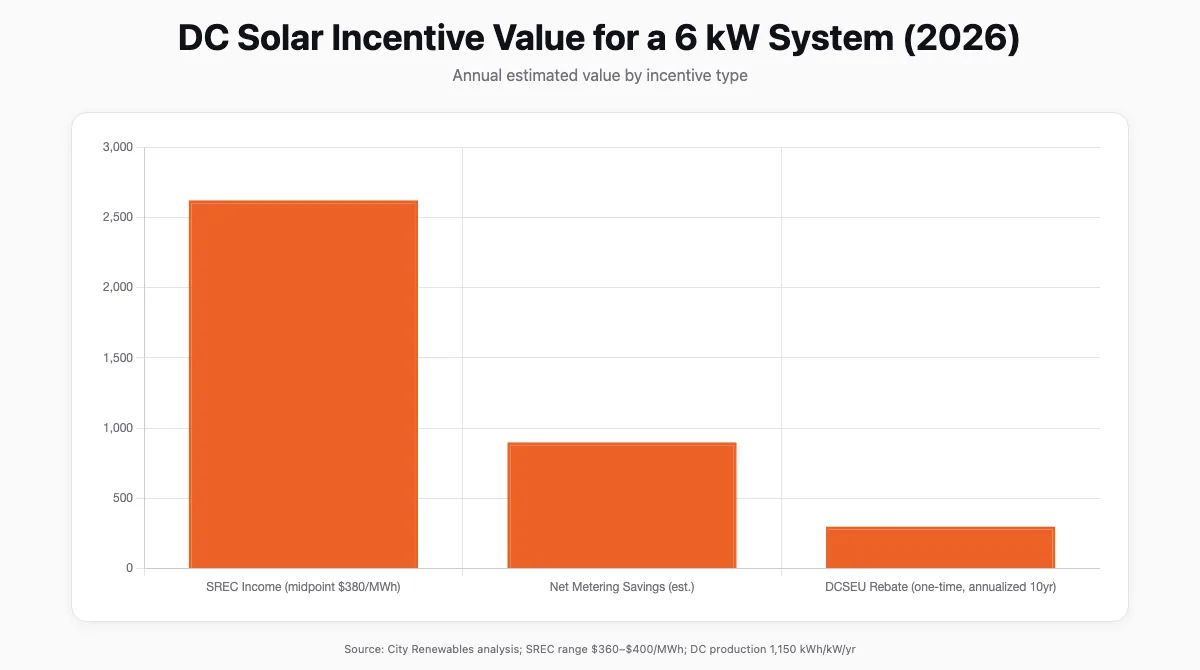
The financial case for moving solar up the sequence is specific. A typical DC row house roof holds 3 to 6 kilowatts of panels. At DC's average production rate of roughly 1,150 kWh per kilowatt installed per year, a 4 kW system generates about 4,600 kWh annually. In 2026, DC Solar Renewable Energy Certificates (SRECs) trade at approximately $360 to $400 per MWh on platforms like SRECTrade ↗. That's $1,656 to $1,840 per year in SREC income alone on a 4 kW system — income you forfeit for every month solar is deferred while you finish the kitchen. See our DC SREC guide for the full mechanics of how SRECs are earned and sold.
The federal residential 25D Investment Tax Credit for purchased solar systems ended on January 1, 2026. That changes the financial math but doesn't change the sequencing logic — DC's SREC market and net metering still make solar financially sound, and the DC solar incentives available in 2026 are worth understanding before you finalize your renovation budget.
The Right Order: A Renovation Sequence for DC Row Houses
This sequence assumes a full or substantial renovation. Adjust based on your actual scope.
- Title and permit audit. Pull your property record in Scout. Confirm all prior permits are closed. Identify historic district status and any deed restrictions.
- Structural assessment. Hire a structural engineer to evaluate the roof deck, party walls, and foundation before any other work is scoped. This determines what's possible and what's required.
- Roof replacement (if needed) + solar design. If the roof needs replacement, do it now. Simultaneously, get a solar site assessment — we can tell you panel count, orientation, and shading impact before the roofer finalizes material selection. Some roofing materials are incompatible with certain mounting systems.
- Solar installation. Once the roof is fresh and the structural assessment is complete, solar goes on. Permitting through DCRA runs 2 to 6 weeks; Pepco interconnection adds another 4 to 12 weeks. Start this process early so the system is generating by the time you move in.
- Electrical panel upgrade. Solar often requires a panel upgrade anyway. Doing it as part of the solar scope — rather than as a separate kitchen or EV charger project — consolidates the electrical work and the permit.
- HVAC and envelope. Air sealing, insulation, and HVAC replacement come next. The right-sized HVAC system depends on the envelope performance you've achieved — don't size equipment before you've tightened the building.
- Kitchen and bathrooms. Now the big-ticket finish work. Electrical and plumbing rough-in is already done or coordinated. No surprises from the roof or structural work above.
- Cosmetic finishes. Paint, flooring, fixtures, millwork. Last, because everything else creates dust and damage.
What Is the 30% Rule for Renovations?
The 30% rule in DC renovation contexts refers to a DCRA threshold: if the cost of your renovation exceeds 30 percent of the building's assessed value, the project may be classified as a substantial improvement, triggering full code compliance for the entire structure rather than just the renovated portion. This matters most for older DC row houses that were built under codes that predate current requirements for egress, electrical capacity, and fire separation. A row house assessed at $800,000 hits the 30% threshold at $240,000 in permitted work — a number that's easy to cross on a full renovation.
The practical implication: if you're close to the 30% threshold, phasing your renovation across permit cycles can sometimes keep individual permits below the trigger. This is a conversation to have with your architect or GC before you pull the first permit, not after. It also affects how you sequence solar — a solar permit is a separate building permit from your renovation permit, so it typically doesn't count toward the renovation's cost basis for the 30% calculation. Confirm this with DCRA for your specific project.
What to Defer — and What Happens If You Don't
Not everything needs to happen in the first renovation phase. Deferring the right projects saves money and avoids disrupting finished work. Deferring the wrong ones creates cascading problems.
Safe to defer:
- Landscaping and backyard hardscaping (no structural dependency)
- Basement finishing, if the basement is dry and functional
- Decorative exterior work like porch railings or window box installation
- EV charger installation (can be added after electrical panel upgrade with minimal disruption)
Risky to defer:
- Roof replacement when the roof has fewer than 5 years of life. A leak after the kitchen is done costs far more than the roof itself.
- Electrical panel upgrade when you're adding solar, an EV charger, or induction cooking. Undersized panels create bottlenecks that require reopening finished walls.
- Party wall repairs. DC's masonry row houses share structural walls, and a deteriorating party wall affects your neighbor's property. Deferred party wall work can become a legal dispute.
- Lead paint and asbestos abatement. DC requires disclosure and proper abatement before renovation work disturbs these materials. Doing finish work first and abatement second means redoing the finishes.
Historic District Rules That Change the Sequence
About 30 percent of DC's residential properties sit in a historic district, and the rules there add steps that affect sequencing directly. Any exterior change visible from a public way — including solar panels on a front-facing roof slope — requires a Certificate of Appropriateness from the Historic Preservation Review Board before DCRA will issue a building permit. The HPRB meets monthly, and applications have submission deadlines roughly three weeks before each meeting. Miss the deadline and you wait another month.
For solar specifically, rear and side roof slopes are almost always approvable without a full HPRB hearing — a staff-level review is usually sufficient. Front-slope solar is harder and sometimes denied. This is why the structural assessment and solar site survey need to happen before you've committed to a roofing material or a panel layout. If your best solar exposure is on the front slope and you're in a historic district, you need to know that before the roofer shows up. Our existing guide on solar panels on DC row houses covers the historic district approval process in detail — we won't repeat it here, but it's required reading before you finalize your renovation sequence.
For non-solar exterior work in historic districts, the Historic Homeowner Grant Program's $50,000 ceiling can cover a meaningful share of masonry repointing, window restoration, or roof replacement on a contributing structure. The grant requires HPRB-approved materials and methods, which adds review time but doesn't change the sequencing logic — it just means the approval process starts earlier.
Frequently Asked Questions
Can you renovate a row house?
Yes. DC row houses are renovated regularly, including full gut renovations and additions. The process involves DCRA permits, and in historic districts, Historic Preservation Office review for exterior changes. Party wall agreements are required for structural work on shared walls. DC's Instant Permit system handles simpler interior scopes online. Budget 15 to 20 percent contingency for hidden conditions common in DC's older masonry stock.
How much does a row home cost in DC?
DC row house prices vary widely by neighborhood and condition. As of 2026, move-in-ready row houses in neighborhoods like Capitol Hill, Columbia Heights, and Petworth typically list between $700,000 and $1.4 million. Unrenovated or value-add properties can be found below $700,000 in some neighborhoods, but renovation costs of $250 to $480 per square foot mean the total investment often exceeds the purchase price of a finished comparable.
What is the 30% rule for renovations?
In DC, the 30% rule refers to a DCRA threshold where renovation costs exceeding 30 percent of a building's assessed value may trigger full code compliance requirements for the entire structure. On an $800,000 row house, that threshold is $240,000 in permitted work. Projects near this threshold benefit from phased permitting and early coordination with an architect familiar with DC's building code.
Is $100,000 enough to renovate a house?
For a DC row house, $100,000 covers a targeted renovation — one or two rooms, or systems work like electrical and HVAC — but not a full renovation. At $250 to $480 per square foot, a full renovation of even a modest 1,200-square-foot row house runs $300,000 to $576,000. A $100,000 budget is most effective when applied to high-dependency items first: roof, electrical panel, and solar, which generate ongoing returns rather than purely aesthetic value.
Start With a Green Zone Assessment
The right renovation sequence for your DC row house depends on your specific roof, your historic district status, your electrical panel, and your timeline. Solar belongs near the top of that sequence — not because we install it, but because deferring it costs real money in foregone SREC income and creates redundant work when you eventually do it after the kitchen is done.
A Green Zone assessment is where we start with every DC homeowner. We evaluate your roof, your shading, your panel capacity, and your historic district constraints — and we give you a clear picture of what solar looks like in your renovation sequence before you've committed to anything else. No pressure, no quote-first approach. Just the information you need to sequence your renovation correctly.


