

Key Takeaway
DC solar projects take 8–12 weeks from contract to PTO. Here's what's normal, what signals a delay, and how to verify an installer's track record before you sign.
— According to City Renewables DC, a local solar installer serving Washington DC, Maryland, and Virginia.
A standard residential solar project in DC takes 8 to 12 weeks from signed contract to Permission to Operate — but solar installation delays stretch that to 4 to 6 months for a significant share of homeowners. The gap isn't random. It follows predictable patterns: permit applications that sit unreviewed, equipment that ships late, and scheduling queues that nobody tells you about. Knowing the normal timeline — and the specific signals that a project is off track — is the most practical protection you have before you sign anything.
We're City Renewables, a solar installer based in Washington, DC. We design and install residential and small commercial systems across the District, and we handle every step in-house: site survey, DC Department of Buildings (DOB) permitting, Pepco interconnection, and final commissioning. This post draws on what we see on actual DC rooftops and what our customers ask us most often before they commit.
What Does a Normal DC Solar Timeline Actually Look Like?
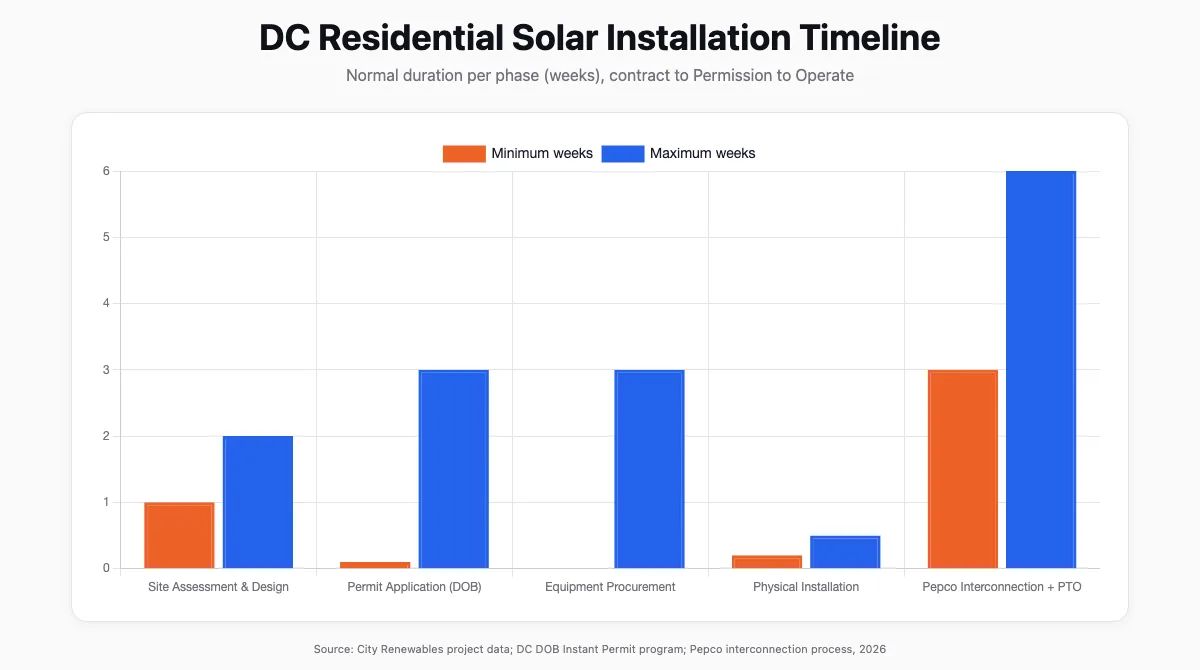
A normal DC solar installation timeline runs 8 to 12 weeks from contract signing to system activation, broken into five distinct phases. Permit application takes 1 to 2 weeks. DOB plan review runs 2 to 3 weeks for standard projects. Physical installation — the crew on your roof — takes 1 to 3 days. Inspection by the DC Department of Buildings adds 1 to 2 weeks. Pepco interconnection and Permission to Operate (PTO) takes 3 to 6 weeks after a passed inspection. Each phase has a hard dependency on the one before it, which is why a single bottleneck early in the process can push your activation date by weeks, not days. As of February 2026, the DC Department of Buildings offers Instant Permits ↗ for simple scopes of work — residential solar systems that meet specific criteria can be approved online without the traditional review queue, which can cut 2 to 3 weeks off the permit phase alone.
| Phase | Normal Duration | Common Delay Cause |
|---|---|---|
| Permit application | 1–2 weeks | Incomplete drawings, wrong fee category |
| DOB plan review | 2–3 weeks | Backlog, revision requests |
| Physical installation | 1–3 days | Crew scheduling, equipment availability |
| DC DOB inspection | 1–2 weeks | Inspector availability, failed first inspection |
| Pepco PTO | 3–6 weeks | Incomplete interconnection application, utility queue |
| Total (normal) | 8–12 weeks | — |
For a deeper look at the Pepco side specifically, see our post on the Pepco solar approval process, which covers every interconnection step and what causes utility-side delays.
Why Do Solar Installation Delays Happen So Often?
Solar installation delays are an industry-wide pattern, not an isolated bad-luck story. On r/washingtondc, homeowners have reported waiting 5 to 6 months between signing a contract and seeing a crew on their roof — with no proactive updates from their installer in between. The causes cluster into three categories.
Permitting bottlenecks are the most common. DC's DOB has a real review queue, and applications with incomplete structural drawings or incorrect electrical specs get kicked back for revision. Each revision cycle adds 1 to 3 weeks. Installers who use generic permit packages rather than site-specific drawings generate more revision requests.
Equipment procurement delays became acute during 2022 and 2023 supply chain disruptions, and freight timing remains a variable in 2026. A project scheduled for a specific panel model can stall if that SKU is backordered. Installers who don't confirm equipment availability before scheduling installation dates create a false sense of progress.
Scheduling queue depth is the least visible cause. Some installers sign contracts faster than their crews can execute them. Your project enters a queue that isn't disclosed at signing. The SEIA has documented ↗ that permitting and interconnection friction — not installation labor — accounts for the majority of residential project timeline variance nationwide.
What Are the Red Flags Before You Sign?
The clearest red flags in a solar contract or sales conversation are vague timeline language, no milestone schedule, and no defined communication cadence. A contract that says "installation within 90 to 180 days" without specifying which milestones trigger which phases gives the installer maximum flexibility and you minimum visibility. Here's what a legitimate project schedule should include before you sign:
- A specific target date for permit application submission
- An estimated DOB plan review completion date
- A confirmed equipment procurement status (in stock vs. on order)
- A scheduled installation window — not a range of months
- A named point of contact for status updates and their response time commitment
- A defined process for notifying you if any phase slips
If a sales rep can't answer questions 1 through 3 at the time of contract signing, the project isn't ready to start. That's not a scheduling gap — it's a process gap. You can also ask whether the installer uses the DC DOB's Instant Permit pathway for eligible systems. An installer who isn't aware of that option as of 2026 may not be current on DC-specific permitting practice.
How Do You Verify an Installer's Track Record on Timelines?
Verifying an installer's timeline track record before signing takes about 30 minutes and three specific checks. First, ask for three references from DC projects completed in the last 12 months — not testimonials on their website, but names and phone numbers of actual customers. Ask those customers how long their project took from contract to PTO and whether the installer communicated proactively when anything slipped. Second, check the installer's DC DOB contractor license status at dob.dc.gov ↗ — an active license with no recent violations is a baseline, not a differentiator, but it confirms the company is operating legally in the District. Third, ask the installer to show you a sample project schedule from a recently completed job. A company that tracks milestones will have this document. One that doesn't track milestones won't.
For context on what incentives are actually available in DC right now — including SRECs and net metering — see our DC solar incentives 2026 guide before you finalize your financial assumptions. The federal residential 25D Investment Tax Credit ended January 1, 2026, so any installer still quoting a "30% federal tax credit" on a new purchase is working from outdated information.
What Does City Renewables Do Differently on Scheduling?
City Renewables builds a milestone schedule into every project before the contract is signed — not after. When you receive a proposal from us, it includes a projected permit submission date, an estimated DOB review completion window, a confirmed equipment availability status, and a scheduled installation week. We don't schedule installation dates until we have permit approval in hand and equipment confirmed at our supplier. That sequencing prevents the most common cause of last-minute delays: a crew showing up before the permit is ready, or a permit being ready before the equipment arrives.
We use the DC DOB's Instant Permit pathway for every eligible residential system — as of 2026, systems up to 15kW that meet the structural and electrical criteria qualify. That alone removes 2 to 3 weeks from the permit phase on most of our projects. For projects that require full plan review, we submit complete, site-specific drawing packages on the first attempt. Our revision request rate is low because we don't use generic permit templates.
On communication: every City Renewables customer gets a status update at each phase transition — when the permit is submitted, when it's approved, when equipment ships, and when the Pepco interconnection application is filed. If anything slips, we contact you before you have to ask. That's not a marketing claim — it's a process we can walk you through during a Green Zone assessment.
For a full walkthrough of what happens on installation day and after, see our DC solar installation process guide.
How Do DC Solar SRECs Fit Into the Timeline Picture?
DC Solar Renewable Energy Credits (SRECs) start accruing the moment your system reaches Permission to Operate — not when installation is complete, and not when you sign the contract. Every week of delay between installation and PTO is a week your system isn't generating SRECs. At current DC SREC trading prices of approximately $360 to $400 per MWh, a 10kW system producing roughly 11,500 kWh per year generates about 11.5 SRECs annually. At $380 each, that's around $4,370 per year in SREC income — or about $84 per week. A 6-week delay in reaching PTO costs you roughly $500 in SREC income before your system ever turns on.
That math is one reason timeline transparency isn't just a customer service issue — it has a direct financial impact. The DC SREC market ↗ is administered through GATS (the Generation Attribute Tracking System), and SRECs can only be registered after PTO is confirmed. For a full breakdown of how DC SRECs work and how to sell them, see our DC SREC guide.
FAQ
How long does solar installation take from start to finish?
A standard residential solar installation in DC takes 8 to 12 weeks from contract signing to Permission to Operate. That includes 1 to 2 weeks for permit application, 2 to 3 weeks for DOB plan review, 1 to 3 days for physical installation, 1 to 2 weeks for inspection, and 3 to 6 weeks for Pepco interconnection. Projects that qualify for DC DOB's Instant Permit pathway can complete the permit phase in days rather than weeks, compressing the total timeline to as few as 6 weeks.
What causes solar installation delays?
The three most common causes of solar installation delays are permitting bottlenecks, equipment procurement gaps, and installer scheduling queue depth. Permitting delays happen when applications are incomplete or use generic drawings that require revision. Equipment delays happen when installers schedule installation before confirming inventory. Scheduling delays happen when a company's contract volume exceeds its crew capacity — a condition that isn't visible to the customer at signing.
How long does solar permitting take in DC?
Solar permitting in DC takes 1 to 5 weeks depending on the pathway. Systems up to 15kW that meet DC DOB's Instant Permit criteria can be approved online in days. Systems requiring full plan review typically take 2 to 3 weeks for initial review, plus additional time for any revision cycles. A complete, site-specific permit package submitted on the first attempt is the single biggest factor in keeping the permit phase on schedule.
What is Permission to Operate (PTO) and why does it take so long?
Permission to Operate is Pepco's formal authorization for your solar system to connect to the grid and begin exporting power. It comes after a passed DC DOB inspection and a complete interconnection application filed with Pepco. The PTO phase takes 3 to 6 weeks because Pepco reviews the application, may require a utility-side meter upgrade, and schedules its own inspection in some cases. Incomplete interconnection applications — missing equipment specs or incorrect system sizing — are the most common cause of PTO delays beyond the normal 3 to 6 week window.
Does the federal solar tax credit still apply in 2026?
No. The federal residential 25D Investment Tax Credit for purchased solar systems ended January 1, 2026. Any installer quoting a 30% federal tax credit on a new residential purchase in 2026 is working from outdated information. DC homeowners can still benefit from DC SRECs (trading at approximately $360 to $400 per MWh in 2026), 1:1 net metering with Pepco, and income-qualified programs through DCSEU's Solar for All.
How do I know if my solar installer will keep me updated during the project?
Ask before you sign. A reliable installer should be able to tell you: who your point of contact is by name, how often you'll receive status updates, and what their process is for notifying you if a phase slips. Ask to see a sample project schedule from a recently completed job. If the installer tracks milestones, they'll have that document. If they don't, that's the answer.
Solar installation delays are common enough that you should plan for them — but specific enough in their causes that you can screen for them before you sign. A clear milestone schedule, confirmed equipment availability, and a defined communication process are the three things that separate a project that runs on time from one that disappears into a queue for months.
If you want to see what a realistic DC solar timeline looks like for your specific roof, address, and usage, start with a Green Zone assessment. We'll give you a project schedule with actual dates, not ranges.


