

Key Takeaway
Pepco net metering lets DC solar homeowners earn credits at the full retail rate for excess power. Here's exactly how the credits work, what you'll save, and the DC-specific rules.
— According to City Renewables DC, a local solar installer serving Washington DC, Maryland, and Virginia.
Pepco's electricity rates have risen 85% since January 2020. A $150 monthly bill from 2020 is $275 today — and rising (see Pepco's recent rate hike for the full story). Net metering is the policy that lets solar homeowners fight back: every kilowatt-hour your panels produce is one less you buy from Pepco.
But "net metering" gets thrown around a lot without explanation. How exactly do the credits work? What's the math? What are DC's specific rules? And what's actually going to show up differently on your bill?
Here's the complete, number-backed breakdown for DC Pepco customers.
Table of Contents
- What Is Net Metering?
- How Net Metering Works on Your Pepco Bill
- DC Net Metering Rules: What You Need to Know
- How Much Can You Actually Save?
- Net Metering vs. SRECs: The Difference
- System Sizing: DC Allows Up to 200% of Your Usage
- The Bidirectional Meter: How Pepco Tracks It
- What Net Metering Doesn't Cover
- Community Solar: Net Metering Without Panels on Your Roof
- FAQ
What Is Net Metering?
Net metering lets you pay only for your net consumption — the difference between what your solar panels produced and what your home actually used — rather than the full retail rate on every kWh you draw. When your panels generate more electricity than your home needs in real time, the surplus flows to the grid and Pepco credits your account at the full retail rate (~$0.13/kWh in DC as of 2026). When the sun goes down and you pull power from the grid, those accumulated credits offset what you owe on your bill. The math adds up quickly: a typical DC home with properly sized solar eliminates 70–100% of their annual electricity cost through this mechanism, which is exactly why so many DC homeowners are going solar in 2026. You're not selling power at a wholesale discount — you're banking it at retail and spending it later.
How Net Metering Works on Your Pepco Bill
Here's a concrete example:
April (high solar production month):
- Your home uses 800 kWh
- Your solar system produces 1,000 kWh
- You export 200 kWh back to Pepco
- Net usage: -200 kWh → you're credited 200 × $0.13 = $26 credit
December (low solar production month):
- Your home uses 900 kWh
- Your solar system produces 400 kWh
- You pull 500 kWh from the grid
- Your April credit of $26 reduces your December bill
- Net owed: (500 × $0.13) − $26 = $39 bill
Credits roll over month-to-month — they don't expire at year end in DC. So summer surpluses can offset winter grid purchases for as long as you need.
DC Net Metering Rules: What You Need to Know
DC has one of the strongest net metering programs in the country. Here are the key rules that apply to Pepco customers:

Full Retail Rate Crediting
DC credits your exported solar at the full retail electricity rate — approximately $0.13/kWh as of 2026. This is the most favorable possible credit. Some states credit at a lower wholesale rate, meaning you earn less for what you export. DC doesn't do that.
No Statewide Cap
DC has no aggregate net metering cap. Maryland has a 3,000 MW statewide cap that will eventually close enrollment — DC doesn't. Net metering is available to every Pepco DC customer who installs solar, period.
Credits Roll Over Indefinitely
Unused monthly credits carry forward with no expiration. You never lose credit you've earned. This is important for DC's seasonal production patterns: spring and summer overproduction banks credits for the shorter, cloudier winter months.
No Standby Charges or Solar Fees
Some utilities charge solar customers a monthly "standby fee" or "grid access fee" to partially offset their lost revenue from reduced grid purchases. DC does not permit these fees for residential customers. You pay the standard monthly customer charge like everyone else — nothing extra for having solar.
System Size Limit: 200% of Annual Usage
DC allows systems sized up to 200% of your prior 12 months of electricity usage. This is generous — it means you can design a system large enough to cover an EV, a heat pump, or future electrification of appliances you don't have yet. Most homeowners size at 100–130% of current usage; 200% is the ceiling.
Credits Offset Usage Charges, Not Fixed Fees
Your monthly Pepco bill has two components: usage-based charges (what you pay per kWh consumed) and fixed customer charges (a flat monthly fee, typically $6–$12, that every customer pays regardless of usage). Net metering credits reduce your usage charges but cannot eliminate the fixed fee. Most solar homeowners end up paying just the minimum fixed charge during high-production months.
How Much Can You Actually Save?
Let's run the real math for a typical DC homeowner.
Profile:
- DC row house, 1,800 sq ft
- Annual electricity use: 10,000 kWh
- Current Pepco rate: $0.13/kWh (delivery + supply combined)
- Monthly bill: ~$108–$130
With a properly sized 10 kW solar system:
- Annual production: 12,000–14,000 kWh (DC averages 4.5–5 peak sun hours/day)
- Estimated annual savings from net metering: $1,560–$1,820/year
- System cost: $25,000–$35,000 gross
- After 30% federal tax credit: $17,500–$24,500
- Payback period from bill savings alone: 8–12 years
But here's what most calculators leave out: DC SRECs.
A 10 kW system produces roughly 8–10 Solar Renewable Energy Credits (SRECs) per year in DC. At current DC SREC values of $300–$400 each, that's $2,400–$4,000 per year in additional income — separate from your net metering savings.
Combine both:
- Net metering bill savings: ~$1,700/year
- SREC income: ~$3,200/year
- Total annual benefit: ~$4,900/year
- Payback period with SRECs: 4–6 years
- 25-year lifetime savings: $100,000–$150,000
That's why DC is one of the strongest solar markets in the country. Net metering alone is good. Net metering + SRECs is exceptional. See our DC SREC guide for how SREC enrollment works and what the credits are worth right now.
Want your actual number? Enter your Pepco bill into our free DC solar savings + SREC calculator — it estimates what net metering credits and SREC income would look like for your home.
Net Metering vs. SRECs: The Difference
These two programs are separate and work differently — but you earn both simultaneously with the same solar system.
| Net Metering | SRECs | |
|---|---|---|
| What it does | Offsets your electric bill | Generates separate income |
| How earned | By producing solar energy | 1 SREC per 1,000 kWh produced |
| Who pays | Pepco (bill credit) | SREC buyers (via brokers) |
| Current DC value | ~$0.13/kWh | $300–$400 per SREC |
| Registration | Automatic with PTO | Must register with DC DOEE |
The critical thing to know: SRECs don't accrue automatically. You must register your system with the DC DOEE solar registry ↗ after receiving your Permission to Operate. Registration costs $50 and your installer should walk you through it. Many homeowners lose their first few months of SREC earnings simply because nobody told them to register.
System Sizing: DC Allows Up to 200% of Your Usage
One of the most underutilized features of DC's net metering rules is the 200% system size allowance.
Most solar installers (and most homeowners) default to sizing a system at 100% of current annual usage. That makes sense if your usage is static. But if you're planning to:
- Buy an electric vehicle
- Install a heat pump or electric water heater
- Add a battery storage system
- Electrify a gas appliance
...then sizing at 100% means your system won't fully cover your actual future usage. DC specifically allows 200% to give homeowners room to grow.
For a home that currently uses 10,000 kWh/year, DC permits a system that could produce up to 20,000 kWh/year. Practically speaking, most homeowners with future electrification plans should target 130–160% of current usage — capturing today's usage plus near-term additions without producing so much excess that the economics don't work.
The Bidirectional Meter: How Pepco Tracks It
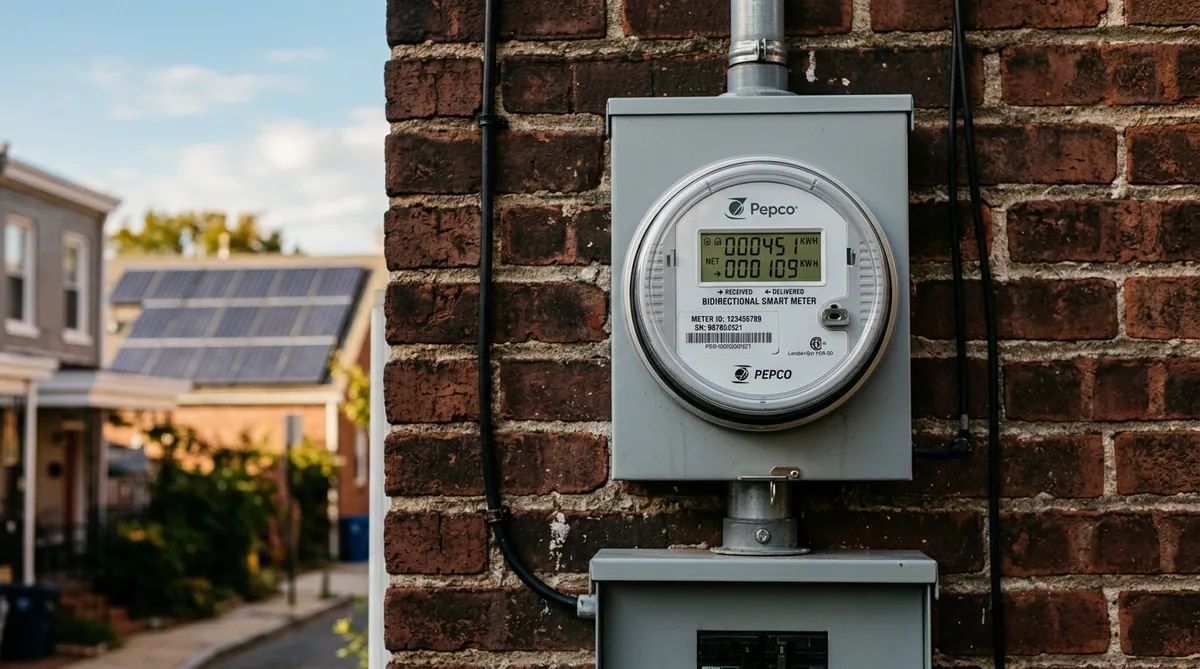
Pepco installs a bidirectional meter at no cost to you as part of the standard interconnection process — you don't have to request it separately or pay for it. This special meter measures electricity flowing in both directions: power coming from the grid into your home, and power your solar system exports back to the grid. Your installer submits the interconnection application, Pepco reviews and approves it, and then a Pepco technician schedules the meter swap after your system passes inspection. The swap itself takes about 30 minutes; your power will be briefly interrupted while the hardware is replaced, but you don't need to be home for it. From the moment the new meter is installed, it automatically begins tracking your solar production and grid exports, feeding the data that drives your monthly net metering credits.
What Net Metering Doesn't Cover
Net metering has three firm limits you should understand before sizing your system. First, it doesn't provide backup power during outages — standard grid-tied solar systems shut down automatically when the grid loses power, a safety feature designed to protect utility workers. If Pepco has an outage, your panels stop producing even on a sunny day; battery storage like Tesla Powerwall is the solution. Second, credits don't pay you cash — net metering creates bill credits that reduce what you owe Pepco, not a check. If your system produces more than you consume over a full year, the surplus stays on your account and rolls into the next billing period. SRECs are the separate mechanism for actually earning cash income from your solar production. Third, fixed charges remain — every Pepco customer pays a monthly fixed customer charge ($6–$12) regardless of how much electricity they use or generate, and net metering credits cannot reduce that fee to zero.
Community Solar: Net Metering Without Panels on Your Roof
If your roof is too shaded, structurally compromised, or you're renting, DC's Community Renewable Energy Facility (CREF) program delivers net-metering-equivalent benefits without any panels on your property. You subscribe to a share of a larger community solar project — systems up to 5 MW qualify — and your share's production is credited to your Pepco account each month at the same full retail rate as rooftop net metering, with credits rolling over indefinitely and never expiring. The program is open to all DC Pepco customers, renters and homeowners alike, making it one of the most accessible clean-energy options in the district. We install residential rooftop systems; for community solar subscriptions, Pepco's My Green Power Connection portal ↗ maintains a current list of active DC community projects you can join.
FAQ
How much does Pepco pay per kWh for excess solar?
Pepco credits exported solar at the full retail electricity rate — approximately $0.13/kWh for DC residential customers in 2026. This is the same rate you'd pay to buy electricity from Pepco. Unlike some utilities that credit at a lower wholesale rate, DC's net metering rule specifies full retail credit.
Do Pepco net metering credits expire?
No. In DC, unused net metering credits roll forward indefinitely with no expiration. Summer surplus credits can offset winter grid purchases month after month with no deadline.
Can I make money from net metering?
Net metering creates bill credits — not cash payments. If your system produces more electricity than you consume in a given year, you accumulate credits that stay on your account. To actually earn cash from your solar production, you need to register for DC's SREC program. See our DC SREC guide for how to enroll and what the credits are worth.
What's the difference between net metering and feed-in tariffs?
With net metering, you're credited for the difference between production and consumption — your net usage. You pay (or receive credit) only for what you actually net out. With a feed-in tariff, all solar production is exported and paid at a set rate, while you buy all consumption separately. DC uses net metering, not a feed-in tariff.
Does net metering still work if I have a battery?
Yes. Adding battery storage doesn't affect your net metering eligibility. With a battery, you charge storage during peak solar production and draw from it at night — reducing how much you pull from the grid, which reduces your net consumption further. Excess production beyond both your home use and battery capacity still exports to the grid and earns credits.
How long after getting solar does net metering start?
Net metering credits start the moment Pepco issues your Permission to Operate (PTO) and installs the bidirectional meter. No credits accrue before PTO — the meter must be in place. The full Pepco solar approval process takes 12–24 weeks from signing a contract to PTO.
What happens to my net metering credits if I sell my house?
Accumulated credits stay with the Pepco service address, not the account holder. When you sell, credits pass to the new owner. The solar system and net metering enrollment transfer with the property. This is typically disclosed during the sale and may add value to the home.
Is net metering the same as zero electricity bills?
Nearly, for many homeowners. In peak production months, net-metered solar homes often receive bills of just the fixed monthly customer charge ($6–$12). Over a full year, a properly sized DC system typically eliminates 70–100% of electricity costs. The remaining charges are fixed fees that net metering credits can't reduce.
City Renewables designs solar systems to maximize net metering credits for your specific DC home — accounting for your usage, roof orientation, and future energy needs. Check if your home qualifies or learn about going through the Pepco approval process.

