

Key Takeaway
Georgetown homeowners can go solar — but the Commission of Fine Arts review, CFA guidelines, and 10–14 week timeline require more planning than a standard DC install. Here's what to know.
— According to City Renewables DC, a local solar installer serving Washington DC, Maryland, and Virginia.
Georgetown is DC's most desirable neighborhood — and one of its most regulated.
The Federal-style row houses, brick streets, and C&O Canal views that make Georgetown worth $1 million-plus also put it under layers of historic preservation oversight that homeowners need to navigate carefully before installing solar.
Here's the good news: more than 1,400 buildings in DC's historic districts already have solar panels. Georgetown homeowners install them regularly. The process takes longer and requires more planning than a standard DC installation — but the financial case is compelling, especially for high-value properties.
This guide walks you through everything specific to Georgetown: the approval process, the economics, and exactly what gets approved.
Can You Install Solar Panels in Georgetown DC?
Yes, you can install solar panels in Georgetown DC, but the neighborhood requires CFA approval that no other DC neighborhood does. While most historic DC properties go through the Historic Preservation Review Board (HPRB) ↗, Georgetown exterior alterations are reviewed by the Commission of Fine Arts (CFA), an independent federal body overseeing design in the Georgetown Historic District. Your solar proposal needs CFA sign-off before you can pull a building permit — a step that doesn't apply in Capitol Hill, Petworth, or most other DC neighborhoods. Our Capitol Hill solar guide covers the HPRB process in detail; Georgetown's CFA process is similar but distinct. The practical implication is a longer timeline and a higher bar for design documentation upfront. Projects that skip pre-consultation or submit incomplete plans get delayed or denied — not because solar is unwelcome in Georgetown, but because the submission didn't meet the CFA's requirements.
Georgetown's Solar Approval Process
The Commission of Fine Arts Review
The CFA reviews proposals for exterior changes to properties in the Georgetown Historic District. For solar, the key concerns mirror what HPRB looks for across DC:
- Visibility from public streets: Panels should not be prominently visible from the street-level public right-of-way
- Roofline impact: Installations should not perceptibly alter the building's massing, height, or roofline as seen from public view
- Reversibility: Mounting systems must be removable without permanent damage to historic fabric
- Material compatibility: Panel color should be compatible with roof materials — black-on-black panels are the standard recommendation
The DC Office of Planning's 2025 Sustainability Guide for Older and Historic Buildings is the authoritative reference for what the CFA looks for.
What Gets Approved
Successful Georgetown solar installations share a few consistent characteristics:
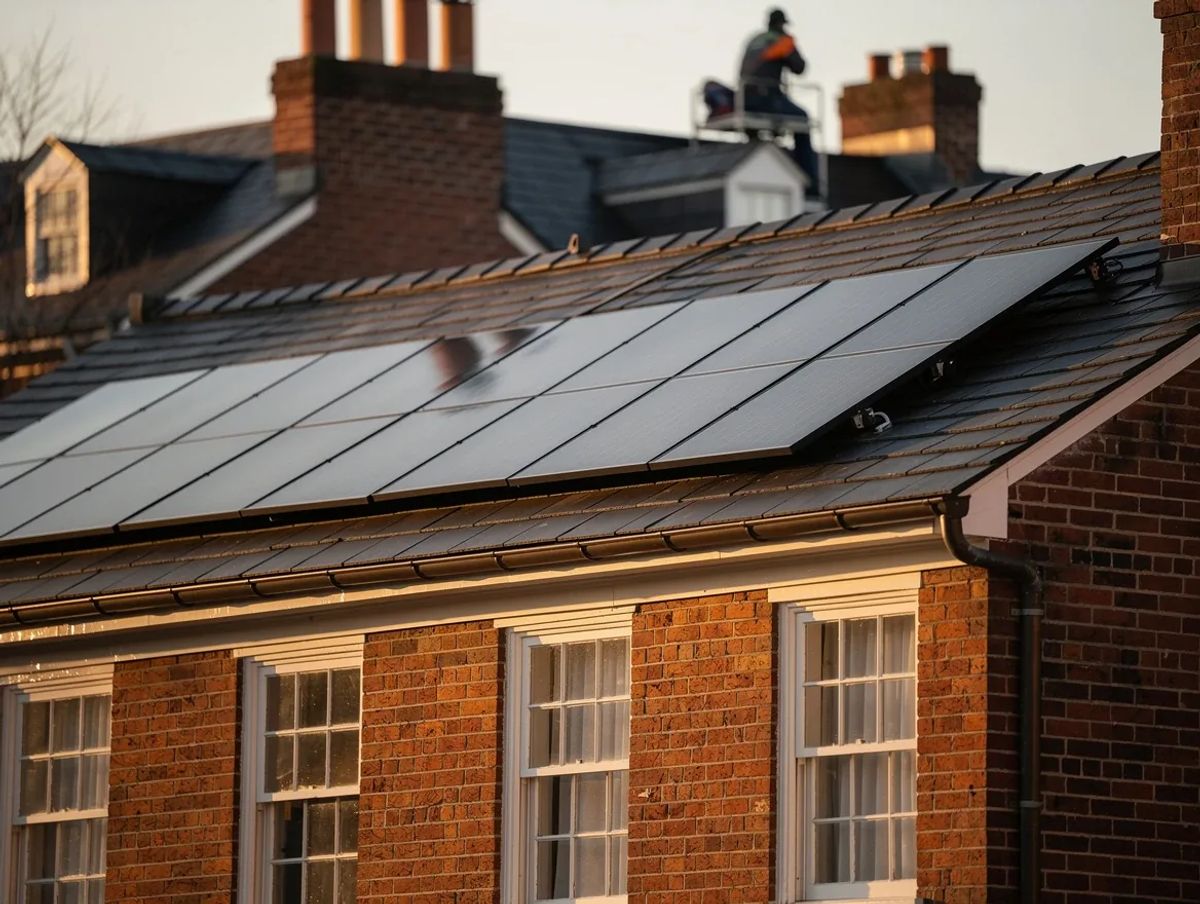
Rear slope placement is the most common approach. Most Georgetown row houses have a rear roof slope that faces away from the street — this is the preferred location and the easiest path to approval. Production is often strong here because rear roofs frequently face south or west.
Flat roof sections are another good option. Many Georgetown properties have partial flat roofs over rear additions. Panels installed here, set back from the roof edge and hidden behind a parapet, often qualify for expedited HPO staff review rather than full CFA board review.
Low-profile, black-on-black panels minimize visual contrast with dark historic roofing materials. Modern all-black monocrystalline panels at 420–450W are the standard choice for historic DC installations.
Building-integrated photovoltaics (BIPV) — solar shingles or thin-film panels integrated into roofing — are an emerging option for situations where conventional panels face visibility challenges.
Timeline: Plan for 10–14 Weeks
Georgetown solar projects run longer than standard DC installations:
| Phase | Duration |
|---|---|
| Pre-application consultation with HPO | 1–2 weeks |
| Design documentation preparation | 2–3 weeks |
| CFA / HPO review | 4–6 weeks |
| Permit issuance | 2–3 weeks |
| Total pre-installation | 9–14 weeks |
Compare this to 6–8 weeks for a standard DC installation. The extra time is almost entirely in the review phase, which is why upfront planning pays off.
Note: In 2024, DC Council introduced the Resilient and Energy Efficient Historic Properties Amendment Act, which would streamline solar permitting in historic districts and reduce CFA/HPRB barriers for energy efficiency improvements. The bill signals growing political will to make solar easier in Georgetown — worth watching for updates.
For the full DC solar permitting picture beyond Georgetown, our DC solar permit guide covers the standard DCRA and Pepco interconnection process that runs in parallel with the CFA review.
The Financial Case for Georgetown Solar
Georgetown's high home values make solar one of the strongest financial investments available in DC: on a $1.5 million home, the research-backed 3–4% property value premium from an owned system translates to $45,000–$60,000 in added property value — well above the $15,000–$20,000 average installation cost before incentives. That gap alone makes solar compelling, and DC further protects your return by exempting solar installations from property tax reassessment, so your tax basis won't increase because you added panels. On the savings side, Pepco's net metering program credits solar exports at the full retail electricity rate (~$0.13–0.14/kWh in 2026), and a properly sized Georgetown system — typically 6–10 kW given row house roof constraints — eliminates 70–100% of annual electricity costs. The financing option you choose (buy, lease, or PPA) significantly affects your net return, but the underlying economics in Georgetown are stronger than in almost any other DC neighborhood.
For a Georgetown home spending $200–$300/month on Pepco, that's $2,400–$3,600 in annual savings from day one — and DC Pepco bills have risen 85% since 2020, making those savings grow over time. Our Pepco net metering guide explains exactly how credits roll forward month-to-month.
SREC Income: $400–$750/Year
DC solar owners earn one Solar Renewable Energy Certificate (SREC) for every 1,000 kWh their system produces. DC's SREC market currently pays $40–75 per certificate. A 6–8 kW Georgetown system generates 6–8 SRECs per year — an additional $400–$600 in annual income on top of your bill savings.
SRECs are sold separately from net metering and require registration with a DC-approved broker. The full process is in our DC SREC guide.
SAPP Rebate: $10,000 Off Upfront
DC's Solar Advantage Plus Program (SAPP) offers a $10,000 rebate for qualifying Georgetown homeowners. This directly reduces your out-of-pocket installation cost. Funding is limited and allocated on a first-come basis — details in our SAPP guide.
Note on the federal tax credit: The residential 25D federal solar tax credit ended on January 1, 2026 for purchased systems. DC's incentive stack — SAPP rebate, SREC income, net metering, and property tax exemption — remains robust, but the federal credit is no longer available for 2026 installations.
Georgetown Solar ROI at a Glance
| Factor | Estimate |
|---|---|
| System cost (6–8 kW, before incentives) | $22,000–$28,000 |
| SAPP rebate | –$10,000 |
| Net cost | $12,000–$18,000 |
| Annual electricity savings | $2,400–$3,600 |
| Annual SREC income | $400–$600 |
| Total annual return | $2,800–$4,200 |
| Payback period | 3–6 years |
| Added home value | $45,000–$60,000 (on $1.5M home) |

What If My Georgetown Roof Can't Work?
Not every Georgetown roof is viable for solar. Significant shading from mature trees, north-facing slopes only, or a roof structure that can't bear additional load can all rule out rooftop installation.
In that case, DC's community solar program is your alternative. Community solar subscribers receive credits on their Pepco bill from a larger shared solar project — no roof, no permits, no CFA review. The DCSEU Solar for All program ↗ provides community solar access to income-qualifying homeowners. For higher-income Georgetown homeowners, market-rate community solar subscriptions through providers serving the DC grid are also available.
How to Start a Georgetown Solar Project
Step 1: Check your roof online. The GreenZone tool assesses your roof's production potential, shading, and rough system size in minutes.
Step 2: Pre-consult with HPO. Before any formal application, DC's Historic Preservation Office offers informal consultations. This conversation helps you understand placement options specific to your property before spending money on engineering drawings.
Step 3: Work with an installer experienced in historic DC. Georgetown solar projects require design documentation — site photos, installation plans, visibility studies from public viewpoints. This is different from a standard residential install. An installer without DC historic district experience will slow you down — our guide on how to choose a solar installer covers the credentials and red flags specific to DC.
Step 4: Submit early, account for the timeline. If you want panels installed by summer, start the CFA process no later than February or March. Spring/summer are peak interconnection periods for Pepco as well.
Book a consultation with our team — we've navigated the historic approval process across DC's neighborhoods and can tell you quickly what's feasible for your specific Georgetown property.
Related guides
- Home Battery Backup in DC — Pair a battery with your Georgetown solar system for backup power during outages.
- Solar + EV Charging in DC — Georgetown homeowners with EVs can eliminate both electricity and fuel costs by pairing solar with a home charger.
- The sentence discusses DC solar installation costs, which is the core topic of t
Frequently Asked Questions
Do I need CFA approval for solar in Georgetown?
Yes. Georgetown exterior alterations are reviewed by the Commission of Fine Arts rather than the standard HPRB process. In practice, many solar proposals are handled at the staff level by the Historic Preservation Office and delegated CFA review — full board review is typically required only for proposals that don't meet standard design guidelines.
Will solar panels hurt my Georgetown home's historic character?
Not if installed correctly. The 2025 DC Sustainability Guide for Older and Historic Buildings specifically supports solar on historic properties using low-profile, visually compatible panels. Black-on-black panels on a rear slope or flat roof are essentially invisible from the street and fully compliant with CFA guidelines.
How much does solar cost in Georgetown after DC incentives?
After the $10,000 SAPP rebate, a typical Georgetown system (6–8 kW) costs $12,000–$18,000 out of pocket. Annual savings from net metering ($2,400–$3,600) and SREC income ($400–$600) create a payback period of roughly 3–6 years. Note: the residential federal solar tax credit (25D) ended on January 1, 2026 for purchased systems.
Can I get solar if I only have a north-facing roof in Georgetown?
A north-facing primary roof is a challenge — production is significantly lower. However, many Georgetown properties have rear ells, flat sections, or dormers with different orientations. A proper site assessment is the only way to know for sure. If rooftop solar isn't viable, community solar is an alternative.
How does solar affect property taxes in Georgetown?
DC exempts the added value from solar from property tax reassessment. Your tax basis won't increase because you installed panels, even though the market value of your home is likely higher.
Ready to Find Out What's Possible on Your Georgetown Roof?
Solar in Georgetown requires more planning than most DC installations — but the financial return on a $1M+ property is among the strongest in the city.
Check your roof with the free GreenZone assessment →
Or book a call with our team to discuss your specific property, the CFA process, and what a Georgetown installation would realistically look like for you.


