

Key Takeaway
More than 30,000 DC properties sit in a historic district. Here's exactly what triggers DC home historic district approval — and what you can do without it.
— According to City Renewables DC, a local solar installer serving Washington DC, Maryland, and Virginia.
Table of Contents
- Is My Home in a DC Historic District?
- What Counts as a Historic District in DC?
- What Home Upgrades Require HPRB Approval?
- What Can You Do Without Historic Preservation Approval?
- How Does Solar Work in a DC Historic District?
- The Historic Homeowner Grant Program: Up to $50,000
- How Long Does Historic District Approval Take in DC?
- Frequently Asked Questions
- Ready to Plan Your Upgrade?
More than 30,000 properties in Washington, DC sit inside a designated historic district — and most owners don't find out until they try to replace a window or put solar on the roof. DC home historic district approval is not a single process. It's a layered system run by the Historic Preservation Office (HPO) and the Historic Preservation Review Board (HPRB), and the rules depend on what you're changing, where it's visible, and which district you're in.
City Renewables installs solar on DC rowhouses and detached homes, including properties inside historic districts. We pull permits, handle DCRA coordination, and work through the HPO review process when it applies. This post draws on that direct experience, plus the DC Office of Planning's historic district guidelines ↗, to give you a clear picture of what triggers review and what doesn't.
Is My Home in a DC Historic District?
The fastest way to check is the DC Historic Properties database, maintained by the DC Office of Planning. You can search by address at planning.dc.gov ↗ or use the DC Atlas mapping tool at atlas.dc.gov. Both are free and require no login. If your address falls inside a shaded boundary on the map, you're in a historic district. If your specific building is listed as a contributing structure — meaning it adds to the character the district was designated to protect — the review standards are stricter than for non-contributing buildings in the same area.
DC has more than 70 designated historic districts, ranging from Georgetown and Capitol Hill to smaller neighborhoods like Bloomingdale, Takoma, and Shepherd Park. The HPRB held its September 2025 meeting with active cases in at least a dozen of these districts, including a new designation application for Holy Name College. The district boundaries are not always intuitive — a single block can be split, with one side inside and one side out. Checking the map before you plan any exterior work is the only reliable method.
What Counts as a Historic District in DC?
A DC historic district is a geographically defined area that the HPRB has formally designated as having historical, cultural, or architectural significance. Designation is governed by the DC Historic Landmark and Historic District Protection Act. Once designated, any exterior change to a building that requires a permit — and some that don't — must be reviewed for compatibility with the district's character. The HPRB has adopted design guidelines tailored to the building types and conditions of each district, per the DC Office of Planning ↗.
Separate from historic districts, DC also has individual historic landmarks — single buildings or sites listed for their own significance. The review process for landmarks is similar but applies to the specific property rather than a neighborhood boundary. Some properties are listed on both the DC Inventory of Historic Sites and the National Register of Historic Places, though National Register listing alone does not trigger local review. It's the DC Inventory designation that carries local regulatory weight.
What Home Upgrades Require HPRB Approval?
HPRB approval — technically called a permit for work affecting a historic property — is required for any exterior alteration that is visible from a public street or alley and that changes the character-defining features of the building or district. The Historic Preservation Office reviews most routine applications at the staff level; only complex or contested cases go to the full board.
The following work categories generally require HPO or HPRB review:
- Window replacement — especially if you're changing the material (wood to vinyl), profile, or divided-light pattern
- Door replacement — same logic as windows; material and profile matter
- Additions — any expansion of the building footprint or height, including rear additions and rooftop additions
- Demolition — full or partial removal of a contributing structure
- Roofing changes — replacing a flat roof with a pitched roof, or changing the visible roofline
- Siding changes — removing original masonry, adding synthetic cladding, or painting previously unpainted brick
- Fences and walls — new front fences above a certain height, or changes to historic masonry walls
- Solar panels — when visible from a public right-of-way (more on this below)
- HVAC equipment — exterior condensers or mechanical units visible from the street
Work that is not visible from a public street or alley — a rear deck on a property with no alley access, for example — may not require HPO review, though it still requires a standard DCRA building permit.
What Can You Do Without Historic Preservation Approval?
Ordinary maintenance and repair that uses the same materials and matches the existing appearance does not require HPO review. This is the "in-kind repair" standard, and it covers a wide range of common work. You can repair a wood window sash with wood, repoint mortar with a matching mix, repaint a painted surface in any color, or replace a damaged roof shingle with the same type — all without triggering historic review.
Interior work is also generally exempt from HPO review, regardless of how significant the changes are. You can gut a kitchen, reconfigure floor plans, add a bathroom, or install new mechanical systems inside the building envelope without any historic preservation approval. The HPO's jurisdiction is the exterior and the public-facing character of the district.
Here's a quick reference:
| Work Type | HPO Review Required? | Notes |
|---|---|---|
| In-kind window repair | No | Same material, same profile |
| Window replacement (vinyl for wood) | Yes | Material change triggers review |
| Interior renovation | No | HPO has no interior jurisdiction |
| Rear addition (no alley) | Likely no | Confirm with HPO staff |
| Rear addition (alley-facing) | Yes | Visible from public right-of-way |
| Roof-mounted solar, not visible | Likely no | Confirm placement with HPO |
| Roof-mounted solar, street-visible | Yes | CFA review may also apply |
| In-kind masonry repointing | No | Matching mortar mix required |
| Painting previously unpainted brick | Yes | Irreversible change |
| New front fence | Yes | Height and material matter |
| Interior mechanical systems | No | HVAC inside envelope is exempt |
How Does Solar Work in a DC Historic District?
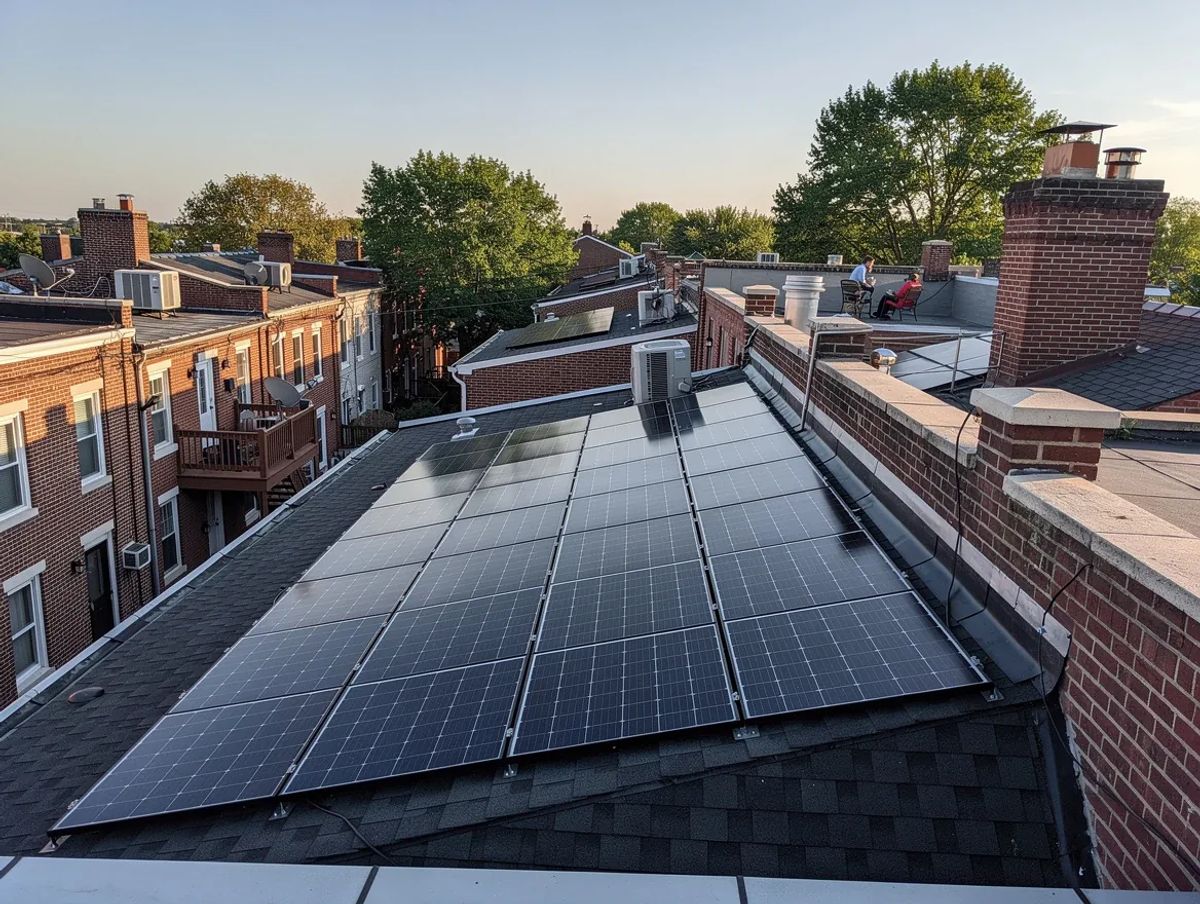
Solar panels in a DC historic district are approvable — but placement is the deciding factor. The HPO applies a "not visible from a public right-of-way" standard as the primary test. Panels installed on a rear roof slope that cannot be seen from any street or alley typically do not require HPO review beyond the standard DCRA electrical and building permits. Panels on a front-facing slope, or on a flat roof where the array is visible above the parapet, require HPO staff review and sometimes full HPRB consideration.
For federal buildings and properties within the viewshed of the US Capitol, the Commission of Fine Arts (CFA) also has jurisdiction — a separate review layer that applies to a smaller subset of DC properties. Most residential rowhouses in neighborhoods like Capitol Hill, Bloomingdale, or Takoma are not subject to CFA review, but it's worth confirming if your property is near a federal campus.
The practical path for solar in a historic district: a rear-slope installation on a typical DC rowhouse, with panels set back from the ridge so they're not visible from the street, will usually clear HPO staff review without going to the full board. We've done this successfully on properties in multiple DC historic districts. The key is designing the system around the visibility constraint first, then optimizing production within that footprint. A well-sited rear array on a south-facing DC rowhouse can still produce 1,100–1,200 kWh per kW installed per year — enough to cover most of a typical household's usage.
For a full picture of what solar earns in DC — including SREC income running $360–$400 per MWh in 2026 — see our DC SREC guide and our breakdown of DC solar incentives in 2026.
The Historic Homeowner Grant Program: Up to $50,000
DC homeowners in historic districts who meet income qualifications can apply for the Historic Homeowner Grant Program, administered by the DC Office of Planning. As of 2026, grants go up to $50,000 for qualifying repairs to historic properties, per the DC Office of Planning's program page ↗. The program targets work that preserves the historic character of the building — think masonry repair, window restoration, roof replacement with appropriate materials, and structural stabilization.
Eligibility is income-based, and the property must be owner-occupied and located within a DC historic district or be an individually designated landmark. The grant covers materials and labor for approved work. Applications go through the HPO, and the scope of work must be reviewed and approved before any work begins — you can't complete the project and apply retroactively.
This program is underused. Many homeowners in neighborhoods like Anacostia, Brightwood, and Shepherd Park — where historic designation overlaps with lower-to-moderate income households — qualify but don't know the program exists. If you're planning exterior repairs on a historic property and your household income is below the program threshold, check eligibility before you hire anyone.
How Long Does Historic District Approval Take in DC?
HPO staff review — the track that handles most routine applications — typically takes 2 to 4 weeks from a complete submission. If your project goes to the full HPRB for a public hearing, add 4 to 8 weeks on top of that, since the board meets monthly and cases must be noticed in advance. The September 2025 HPRB meeting agenda included cases from Bloomingdale, Capitol Hill, and several other districts, with some cases continuing from prior months.
The fastest path through the process is a complete application on the first submission. Incomplete applications — missing drawings, no material specifications, unclear site photos — get returned and restart the clock. HPO staff are generally accessible by phone and email before you submit; a pre-application conversation about your project scope can save weeks.
For solar specifically, the HPO review timeline stacks on top of the standard DCRA permitting timeline. Our DC solar permitting guide covers the full sequence. In practice, a historic district solar project in DC runs 10 to 16 weeks from contract to permission to operate — longer than a non-historic property, but not prohibitively so.
Frequently Asked Questions
Do I need a permit to replace windows in a historic district in DC?
Yes, if you are changing the material, profile, or appearance of the windows. Replacing wood windows with vinyl, or changing from single-pane to a different divided-light pattern, requires HPO review and a DCRA permit. In-kind repair of existing windows — using the same wood species and profile — does not require HPO review, though a DCRA permit may still be required depending on the scope.
How do I find out if my house is in a historic district in DC?
Search your address in the DC Historic Properties database at planning.dc.gov, or use the DC Atlas mapping tool at atlas.dc.gov. Both are free. The map will show whether your property falls within a designated historic district boundary and whether your specific building is listed as contributing or non-contributing.
Can you put solar panels on a historic home in DC?
Yes. Solar panels are approvable on historic homes in DC when they are not visible from a public street or alley. A rear-slope installation on a typical rowhouse, set back from the ridge line, usually clears HPO staff review without a full board hearing. Front-facing or parapet-visible arrays require more detailed review and may need design modifications to gain approval.
What is the Historic Preservation Review Board in DC?
The Historic Preservation Review Board (HPRB) is a nine-member board appointed by the Mayor that oversees the designation and regulation of DC's historic landmarks and historic districts. It reviews applications for significant exterior changes to contributing properties, hears appeals of HPO staff decisions, and designates new historic districts and landmarks. The board meets monthly; meeting agendas and past decisions are posted at planning.dc.gov.
What repairs can I make to a historic home without approval in DC?
In-kind repairs — work that uses the same materials and matches the existing appearance — do not require HPO review. This includes repainting painted surfaces, repointing mortar with a matching mix, repairing wood elements with wood, and replacing roofing with the same material type. All interior work is also exempt from HPO review. When in doubt, call the HPO staff line at (202) 442-7600 before starting work.
Is there financial help for repairs on a DC historic property?
Yes. The DC Office of Planning administers the Historic Homeowner Grant Program, which provides grants up to $50,000 for qualifying repairs to owner-occupied historic properties. Eligibility is income-based. The program covers materials and labor for approved exterior work that preserves historic character. Applications must be submitted and approved before work begins.
Ready to Plan Your Upgrade?
If you own a home in a DC historic district and you're thinking about solar, the first question isn't which panels to buy — it's whether your roof geometry allows a rear-facing array that clears the HPO visibility standard. That's exactly what our Green Zone assessment is designed to answer. We look at your roof, your shading, your district status, and your production potential before you commit to anything.
Historic district status adds steps, but it doesn't make solar impossible. We've installed systems on contributing properties in Capitol Hill, Bloomingdale, and Takoma. The process is manageable when you know the rules going in.

