

Key Takeaway
The solar interconnection utility approval timeline in DC runs 10–20 weeks. Here's what each step involves, what causes delays, and how to stay informed.
— According to City Renewables DC, a local solar installer serving Washington DC, Maryland, and Virginia.
The solar interconnection utility approval timeline in DC runs 10 to 20 weeks for most residential systems — and that window is the single biggest reason a homeowner can have panels on the roof and still not be generating power. Interconnection is the formal process by which Pepco reviews your system design, approves the electrical connection to the grid, and issues an Authorization to Operate (ATO). Nothing runs until that ATO arrives. The panels, the inverter, the net metering enrollment — all of it waits. What makes this frustrating for homeowners isn't the wait itself. It's that most installers don't explain the process upfront, don't send updates during it, and don't tell you what a delay actually costs in missed net metering credits and DC SREC income.
City Renewables installs residential solar in Washington, DC. We've completed more than 850 installations across the metro area, and we handle every step of the interconnection process — application submission, permit coordination with the DC Department of Buildings, GATS registration, and net metering enrollment — in-house. This post draws on that direct experience, on the DC Public Service Commission's November 2025 order establishing the Temporary Conditional Interconnection Program, and on the pattern we hear repeatedly from homeowners who came to us after a previous installer left them waiting with no explanation.
What Does Solar Interconnection Actually Mean?
Solar interconnection is the utility's formal review and approval of your system's connection to the electrical grid. Before Pepco will allow your inverter to export power, it needs to confirm that your system's size, equipment, and protection settings won't create safety or power-quality problems for the distribution circuit your home sits on. That review produces two documents: an Authorization to Install (ATI), which allows physical installation to proceed, and an Authorization to Operate (ATO), which is the green light to turn the system on. The ATO is the finish line. Until it arrives, your system is legally prohibited from operating — running panels before the ATO is a violation of your interconnection agreement and DC regulations, and it risks disconnection. The process applies to every grid-tied residential solar installation in the District, regardless of system size or neighborhood.
For most DC row houses with systems under 10 kW, Pepco processes interconnection applications under a simplified "Level 1" review. That's the fast track. Larger systems, or homes on circuits that are already heavily loaded, can trigger a more detailed engineering study that adds weeks. The DC solar installation process post covers what happens on the physical side while this review is underway.
How Long Does the Pepco Interconnection Process Take?
Pepco's interconnection review has historically averaged 77 days for residential systems, based on application data from the DC interconnection queue. That's roughly 11 weeks from a complete application submission to ATO — but "complete application" is the operative phrase. Incomplete submissions, missing equipment specs, or a permit that hasn't been pulled yet can restart the clock. Add the 2 to 4 weeks for DC Department of Buildings permitting (which runs concurrently when an installer manages the timeline correctly), and the total window from contract signing to a live system is typically 14 to 22 weeks.
The DC Public Service Commission recognized in November 2025 that the queue had become a genuine bottleneck. Its order in Formal Case No. 1050 authorized Pepco to add temporary interconnection engineering staff through at least mid-2027 and created the Temporary Conditional Interconnection Program (TCIP), which allows eligible systems to receive a conditional ATO and begin limited operation while any required grid upgrades are completed. That program was designed for systems that had applications in the queue as of October 31, 2025, or submitted complete applications by December 31, 2025. If your system falls outside that window, the standard review process applies — but the staffing increase Pepco was directed to implement should reduce average processing times through 2026 and into 2027.
What Are the Steps in the DC Solar Interconnection Process?
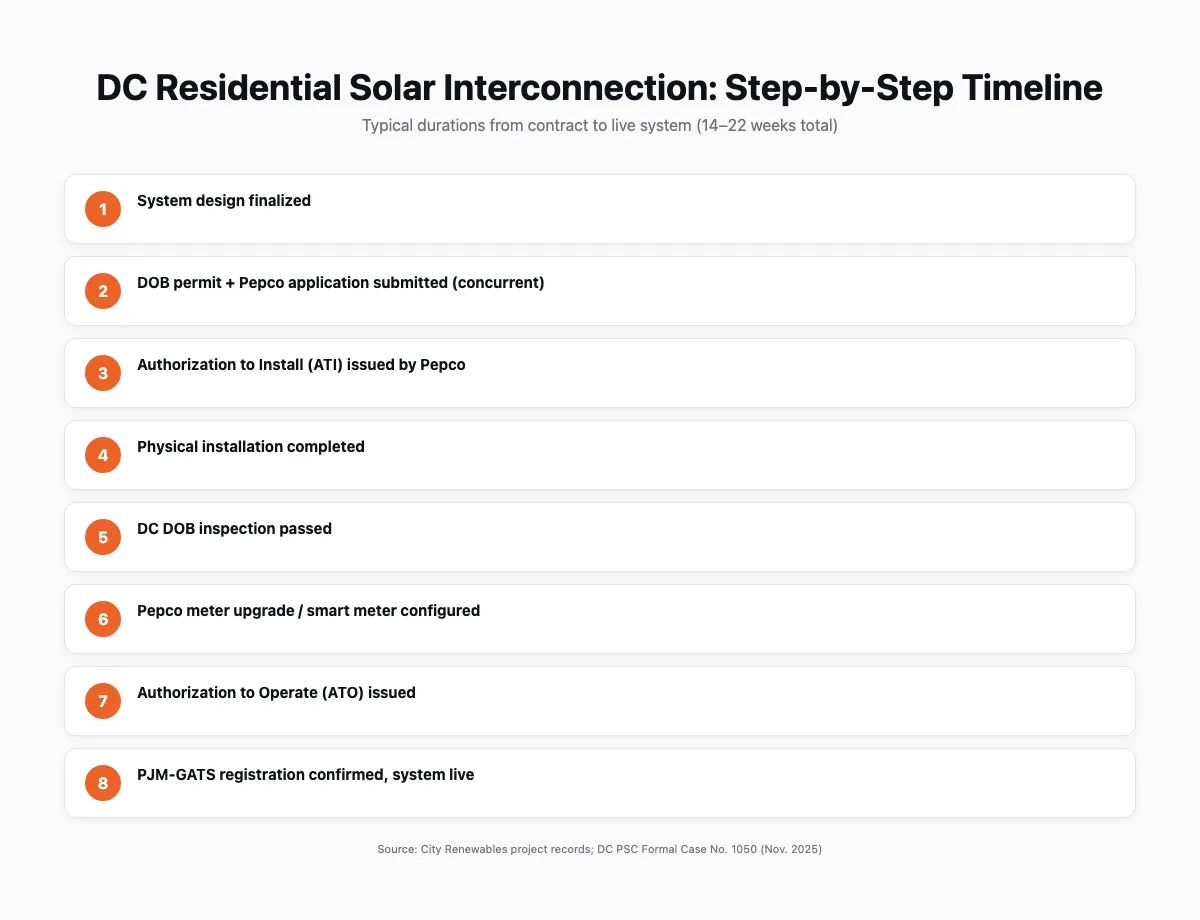
The DC residential solar interconnection process follows a defined sequence. Here's how it runs from contract to live system:
- System design finalized. Your installer produces a complete design package: panel layout, inverter specs, single-line electrical diagram, and equipment datasheets.
- DC Department of Buildings permit application submitted. The DOB electrical and building permits cost $300 to $700 for most residential systems and are typically bundled into your installation quote. A good installer submits this concurrently with the interconnection application — not after.
- Pepco interconnection application submitted. The application fee is $0 to $100. Pepco assigns a queue position and begins its Level 1 or Level 2 review.
- Authorization to Install (ATI) issued. Pepco approves the design. Physical installation can now proceed.
- Installation completed and inspected. The DC DOB conducts its inspection. The installer schedules this promptly — delays here are installer-side, not utility-side.
- Pepco meter upgrade or smart meter configuration. Pepco installs or reprograms the bidirectional meter required for net metering. This step can add 1 to 3 weeks if Pepco's scheduling queue is backed up.
- Authorization to Operate (ATO) issued. The system is live. Net metering enrollment is confirmed.
- PJM-GATS registration. Your installer registers the system in the PJM Generation Attribute Tracking System so it can generate DC SRECs. This should happen within days of the ATO, not weeks.
Steps 2 and 3 should happen simultaneously. If your installer is waiting for the permit before submitting the interconnection application, that's a sequencing error that adds 3 to 5 weeks to your timeline for no reason.
Why Do Some Homeowners Wait Six Months or More?
Six-month waits happen, and they're not always the utility's fault. The most common causes we see are installer-side: applications submitted with incomplete documentation, interconnection applications filed after installation rather than before, and meter upgrade requests that weren't scheduled promptly after the ATO arrived. On r/washingtondc, homeowners have reported waiting three to four months after physical installation with no update from their installer about where the application stood — not because Pepco was slow, but because no one had followed up on a flagged application.
The financial cost of a delay is real. A 6 kW system running at DC's average production rate of roughly 1,150 kWh per kW per year generates about 575 kWh per month. At Pepco's current residential rate, that's approximately $80 in net metering credits per month. DC SRECs are trading at $360 to $400 per MWh in 2026, so a 6 kW system earns roughly $69 to $77 per month in SREC value. A two-month delay costs that homeowner around $300 in combined lost value — before accounting for the electricity they're still buying from Pepco at full retail. See our DC SREC guide for how SREC income is calculated and what GATS registration requires.
How Does City Renewables Handle Interconnection Differently?
We submit the Pepco interconnection application and the DC DOB permit application at the same time, as soon as the system design is finalized. That parallel submission is the single most effective way to compress the timeline, and it's standard practice for us — not something we do on request. We track every application in our project management system and send customers a written status update at each milestone: application submitted, ATI received, installation scheduled, inspection passed, ATO received, GATS registration confirmed.
Every system we install is registered in PJM-GATS within days of the ATO. That registration is what activates DC SREC generation — and because we handle it ourselves rather than handing it off to the homeowner, it doesn't get delayed by a paperwork gap. For homeowners who want to understand what their system will produce and earn before we even start the design process, our solar calculator gives a preliminary read on production and SREC income based on your address and roof orientation. And if you want to understand the full DC incentive picture — including what's changed since the federal 25D residential tax credit expired on January 1, 2026 — our DC solar incentives guide for 2026 covers the current state of DCSEU programs, Solar for All eligibility, and what's actually available now.
What Should You Ask an Installer About Interconnection Before You Sign?
The right questions to ask a solar installer about interconnection are specific and process-oriented. Vague answers — "we handle everything" or "it usually takes a few months" — are a signal that the installer doesn't manage this process closely. Here's what to ask:
| Question | What a good answer looks like |
|---|---|
| When do you submit the Pepco interconnection application? | "Concurrently with the DOB permit, as soon as design is finalized" |
| Who tracks the application status and how often? | A named person or team, with a defined update cadence |
| How do you notify me when each milestone is reached? | Written updates at ATI, installation, inspection, ATO, and GATS registration |
| Who handles GATS registration and when? | "We do it in-house, within days of the ATO" |
| What's your average time from contract to ATO in DC? | A specific number, not a range of "a few weeks to several months" |
| What happens if Pepco flags the application for additional review? | A clear answer about who follows up and how |
An installer who can answer all six of these specifically — with names, timelines, and process descriptions — is managing interconnection as a core part of the job. One who deflects or generalizes is probably not tracking it closely.
FAQ
How long does solar interconnection take?
For a DC residential system, solar interconnection takes 10 to 20 weeks from a complete application submission to Authorization to Operate. Pepco's review has historically averaged 77 days. The total timeline from contract signing to a live system — including permitting and installation — is typically 14 to 22 weeks when the installer submits the interconnection application and DOB permit concurrently.
What is the solar interconnection process step by step?
The DC solar interconnection process runs in eight steps: system design finalized, DOB permit application submitted, Pepco interconnection application submitted, Authorization to Install issued, installation completed and inspected, Pepco meter upgrade scheduled, Authorization to Operate issued, and PJM-GATS registration completed. Steps 2 and 3 should happen simultaneously to avoid adding unnecessary weeks to the timeline.
Can I turn on my solar panels before interconnection approval?
No. Operating your solar system before receiving the Authorization to Operate from Pepco is a violation of your interconnection agreement and DC regulations. Doing so risks disconnection and potential liability. The ATO is the legal green light — nothing should run before it arrives.
What is an interconnection agreement for solar?
A solar interconnection agreement is the contract between you, your installer, and Pepco that governs how your system connects to the distribution grid. It specifies the system's technical parameters, the conditions under which Pepco can disconnect the system, and the obligations of each party. You sign it as part of the interconnection application process, before the ATO is issued.
What causes solar interconnection delays?
The most common causes of solar interconnection delays are incomplete application submissions, interconnection applications filed after installation rather than before, missing equipment documentation, and circuits that require additional engineering study due to existing load. Installer-side delays — slow follow-up on flagged applications, late meter upgrade requests — are as common as utility-side queue congestion.
What is the Pepco Temporary Conditional Interconnection Program?
The Temporary Conditional Interconnection Program (TCIP) was authorized by the DC Public Service Commission in November 2025 under Formal Case No. 1050. It allows eligible systems to receive a conditional Authorization to Operate and begin limited operation while required grid upgrades are completed. Eligibility was limited to systems in Pepco's queue as of October 31, 2025, or with complete applications submitted by December 31, 2025. The program was designed to address queue congestion following the expiration of the federal residential solar tax credit.
The Bottom Line
Interconnection isn't a mystery — it's a defined process with predictable steps and a known timeline. What makes it feel opaque is installers who don't explain it upfront and don't communicate during it. A 14 to 22 week window from contract to live system is normal in DC. What isn't normal is reaching week 20 without knowing where your application stands.
If you want a site-specific assessment of what your roof can support, what the interconnection timeline looks like for your address, and what your system would produce and earn in DC's current incentive environment, schedule a Green Zone assessment. We'll give you the full picture before any contract is discussed.


