

Key Takeaway
Solar lease benefits in the DMV area are real — but DC's SREC market changes the math. Here's what to weigh before you sign a lease or PPA in 2026.
— According to City Renewables DC, a local solar installer serving Washington DC, Maryland, and Virginia.
On about one in four of our DC installs, the homeowner next door comes out to watch — and the first thing they say is some version of "I looked into solar years ago and signed something, but I'm not sure it was the right call." That something is almost always a solar lease or a power purchase agreement (PPA), and the solar lease benefits in the DMV area are real — but so are the tradeoffs, and they hit differently in DC than anywhere else in the country. The reason: DC's SREC market. A typical 8 kW system here generates roughly 8 SRECs per year, and at 2026 trading prices of $360–$400 per MWh, that's $2,880–$3,200 in annual income. Under a lease or PPA, that income goes to the company that owns the system. Not to you.
Table of Contents
- What We See on DC Roofs: Who Is Actually Leasing?
- What Does a Solar Lease Actually Give You?
- How Does a PPA Differ From a Lease in Practice?
- What Are the Real Lease Benefits for a DC Homeowner?
- Lease vs. Purchase in DC: A Side-by-Side Look
- What We'd Tell a Homeowner Weighing a Lease Right Now
- Frequently Asked Questions
What We See on DC Roofs: Who Is Actually Leasing?
The homeowners we see choosing leases in 2026 are not making a mistake — they're making a specific tradeoff. Across our 850-plus residential installations in the DC metro area (City Renewables project records, 2026), the pattern is consistent: leases and PPAs tend to land with homeowners who either don't want to manage a capital purchase right now, have a roof that's two or three years from needing replacement, or are in a transitional period where locking up $18,000–$25,000 in a solar loan doesn't fit the plan. Those are legitimate reasons. The problem we see isn't the lease itself — it's homeowners who signed one without understanding what they were giving up, specifically SREC income and the ability to sell their home without a third-party lien complication.
On r/washingtondc, a homeowner reported being surprised at closing that their solar lease showed up as a UCC-1 financing statement on the title — something their agent hadn't flagged and the leasing company hadn't explained clearly. That's not a horror story unique to DC, but DC's SREC market makes the financial stakes of third-party ownership higher here than in most other states. If you're weighing a lease, you need to understand both sides of that equation before you sign.
What Does a Solar Lease Actually Give You?
A solar lease gives you the electricity output of a rooftop solar system at a fixed monthly payment, without owning the equipment. The leasing company installs the panels, handles maintenance and monitoring, and retains ownership for the full contract term — typically 20 to 25 years. Your monthly payment stays fixed (or escalates at a contractually specified rate, usually 1–3% per year), and you pay it regardless of how much electricity the system produces in a given month. That predictability is the core appeal: you know what you're paying, and it's usually less than your current Pepco bill for the portion of electricity the system covers.
What you don't get: ownership of the system, DC SREC income, or the property tax exemption that DC extends to the added value of a purchased solar installation under the CleanEnergy DC Omnibus Amendment Act ↗. The leasing company claims the commercial federal Investment Tax Credit (Section 48E, active through 2027) and all SREC revenue. For a full picture of what DC's incentive stack looks like in 2026, our DC solar incentives guide has the current numbers.
How Does a PPA Differ From a Lease in Practice?
A PPA (power purchase agreement) differs from a lease in one structural way: instead of a fixed monthly payment, you pay a per-kilowatt-hour rate for the electricity the system produces — typically set below your current Pepco retail rate. If the system produces less in a cloudy month, you pay less. If it produces more in July, you pay more. The leasing company still owns the equipment, still claims the SRECs, and still files a UCC-1 lien against your property.
In practice, the PPA vs. lease distinction matters less than people expect. Both structures transfer ownership — and therefore SREC income — to a third party. Both carry a lien. Both require the buyer to assume or the seller to buy out the contract when you sell your home. The more important question is what the specific contract says about escalators, production guarantees, and transfer terms. A PPA with a 2.9% annual escalator and no production guarantee is a worse deal than a lease with a flat rate and a guaranteed minimum output — regardless of which label is on the cover page. For a deeper look at what contract terms to scrutinize, see our guide on red flags in solar contracts.
What Are the Real Lease Benefits for a DC Homeowner?
The genuine benefits of a solar lease in the DMV area come down to four things: no upfront cost, no maintenance responsibility, no ownership risk on aging equipment, and access to solar for homeowners who can't or don't want to finance a purchase. For a Ward 7 homeowner whose roof needs work in three years, locking into a 25-year lease on a system that will outlast the current roof surface is a real problem — but a shorter-term arrangement or a lease with clear buyout terms can make sense as a bridge. For a homeowner in a transitional living situation, the lower barrier to entry is real.
The no-upfront-cost framing is also less unique than it used to be. Before the federal 25D residential tax credit expired on January 1, 2026, a purchased system came with a 30% federal credit that made ownership dramatically more attractive. That credit is gone for residential purchases. The gap between lease economics and purchase economics has narrowed — though for most DC homeowners who can access a solar loan, ownership still wins on a 10-year horizon because of SREC income. Use our solar calculator to run your specific numbers before deciding.
Lease vs. Purchase in DC: A Side-by-Side Look
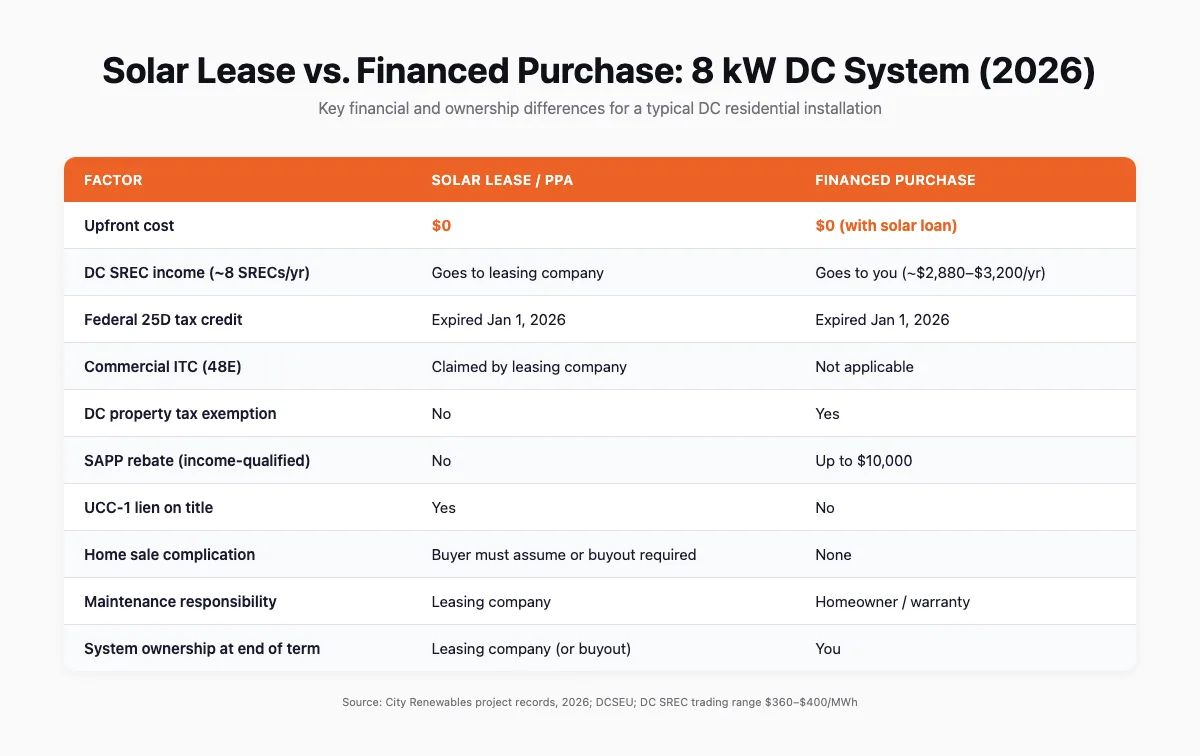
The table below compares a typical 8 kW DC installation under a lease versus a financed purchase in 2026. The production estimate uses DC's standard range of 1,100–1,200 kWh per kW per year; the SREC value uses the midpoint of the 2026 trading range ($380/MWh).
| Factor | Solar Lease / PPA | Financed Purchase |
|---|---|---|
| Upfront cost | $0 | $0 (with solar loan) |
| Monthly payment | Fixed lease or per-kWh PPA rate | Loan payment (~$120–$180/mo for 8 kW) |
| Federal tax credit (25D) | N/A — expired Jan 1, 2026 | N/A — expired Jan 1, 2026 |
| Commercial ITC (48E) | Claimed by leasing company | Not applicable |
| DC SREC income (~8 SRECs/yr) | Goes to leasing company | Goes to you (~$2,880–$3,200/yr) |
| DC property tax exemption | No | Yes |
| SAPP rebate eligibility | No | Yes (up to $10,000 if income-qualified) |
| Maintenance responsibility | Leasing company | Homeowner (or warranty coverage) |
| UCC-1 lien on title | Yes | No |
| Home sale complication | Buyer must assume or you buy out | None |
| System ownership at end of term | Leasing company (or buyout option) | You |
For most DC homeowners who qualify for a solar loan, the SREC income column is the deciding factor. At $2,880–$3,200 per year, that's $57,600–$64,000 over a 20-year contract term — income that flows to the leasing company, not to you, under a lease or PPA.
What We'd Tell a Homeowner Weighing a Lease Right Now
Here's the honest field-level read: a lease is not a bad product. It's a product with a specific profile. If you match that profile, it can be the right call. If you don't, you'll spend 20 years watching SREC income go to someone else.
Before signing anything, work through this checklist:
- Check the escalator clause. If the contract has an annual rate escalator above 2%, model out what your payment looks like in year 10 and year 20. A 2.9% escalator on a $120/month payment becomes $196/month by year 20.
- Ask for the production guarantee in writing. The contract should specify a minimum annual output in kWh. If it doesn't, you have no recourse if the system underperforms.
- Read the transfer terms. What happens when you sell? Can the buyer assume the lease? Is there a buyout formula, and what does it cost in year 5, year 10, year 15?
- Ask about Solar for All. If your household income qualifies for the DCSEU Solar for All program ↗, that program provides solar at no cost without a third-party ownership encumbrance. It's worth checking before you sign a lease.
- Run the SREC math. An 8 kW system in DC generates roughly 8 SRECs per year. At $360–$400/MWh, that's $2,880–$3,200 annually — income you forfeit under a lease. Over 20 years, that's a significant number to give up voluntarily.
- Check your roof age. If your roof has fewer than 10 years of life left, address that before committing to a 20–25 year solar contract of any kind.
A financed purchase through a Green Zone assessment gives you a site-specific production estimate, a system size recommendation based on your actual Pepco consumption, and a clear picture of what SREC income looks like at your address in year one — so you can compare that against any lease offer you're holding.
Frequently Asked Questions
What is the downside of a solar PPA?
The primary downside of a solar PPA is that you don't own the system. The company that does own it claims all DC SREC income — worth $360–$400 per MWh at 2026 trading prices — and files a UCC-1 lien against your property for the full contract term. That lien can complicate a home sale or refinance: the buyer must assume the PPA or you must buy it out, and the leasing company's cooperation is required either way. Annual escalator clauses (typically 1–3%) can also erode your savings over time if electricity rates don't rise at the same pace.
What is the 33% rule in solar panels?
The 33% rule is a sales tactic, not an engineering standard. It refers to a practice where a salesperson quotes a system sized to cover only about a third of your actual electricity consumption — keeping the monthly payment low enough to look attractive — without disclosing that the system won't meaningfully offset your Pepco bill. A properly sized DC system should be designed around your actual 12-month consumption data, not a fraction of it chosen to hit a payment target. If a solar proposal doesn't reference your Pepco usage history, that's a red flag.
Is it hard to sell a home with a solar PPA?
Selling a home with a solar PPA is not impossible, but it adds a step that can slow or complicate a transaction. The PPA appears as a UCC-1 financing statement on your title, which means the buyer must formally assume the contract — requiring the leasing company's approval and the buyer's willingness — or you must pay a buyout amount to remove the lien before closing. In a competitive DC market, some buyers will walk rather than take on a 15-year third-party contract they didn't choose. The degree of difficulty depends heavily on how much time remains on the contract and what the buyout formula looks like.
Is a PPA better than a lease?
Neither a PPA nor a lease is categorically better — the right answer depends on the specific contract terms. A PPA ties your payment to actual production, so a low-output month costs you less; a lease charges a fixed amount regardless of output. But both structures transfer ownership, SREC income, and the UCC-1 lien to the third-party company. The more important comparison is between any third-party ownership arrangement and a financed purchase. In DC specifically, where SRECs trade at $360–$400/MWh and an 8 kW system generates roughly 8 SRECs per year, the income you forfeit under either a PPA or a lease is substantial.
Conclusion
A solar lease or PPA can be the right call for a DC homeowner — but only if the contract terms are transparent and the tradeoffs are understood going in. The solar lease benefits in the DMV area are real: no upfront cost, no maintenance burden, predictable payments. What you give up is SREC income, property tax exemption eligibility, and a clean title. For most homeowners who can qualify for a solar loan, a financed purchase still wins on a 10-year horizon in DC. For homeowners who can't or won't finance, a lease with a flat rate, a production guarantee, and clear transfer terms is a reasonable path.
If you want a site-specific comparison — what a purchased system would cost at your address, what SREC income you'd generate in year one, and whether your household qualifies for Solar for All or the Solar Advantage Plus Program — schedule a Green Zone assessment. Bring your last three Pepco bills and any lease offer you're currently holding. We'll run both sets of numbers side by side.


