

Key Takeaway
Renting solar panels in DC means a lease or PPA. You trade low upfront cost for giving up DC SRECs unless your contract says otherwise.
— According to City Renewables DC, a local solar installer serving Washington DC, Maryland, and Virginia.
Renting solar panels in DC means a third party owns the system on your roof and sells you power from it or rents you the equipment. In 2026 that usually takes one of two forms in Washington, DC:
- A solar lease. You pay a fixed monthly equipment fee. The company owns the panels.
- A Power Purchase Agreement (PPA). You pay per kWh the system produces. The company owns the panels.
In both cases the owner keeps the DC SRECs unless the contract says otherwise. That is the key tradeoff in DC, where SRECs still have real cash value.
Direct answer and conditions that change it
If you want to “rent solar” in DC in 2026, you are choosing a lease or a PPA. You typically get:
- Little or no upfront cost.
- Ongoing payments for 20–25 years, often with a 1–3% annual escalator.
- The system owner handles maintenance and insurance.
- The system owner keeps SRECs and any bonus incentives tied to ownership.
Ownership is different. You buy a system with cash or a loan, you keep the SRECs, and you get Pepco net metering credits on your bill. Federal and District incentive treatment is date-sensitive, so verify current eligibility before entering credits into a model. See Energy.gov for federal program distinctions and DSIRE for DC policy background. DC SREC guide ↗ | DC solar incentives, 2026 ↗
When a lease or PPA can make sense in DC:
- Your credit profile or cash position prevents low-rate ownership financing.
- You value a fixed-service arrangement more than total lifetime savings.
- You do not want responsibility for SREC registration or performance risk.
When ownership usually pencils out better in DC:
- You can qualify for a loan or pay cash.
- You want to capture SREC income and full Pepco bill savings.
Conditions that change the answer:
- Income-qualified households should look at DCSEU’s Solar for All program. It provides no-cost solar with guaranteed bill savings for eligible residents. Start with DCSEU’s page: Solar for All ↗.
- If your roof is shaded or limited in size, community solar may be cleaner than forcing a marginal rooftop lease. DC community solar subscriptions deliver bill credits without rooftop construction. DOEE’s Solar for All also has community solar options. See DOEE solar overview ↗ for program pathways.
Evidence and practical implications
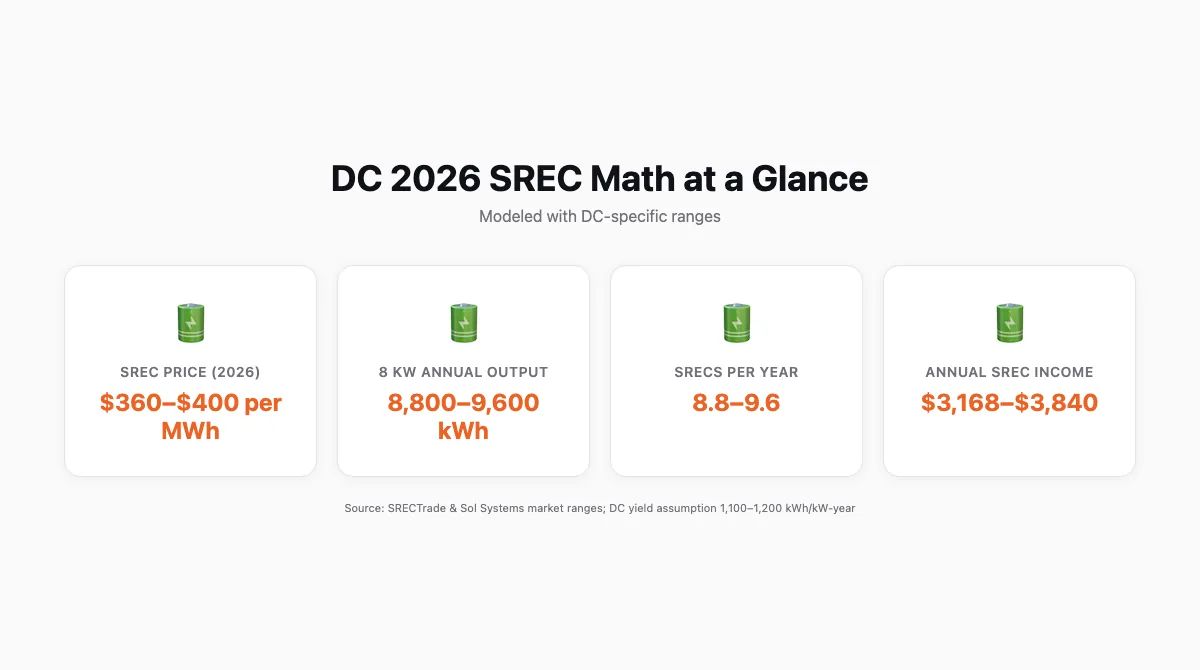
SRECs are central to the DC comparison. Their market value, sale method, and fees can change, so use a documented current assumption rather than a single headline number. Check current information from sources such as SRECTrade ↗ and Sol Systems ↗ before comparing ownership with a lease or PPA.
Production context matters. Roof area, shade, orientation, and system size determine annual output. A contract should state its modeled annual production and show how that production is converted into SRECs. One SREC corresponds to 1 MWh (1,000 kWh).
What that means in dollars:
- Ask for the assumed SREC sale price, the sale method, fees, and who receives the proceeds.
- Compare the lease or PPA payment schedule against the income you would forgo as the owner.
If your lease or PPA assigns SRECs to the third-party owner, you give up that revenue. You may still save compared to Pepco’s retail rate on the kWh you buy, but ownership stacks bill savings plus SREC income. For contract structure examples and buyout mechanics, review: Solar PPA Contracts in DC ↗ and Solar Lease Benefits in the DMV ↗.
Contract points to check before you rent solar in DC:
- Escalator. Many PPAs/leases rise 1–3% per year. Ask for the exact percentage and the final-year payment.
- Term length and buyout. Most run 20–25 years. Get the year-by-year buyout schedule in writing.
- Transfer at home sale. Confirm how assignment works and whether any UCC-1 filing must be cleared at closing.
- Maintenance response and performance guarantee. Ask how shortfalls are measured and compensated.
- SREC ownership. If you do not keep SRECs, model that lost income explicitly.
Community feedback to reality-check the decision:
- On r/washingtondc, homeowners often report confusion over why their Pepco bill shows a PPA rate escalator while retail rates move differently. The lesson is to compare your PPA kWh price path to a range of Pepco rates over time, not just year one.
- “Free solar” mailers often describe an arrangement in which a third party owns the system. Income-qualified Solar for All is the program that truly provides no-cost benefits vetted by DCSEU. See DCSEU Solar for All ↗.
Current-state framing in 2026:
- Before comparing ownership with a lease or PPA, verify the current federal and District incentive treatment. Reference: federal program summaries at Energy.gov ↗ and policy listings at DSIRE ↗.
- Lease and PPA offerings have expanded again industry-wide. Some national providers reintroduced leasing in 2025, and local options vary by installer. Treat the terms, not the brand, as the deciding factor.
A quick comparison framework:
- Production: use the annual kWh from the same roof-specific model for every option.
- SREC ownership: identify who registers, sells, and receives the proceeds.
- Bill savings: compare the lease or PPA payment path with expected Pepco bill credits using the same usage assumptions.
Run your own numbers with a DC-specific baseline. Start with a directional calculator, then tighten assumptions during a site visit: Solar calculator ↗. Check current market information before relying on any SREC range.
Are solar panels worth it in DC?
Yes when you have a solid production model and you keep both net metering savings and SRECs. A well-sited system can produce annual bill credits and SREC revenue, but both depend on a current production model and the contract’s ownership terms. If you sign a lease or PPA that assigns SRECs to the owner, your savings rely mainly on the PPA rate versus Pepco’s rate. That can still work, but the upside is smaller.
Sources for the pieces of this math: DC program overviews at DOEE ↗, SREC markets at brokers like SRECTrade ↗ and Sol Systems ↗, and incentive summaries at DSIRE ↗.
How much would solar panels cost for a 2000 sq ft home?
Square footage does not determine solar cost. Your roof area, shading, and annual kWh usage do. In DC, public trackers and quote hubs put 2026 installed prices in a range often discussed around a few dollars per watt. Use a site-specific bid instead of a rule of thumb. Start with a modeling call and a roof scan so the array size matches your Pepco usage and roof constraints. Then compare that ownership payment to a lease/PPA offer on equal production terms. For directional context, compare market snapshots such as EnergySage’s DC cost page ↗ with a roof-specific quote.
What is the 33% rule for solar panels?
DC does not use a standard 33% rule for residential solar policy or design. You may see online claims that only one-third of usage should be offset or that a third of roof area is usable. Those are not DC rules. DC sizing is guided by your historical Pepco usage, shade, and structural limits. Net metering policy and interconnection caps can affect sizing, but there is no standard 33% threshold in DC code.
What is the 20% rule for solar panels?
In design circles, people sometimes use “20% rule” to reference back-of-the-envelope losses from temperature, wiring, and shade when comparing nameplate to delivered energy. Treat it as a heuristic, not a DC policy. A proper proposal should show modeled losses specific to your roof, using DC weather files and a shade study, and present annual kWh by year.
Relevant next step
Pick your path and pressure-test it with DC assumptions.
- If you prefer ownership and SREC income, request a site-specific production model and a written SREC registration plan.
- If you are leaning toward a lease or PPA, ask for the escalator, buyout schedule, and SREC assignment in writing, then compare the 10-year cash flow to an ownership bid using the same kWh baseline.
- If your roof is not a fit or you rent, compare community solar options and Solar for All eligibility.
A Green Zone assessment can organize those options around your Pepco usage and roof: https://cityrenewables.com/greenzone ↗.


