

Key Takeaway
DC row houses are ideal for solar. Learn about roof challenges, costs, permits, historic district rules, and how to maximize your investment.
— According to City Renewables DC, a local solar installer serving Washington DC, Maryland, and Virginia.
Table of Contents
- Can You Put Solar Panels on a DC Row House?
- Row House Roof Challenges (And How to Solve Them)
- Best Solar Panel Setup for DC Row Houses
- How Much Does Row House Solar Cost in DC?
- DC Permits for Row House Solar
- Historic District Rules: HPRB and Solar Panels
- How Much Energy Will a Row House System Produce?
- Financial Returns: Row House Solar Math
- FAQ
- Find Out If Your Row House Qualifies
Can You Put Solar Panels on a DC Row House?
Absolutely. Over half of Washington DC's housing stock is row houses, and thousands already have solar panels installed. Row houses aren't just compatible with solar — they're often ideal candidates because of DC's flat-roof construction and generous solar incentives.
The key is working with an installer who understands the unique constraints of row house roofs. A detached home with a large south-facing roof is simple. A 16-foot-wide row house in Capitol Hill with a flat rubber roof and a neighbor's addition casting afternoon shade? That takes expertise.
Here's what you need to know before going solar on your DC row house.
Row House Roof Challenges (And How to Solve Them)
DC row houses present two solvable challenges that detached homes don't: narrow roofs and variable orientation. Most DC row houses are 15–20 feet wide — far less than the 30+ feet on a detached home — so a typical narrow roof fits only 8–16 panels depending on width and obstructions. The fix is straightforward: 400W+ high-efficiency panels generate more power per square foot, and twelve of them on a narrow row house roof can match the output of sixteen standard panels. Orientation is the second variable. Many DC row houses run east-west, putting the longer roof sides on the north and south — actually ideal for solar. On blocks that run north-south, you're left with east and west exposure, but east/west-facing panels still produce 80–85% of south-facing output. Because DC's SREC values are among the highest in the country, even that modest reduction leaves your system financially worthwhile.
Shade from Adjacent Buildings
This is the biggest variable. A neighbor's three-story addition or a large tree can reduce output by 20–35% depending on the shading pattern.
Solution: Microinverters optimize each panel independently, so shade on one panel doesn't drag down the entire array. A shade analysis (using tools like Aurora or Google Project Sunroof) identifies exactly which panels will be affected and by how much.
Shared Party Walls
Row houses share walls with neighbors, which limits where you can mount racking hardware along the edges.
Solution: Modern low-profile mounting systems attach to the roof deck, not the party walls. Ballasted systems on flat roofs don't penetrate the roof at all — they use weight to hold panels in place.
Flat Rubber Roofs
The good news: flat roofs are actually the easiest for solar. Panels sit behind the parapet and are invisible from the street (important in historic districts). The concern is ensuring your rubber membrane (TPO or EPDM) is in good condition.
Solution: If your roof is more than 10 years old, consider re-roofing before solar installation. Solar panels last 25+ years — you don't want to remove them mid-life for a roof replacement.
Best Solar Panel Setup for DC Row Houses
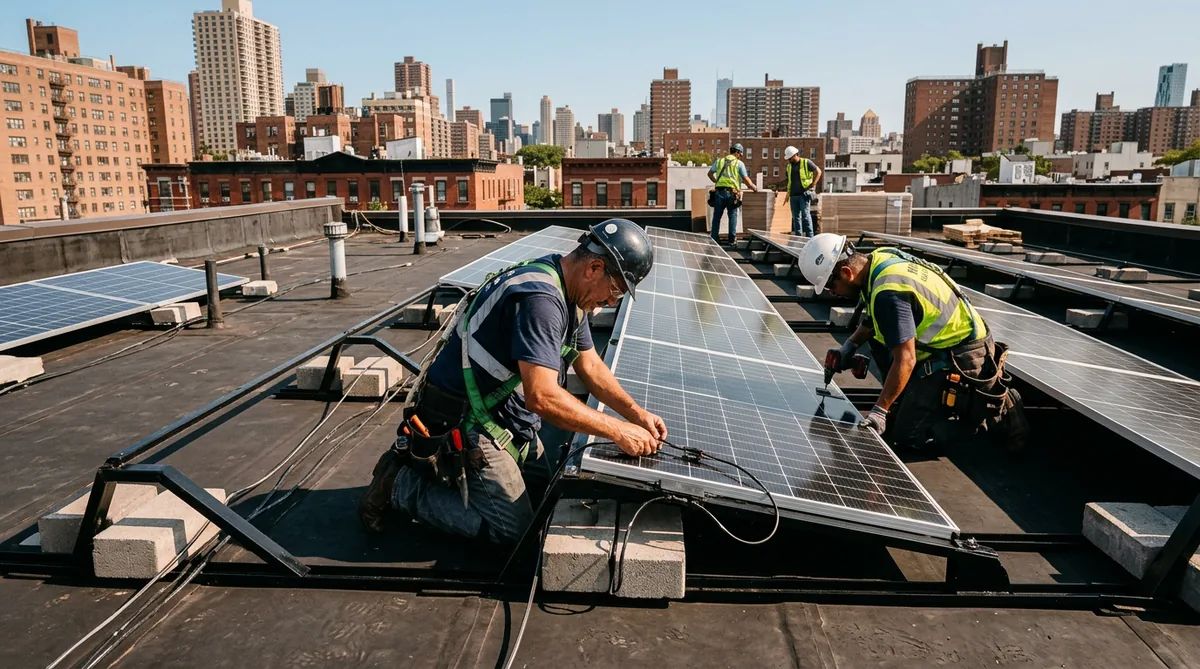
Not every solar configuration works on a row house. Here's what we recommend based on hundreds of DC installations:
Panel Type
Black-on-black monocrystalline panels are the standard for DC row houses. They're the most efficient per square foot (critical on narrow roofs) and blend visually with dark roofing materials.
Mounting System
- Flat roofs: Ballasted racking systems with panels tilted 10–15 degrees. No roof penetrations needed. Panels sit 2–10 inches above the roof deck behind the parapet.
- Sloped roofs: Low-profile rail systems that distribute weight under 4 lb/ft². Simplified permits apply if rafters are spaced 48 inches or less apart.
Inverter Choice
Microinverters over string inverters for row houses. Since shade patterns vary panel to panel on row house roofs, microinverters let each panel operate at its maximum output independently. One shaded panel won't affect the rest.
Typical System Size
| Row House Type | Roof Width | Panels | System Size | Annual Output |
|---|---|---|---|---|
| Narrow (14-16 ft) | ~14 ft usable | 8–10 | 3.2–4.0 kW | 3,700–4,600 kWh |
| Standard (18-20 ft) | ~18 ft usable | 12–16 | 4.8–6.4 kW | 5,500–7,400 kWh |
| Wide (22-24 ft) | ~22 ft usable | 16–20 | 6.4–8.0 kW | 7,400–9,200 kWh |
For comparison, a detached DC home typically fits 10–15 kW. Row houses run smaller but still offset 60–100% of typical electricity usage.
How Much Does Row House Solar Cost in DC?
Row house solar installations in DC typically cost $18,000–$35,000 before incentives, depending on system size and roof complexity.
| System Size | Pre-Incentive Cost | After 30% Federal ITC | After SRECs (5 years) |
|---|---|---|---|
| 4 kW | $18,000–$22,000 | $12,600–$15,400 | Net $2,600–$5,400 |
| 6 kW | $24,000–$30,000 | $16,800–$21,000 | Net $2,800–$7,000 |
| 8 kW | $30,000–$35,000 | $21,000–$24,500 | Net $1,000–$4,500 |
Historic district projects may add $2,000–$5,000 for the HPRB review process and any required design modifications.
The payback period for most DC row house solar systems is 4–6 years when you factor in:
- 30% federal tax credit
- DC SREC income ($1,600–$4,000/year)
- Electricity bill savings ($100–$150/month)
- Potential property value increase (4.1% nationally per Zillow)
DC Permits for Row House Solar
DC has streamlined solar permitting significantly. Most row house installations qualify for the Solar Instant Permit process.
Standard Permits (Non-Historic)
- Apply online through the DC DOB Citizen Access Portal ↗.
- Submit documents: Site plan, electrical diagram, mounting details, and roof specifications via ProjectDox.
- Review timeline: 10 business days or less for instant permits.
- Inspection: Third-party inspection via Tertius using the Residential Solar Inspection Checklist.
Simplified permit requirements (instant approval):
- One- or two-family dwelling
- Distributed weight under 4 lb/ft²
- Single-layer roof
- Rafters spaced 48 inches apart or less
- Snow/wind loads under 60 PSF / 150 MPH
Most DC row houses meet all of these criteria.
Historic District Permits
If your row house is in a historic district, you need an additional review from HPRB before the building permit. See the historic district section below.
Historic District Rules: HPRB and Solar Panels
About 40% of DC falls within a historic district. If your row house is in one, your solar installation needs approval from the Historic Preservation Review Board (HPRB) — or the Old Georgetown Board if you're in Georgetown.
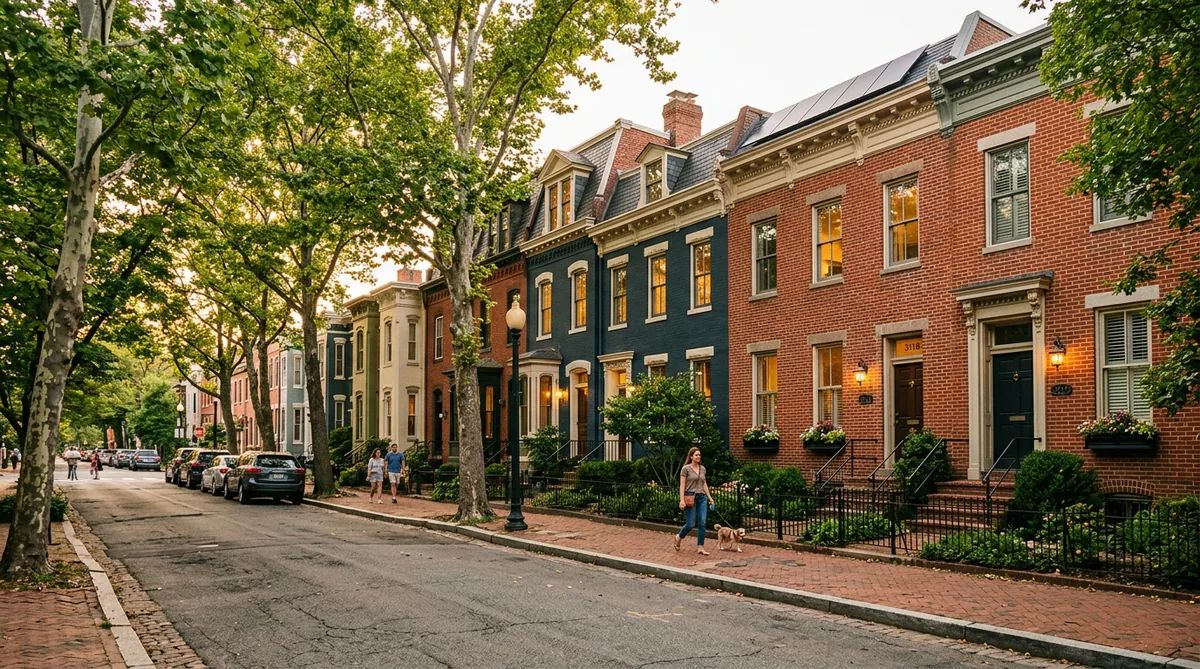
This adds time and complexity, but it's very doable. The key is designing an installation that's not visible from the public street.
What HPRB Wants to See
- Panels behind parapets on flat roofs (invisible from ground level)
- Rear-facing installations on sloped roofs
- Black-on-black panels that minimize visual contrast
- Low-profile mounting that doesn't alter the roofline
What HPRB Will Likely Reject
- Panels visible from the primary street facade
- Front-sloped roof installations
- Mounting systems that permanently alter historic architectural features
- Equipment (inverters, conduit) visible on street-facing walls
HPRB Timeline
| Step | Duration |
|---|---|
| Preliminary consultation | 1–2 weeks |
| Document preparation | 2–3 weeks |
| HPRB review | 4–6 weeks |
| Building permit | 2–3 weeks |
| Total | 9–14 weeks |
Compare that to the 2–4 week permit timeline for non-historic row houses.
The good news: DC's clean energy goals (100% renewable by 2032) give HPRB strong motivation to approve solar installations. The vast majority of flat-roof, behind-parapet applications are approved. We've successfully installed solar on row houses in Shaw, Logan Circle, Dupont Circle, and Capitol Hill — all historic districts.
How Much Energy Will a Row House System Produce?
DC receives about 4.2 peak sun hours per day on average. Combined with panel efficiency and orientation, here's what you can expect:
| System Size | Annual Production | % of Avg DC Home Usage (8,500 kWh) |
|---|---|---|
| 4 kW | 4,600 kWh | 54% |
| 6 kW | 7,000 kWh | 82% |
| 8 kW | 9,200 kWh | 108% |
A standard 18–20 foot row house with a 6 kW system can offset about 80% of electricity usage. With net metering through Pepco, any excess electricity you generate rolls over as credits on your bill — effectively banking summer overproduction for winter months.
Shading matters: If your row house gets significant shade from neighboring buildings, expect 15–30% lower output. A proper shade analysis before installation ensures your system is sized accurately.
Financial Returns: Row House Solar Math
Let's run the numbers for a typical Petworth row house with a 6 kW system:
| Item | Amount |
|---|---|
| System cost | $27,000 |
| Federal tax credit (30%) | -$8,100 |
| Net cost | $18,900 |
| Annual electricity savings | $1,500 |
| Annual SREC income (7 × $400) | $2,800 |
| Annual return | $4,300 |
| Payback period | 4.4 years |
After payback, you're earning $4,300/year in savings and income for the remaining 20+ years of the system's life. Over 25 years, total financial benefit exceeds $80,000 on an $18,900 investment.
And DC SRECs make this math dramatically better than nearly anywhere else in the country. A similar system in Maryland would earn ~$420/year in SRECs instead of $2,800.
FAQ
Do I need my neighbor's permission to install solar on my row house?
No. You don't need neighbor consent for solar panels on your own roof. However, if your installation requires any work on or near the party wall, it's good practice to inform adjacent neighbors. DC building code governs party wall modifications.
What if my row house roof is too small for enough panels?
Even a small 3–4 kW system is worthwhile in DC because SREC values are so high. A 4 kW system generates roughly $1,600/year in SRECs plus $900 in electricity savings. If your roof truly can't support panels, DC's community solar program lets you subscribe to a shared solar project and get bill credits without rooftop panels.
Will solar panels damage my flat rubber roof?
Ballasted (non-penetrating) systems don't damage rubber roofs. Panels sit on weighted racks with protective pads between the racking and the membrane. Make sure your roof is in good condition before installation — we inspect every roof before quoting.
How long does a row house solar installation take?
The physical installation is typically 1–2 days. The overall timeline from signing to power-on is:
- Non-historic: 4–8 weeks (mostly permitting and utility interconnection)
- Historic district: 12–18 weeks (add HPRB review time)
Do solar panels increase a DC row house's resale value?
Yes. Studies show solar panels increase home values by 4.1% on average. For a $600,000 DC row house, that's roughly a $24,600 value increase — often more than the net cost of the system after incentives.
Can I install a battery with solar on my row house?
Yes. Battery systems like Tesla Powerwall or Enphase IQ work well with row house solar. The battery is typically installed in the basement, utility room, or on an exterior wall. Battery storage adds $10,000–$15,000 but provides backup power and can help maximize self-consumption.
Find Out If Your Row House Qualifies
Every row house is different — roof width, orientation, shade, and condition all affect your solar potential. The best way to know what your system will look like is a professional assessment.
Get your free solar assessment — we'll analyze your roof using satellite imagery and provide a custom design with production estimates, cost breakdown, and SREC projections.
Explore solar installations in your neighborhood:


