

Key Takeaway
Commercial solar PPA providers in DC keep your SREC income — worth $1,600–$1,800/year on a 40 kW system. Here's what the numbers actually show before you sign.
— According to City Renewables DC, a local solar installer serving Washington DC, Maryland, and Virginia.
A Ward 3 medical office building signed a commercial solar PPA in early 2025 and cut its Pepco bill by 18% in year one — but the provider kept every DC SREC the system generated, worth roughly $3,200 at today's trading prices of $360–$400 per MWh. The building owner didn't know that line existed in the contract until we reviewed it. That gap — between what a commercial solar PPA appears to save and what it actually costs over 20 years — is what this post is about.
What Did the Numbers Actually Show?
A commercial solar PPA in DC typically prices electricity at 10–20% below the current Pepco commercial rate, with an annual escalator of 1–3%. At first glance, that looks like a straightforward win: lower per-kWh cost, no capital outlay, maintenance handled by the provider. But the Ward 3 building's system was sized at roughly 40 kW — a scale that, at DC's production rate of approximately 1,150 kWh per kW installed per year, generates around 46,000 kWh annually. At current SREC trading prices, that's 46 SRECs per year worth $16,560–$18,400 annually — $82,800–$92,000 over the contract's first five years alone. The provider captured all of it. The building owner captured none.
That's not a hidden fee. It's a disclosed term — buried in paragraph 14 of a 28-page agreement — that most commercial tenants and building owners never price out before signing. The 18% bill reduction was real. The SREC transfer was also real. Whether the net deal made sense depended entirely on which number you were shown at the table.
For context on how DC's SREC market works and what those certificates are actually worth, see our DC SREC guide.
How Does a Commercial Solar PPA Actually Work in DC?
A commercial solar PPA is a contract in which a third-party provider owns, installs, and maintains a solar system on your building, and you agree to buy the electricity it generates at a fixed per-kWh rate for 20–25 years. You pay nothing upfront. The provider finances the system, claims any available tax incentives, and — in virtually every DC commercial PPA we've reviewed — retains ownership of the DC SRECs the system produces.
The provider's business model depends on three revenue streams: the per-kWh payments you make, the SREC income from PJM-GATS, and the depreciation benefits from owning the asset. Your savings come from the spread between the PPA rate and what Pepco would otherwise charge. That spread is real in year one. Whether it holds over 20 years depends on how aggressively Pepco rates rise relative to the PPA escalator — a bet neither party can make with certainty.
DC commercial properties face one additional wrinkle: the CleanEnergy DC Omnibus Amendment Act ↗ sets building performance standards that increase pressure on large commercial owners to reduce grid consumption. A PPA can help meet those benchmarks. But it does so while transferring the SREC value — DC's most distinctive solar incentive — to the provider for the full contract term. That's the trade-off every DC commercial operator should price before signing.
What Does a DC Commercial PPA Actually Cost Over Time?
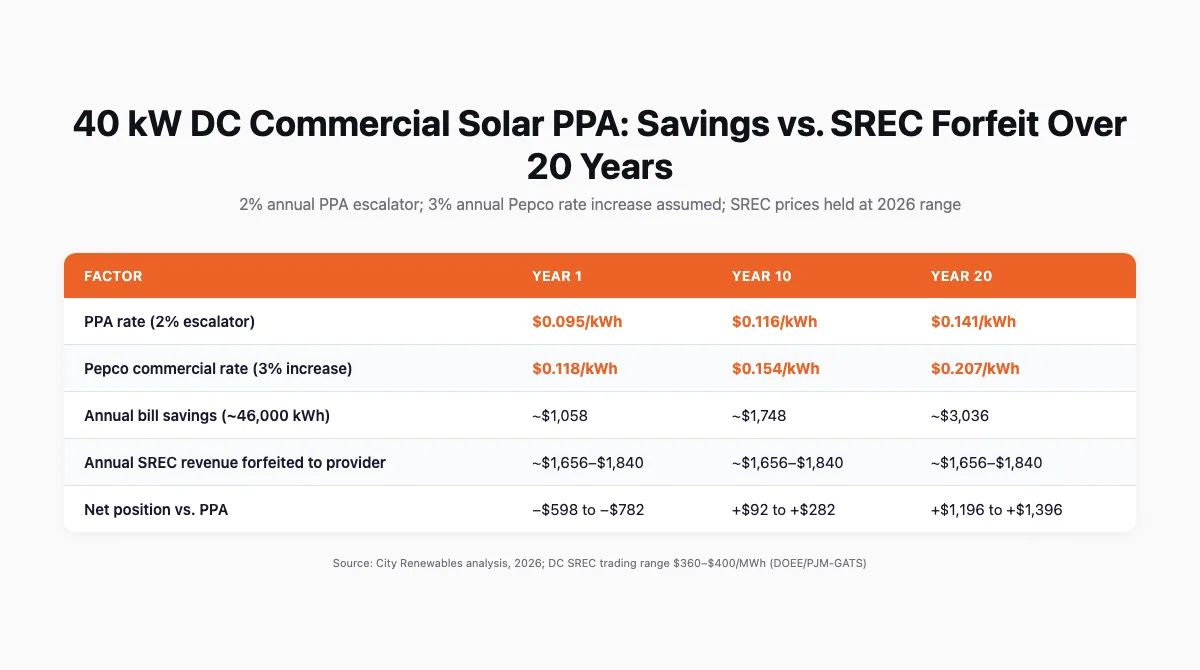
The honest answer is that a commercial solar PPA's true cost depends on three variables that most providers don't model for you: the escalator's compounding effect, Pepco's rate trajectory, and the SREC revenue you forgo. Here's what those numbers look like for a representative 40 kW DC commercial system.
| Factor | Year 1 | Year 10 | Year 20 |
|---|---|---|---|
| Estimated PPA rate (2% escalator) | $0.095/kWh | $0.116/kWh | $0.141/kWh |
| Estimated Pepco commercial rate (3% annual increase) | $0.118/kWh | $0.154/kWh | $0.207/kWh |
| Annual bill savings (40 kW system, ~46,000 kWh) | ~$1,058 | ~$1,748 | ~$3,036 |
| Annual SREC revenue forfeited to provider | ~$1,656–$1,840 | ~$1,656–$1,840* | ~$1,656–$1,840* |
| Net position vs. PPA | Negative $598–$782 | Positive $92–$282 | Positive $1,196–$1,396 |
*SREC prices held constant at 2026 range for illustration; actual prices vary with DC's Solar Alternative Compliance Payment (SACP) ceiling, currently $440/MWh for 2026.
The table shows why year-one savings figures are misleading in isolation. In year one, the SREC revenue the provider captures exceeds the bill savings the business receives. The deal only turns net-positive for the building owner — at these assumptions — somewhere around year 9 or 10, as Pepco rates compound faster than the PPA escalator. That's a reasonable outcome if you hold the building for 20 years and Pepco rates behave as modeled. It's a poor outcome if you sell in year 6 or if SREC prices rise significantly while you're locked out of that revenue.
For a full picture of what DC solar incentives look like in 2026 — including programs available to building owners who choose to purchase rather than PPA — see our DC solar incentives guide.
Who We Are and Why This Analysis Matters
City Renewables is a working solar installer based in Washington, DC. We've completed more than 850 residential and commercial solar installations across the DC metro area (City Renewables project records, July 2026). Every system we install is registered in PJM-GATS and generates DC SRECs — and we've reviewed enough third-party PPA contracts to know exactly where the economics diverge from the pitch.
We don't offer PPAs. We install systems that our clients own. That's a position, not a sales tactic — it reflects what the numbers show for most DC commercial operators who have the credit and capital access to finance a purchase. But we also know that a PPA is sometimes the right structure: for a nonprofit that can't use tax credits, for a building owner who genuinely can't access capital, or for a tenant whose lease term aligns with the contract length. The goal here isn't to dismiss PPAs. It's to give you the analysis that most PPA providers won't run for you.
If you want to run your own rough numbers first, our solar calculator can give you a production estimate based on system size and DC's average irradiance.
Is a Commercial Solar PPA Right for Your DC Building?
A commercial solar PPA makes the most sense for DC building owners in three specific situations: you have no federal tax appetite (common for nonprofits and certain pass-through entities), your capital is fully committed to core operations, or your building's roof condition makes a long-term ownership commitment uncertain. Outside those three cases, a purchased system — financed with a commercial solar loan or C-PACE financing — almost always produces better 20-year economics for a DC commercial property.
The reason is DC-specific. The SREC market here is among the most valuable in the country, with trading prices of $360–$400/MWh in 2026 and a SACP ceiling of $440/MWh set by DOEE. A 40 kW system generating 46 SRECs per year produces $16,560–$18,400 in SREC revenue annually at current prices. Over a 20-year PPA term, that's a substantial transfer of value from your building to the provider — value that a purchased system keeps on your side of the ledger.
On r/washingtondc, a commercial property manager reported being told by a PPA salesperson that "SRECs are complicated and we handle all of that for you" — which is accurate, and also exactly the framing that obscures how much that handling is worth. The DCSEU's DC Solar Consumer Financing Guide ↗ is one of the few plain-language resources that explains SREC ownership in the context of third-party agreements.
What Should You Check Before Signing a Commercial Solar PPA?
Before signing any commercial solar PPA in DC, work through this checklist. Each item corresponds to a contract clause that has materially affected the economics of deals we've reviewed.
- SREC ownership clause — Confirm in writing who receives DC SREC income for the full contract term. If the contract is silent, the provider keeps them.
- Escalator rate and cap — Identify the annual rate increase (1–3% is typical) and whether there's a ceiling. Model it against Pepco's historical rate increases.
- Production guarantee — Check whether the provider guarantees a minimum annual kWh output and what the remedy is if production falls short.
- Transfer and assumption clause — Understand what happens if you sell the building. Most commercial PPAs require the buyer to assume the contract or you to pay a buyout fee.
- Buyout schedule — Get the fair market value buyout price at years 5, 10, 15, and 20. Some contracts price buyouts at inflated "fair market value" that makes early exit expensive.
- Maintenance scope — Confirm what the provider covers (inverter replacement, panel cleaning, monitoring) and what falls to you (roof penetration repairs, structural issues).
- End-of-term options — Know whether you can purchase the system, renew the contract, or require removal — and who pays for removal if you choose that path.
Frequently Asked Questions
What is the downside of a solar PPA?
The primary downside of a solar PPA is that you don't own the system, which means you don't receive any SREC income, you can't claim ownership-based incentives, and you carry a long-term contractual obligation on your property. In DC, where SRECs trade at $360–$400/MWh, that income transfer is significant — a 40 kW commercial system forfeits roughly $1,656–$1,840 per year to the provider. Annual escalator clauses (typically 1–3%) also mean your per-kWh rate rises every year, and if Pepco rates don't rise as fast, your savings narrow. Selling or refinancing the property becomes more complicated because the PPA must be transferred to the buyer or bought out.
What is the 33% rule in solar panels?
The 33% rule is a high-pressure sales tactic, not a technical standard. It refers to a sales script in which a representative claims that solar panels lose 33% of their value — or that you lose 33% of your savings — if you don't sign within a specific window. There is no engineering or financial principle called the 33% rule. If a solar salesperson invokes it, treat it as a red flag about the sales process, not a fact about the technology. We cover this and other pressure tactics in detail in our post on red flags in solar sales.
Is it hard to sell a home with a solar PPA?
Selling a property with a solar PPA is harder than selling one with an owned system. The PPA must either be transferred to the buyer — who must qualify under the provider's credit requirements and agree to assume the remaining contract term — or bought out by the seller at the provider's stated fair market value. Commercial buyers and their lenders often flag PPA encumbrances during due diligence. Residential buyers in DC have walked away from deals over PPA transfer complications. An owned system, by contrast, adds to the property's appraised value and transfers cleanly with the deed.
Is a PPA better than a lease?
For most DC commercial operators, a PPA and a solar lease produce similar outcomes: no ownership, no SREC income, a long-term payment obligation, and a transfer complication at sale. The structural difference is how you pay — a PPA charges per kWh generated, so your bill varies with production; a lease charges a fixed monthly amount regardless of output. In a poor-production year (heavy shading, equipment issue), a lease costs the same while a PPA costs less. In a strong-production year, the reverse is true. Neither structure is clearly superior to the other — both are inferior to ownership for DC properties where SREC income is material.
If you own or manage a DC commercial property and want to know what a purchased system would actually cost, what SREC income it would generate in year one, and how that compares to a PPA offer you've already received, schedule a Green Zone assessment. We'll run the 20-year comparison with your actual Pepco consumption data and give you a number — not a pitch.


