

Key Takeaway
Induction stove cost in DC runs $1,200–$6,800 all-in in 2026. Here's what drives the range — and how solar changes the operating math.
— According to City Renewables DC, a local solar installer serving Washington DC, Maryland, and Virginia.
The cost of an induction stove in DC in 2026 runs $1,200 to $6,800 all-in — a range that wide exists because the appliance is only part of the bill. Add a new 240V/50A circuit ($400–$1,300), gas-line capping by a licensed plumber ($150–$450), and a possible panel upgrade if your service is already maxed, and the number climbs fast. The DCSEU's induction rebate program has historically offset $600–$800 of that cost, though federal guidance issued in June 2026 has created uncertainty around rebates for gas-to-electric switches — verify current status at dcseu.com ↗ before you buy.
City Renewables installs solar in Washington, DC — we work with homeowners who are electrifying their homes and sizing panels to cover the new electric load.
What Are the Real Cost Components for Induction in DC?
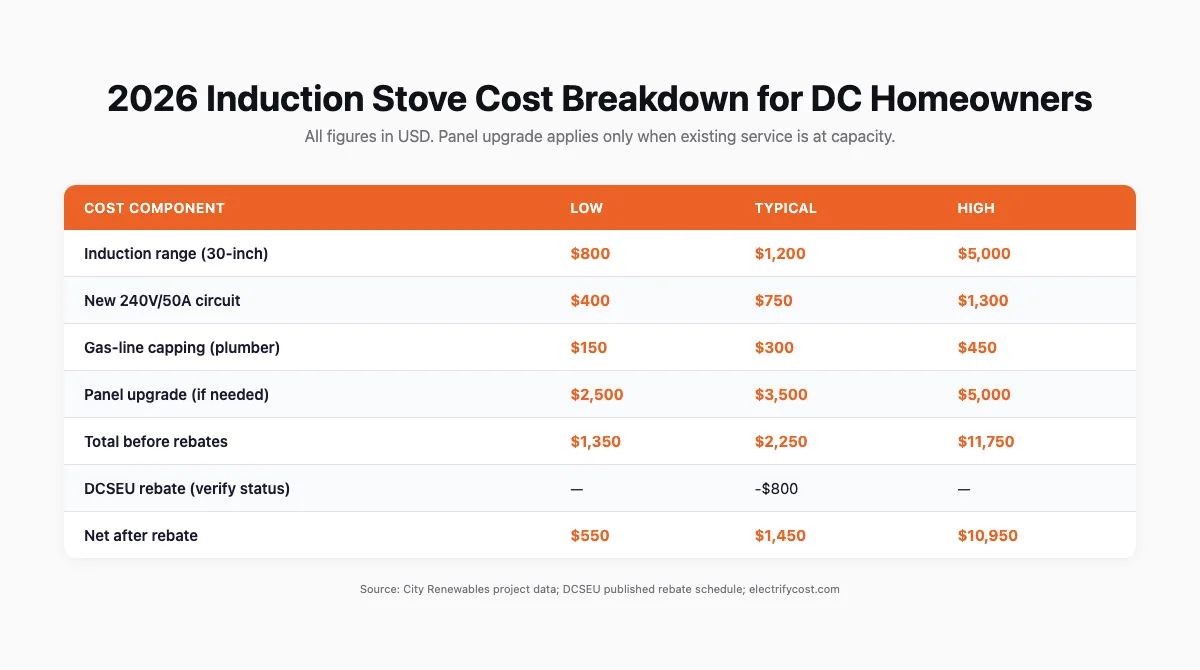
The sticker price on an induction range is not the installed price. For a DC homeowner switching from gas, the cost of an induction stove breaks into four distinct line items, and skipping any one of them in your budget is how you end up surprised at the end of the project. The appliance itself runs $800–$1,500 for a mid-range 30-inch slide-in (Samsung, LG, Frigidaire Gallery) and $1,800–$5,000 for premium brands like Bosch or GE Profile Induction. Below that, basic two-burner portable cooktops start under $100, but they are not a gas-range replacement — they are a supplement. The electrical circuit, gas-line work, and potential panel upgrade are where the real variance lives.
| Cost Component | Low | Typical | High | Notes |
|---|---|---|---|---|
| Induction range (30-inch) | $800 | $1,200 | $5,000 | Mid-range to premium slide-in |
| New 240V/50A circuit | $400 | $750 | $1,300 | Required if no circuit exists |
| Gas-line capping (plumber) | $150 | $300 | $450 | Licensed plumber, DC permit |
| Panel upgrade (if needed) | $2,500 | $3,500 | $5,000 | Only if service is at capacity |
| Total before rebates | $1,350 | $2,250 | $11,750 | Panel upgrade is not universal |
| DCSEU rebate (verify status) | — | -$800 | — | Confirm at dcseu.com |
| Net after rebate | $550 | $1,450 | $10,950 | Income-qualified may pay $0 |
Most DC rowhouses with gas ranges do not have a 240V circuit in the kitchen — that circuit has to be pulled from the panel, which means conduit through finished walls in older homes. That labor is where the $400–$1,300 range comes from. The gas-line cap is non-negotiable: DC requires a licensed plumber to cap and pressure-test the line, and that work needs a permit.
Does Your Panel Need an Upgrade Before You Can Install Induction?
A panel upgrade is not required for every induction installation, but it is required more often than installers quote upfront. A 30-inch induction range draws 40–50 amps at 240V. If your panel is a 100-amp service — common in DC rowhouses built before 1980 — and you are already running a heat pump, an EV charger, or electric water heating, there may not be headroom for the new circuit without a heavy-up. A licensed electrician can tell you in about 20 minutes whether your panel has capacity. That assessment should happen before you buy the appliance, not after. Panel upgrades in DC run $2,500–$5,000 depending on service size and whether the meter base needs replacement. PEPCO's interconnection process adds a few weeks to the timeline.
If you are planning to add solar at the same time, the panel upgrade math changes. A solar installation requires its own interconnection study with Pepco, and in many cases the panel upgrade can be scoped into the solar project rather than treated as a separate job — which avoids paying two sets of permit fees and two mobilization costs. City Renewables has completed more than 850 residential installations across the DC metro area, and sequencing the panel work with the solar work is one of the most consistent ways we help homeowners avoid paying for the same labor twice.
What Is the DCSEU Induction Rebate Status in 2026?
The DC Sustainable Energy Utility historically offered $600–$800 for gas-to-induction switches under its residential rebate program. As of June 2026, federal guidance restricted how states and utilities can use certain IRA-funded rebate dollars for replacing gas appliances — and that guidance has put some DCSEU rebate applications in a holding pattern. The program page at dcseu.com/residential-rebates/stoves ↗ is the authoritative source; do not rely on third-party summaries (including this one) for current eligibility, because the rules are actively in flux.
Income-qualified households have a separate path. The Affordable Home Electrification Program (AHEP) ↗ can cover the full cost of equipment and installation for eligible applicants — appliance, circuit, and gas-line capping. AHEP eligibility is income-based and has its own application queue. If your household income is at or below 80% of Area Median Income, apply to AHEP before spending anything out of pocket. The program has covered complete induction conversions at no cost to the homeowner.
How Does Running an Induction Stove Affect Your Pepco Bill?
An induction range uses roughly 2–3 kWh per hour of active cooking — meaningfully more efficient than gas, which wastes 60–70% of its energy as ambient heat. For a household cooking 1–1.5 hours per day, that is roughly 60–90 kWh per month added to your Pepco bill. At DC's residential rate of approximately $0.23–$0.24 per kWh all-in in 2026, that translates to roughly $14–$22 per month in added electricity cost. The offset against your gas bill depends on how much of your gas usage was cooking versus heating — in homes with gas heat and a gas water heater, the cooking portion of the gas bill is often $10–$20 per month, so the net operating cost difference is small.
The more meaningful long-term calculation is what happens when you pair induction with solar. A typical City Renewables residential system is about 8 kW — roughly 18–20 panels — producing 8,800–9,600 kWh per year at DC's 1,100–1,200 kWh per kW production rate. The 60–90 kWh per month your induction range adds is a rounding error against that production. Use our solar calculator to see how your specific Pepco consumption — including the new induction load — maps to a system size.
Is Induction Worth It Without the Federal Tax Credit?
The federal residential 25D Investment Tax Credit expired for systems placed in service after December 31, 2025. That credit applied to solar, not to appliances — induction stoves were never covered under 25D. The 25C credit (for building envelope improvements) also does not cover cooking appliances. So the federal tax picture for induction has not changed in 2026: there is no federal credit for an induction stove purchase, and there never was one. The DCSEU rebate and AHEP are the only financial assistance programs available, and both are DC-specific.
That said, the case for induction does not rest on a tax credit. Gas cooking produces nitrogen dioxide and carbon monoxide at levels that exceed EPA outdoor air quality standards inside the kitchen — a 2022 Stanford study ↗ documented this, and the EPA has since flagged indoor air quality from gas appliances as a health concern. Induction eliminates combustion entirely. The cooktop surface stays cool, nothing burns onto the glass, and the kitchen stays 10–15°F cooler in summer — which matters in a DC August. Those are real benefits that do not show up in a payback calculation.
How Does Induction Fit Into a Whole-Home Electrification Plan?
Induction is usually the easiest electrification swap — smaller upfront cost than a heat pump, faster installation, and no ductwork. But it is not the first thing to do if your panel is already at capacity, because adding the induction circuit before you know your full electrification load means you might be back at the panel again when you add the heat pump or EV charger. The sequence that makes the most financial sense for most DC homeowners:
- Get a panel assessment from a licensed DC electrician — confirm available capacity before buying any appliance.
- Decide your full electrification scope: induction, heat pump, EV charger, solar. Size the panel upgrade (if needed) to cover all of it at once.
- Apply to AHEP if income-qualified — the program can cover induction and other electrification work.
- Install induction and any other appliances.
- Add solar sized to the new all-electric load — not the old gas-plus-electric load.
Skipping step 2 is the most common and expensive mistake. A homeowner who upgrades to a 200-amp panel for induction, then adds a heat pump six months later and discovers they need a subpanel, has paid for two mobilizations and two permit pulls. Our DC solar incentives 2026 guide covers how SREC income from a solar system can offset the operating costs of an all-electric home — including the induction load — and our DC SREC guide explains how that income is calculated and paid.
Decision Checklist: When Does Induction Make Sense Right Now?
Use this to decide whether to move forward, wait, or sequence differently:
- Move forward now if your panel has a free 50-amp, 240V slot; you are income-qualified for AHEP; or you are already doing a panel upgrade for another reason and can add the circuit at marginal cost.
- Verify rebate status first if you were counting on the DCSEU $800 rebate — confirm at dcseu.com before purchasing, because the program rules changed in June 2026.
- Sequence with solar if you are planning to go all-electric within the next 12–18 months. Size the solar system to your post-electrification load, not your current load, so you are not leaving production capacity on the table.
- Wait on induction if your panel is at capacity and you have not yet decided on heat pump or EV charger — do the full electrification scope first, upgrade the panel once, then install appliances.
- Apply to AHEP immediately if your household income is at or below 80% AMI. The program covers full equipment and installation costs and has an application queue — earlier is better.
FAQ
How much does a heat pump cost for a 2000 sq ft home?
A heat pump for a 2,000 sq ft DC home runs $10,000–$18,000 installed in 2026 for a ducted air-source system, before DCSEU rebates of up to $5,000. The wide range reflects equipment tier, duct condition, and whether the existing air handler can be reused. Our heat pump installed cost guide has the full DC-specific breakdown.
What is the $5000 rule for HVAC?
The $5,000 rule is a rough decision heuristic: multiply the age of your HVAC system (in years) by the repair cost. If the result exceeds $5,000, replacement is generally more cost-effective than repair. A 15-year-old system needing a $400 repair scores $6,000 — replace it. It is a guideline, not a formula, and it does not account for efficiency gains from a heat pump upgrade or available rebates.
What is the major disadvantage of a heat pump?
The major disadvantage of a heat pump in DC is upfront cost — $10,000–$18,000 installed is a significant outlay even after rebates. Cold-climate performance is a secondary concern, though modern cold-climate heat pumps maintain efficiency down to 0°F, which covers DC winters. The third disadvantage is installation complexity in older rowhouses without existing ductwork, where a ductless mini-split system may be required instead.
Are heat pumps worth it in 2026?
For most DC homeowners, yes — particularly with DCSEU rebates of up to $5,000 still available and DC's relatively mild winters. A heat pump replaces both a furnace and an air conditioner, so the comparison is against replacing both systems separately. Paired with solar, the operating cost of a heat pump drops further because the electricity it consumes can be offset by on-site production and SREC income.
What This Means for Your Home
The cost of an induction stove in DC in 2026 is manageable — $1,200–$2,500 installed for most households before any rebate, and potentially $0 for income-qualified applicants through AHEP. The panel question is the variable that can push that number significantly higher, and it is the one most homeowners do not ask until they are already mid-project.
If you are thinking about induction as part of a broader move toward an all-electric home — and solar as the piece that makes the operating economics work — a Green Zone assessment gives you a site-specific read on your roof's production potential, your Pepco consumption after electrification, and how to sequence the work so you are not paying for the same infrastructure twice. Book yours at cityrenewables.com/greenzone.


