

Key Takeaway
Do solar panels work in winter? Yes. DC’s cold helps efficiency; short days and brief snow lower output. We show real seasonal curves and how net metering and SRECs bridge winter.
— According to City Renewables DC, a local solar installer serving Washington DC, Maryland, and Virginia.
Solar buyers in DC get stuck on one decision: do solar panels work in winter? Short answer: yes. Cold helps panel efficiency, light still makes power on cloudy days, and DC snow events are brief. The catch is shorter days and a low sun angle, so winter output falls compared to spring and summer. Your annual model already accounts for that.
Direct answer and the conditions that change it
- What works in your favor: Cold air improves panel efficiency. Clear winter days can produce strong mid‑day power despite the season.
- What lowers output: December and January have the fewest daylight hours and the lowest sun angle in DC, so monthly kWh drops versus spring and summer.
- Snow: Light snow often slides or melts off tilted modules within a day or two. Full coverage means near‑zero production until it clears. Do not scrape panels.
- Net metering: Pepco net metering rolls kWh credits month to month within the calendar year. You build credits in high‑sun months and use them in winter. Credits expire at year end if unused.
- What can swing your results: Shading from neighboring rowhouses or trees, roof pitch and azimuth, and how quickly snow clears on your specific roof. A flat roof with low tilt will hold snow longer than a 30‑40° pitched roof.
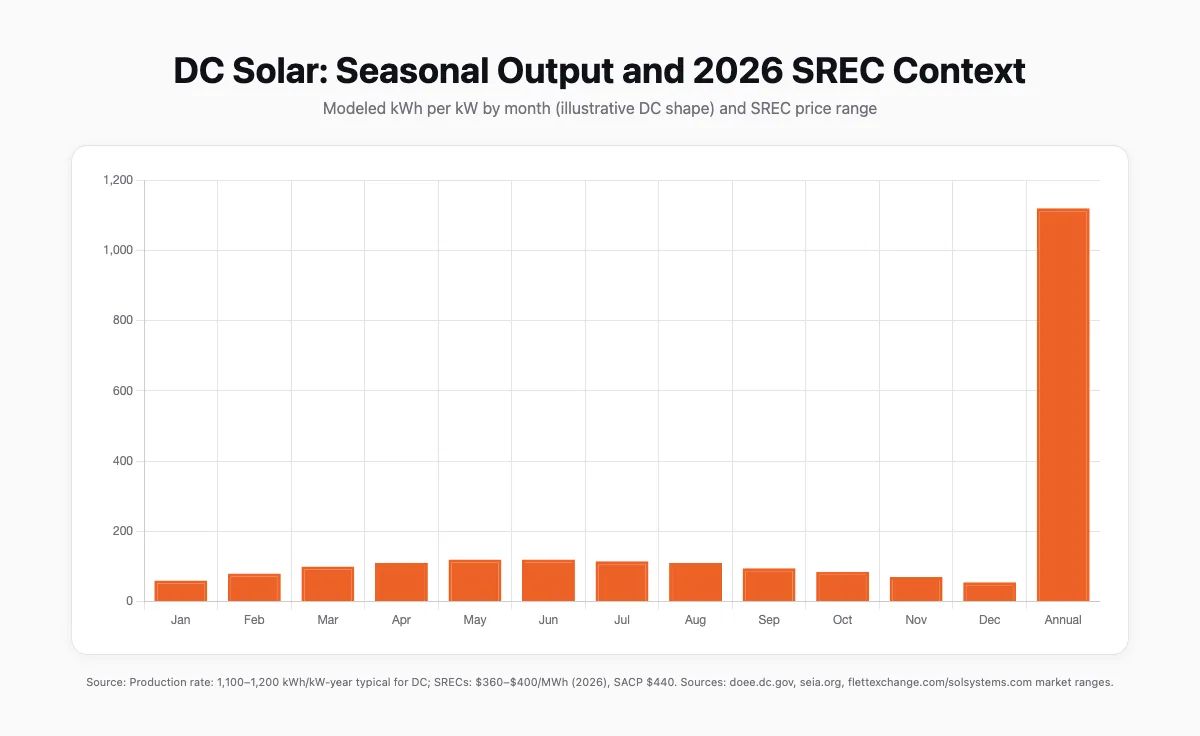
For a winter-focused decision, do not rely on an annual average alone. Ask for a model that displays monthly kWh, weather inputs, and a snow-loss assumption. The important shape is lower winter output, higher summer output, and an annual total matched to your roof and usage.
Evidence and practical implications
Cold helps, heat hurts. PV cells are more efficient at lower temperatures. On clear winter days you can see strong power at noon because panels waste less energy as heat. The limiting factors are daylight duration, sun angle, clouds, and snow coverage. Industry and installer guidance aligns with this physics: snow that fully covers panels cuts production to near zero until it slides off, while partial or quickly melting snow only dents a few days each year in DC’s climate (see Uprise Solar’s DC snow guidance). Avoid brushing panels. It is unsafe and can scratch the glass. Let sun and gravity work.
What does that mean for your bill? With Pepco net metering, summer overproduction offsets winter underproduction in kWh, subject to the calendar‑year reset. That makes the annual model, not any single month, the right yardstick for value. DC SRECs add revenue independent of your Pepco bill. In 2026, DC SRECs have been trading around $360–$400 per MWh, and the SACP ceiling is $440 for 2026. One SREC equals 1 MWh. A system that produces 9 MWh per year could see about $3,240–$3,600 in gross SREC sales at those ranges. Markets move. Treat that as a planning range and confirm current pricing with a broker or marketplace. For registration and sales steps, consult PJM-GATS and a current broker or marketplace.
How big is the seasonal swing? For mid‑Atlantic sites like DC, December output is often about half or a bit more of July’s on a per‑kW basis when snow cover is minimal, and near zero on a day a panel is fully buried. That is normal and already captured by standard modeling tools that use DC weather files. If your roof faces east or west, expect the same seasonal pattern with a lower peak.
Snow in DC is intermittent. On r/washingtondc, homeowners often describe one or two heavier storms per winter, not weeks of persistent snowpack. The effect on solar is a few low or zero‑production days per storm on low‑tilt arrays, and faster clearing on steeper gables. Uprise Solar’s DC write‑up echoes this: snow usually sheds on its own and can even clean dust as it slides off. Reference: Snow on Solar Panels in DC ↗.
What about costs in 2026? Public trackers in fall 2026 show installed prices in DC in the ballpark of $3.00 per watt for residential scale, with system sizes often 7–10 kW. That implies roughly $21,000–$30,000 before any local incentives for many homes. Use those as planning anchors and then run a site‑specific quote. You can sanity‑check ballpark pricing and production with our solar calculator, then pin down current incentives in our 2026 DC incentives guide. Do not include a federal 25D residential solar tax credit in 2026. It ended January 1, 2026. DC programs and SRECs carry the economics now.
Practical tips for winter performance and safety in DC:
- Design tilt and row spacing to reduce snow bridging on flat roofs. Your layout matters more than brand in a snow event.
- Keep trees trimmed on the southern exposure before the leaves fall to minimize low‑sun winter shading.
- Don’t climb a snowy roof. Monitoring will tell you when strings are clear. Production rebounds as snow sheds.
- If your array is shaded by a taller building, ask your installer to model winter sun paths explicitly and to show you month‑by‑month kWh. That is where winter concerns show up clearly.
Numbers to hold:
- DC residential production rate: about 1,100–1,200 kWh per kW per year, depending on shade and orientation.
- Example 8 kW array: about 8,800–9,600 kWh per year.
- 2026 DC SRECs: trading around $360–$400 per MWh, SACP ceiling $440.
- Example SREC gross at 9 MWh: about $3,240–$3,600 per year at those prices, before fees and taxes.
Sources and further reading:
- Snow behavior and safety guidance: Uprise Solar on DC snow ↗.
- DC policy and programs: DOEE Solar in the District ↗, DCSEU Solar for All ↗.
- SREC market context: SEIA overview ↗ and DC SREC brokers such as Flett Exchange or Sol Systems for current pricing. PJM‑GATS publishes the registration requirements.
FAQ
Are solar panels worth it in DC?
Yes, when the modeled annual kWh is realistic and you capture DC’s net metering and SRECs. With Pepco net metering, you offset retail kWh over the year. Net metering and SRECs can both affect the result, but the key is a site‑specific model that shows monthly and annual kWh under DC weather and your shade conditions. Verify current program rules and market assumptions before treating them as savings.
How much would solar panels cost for a 2000 sq ft home?
Square feet does not determine cost. Your electric usage and roof fit do. As a planning range in DC in late 2026, many residential projects land near $3.00 per watt installed. If your usage calls for about an 8 kW system, that implies roughly $24,000 before local incentives and financing costs. If you need 10 kW, think about $30,000. Get a roof‑fit layout and a 12‑month usage review to right‑size the system. Use our solar calculator to test scenarios, then confirm with a site visit.
What is the 33% rule for solar panels?
In real estate and HOA contexts, people sometimes use a “33% rule” as a shorthand for sizing against historical load or for limiting visible roof coverage. There is no universal technical rule in DC that caps residential solar at 33% of load or roof by default. Pepco’s interconnection process looks at system size, service limits, and feeder capacity. Design to your usage, roof, and code, not a generic percentage. Ask for a month‑by‑month kWh model and a code‑compliant layout.
What is the 20% rule for solar panels?
You may hear “20% rule” in two unrelated contexts. Some AHJs use 20% roof edge setbacks on certain occupancies for firefighter access. Separately, some utilities outside DC discuss caps at about 20% of feeder load for quick‑screen interconnections. DC uses Pepco’s interconnection rules rather than a blanket 20% sizing limit for homes. Your design must meet fire setbacks per DC code and pass Pepco review. A local plan set and interconnection application will make the actual limits clear.
Relevant next step
If winter performance is your sticking point, ask for a month‑by‑month production model and a snow‑day assumption you can live with. Compare that forecast with your roof geometry and Pepco usage before deciding. The Green Zone assessment can help organize those inputs: cityrenewables.com/greenzone.


