

Key Takeaway
Generator, battery, or solar+battery? A DC-specific cost and capability comparison for 2026 — with permit realities, load limits, and SREC math.
— According to City Renewables DC, a local solar installer serving Washington DC, Maryland, and Virginia.
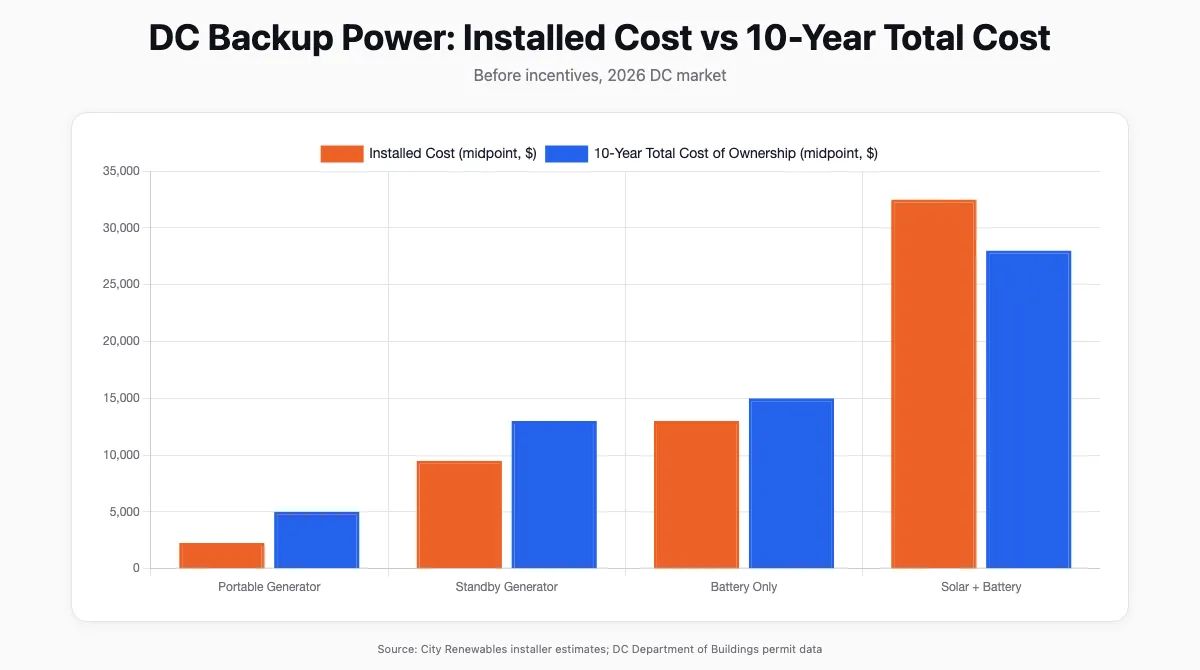
For DC homeowners comparing backup power options in 2026, the honest answer is that the right choice depends on three things: how long your outages typically last, whether you have a natural gas line, and what your outdoor space looks like. A standby generator runs $7,000–$12,000 installed for an 18–22 kW unit. A standalone battery runs $11,000–$13,000 for a 13 kWh system. A solar-plus-battery setup starts around $25,000–$35,000 before incentives — but it's the only option that pays you back during normal grid operation through Pepco net metering and DC SREC income. None of these is universally correct. This post lays out the DC backup generator vs battery comparison so you can make the call for your specific home.
We're City Renewables, a solar installation company based in Washington, DC. We install rooftop solar and battery storage on DC row houses, Capitol Hill colonials, and Petworth bungalows. The comparisons below draw on our permit experience with DCRA, our knowledge of Pepco's interconnection process, and the real costs we see on DC jobs in 2026.
What Does Each Option Actually Do?
A standby generator is a gas-powered engine — typically natural gas — that sits outside your home and kicks on automatically when the grid goes down. It can run indefinitely as long as fuel flows, which makes it the clear winner for multi-day outages. An 18–22 kW unit handles central air conditioning, a refrigerator, lights, and most plug loads simultaneously. The tradeoff: it's loud (65–70 dB at 23 feet), it requires a 5-foot clearance from building openings per NFPA 37, and it produces exhaust — which matters on a DC row house lot where your neighbor's window may be 8 feet away. Permits in DC require both an electrical permit and a mechanical/gas permit through DCRA, with combined fees typically running $150–$800 depending on scope.
A battery system — a Tesla Powerwall 3, Enphase IQ Battery 5P, or similar — is a silent, solid-state unit that can mount indoors or in a garage. It stores electricity from the grid (or from solar panels) and discharges during an outage. A single 13–13.5 kWh battery covers critical loads — refrigerator, lights, phone charging, a few outlets — for roughly 8–24 hours depending on consumption. It won't run central AC for long. It makes no noise and produces no exhaust, which is why it's the default choice for historic DC homes with tight lot lines and HOA restrictions.
A solar-plus-battery system combines rooftop panels with one or more batteries. The panels recharge the battery during daylight, which means a multi-day outage in June — when DC gets 5+ peak sun hours — looks very different than one in January. This is the only configuration that generates ongoing financial return through DC's SREC program and Pepco net metering credits, which partially offsets the higher upfront cost.
How Do the Costs Compare?
The table below uses 2026 DC-market figures. Generator costs come from permit data and contractor quotes for 18–22 kW natural gas units. Battery costs reflect the $11,197–$13,173 range for a single 13 kWh system reported in current DC market data. Solar-plus-battery costs assume a 6 kW array paired with one battery on a typical DC row house.
| Option | Installed Cost (Before Incentives) | Key Incentive Available | Effective Cost (Estimate) | Ongoing Fuel/Maintenance |
|---|---|---|---|---|
| Standby Generator (18–22 kW) | $7,000–$12,000 | None for residential | $7,000–$12,000 | $200–$500/yr maintenance + gas |
| Battery Only (13 kWh) | $11,000–$13,200 | DCSEU rebates; property tax exemption | $9,000–$11,500 | Minimal; no fuel |
| Solar + Battery (6 kW + 13 kWh) | $25,000–$35,000 | DCSEU, SREC income, property tax exemption | $20,000–$28,000 | Near-zero; panels generate revenue |
Note on the federal tax credit: the residential 25D Investment Tax Credit for purchased solar systems expired on January 1, 2026. It is no longer available for systems installed in 2026. Do not rely on a 30% federal credit when budgeting. DC-specific incentives — including DCSEU rebates and the DC property tax exemption for solar equipment — remain active. See our full breakdown at DC solar incentives 2026.
Is a Generator or Battery Better for a DC Row House?
For most DC row houses, a battery is the more practical fit — not because it's cheaper, but because the physical constraints of a typical DC lot make generator installation genuinely difficult. A standard DC row house has a rear yard of 15–25 feet, shared fence lines, and neighbors within close range on both sides. NFPA 37 requires 5 feet of clearance from any building opening (windows, doors, vents). On a 16-foot-wide lot, that clearance requirement can eliminate most viable placement options before you even start. Add in the noise factor — 65–70 dB is roughly equivalent to a vacuum cleaner running continuously — and many DC homeowners find that a generator creates neighbor friction that a battery simply doesn't. Historic district properties face an additional layer: the Historic Preservation Review Board (HPRB) may require review for any exterior mechanical equipment visible from a public street, and a generator enclosure can trigger that process. A battery mounted in a basement or utility room avoids all of it.
That said, generators win on one dimension that matters: runtime. If you're in a neighborhood that loses power for 3–5 days after a major storm — which has happened in parts of Ward 4 and Ward 7 after derecho events — a battery alone won't carry you through. A generator will, as long as the gas line stays live (natural gas lines rarely go down in DC storms).
What Can Each Option Power During an Outage?
This is where the comparison gets concrete. Load capacity determines whether your backup system is a comfort measure or a genuine whole-home solution.
- Standby generator (18–22 kW): Central air conditioning (3–5 kW running load), refrigerator, all lighting, EV charger (Level 1), sump pump, well pump, home office equipment. Essentially whole-home coverage.
- Single battery (13 kWh): Refrigerator (
150W), LED lighting (200W), phone/laptop charging, a window AC unit (700–1,000W). Runtime at moderate load: 8–16 hours. Central AC (3–5 kW) would drain a single battery in 2–4 hours. - Solar + single battery (6 kW panels + 13 kWh): Same critical loads as battery-only, but the panels add roughly 25–35 kWh of generation on a clear DC summer day — enough to recharge the battery and run daytime loads simultaneously. In a multi-day summer outage, this combination can sustain critical loads indefinitely.
- Solar + two batteries (6 kW + 27 kWh): Covers central AC for several hours per day plus all critical loads. Closer to whole-home coverage in summer months.
Does a Battery Save Money When the Grid Is Up?
A battery alone — without solar — saves very little money in DC under current Pepco rates. Pepco's residential Schedule R rate structure as of May 2025 does not include time-of-use pricing for most residential customers, which means there's no peak/off-peak spread to arbitrage. The financial case for a standalone battery in DC is almost entirely about outage resilience, not daily savings.
Solar-plus-battery is different. DC's 1:1 net metering means every kWh your panels produce offsets a kWh you'd otherwise buy from Pepco at the current residential rate. On top of that, DC's SREC market — where solar renewable energy certificates trade at roughly $360–$400/MWh in 2026, with a Solar Alternative Compliance Payment ceiling of $440 — generates real annual income. A 6 kW system producing around 6,900 kWh per year (at DC's ~1,150 kWh/kW production rate) generates roughly 6–7 SRECs annually, worth $2,160–$2,800 at current prices. That income stream changes the financial math considerably compared to a generator or standalone battery. For the full SREC picture, see our DC SREC guide.
What About Permits and HOA Rules in DC?
Permitting requirements differ meaningfully across the three options, and this is an area where DC homeowners frequently underestimate the timeline. Generator installations in DC require an electrical permit and a mechanical/gas permit from DCRA. Combined permit fees run $150–$800. The process typically adds 4–8 weeks to a project timeline. If your home is in a historic district — which covers large portions of Capitol Hill, Georgetown, Dupont Circle, and other neighborhoods — an exterior generator enclosure may require HPRB review, adding further time.
Battery-only installations require an electrical permit. If the battery is paired with an existing solar system, the permit scope is typically limited to the electrical work. Indoor installations (basement, utility room) avoid any historic review trigger.
Solar-plus-battery requires an electrical permit, a building permit for roof penetrations, and Pepco interconnection approval. DCRA has improved solar permit turnaround in recent years, but plan for 6–12 weeks from application to permission to operate. HOA rules vary — some DC condo associations restrict rooftop equipment, while DC law generally protects a homeowner's right to install solar on a single-family home.
How Do I Choose the Right Option for My Home?
The decision comes down to four questions:
- Do you have a natural gas line? If not, a standby generator requires propane storage, which adds cost and complexity. Battery or solar-plus-battery becomes more attractive.
- How long are your typical outages? If your neighborhood loses power for 4+ days after major storms, a generator's unlimited runtime is hard to match with a single battery.
- Do you have usable roof space? A south- or west-facing roof with minimal shading is the prerequisite for solar-plus-battery to make financial sense. Our Green Zone assessment evaluates this for DC homes specifically.
- What's your primary goal — resilience or ROI? A generator is a pure resilience purchase. A battery is a resilience purchase with modest convenience benefits. Solar-plus-battery is the only option that generates a financial return over time.
For most DC homeowners who have roof access and a natural gas line, the practical answer is: a generator if you want the cheapest whole-home backup with unlimited runtime, or solar-plus-battery if you want backup power that also reduces your Pepco bill and generates SREC income over a 25-year system life.
Frequently Asked Questions
Is a whole-home generator worth it?
A whole-home generator is worth it if you experience multi-day outages and have a natural gas line. In DC, an 18–22 kW standby generator costs $7,000–$12,000 installed and provides unlimited runtime during an outage. It does not reduce your electricity bill or generate any financial return during normal grid operation. If your outages are typically short (under 12 hours), a battery may cover your needs at comparable cost with fewer installation constraints.
How long can a battery backup power a house?
A single 13 kWh battery can power critical loads — refrigerator, lighting, phone charging, and a window AC unit — for roughly 8–16 hours depending on consumption. Running central air conditioning (3–5 kW) would drain the same battery in 2–4 hours. Adding solar panels extends this significantly: a 6 kW array on a clear DC summer day generates 25–35 kWh, enough to recharge the battery and sustain critical loads through a multi-day outage.
What is the difference between a generator and a battery backup?
A generator is a gas-powered engine that produces electricity on demand and can run indefinitely as long as fuel is available. A battery stores electricity — from the grid or from solar panels — and discharges it during an outage. Generators handle higher loads (central AC, whole-home coverage) and longer outages. Batteries are silent, require no fuel, can be installed indoors, and — when paired with solar — provide daily financial value through net metering and SREC income.
Do solar panels work during a power outage?
Solar panels alone do not work during a grid outage — standard grid-tied inverters shut down automatically when the grid goes down, a safety requirement to protect utility workers. Solar panels paired with a battery and a hybrid inverter do work during an outage. The battery provides power when the sun isn't shining, and the panels recharge the battery during daylight hours.
What is the federal tax credit for a home battery in 2026?
The residential 25D Investment Tax Credit for purchased solar systems expired on January 1, 2026, and is no longer available for systems installed in 2026. A standalone battery installed without solar does not qualify for a federal residential credit under current law. DC-specific incentives — including DCSEU rebates and the DC property tax exemption for solar and storage equipment — remain active in 2026.
How much does a standby generator cost in DC?
A standby generator in DC costs $7,000–$12,000 installed for an 18–22 kW natural gas unit. That range includes the generator, automatic transfer switch, electrical and gas permits ($150–$800 combined through DCRA), and labor. Homes in historic districts may face additional review costs if the installation requires an exterior enclosure visible from a public street.
The Bottom Line
There is no single right answer for DC backup power in 2026. A generator is the cheapest path to whole-home, unlimited-runtime backup — if your lot allows it. A battery is the cleanest fit for DC row houses with tight lots, historic district rules, or HOA restrictions. Solar-plus-battery is the only option that pays you back over time through net metering and SREC income, but it requires roof access and a longer payback horizon.
If you want to know which option makes sense for your specific DC home — including whether your roof qualifies for solar, what your SREC income would look like, and how a battery would interact with your Pepco bill — start with our Green Zone assessment. It's free, it's specific to DC, and it gives you real numbers rather than national averages.


