

Key Takeaway
Home battery backup in DC costs $10,000–$20,000 installed. Compare Tesla, Enphase, and top brands, plus DC incentives and real ROI numbers.
— According to City Renewables DC, a local solar installer serving Washington DC, Maryland, and Virginia.
A home battery backup in DC typically costs $10,000–$20,000 installed before incentives — and after DC programs and available credits, many homeowners pay closer to $8,000–$14,000. But the real question isn't just cost. It's whether a battery makes financial sense for your home, your Pepco bill, and your tolerance for power outages.
Nationally, 40% of new solar installations now include a battery — up from just 14% in 2023. The technology is mainstream. But does it make sense specifically in DC, where Pepco already offers some of the best net metering in the country?
Here's everything DC homeowners need to know about home battery storage in 2026 — costs, the best brands, local incentives, what a battery actually powers during an outage, and whether the ROI adds up.
Table of Contents
- How Much Does a Home Battery Cost in DC?
- Top Home Battery Brands Compared
- DC Incentives and Tax Credits for Battery Storage
- Pepco Compatibility and Net Metering
- What Can a Battery Actually Power During an Outage?
- Is a Home Battery Worth It in DC?
- Installing a Battery in a DC Row House
- Frequently Asked Questions
How Much Does a Home Battery Cost in DC?
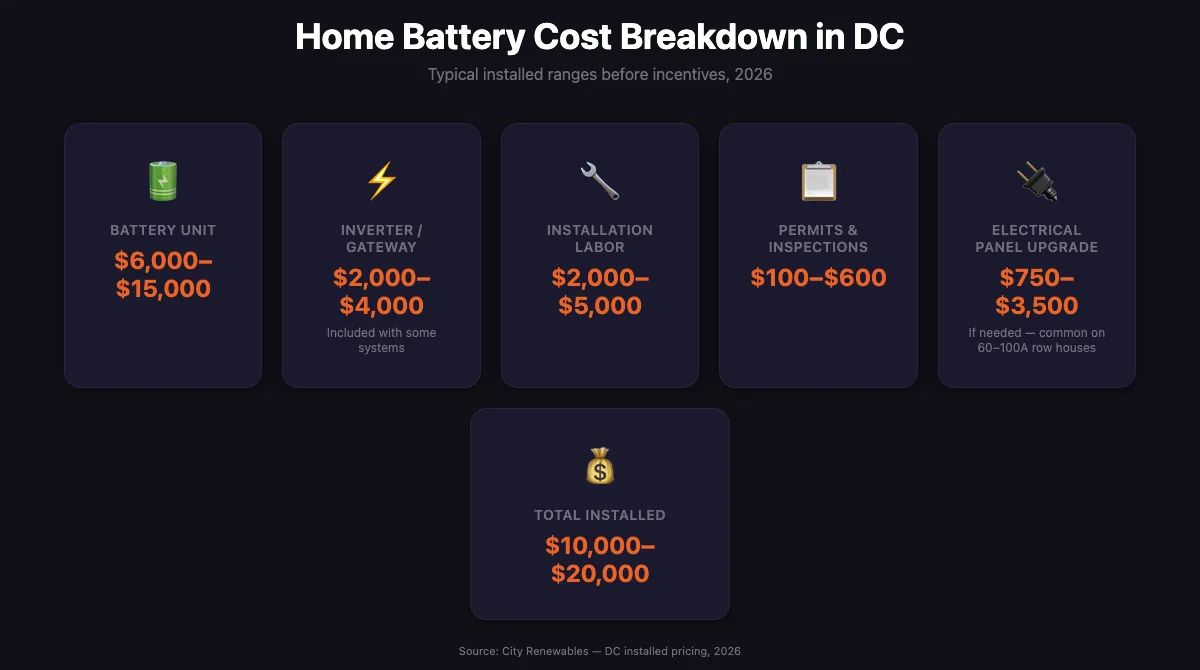
Battery costs depend on the brand, capacity (measured in kWh), and how much electrical work your home needs. Here's what you should budget:
| Cost Component | Typical Range |
|---|---|
| Battery unit | $6,000–$15,000 |
| Inverter/gateway | Included or $2,000–$4,000 |
| Installation labor | $2,000–$5,000 |
| Permits and inspections | $100–$600 |
| Electrical panel upgrade | $750–$3,500 (if needed) |
| Total installed | $10,000–$20,000 |
The most common setup — a single Tesla Powerwall 3 or Enphase IQ Battery 10 paired with an existing solar system — lands in the $13,000–$16,000 range before incentives.
A quick benchmark: installed costs in 2025–2026 average roughly $800–$1,200 per usable kWh, depending on the brand and whether your electrical panel needs upgrading. Older DC row houses with 60–100 amp service panels almost always need an upgrade, which can add $1,500–$3,500 to the project.
Pro tip: Get at least three itemized quotes. Ask each installer to break out the battery unit, inverter/gateway, labor, permits, and any panel upgrades separately. Then compare on a cost-per-usable-kWh basis — that's the only apples-to-apples number.
Top Home Battery Brands Compared
Five brands dominate the DC residential market. Here's how they stack up:
| Brand | Usable Capacity | Continuous Power | Chemistry | Warranty | Approx. Installed Cost |
|---|---|---|---|---|---|
| Tesla Powerwall 3 | 13.5 kWh | 11.5 kW | LFP | 10 years | $14,000–$16,000 |
| Enphase IQ Battery 10 | 10.08 kWh | 3.84–7.08 kW | LFP | 15 years | $12,000–$16,000 |
| LG RESU Prime | 9.6–16 kWh | 5–7 kW | NMC | 10 years | $11,000–$15,000 |
| Sonnen Eco | 5–15 kWh | Up to 8 kW | LFP | 10 years | $10,000–$18,000 |
| FranklinWH | 13.6 kWh | 10 kW | LFP | 12 years | $14,000–$18,000 |
Which battery is best for DC homeowners?
Tesla Powerwall 3 is the strongest all-around option. At 11.5 kW continuous output, it can handle most whole-home backup scenarios — including air conditioning, which most competitors can't sustain. The LFP chemistry means better longevity and safety than older NMC batteries. The downside: Tesla's installation wait times can stretch 2–4 months.
Enphase IQ Battery 10 is the best pick if you already have Enphase microinverters on your solar panels. It integrates seamlessly with your existing system without adding a separate inverter. The 15-year warranty is the longest in the industry. The tradeoff is lower continuous power output — you'll likely need a critical-loads panel rather than whole-home backup.
FranklinWH is gaining traction for homeowners who want whole-home backup without Tesla. Its 10 kW continuous output handles heavy loads well, and the modular design lets you stack units for larger homes.
For most DC row houses with existing solar, we recommend either the Powerwall 3 (for whole-home backup) or the Enphase IQ Battery 10 (for seamless microinverter integration and the longest warranty).
DC Incentives and Tax Credits for Battery Storage
The federal residential tax credit for homeowner-owned solar and battery systems under Section 25D has expired — the One Big Beautiful Bill Act (July 2025) ended the residential ITC extension, eliminating the direct credit for new installations in 2026. If you installed a battery before the Section 25D expiration date, you may still be able to claim the credit on your taxes for that year, so consult a tax professional for your specific situation. The picture isn't entirely bleak, though: solar companies that own systems through lease/PPA structures can still claim commercial clean energy credits under Section 48E, which is a key reason $0-cost-to-you battery-included packages are becoming more common. For the full incentive landscape as of 2026, including DC-specific programs that still offer meaningful local support, review our dedicated incentives guide before you finalize any purchase decision.
DC-Specific Programs
The District still offers meaningful support through local programs:
- DCSEU Electrification Rebates: The DC Sustainable Energy Utility ↗ offers rebates for residential electrification projects, including battery storage. Rebate amounts vary by income tier, with higher incentives for equity-eligible households.
- DOEE Resilience Programs: The Department of Energy and Environment ↗ administers resilience-focused incentives that may include battery storage support, particularly for homes in areas prone to outages.
- Solar for All + Storage: If your household income is below 80% of area median income, Solar for All may cover solar installation — and some program expansions include battery storage.
What this means for your bottom line
Without the federal ITC, the math has changed. A $15,000 installed battery no longer drops to $10,500 after credits. You're paying closer to the full installed price, offset by whatever DC programs you qualify for.
This doesn't mean batteries aren't worth it — but it does mean the ROI timeline is longer than it was in 2025. More on that in the ROI section below.
Pepco Compatibility and Net Metering
Every battery installed in DC must pass Pepco's interconnection process, and understanding that process helps you get the most out of both your panels and your storage. Pepco's net metering program credits you at the full retail rate (~$0.16/kWh) for excess solar energy you export to the grid, and credits roll over indefinitely — one of the better net metering policies in the region. Adding a battery gives you direct control over when you export: instead of sending excess solar to the grid during the day when you don't need it, you can store it and deploy it in the evening when rates are highest, maximizing the value of every kilowatt-hour your panels produce. Pepco requires all battery inverters to meet specific technical standards as part of interconnection approval, so confirming compliance before purchase is an essential step we walk every customer through.- IEEE 1547-2018 smart inverter standards
- UL 1741-SB/CRD certification for anti-islanding and power control
- Zero-export or limited-export capability during conditional operation
All major brands (Tesla, Enphase, LG, Sonnen, FranklinWH) meet these requirements with current firmware. Your installer handles the interconnection application, but confirm they're experienced with Pepco's approval process — queue delays have historically added weeks to project timelines.
TCIP: Conditional interconnection
The DC Public Service Commission created the Temporary Conditional Interconnection Program (TCIP) to help homeowners meet federal tax credit deadlines when Pepco interconnection was delayed. While the residential ITC has expired, TCIP-style conditional authorizations may still apply to projects using commercial credits through installer-owned structures.
What Can a Battery Actually Power During an Outage?
A single 13.5 kWh Powerwall can sustain a typical DC row house for 8–12 hours at moderate usage — or 24+ hours if you're conservative — but what your battery actually powers depends entirely on how you configure it. Critical-loads backup routes power only to your most important circuits through a dedicated subpanel: refrigerator, Wi-Fi router, a few lights, phone chargers, and possibly a medical device, and a 10 kWh battery can keep those running for 24–48 hours. Whole-home backup, by contrast, covers your entire electrical panel — including HVAC, kitchen appliances, and laundry — but requires a battery with high continuous power output (10+ kW) and significantly more energy capacity. Choosing between these two configurations is the first decision we work through with every DC homeowner, because it determines both the battery size you need and the total cost of your system.
| Backup Scenario | Load | Battery Needed | Duration |
|---|---|---|---|
| Survival mode (fridge, lights, Wi-Fi) | ~200W average | 5 kWh | 20–24 hours |
| Comfortable (+ TV, fans, phone charging) | ~500W average | 10 kWh | 18–20 hours |
| Full home (+ HVAC, cooking, laundry) | ~2,000W average | 13.5+ kWh | 6–8 hours |
| Extended full home | ~2,000W average | 27+ kWh (2 batteries) | 12–16 hours |
If you have solar panels, your battery recharges during daylight hours — effectively giving you indefinite backup power during sunny outages. This is the real advantage of solar + battery: not just hours of backup, but days. As one Reddit homeowner put it after a 12-hour blackout with their Powerwall still at 60%: "I'm now looking forward to power outages."
What electrical work is required?
For critical-loads backup, your installer adds an automatic transfer switch (ATS) and a subpanel containing only the circuits you want backed up. This is the most common and affordable approach for DC row houses.
For whole-home backup, you need a battery/inverter that can handle your main panel's full load, plus a service-rated transfer switch. This often triggers a panel upgrade — budget an extra $1,500–$3,500.
Is a Home Battery Worth It in DC?
Let's run the numbers honestly — and then talk about what the numbers don't capture.
The pure financial case
Using a Tesla Powerwall 3 as our example:
- Installed cost: ~$15,400
- DC incentives: Limited or none specifically for batteries — check current DCSEU program eligibility for any applicable electrification rebates
- Net cost: ~$13,000–$14,400
- Annual energy savings (daily cycling at $0.16/kWh): ~$710/year
- Simple payback: ~18–20 years
On pure energy savings alone, the payback period exceeds the typical 10-year warranty. That's the honest math without the federal ITC.
Here's the thing DC homeowners need to understand
DC has one of the best net metering programs in the country. Pepco credits your excess solar at the full retail rate, and those credits roll over indefinitely. That's great for solar owners — but it actually weakens the financial case for a battery.
Why? Because you're already getting maximum value for every kilowatt-hour you export to the grid. A battery doesn't increase that value — it just shifts when you use the energy. In states with time-of-use rates or poor net metering, batteries save significantly more. In DC, the arbitrage opportunity is smaller.
As one solar forum commenter put it: "If your utility has full retail net metering, a battery probably isn't worth it for you" — at least on pure economics. Forum discussions consistently show payback periods of 10–15 years, roughly the battery's lifespan, leading many to conclude batteries "just about pay for themselves."
So why are 40% of solar buyers adding batteries anyway?
The resiliency case changes everything
Ask anyone who's lived through a multi-day DC summer outage whether their battery was worth it. One Powerwall owner described their experience during a major storm: "I don't even notice power outages anymore." Another homeowner who weathered a hurricane with battery backup said they were comfortable while "everyone around was hot and fighting to get gas for generators" — calling it a "total power move, literally."
Consider what outages actually cost you:
- Food spoilage: $200–$600 per extended outage
- Hotel stays: $150–$300/night for a family
- Lost remote work income: Varies, but real for DC's large remote workforce
- Medical device dependence: Priceless
- Sump pump failure / water damage: $5,000–$20,000
DC averages 1–3 significant outages per year, with summer storms and aging Pepco infrastructure driving most of them. If you value uninterrupted power at even $500–$1,000 per year, the effective payback drops to 10–13 years.
There's also a feature most people don't know about: Tesla's Storm Watch automatically detects incoming severe weather and charges your battery to 100% in advance. You don't have to think about it — your home prepares itself.
When a battery makes sense in DC
- You work from home and outages cost you real income (this is the #1 driver in DC)
- You have medical equipment that requires uninterrupted power
- You're in an outage-prone area — older neighborhoods with above-ground Pepco lines (parts of Capitol Hill, Petworth, Brightwood, Takoma)
- You're adding solar + battery together through an installer-owned structure that can still access commercial credits
- Peace of mind matters to you — many battery owners report that the stress relief alone justifies the cost
When it doesn't (yet)
- You don't have solar and aren't planning to install it
- Your budget is tight and the $13,000+ net cost is a stretch
- You rarely experience outages and don't work from home
- A portable generator ($500–$1,500) would cover your backup needs
Installing a Battery in a DC Row House
DC's row house architecture creates unique installation considerations.
Permitting
Battery installations require a permit through DC's process via the DC Department of Buildings ↗. The process involves:
- Online submission via the Citizens Access Portal
- Inter-agency review — electrical, fire safety, and potentially historic preservation
- First review cycle: 15–30 business days
- Additional review cycles if revisions are needed
If your row house is in a historic district (Capitol Hill, Georgetown, Dupont Circle, Logan Circle, and others), the Historic Preservation Office reviews the project. This adds time but rarely blocks battery installations since batteries are typically installed in non-visible locations.
Where does the battery go?
Common locations for DC row houses:
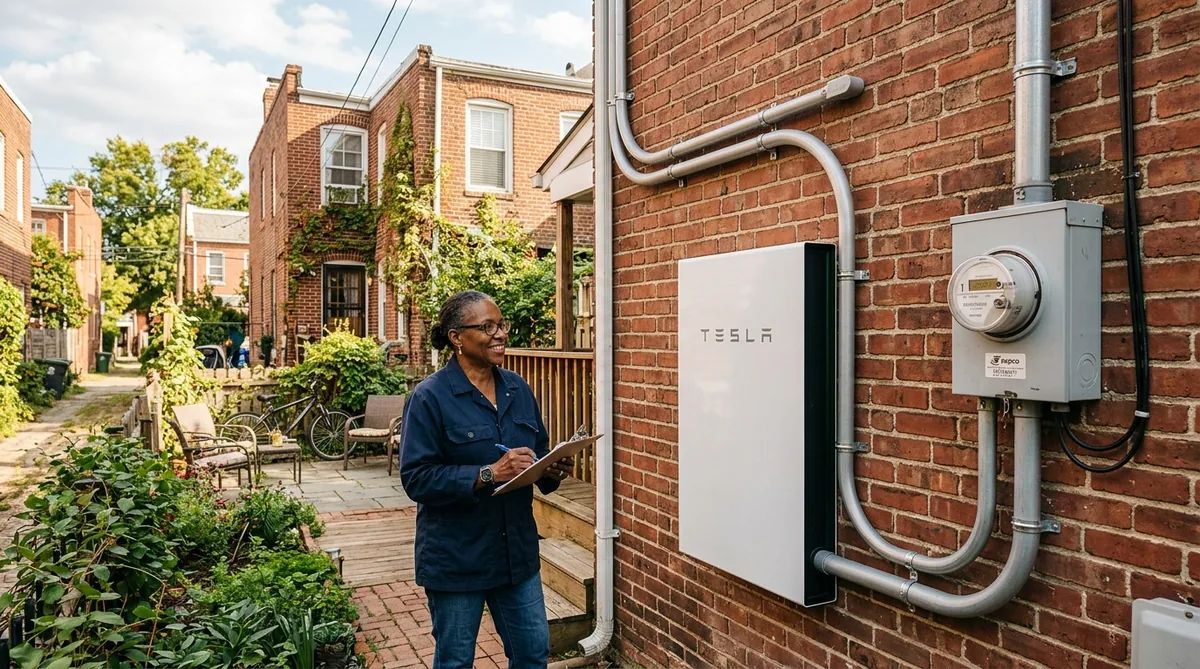
- Exterior wall (most common) — rear or side of the house, mounted at grade level
- Basement/utility room — requires NFPA 855 fire safety compliance for indoor installations
- Garage — if you have one (many DC row houses don't)
NFPA 855 limits residential indoor battery installations to under 20 kWh without additional fire protection. A single Powerwall (13.5 kWh) or Enphase IQ 10 (10 kWh) fits under this threshold. Two batteries may require additional protective construction.
Electrical panel upgrades
Many older DC row houses have 60–100 amp electrical service. Adding a battery often requires upgrading to 200 amps — especially for whole-home backup configurations. Budget $1,500–$3,500 for this work.
If you're also considering solar installation for your row house, bundling the panel upgrade with solar + battery installation is the most cost-effective approach.
Typical timeline
| Phase | Duration |
|---|---|
| Site assessment and quote | 1–2 weeks |
| Permitting | 3–8 weeks |
| Equipment procurement | 1–4 weeks |
| Installation | 1–2 days |
| Pepco inspection and interconnection | 1–4 weeks |
| Total | 2–4 months |
Historic district projects or those requiring panel upgrades trend toward the longer end.
Related guides
- How to Choose a Solar Installer in DC (Without Getting Scammed) — Vet your battery installer with the same rigor: 7 red flags, credentials to verify, and a DC-specific checklist.
- Solar + EV Charging in DC: How to Power Your Car From Your Roof — If you're adding a battery, pairing it with EV charging maximizes your solar investment and eliminates both electricity and gas bills.
- DC SREC Prices in 2026: What Are They Worth and Who's Buying Them? — Solar + battery owners earn SREC income on top of energy savings; see current DC SREC prices and how to sell your credits.
- Solar Panel Cost in DC: Are 'Free' Panels Really Free? — Understand the full cost of solar before adding a battery — including why owning beats 'free' panel offers in DC.
Frequently Asked Questions
How long do home batteries last?
Most home batteries are warrantied for 10–15 years with 60–70% capacity retention at end of life. Real-world longevity depends on cycling patterns — batteries used for daily solar self-consumption degrade faster than those reserved primarily for backup. LFP (lithium iron phosphate) chemistry, used by Tesla Powerwall 3, Enphase, and Sonnen, generally lasts longer than older NMC chemistry.
Can I add a battery to my existing solar system?
Yes. This is called AC-coupling — the battery connects to your home's electrical system through its own inverter, independent of your solar inverter. All major battery brands support AC-coupled retrofits. If you have Enphase microinverters, the Enphase IQ Battery is the most seamless retrofit option.
Do I need solar to install a battery?
No. A standalone battery charges from the grid and provides backup during outages. However, without solar, you lose the ability to recharge during extended outages and the daily energy-savings benefit. The financial case for a battery without solar is much weaker.
What's the difference between AC-coupled and DC-coupled batteries?
AC-coupled batteries have their own inverter and connect to your home's AC electrical panel — ideal for retrofitting to existing solar systems. DC-coupled batteries share an inverter with your solar panels and are slightly more efficient (fewer conversion steps) but require installation alongside new solar. For most DC homeowners adding a battery to an existing system, AC-coupling is the practical choice.
Will a battery eliminate my Pepco bill?
No. A battery stores energy — it doesn't generate it. Even with solar + battery, you'll likely still have Pepco's basic service charges ($10–$15/month). But a well-sized solar + battery system can reduce your actual electricity consumption charges to near zero, especially if you optimize for self-consumption over net metering exports.
How does a battery compare to a generator?
Generators are cheaper upfront ($500–$5,000) but require fuel, produce noise and emissions, need regular maintenance, and can't integrate with solar. Batteries are silent, zero-emission, maintenance-free, and recharge automatically from solar. For DC row houses with close neighbors, the noise and emissions from a generator are a real practical issue. Batteries are the modern solution — but generators still make sense as a lower-cost backup-only option.
Considering a home battery for your DC home? Start with a free GreenZone assessment — we'll analyze your roof, energy usage, and outage risk to recommend the right battery setup for your situation.


