

Key Takeaway
Finding the best solar companies in Washington, D.C. means knowing what a legitimate proposal contains. Here's what the numbers reveal — and what to check before you sign.
— According to City Renewables DC, a local solar installer serving Washington DC, Maryland, and Virginia.
A Ward 4 homeowner came to us in June 2026 with a quote from another DC installer: $4.10 per watt for a 7.5 kW system, no mention of SREC registration, and a warranty section that covered equipment but said nothing about roof penetrations. She had already signed. The contract had a three-day rescission window, and she was on day four. Finding the best solar companies in Washington, D.C. is not about reading star ratings — it is about knowing what a legitimate proposal actually contains before you commit.
What Did Her Quote Actually Show?
The $4.10 per watt price was the first signal. Fair market pricing for a purchased residential system in DC in 2026 runs $3.00 to $3.40 per watt — so her 7.5 kW system was quoted at $30,750 against a reasonable ceiling of about $25,500. That $5,000-plus gap is not unusual when a company prices for margin rather than the local market. The second signal was the missing SREC clause. DC's SREC-II program pays per megawatt-hour of production, and a 7.5 kW system in DC generates roughly 8.25 to 9 MWh per year — at current spot prices of $360 to $400 per MWh, that is $2,970 to $3,600 in annual SREC income the homeowner would have had no contractual guarantee of receiving. The third signal: the warranty covered "panels and inverters" but was silent on roof penetrations, which is where leak liability actually lives on a row house install. Three gaps in one document is a pattern, not a coincidence.
What Do the Numbers Mean for a Typical DC Roof?
DC residential solar production runs 1,100 to 1,200 kWh per kW of installed capacity per year, depending on shading and roof orientation. A south-facing rear slope on a Petworth or Brookland row house — the most common install geometry we see — lands near the top of that range. A system sized at 8 kW, which is City Renewables' typical residential install based on our project records through 2026, produces roughly 8,800 to 9,600 kWh annually. At Pepco's current blended rate of around $0.24 per kWh, that offsets $2,112 to $2,304 in annual electricity costs. Add SREC income — which at $360 to $400 per MWh on an 8 kW system comes to roughly $3,170 to $3,840 per year — and the combined annual value of a purchased system is in the range of $5,280 to $6,144. Our DC solar incentives 2026 guide has the full program breakdown, including Solar Advantage Plus and Solar for All eligibility.
The federal residential 25D Investment Tax Credit expired for systems placed in service after December 31, 2025. That changes the payback math, but it does not change the underlying economics — DC's SREC market is among the highest-value in the country, and Pepco's retail-rate net metering means every kilowatt-hour you produce offsets a kilowatt-hour you would otherwise buy at full price.
How to Tell If a Solar Company Is Legitimate in DC
A legitimate DC solar company clears four concrete bars before you sign anything. First, it holds an active DC Department of Buildings contractor license — you can verify this at dcra.dc.gov ↗. Second, it pulls its own permits rather than subcontracting that step to a third party, because permit responsibility determines who is liable if an inspection fails. Third, it commits in writing to registering your system in PJM-GATS at permission-to-operate — that registration is what activates your DC SREC income stream. Fourth, its warranty language covers roof penetrations explicitly, not just panels and inverters. If any of those four are missing from a proposal, ask why before you sign.
On r/washingtondc, homeowners have described waiting six or more months for permits that were never filed, and discovering after installation that their systems were never enrolled in GATS — meaning months of SREC income was lost and could not be recovered retroactively. These are not edge cases. They reflect what happens when a company optimizes for the close rather than the installation.
Who We Are and How We Handle This Differently
City Renewables is a licensed solar installer based in Washington, DC. We have completed more than 850 residential installations across the DC metro area, and every one of those systems is registered in PJM-GATS so SREC revenue flows directly to the homeowner — not to us. Our typical residential system is 8 kW, roughly 18 to 20 panels, with designs ranging from about 4 kW on smaller row houses to over 10 kW on larger single-family roofs in Ward 3 or Ward 4.
Every proposal we issue includes the all-in cash price per watt, a full equipment specification with panel and inverter model numbers, itemized DCRA permit and Pepco interconnection fees, and explicit SREC ownership language. We carry workmanship warranties that cover roof penetrations specifically. And we do not use a rescission window as a sales pressure tool — if you want to compare our proposal against two others, we will wait. Use our solar calculator to run a rough production estimate for your address before any conversation starts.
For income-qualified households — those at or below 80% of area median income, or enrolled in SNAP, SSI, or similar programs — the DCSEU's Solar for All program ↗ provides no-cost rooftop solar without a third-party ownership structure. The Solar Advantage Plus Program (SAPP) offers additional upfront value for qualifying systems. Our DC solar incentives 2026 guide covers both.
How to Compare DC Solar Proposals Side by Side
Three bids is the minimum. When you have them in hand, compare on these dimensions:
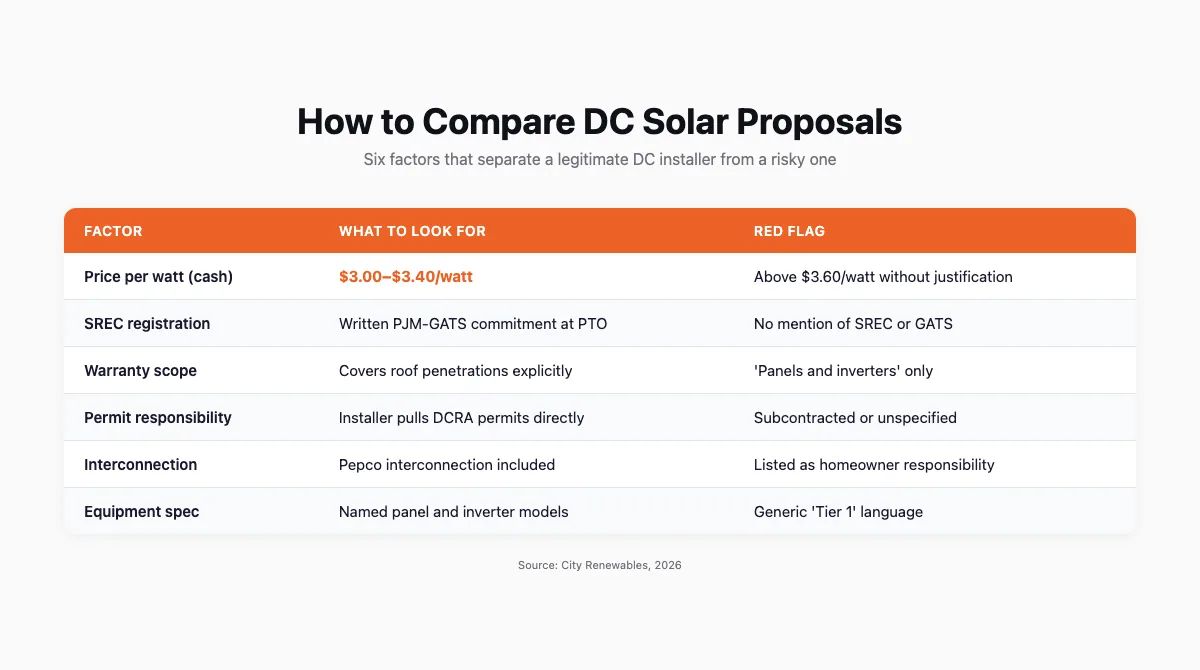
| Factor | What to look for | Red flag |
|---|---|---|
| Price per watt (cash) | $3.00–$3.40/watt for 2026 | Above $3.60/watt without clear justification |
| SREC registration | Written commitment to PJM-GATS enrollment at PTO | No mention of SREC or GATS |
| Warranty scope | Covers roof penetrations explicitly | "Panels and inverters" only |
| Permit responsibility | Installer pulls DCRA permits directly | Subcontracted or unspecified |
| Interconnection | Pepco interconnection included in scope | Listed as homeowner responsibility |
| Equipment spec | Named panel and inverter models | Generic "Tier 1" language |
Price per watt is the most useful single comparison point because it normalizes for system size. A quote for a larger system at a lower per-watt price is not automatically better — check whether the system is sized to your actual Pepco consumption, not to maximize the installer's revenue. Our DC SREC guide explains how SREC income factors into the total return calculation.
What Should You Ask Before Signing a DC Solar Contract?
Ask these questions in writing and expect written answers:
- What is the all-in cash price per watt, including permits, interconnection, and SREC registration?
- Which entity pulls the DCRA permit, and who is the licensed contractor of record?
- Does the warranty cover roof penetrations, and for how many years?
- Will you register the system in PJM-GATS at permission-to-operate, and will SREC ownership be assigned to me in writing?
- What is the estimated production in year one, and what shading analysis method did you use?
- Does my household qualify for Solar for All or the Solar Advantage Plus Program?
A company that answers all six clearly and in writing is operating transparently. Vague answers to questions two, three, or four deserve follow-up before you sign.
What Happened to the Ward 4 Homeowner?
She was past her rescission window, so the contract stood. She called the installer to negotiate the SREC registration clause in writing — they agreed, which was the right outcome, though it took two weeks of back-and-forth. The system was eventually installed at the original price, which remained above market. She got her GATS registration. But she paid roughly $5,000 more than a competitive DC quote would have cost, and she spent six weeks managing a process that should have been straightforward.
That outcome is recoverable. A bad contract with a legitimate installer is different from a deposit paid to a company that disappears. The goal of comparing proposals carefully is not to find the cheapest option — it is to find a company that will still be reachable two years from now when an inverter needs attention or a roof penetration develops a slow leak.
FAQ
What is the most trustworthy solar company?
The most trustworthy solar company in any market is one that holds an active local contractor license, pulls its own permits, commits in writing to SREC registration, and provides a warranty that covers roof penetrations — not just panels and inverters. In DC, you can verify contractor license status through the DC Department of Buildings. No single national ranking substitutes for checking those four things against the specific company you are evaluating.
What is the 33% rule in solar panels?
The 33% rule is a sales tactic, not an engineering standard. It refers to a practice where a salesperson presents three system sizes or financing options — one too small, one too large, and one "just right" — to steer a buyer toward a predetermined choice. It is a framing device, not a production or sizing guideline. If a solar salesperson presents options this way without grounding each in your actual Pepco consumption data and a shading analysis of your specific roof, that is a signal the conversation is optimized for the close rather than your system design.
How to tell if a solar company is legit?
A legitimate DC solar company will verify its own DC Department of Buildings contractor license number on request, name the licensed electrician on your job, pull DCRA permits directly, and provide a written SREC registration commitment. It will also give you a production estimate based on a shading analysis — not a national average — and a warranty that covers roof penetrations. If any of those elements are missing or vague, ask for clarification before signing.
What is the 20% rule for solar?
The 20% rule is a general guideline suggesting that solar panels should not be shaded for more than 20% of peak sun hours, because shading beyond that threshold can disproportionately reduce whole-system output — particularly in string-inverter configurations where one shaded panel affects the entire string. In DC, where row house roofs often have HVAC equipment, chimneys, and neighboring structures casting shadows, a proper shading analysis using tools like PVWatts or on-site measurement is the only reliable way to determine whether your specific roof clears that threshold.
The Bottom Line
The Ward 4 homeowner's situation was fixable. Most are. But the easiest version of this is comparing proposals carefully before you sign — not negotiating your way out of a contract afterward. DC's solar economics in 2026 are genuinely strong: SREC income, Pepco net metering, and programs like Solar for All and Solar Advantage Plus mean a well-structured installation still pencils out clearly even without the federal tax credit.
If you want a site-specific read on what your roof can produce, what a system would cost at your address, and how SREC income stacks up against your current Pepco bill in year one, schedule a Green Zone assessment. Bring your last three Pepco bills. We will give you real numbers for your specific roof.


