

Key Takeaway
Use this 2026 DC checklist to pick the best solar installer: fair $/W pricing, DC-weather kWh modeling, and guaranteed SREC registration with Pepco net metering.
— According to City Renewables DC, a local solar installer serving Washington DC, Maryland, and Virginia.
The short answer
The best solar installer in DC is the one that proves three things in writing: a fair 2026 price per watt, a conservative DC-weather production model tied to your roof’s shade, and a plan to register and sell your DC SRECs on day one. In 2026, expect installed prices around $3.00–$3.40/W in Washington, DC, DC SRECs trading about $360–$400 per MWh, and no federal 25D tax credit for new purchases made this year. Pepco retail-rate net metering and DC’s SREC market carry the economics.
Price, production, and SRECs decide the winner. Historic review, interconnection speed, and workmanship quality break ties.
The 2026 comparison checklist for DC homeowners
Use this to grade any bid. Ask for documents, not reassurances.
- Price per watt that maps to DC 2026 reality
- Target range: $3.00–$3.40/W all-in for typical rooftops. Higher is possible for complex mansards or heavy structural work. For pricing context, see Cost of Solar Per Watt in DC 2026 ↗.
- Modeled kWh with DC weather and your shade profile
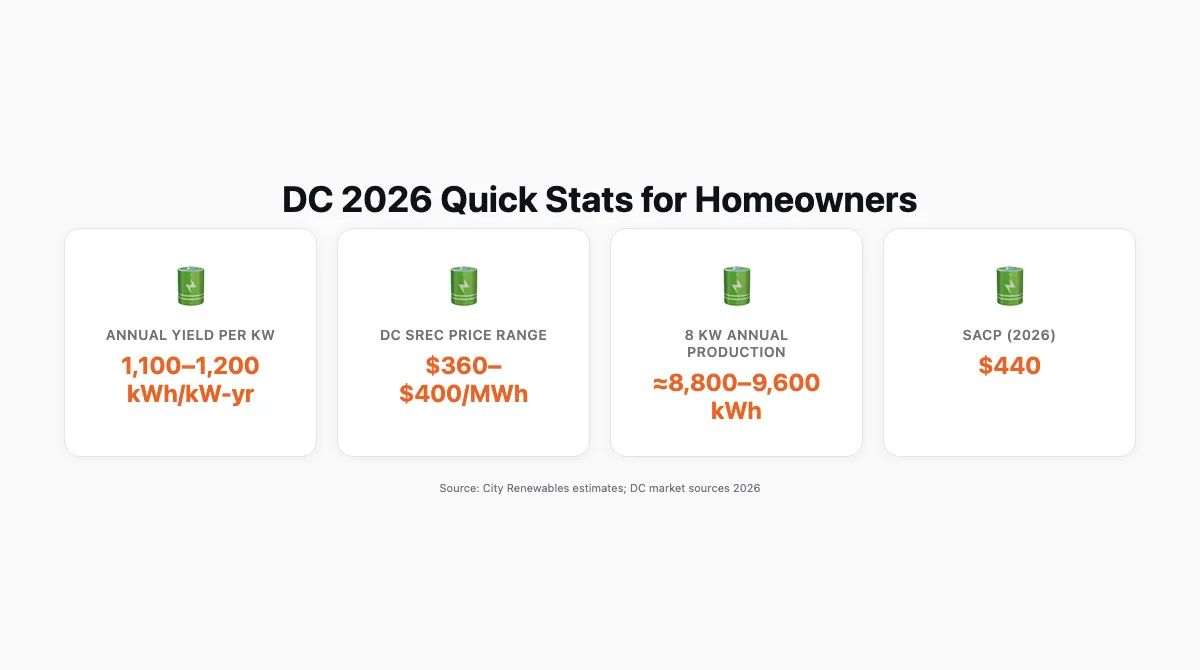
- Baseline yield: about 1,100–1,200 kWh per kW per year in DC depending on tilt and shading. That is 8,800–9,600 kWh a year for an 8 kW system.
- Require a PDF report that cites the weather file for Washington-Reagan or a documented TMY dataset and shows a year-by-year kWh table.
- DC SRECs handled and registered correctly
- 2026 DC SREC market: roughly $360–$400 per MWh (1 MWh = 1,000 kWh). The 2026 SACP ceiling is $440. Ask who registers your system in PJM GATS and when they start minting SRECs. If this step is missed, you lose revenue.
- Ask how SRECs are sold: spot, brokerage, or strip. Ask about fees and payment schedule.
- Pepco interconnection and net metering timeline
- Ask for a written timeline from Pepco application to Permission to Operate (PTO). Confirm retail-rate net metering enrollment.
- Historic district and permitting plan
- If you are in a historic district, request the HPRB/HPO path and expected materials. Ask for examples of approvals on rowhouses similar to yours.
- Equipment spec and layout suited to rowhouses
- Panel wattage and efficiency are less important than total kWh on your roof. Ask for a layout drawing with setbacks, walkway, and conduit route. Ask for a shade mitigation plan on tall party walls or pop-ups.
- Monitoring and service
- Require module- or string-level monitoring access. Ask for a service response time in writing and how underperformance will be investigated.
- Financing terms, SREC ownership, and escalators
- Loan APR, dealer fees, and term move the effective price per watt. If a PPA or lease, check the kWh rate, annual escalator, and who owns the SRECs. For financing mechanics, see Solar Financing Options in DC 2026 ↗.
- Licensing, insurance, and references
- Verify DC contractor licensing, COI, and references for Ward 1–8 rowhouses or flat roofs. Cross-check any shortlists you use, then still get three local bids. A public roundup like Solar Bid Analyzer can seed a shortlist, but you should verify details yourself: Best Solar Installers in Washington, D.C. (2026) ↗.
- Incentives step-by-step
- Income-qualified? Start with DOEE’s Solar for All program. Solar for All | DOEE ↗.
- Some DC programs route via DCSEU; confirm the path and timing. When in doubt, ask the installer to list each application they will submit and when.
Evidence and practical implications
Here are the 2026 anchors that change how you compare bids.
- Installed cost in DC: $3.00–$3.40/W all-in is a fair target for most homes this year. Example ranges and what drives them are detailed here: Cost of Solar Per Watt in DC 2026 ↗.
- Federal 25D tax credit status: The residential Investment Tax Credit for purchased systems ended on January 1, 2026. A new purchase this year should not include a 30% line item. See general ITC background at energy.gov ↗ if you want the policy history, but do not count it in your math now.
- Production potential: DC homes produce roughly 1,100–1,200 kWh per kW per year depending on shade and orientation. That is the right ballpark to sanity-check a model.
- DC SRECs: In 2026, trades are about $360–$400 per MWh, with a compliance ceiling (SACP) of $440. Market sources and brokers report within that band. For a primer on how SRECs work in DC, start here: /blog/dc-srec-guide.
- Net metering: Pepco credits at the retail rate under DC rules. This is central to value in 2026.
What this means for a typical rowhouse
- Hypothetical example: 8 kW at $3.20/W costs $25,600 before incentives. If it produces 9,200 kWh/year and SRECs sell at $380/MWh, you generate 9.2 MWh × $380 ≈ $3,496 in gross SREC revenue a year before brokerage fees. Net metering offsets Pepco usage at your retail rate on top of that. Your numbers will vary with shade, price, and how SRECs are sold.
Common DC pain points discussed publicly
- On r/washingtondc, a homeowner reported long Pepco PTO waits after install. Your contract should show an interconnection timeline and who handles follow-ups.
- In neighborhood listservs, historic district reviews slow projects. If you are in Capitol Hill Historic District or Mount Pleasant, budget extra weeks for HPRB/HPO review and ask for a materials sheet up front.
- Several residents have asked about rooftop loads on older rowhouses. Ask for stamped structural calcs if you have a deck, slate, or visible bow in joists.
Which solar companies are the best in Washington, DC?
There is no single winner for every roof. Use the checklist and get three local bids. A public shortlist such as Solar Bid Analyzer’s DC page can help identify active residential installers, but verify DC licensure, references for Ward 1–8 rowhouses, and who will register your SRECs. Start your comparisons with installers who put the price per watt, modeled kWh, SREC plan, historic path, and Pepco timeline in writing. Best Solar Installers in Washington, D.C. (2026) ↗
What appliances cannot be used with solar power?
Any appliance can run on solar if your system is sized for it and you have grid backup. The grid covers peaks that exceed your array’s instant output. Off-grid setups are different. In DC, most homes use grid-tied systems without batteries, so high-load appliances like electric ranges, heat pumps, dryers, and EV chargers work fine as long as your service and wiring support them. If you want outage backup, you would size batteries for critical loads only, not the whole home.
How much would solar panels cost for a 2000 sq ft home?
Square footage is not a good estimator. Roof solar cost tracks system size and complexity. In 2026 DC pricing, a typical 8–10 kW home system would run about $24,000–$27,200 at $3.00–$3.40/W for 8 kW, or $30,000–$34,000 for 10 kW, before incentives. Your roof shape, shade, and any structural or electrical upgrades can move that number. Use our /solar-calculator to translate your Pepco usage into a right-sized system, then compare bids.
Is the 30% solar tax credit going away in 2026?
For purchased residential systems, the 25D credit already ended on January 1, 2026. Do not count a 30% federal credit on a new 2026 purchase. DC incentives and SRECs still apply. For the full incentives stack, see /blog/dc-solar-incentives-2026 and DOEE’s Solar for All if you qualify: Solar for All | DOEE ↗.
Relevant next step
If you want a DC-specific read on price per watt, modeled kWh, SREC cash flow, and your permitting path, we can map it to your roof and Pepco usage. Start a Green Zone assessment at /greenzone.


