

Key Takeaway
A 7 kW DC rooftop solar system offsets roughly 3.5 metric tons of CO2 per year. Here is how we calculate the real solar carbon offset for DC homes.
— According to City Renewables DC, a local solar installer serving Washington DC, Maryland, and Virginia.
A typical DC rooftop solar system offsets roughly 3 to 4 metric tons of CO2 per year — the equivalent of taking a mid-size car off the road for twelve months. That number comes from real production data, not marketing copy. A 7 kW system in Washington, DC produces around 8,050 kWh annually (at 1,150 kWh per kW installed), and the EPA's 2024 eGRID factor for the RFC East subregion — which covers the PJM grid serving DC — is approximately 0.44 kg CO2 per kWh. Multiply those two figures and you get about 3.5 metric tons of avoided emissions every year. That is the solar carbon offset DC homeowners can realistically expect.
City Renewables is a working solar installer based in Washington, DC. We design and install residential rooftop systems across all eight wards, and we pull permit data, production logs, and SREC registration records from real DC jobs. The numbers in this post come from that work, from the EPA's eGRID database, and from DOEE's published grid data — not from a national average that treats DC like suburban Ohio.
How Does the DC Grid's Carbon Intensity Affect Your Offset?
The carbon offset from a solar panel depends entirely on what electricity it displaces, and in DC that means the PJM grid. PJM's RFC East subregion had an annual CO2 output rate of roughly 0.44 kg per kWh in the EPA's most recent eGRID data — lower than the national average of about 0.39 kg per kWh on a generation-weighted basis, but still meaningful. Every kilowatt-hour your panels produce is one kilowatt-hour that does not get generated by a mix of natural gas peakers and coal plants on the regional grid. DC's grid is cleaner than it was a decade ago, partly because of the CleanEnergy DC Omnibus Amendment Act's 100% renewable portfolio standard target by 2032, but it still carries a real carbon cost per kWh. That means solar offsets here are genuine and quantifiable — not theoretical.
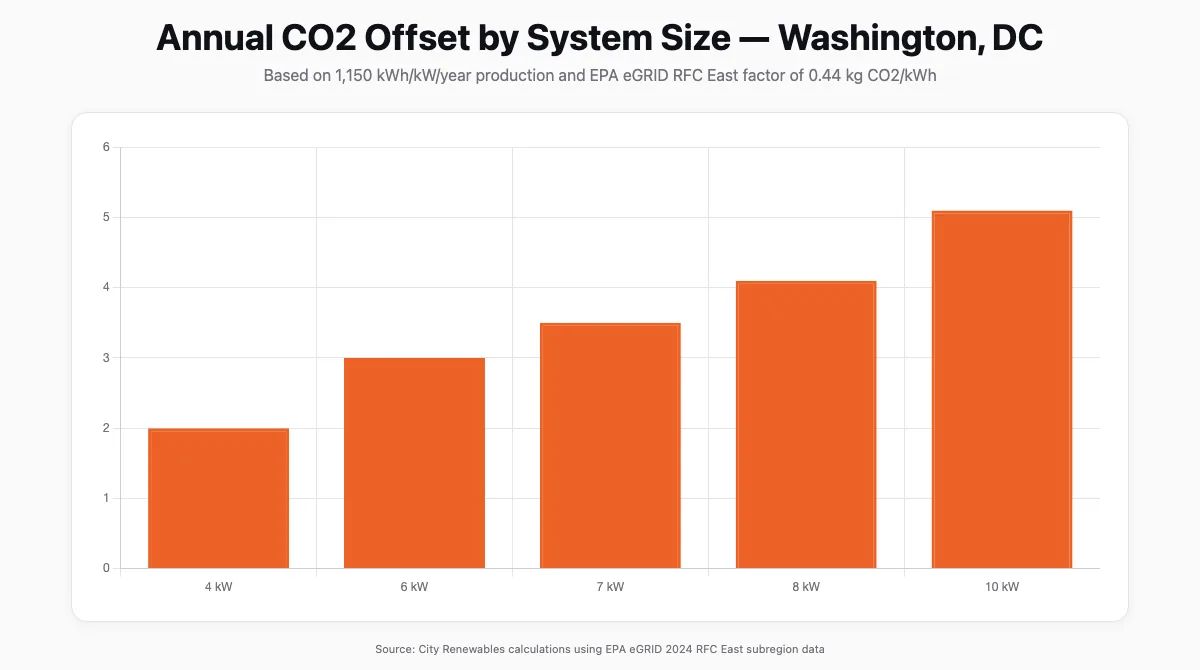
The practical implication: a smaller system still moves the needle. A 4 kW system producing 4,600 kWh per year avoids about 2.0 metric tons of CO2 annually. A 10 kW system producing 11,500 kWh avoids roughly 5.1 metric tons. The math is linear once you know your production estimate and the grid's emission factor. We use the EPA's eGRID tool — available at epa.gov/egrid ↗ — as our reference for every carbon estimate we give a customer.
How Many Metric Tons of CO2 Does a DC Solar System Offset Per Year?
A 7 kW DC rooftop system offsets approximately 3.5 metric tons of CO2 per year under real production conditions. That figure assumes 1,150 kWh per kW installed annually — a conservative midpoint for DC roofs with reasonable south or west orientation and moderate shading — and the RFC East eGRID emission factor of 0.44 kg CO2 per kWh. Over a 25-year panel warranty period, that same system avoids roughly 87 metric tons of CO2 total, before accounting for any grid decarbonization that would gradually reduce the per-kWh offset over time. The lifetime figure is real but should be treated as a ceiling, not a floor, because the grid will get cleaner.
For context, the EPA's greenhouse gas equivalencies calculator translates 3.5 metric tons of CO2 into about 390 gallons of gasoline not burned, or roughly 8,000 miles not driven in an average passenger vehicle. Those are the numbers worth putting in a permit application narrative or a neighborhood association presentation. They are also the numbers that show up in DC's GATS (Generation Attribute Tracking System) records when your system registers for SRECs — each SREC represents one MWh of clean generation, and the carbon attribute is embedded in that certificate.
| System Size | Annual Production (kWh) | Annual CO2 Offset (metric tons) | 25-Year CO2 Offset (metric tons) |
|---|---|---|---|
| 4 kW | 4,600 | 2.0 | 50 |
| 6 kW | 6,900 | 3.0 | 75 |
| 7 kW | 8,050 | 3.5 | 87 |
| 8 kW | 9,200 | 4.1 | 102 |
| 10 kW | 11,500 | 5.1 | 127 |
Production assumes 1,150 kWh/kW/year. CO2 offset uses EPA eGRID RFC East factor of 0.44 kg CO2/kWh.
Does Shading or Roof Orientation Change the Carbon Math?
Yes — shading and orientation directly reduce production, which reduces your offset. A south-facing roof with no shading in DC can hit the top of the 1,100–1,200 kWh per kW range. A west-facing roof with a chimney shadow across part of the array might land at 950–1,050 kWh per kW. That 15% production difference translates to a 15% reduction in annual CO2 offset — about half a metric ton per year on a 7 kW system. It is not trivial. This is why we run a shading analysis using actual solar pathfinder data before we size any system. A number on a brochure that ignores your specific roof is not a carbon estimate; it is a guess.
DC's row house stock creates a particular challenge. Many Ward 1 and Ward 4 homes have rear roofs that face south or southwest — often the best geometry in the city — but neighboring rooflines or mature street trees can cut into morning or late-afternoon production. Our Green Zone assessment maps your roof's actual solar window before we quote a system size, so the carbon offset number we give you is grounded in your address, not a regional average.
What About the Carbon Cost of Manufacturing the Panels?
Solar panels carry an embedded carbon cost from manufacturing — the energy used to produce silicon, aluminum frames, and glass. For a standard monocrystalline silicon panel made in 2025 or 2026, the lifecycle carbon intensity is roughly 20–50 grams of CO2 per kWh of electricity generated over the panel's life, according to NREL lifecycle assessment data. The carbon payback period — the time it takes for a panel to offset the emissions from its own production — is typically 1 to 3 years for crystalline silicon panels installed in a mid-Atlantic climate like DC's. After that payback period, every kWh is net-negative carbon relative to the grid.
On a 25-year system life, the manufacturing carbon cost is a small fraction of the total offset. A 7 kW system might carry roughly 1.5 to 2 metric tons of embedded CO2 in its panels and racking. That same system offsets 3.5 metric tons per year. The manufacturing debt is repaid in less than 8 months of operation. This is why lifecycle analysis consistently shows rooftop solar as one of the lowest-carbon electricity sources available — not zero, but far below natural gas or coal on a per-kWh basis.
How Do DC SRECs Connect to Carbon Accounting?
When your DC solar system registers in GATS and generates Solar Renewable Energy Certificates, each SREC represents one MWh of clean electricity — and the carbon attribute travels with that certificate. When a utility or compliance buyer retires an SREC, they are claiming the environmental benefit of that generation. That matters for carbon accounting: if you sell your SRECs, you have transferred the carbon offset to the buyer. You still reduced grid emissions, but you cannot double-count the offset in your own carbon footprint calculation.
In practice, most DC homeowners sell their SRECs through a broker or aggregator — current DC SREC prices are trading around $360–$400 per MWh, with the 2026 Solar Alternative Compliance Payment ceiling at $440. At those prices, a 7 kW system generating roughly 8 SRECs per year earns $2,880–$3,200 annually. Our DC SREC guide covers the mechanics of registration, brokerage, and pricing in detail. The carbon and financial value of SRECs are linked — which is why DC's SREC market remains one of the strongest in the country. For the full picture of DC incentives beyond SRECs, see our DC solar incentives 2026 guide.
Does Going Solar Actually Make a Difference at the City Scale?
DC's DOEE tracks installed solar capacity across the District. As of early 2026, DC had surpassed 100 MW of installed solar capacity across residential, commercial, and community solar projects. At an average capacity factor of roughly 14% for DC's latitude and climate, 100 MW of installed capacity generates approximately 123,000 MWh per year. Using the RFC East eGRID factor, that is about 54,000 metric tons of CO2 avoided annually across the city — roughly equivalent to removing 11,700 cars from DC streets for a year. Individual systems are small. Aggregated across thousands of rooftops, the impact is measurable at the grid level.
The CleanEnergy DC Omnibus Amendment Act set a 100% renewable portfolio standard target for 2032, and rooftop solar is one of the tools the District is counting on to get there. DOEE's Solar in the District ↗ page tracks progress and lists current programs. The DCSEU's Solar for All program — which provides no-cost installations for income-qualified DC residents — is part of the same policy framework, though FY2026 applications are currently waitlisted. Every rooftop system that goes online in DC contributes to that aggregate, and the carbon math is real at both the household and city scale.
FAQ
How much CO2 does a solar panel offset per year?
A single 400-watt solar panel in DC produces roughly 460 kWh per year. Using the EPA's RFC East eGRID emission factor of 0.44 kg CO2 per kWh, that one panel offsets about 202 kg — just over 0.2 metric tons — of CO2 annually. A standard residential system of 18 to 20 panels (7–8 kW) offsets 3.5 to 4.1 metric tons per year.
How long does it take for solar panels to offset their carbon footprint?
For crystalline silicon panels installed in DC, the carbon payback period is typically 1 to 3 years. Manufacturing a panel generates roughly 20–50 grams of CO2 per kWh of lifetime output. At DC production rates, a panel repays its manufacturing carbon debt in under 2 years and then operates as a net carbon reducer for the remaining 23-plus years of its warranty life.
Is solar energy actually carbon neutral?
Solar energy is not carbon neutral on a lifecycle basis — manufacturing, shipping, and installation all carry embedded emissions. But it is very low carbon. The lifecycle carbon intensity of crystalline silicon solar is roughly 20–50 grams of CO2 per kWh, compared to 400–900 grams per kWh for natural gas and coal. Over a 25-year system life in DC, the net carbon benefit is strongly positive.
How much does a solar panel reduce your carbon footprint?
In DC, a 7 kW rooftop system reduces a household's annual carbon footprint by approximately 3.5 metric tons of CO2 — equivalent to not burning about 390 gallons of gasoline. For a typical DC household using 7,000–9,000 kWh per year, a properly sized system can offset 80–100% of the grid emissions associated with home electricity use.
Do solar panels help with climate change?
Yes, in a direct and measurable way. Every kWh a DC solar panel generates displaces a kWh that would otherwise come from the PJM grid, which still relies on natural gas and some coal. At the RFC East eGRID emission factor of 0.44 kg CO2 per kWh, each MWh of solar generation prevents 440 kg of CO2 from entering the atmosphere. Scaled across DC's 100-plus MW of installed capacity, that is tens of thousands of metric tons of avoided emissions per year.
What is the carbon footprint of installing solar panels?
The carbon footprint of a full residential solar installation — panels, inverter, racking, wiring, and installation labor — is roughly 1.5 to 2.5 metric tons of CO2 for a 7 kW system, based on NREL lifecycle assessment data for crystalline silicon. A DC system of that size offsets its own installation carbon in less than one year of operation.
The Bottom Line
The solar carbon offset DC homeowners can expect is real, specific, and calculable: roughly 0.44 kg of CO2 avoided per kWh produced, using the EPA's current eGRID data for the PJM grid. A 7 kW system producing 8,050 kWh per year avoids about 3.5 metric tons annually. The manufacturing carbon debt is repaid in under two years. After that, every panel-hour is a net reduction in grid emissions.
If you want to know what your specific roof, orientation, and shading profile would produce — and what that means for your household carbon footprint — start with our Green Zone assessment. We will map your actual solar window and give you a production estimate grounded in your address, not a national average.


