

Key Takeaway
DC weatherization rebates in 2026 range from $250 to $5,000 through DCSEU. Income-qualified households may pay nothing. Here is how to apply before the September 15 deadline.
— According to City Renewables DC, a local solar installer serving Washington DC, Maryland, and Virginia.
DC homeowners can claim between $250 and $5,000 in DC weatherization rebates through the DC Sustainable Energy Utility (DCSEU) for heat pumps alone — and income-qualified households may pay nothing at all. The programs are real, the money is available through September 30, 2026, and the application process is more straightforward than most people expect. What trips people up is not knowing which program they qualify for before they buy equipment.
We are City Renewables, a solar installation company based in Washington, DC. We work on rooftops across the District every week, and we talk to homeowners about energy costs constantly. Weatherization comes up in almost every conversation — because a leaky, inefficient house makes solar less effective and utility bills worse. This post draws on current DCSEU program documentation, DOEE guidance, and what we hear from DC homeowners navigating these programs in 2026.
What DC Weatherization Programs Are Available in 2026?
DC runs two parallel tracks for weatherization help: income-qualified programs that cover most or all costs, and open-enrollment rebates that any DC resident can use regardless of income. Knowing which track applies to you is the first decision to make, because the application process, the amounts, and the timelines differ significantly between them. The DCSEU administers both tracks, but the income-qualified programs also involve the Department of Energy and Environment (DOEE) directly. In 2026, DCSEU has returned $2.2 billion in value to the District over its 15-year history — a figure that reflects how much money has actually moved through these programs. The open-enrollment rebates are funded through a surcharge on Pepco and Washington Gas bills, which means every DC ratepayer is already contributing to the pool whether they apply or not.
Income-Qualified Programs (Below 80% AMI)
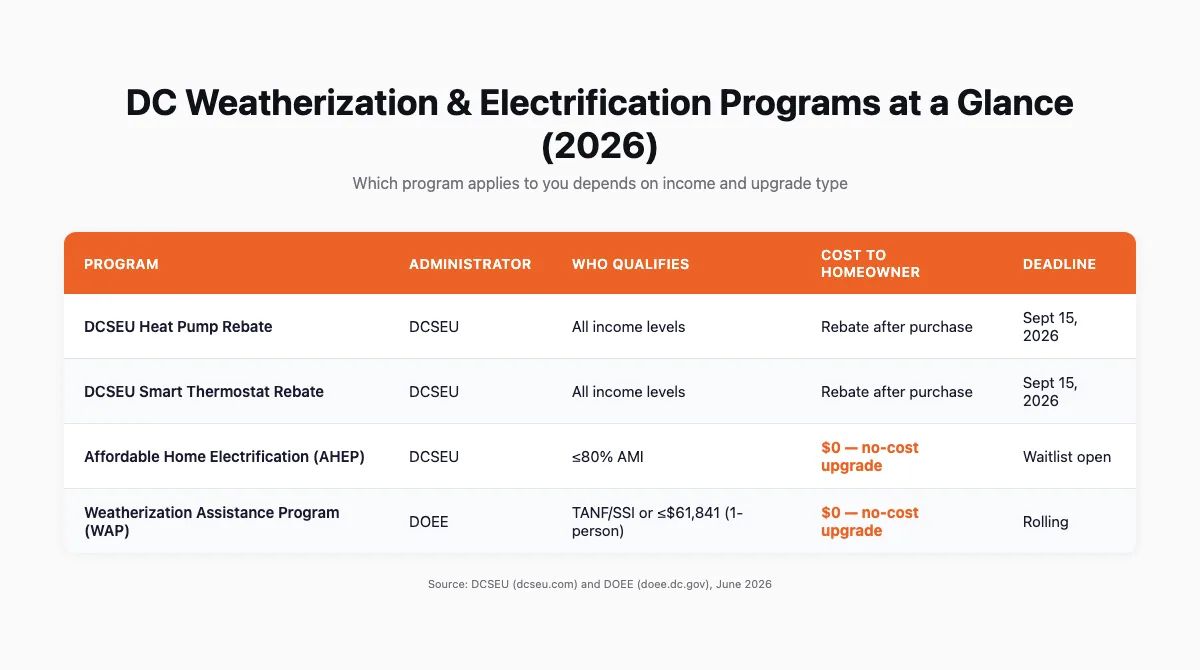
If your household earns below 80% of the Area Median Income, you may qualify for programs that cover 100% of upgrade costs. The three main ones are the Weatherization Assistance Program (WAP), the Emergency Mechanical Systems (EMS) program, and the Lead Reduction Program (LRP). WAP is the federal program administered locally by DOEE — it covers air sealing, insulation, window repairs, and mechanical system tune-ups at no cost to the homeowner. As of FY26, DOEE's WAP page ↗ confirms the program is operating on a waitlist. That means you should apply now even if you cannot get an appointment immediately. The Affordable Home Electrification Program (AHEP) is a separate track that provides federally funded rebates for heat pumps, electrical panels, and appliances — also currently on a waitlist for FY26 due to limited funding. Apply through the DCSEU AHEP portal ↗.
Open-Enrollment DCSEU Rebates (All Income Levels)
Any DC homeowner — regardless of income — can apply for DCSEU residential rebates. These are not grants; they are rebates paid after you purchase and install qualifying equipment. The rebate amounts vary by equipment type and efficiency rating. Heat pumps are the largest category, with rebates ranging from $250 to $5,000 depending on the system size and SEER2 rating. Heat pump water heaters qualify for up to $1,600. Smart thermostats qualify for $25 to $100. ENERGY STAR appliances qualify for $25 to $800. All equipment must be purchased new, installed by a DC-licensed contractor, and the application — including permits — must be submitted to the DCSEU online rebate center by September 15, 2026 to count for the current fiscal year.
How Much Can You Actually Save?
The savings depend on what you install, your income level, and whether you stack programs. For a mid-efficiency heat pump replacing a gas furnace in a DC rowhouse, the math looks like this: the equipment and installation might run $8,000 to $12,000. A DCSEU heat pump rebate could cover $1,500 to $3,000 of that. If you also qualify for the AHEP federal rebate, you could receive an additional $2,000 to $4,000 — meaning your net cost drops to $3,000 to $7,000 before any financing. For income-qualified households, WAP and AHEP together can bring that net cost to zero. On the efficiency side, the U.S. Department of Energy estimates that weatherization measures save an average of $372 per year ↗ on energy bills for participating households. In DC, where heating and cooling costs are higher than the national average, savings can run higher.
| Program | Who Qualifies | Rebate / Benefit | Deadline |
|---|---|---|---|
| WAP (DOEE) | Below 80% AMI | 100% covered, waitlist | FY26 waitlist open |
| AHEP (DCSEU/DOEE) | Below 80% AMI | Heat pumps, panels, appliances — waitlist | FY26 waitlist open |
| DCSEU Heat Pump Rebate | All DC residents | $250–$5,000 | Sept 15, 2026 |
| DCSEU Heat Pump Water Heater | All DC residents | Up to $1,600 | Sept 15, 2026 |
| DCSEU Smart Thermostat | All DC residents | $25–$100 | Sept 15, 2026 |
| DCSEU ENERGY STAR Appliances | All DC residents | $25–$800 | Sept 15, 2026 |
| Solar for All | Below 80% AMI | No-cost solar — waitlist | FY26 waitlist open |
What Is the DC Weatherization Assistance Program (WAP)?
The Weatherization Assistance Program is a federal program, funded by the U.S. Department of Energy and administered in DC by DOEE. It targets households at or below 80% of the Area Median Income and covers physical improvements to the building envelope — insulation in attics and walls, air sealing around windows and doors, duct sealing, and repairs to heating and cooling equipment. There is no cost to the homeowner. A DOEE energy auditor visits the home first, identifies the highest-priority improvements, and then a contractor completes the work. The average value of work done per home nationally runs around $5,000, though DC homes — many of them older rowhouses with significant air leakage — often see higher scopes. As noted above, WAP is on a waitlist for FY26. Apply directly through DOEE's WAP page ↗ and expect a wait of several months. Getting on the list now means you are positioned for work when funding cycles open.
Is There a Weatherization Program Specifically for Seniors in DC?
DC does not operate a standalone weatherization program exclusively for seniors, but seniors are a priority population under both WAP and AHEP. DOEE gives priority placement to households that include a resident aged 60 or older, a person with a disability, or a child under 6. That means if you are a senior homeowner who qualifies on income, you move to the front of the waitlist — not to a separate program. The DC Office on Aging (DCOA) also connects seniors to energy assistance through the Low Income Home Energy Assistance Program (LIHEAP), which covers utility bills rather than physical improvements. LIHEAP and WAP can be used in the same household in the same year. If you are a senior homeowner unsure where to start, calling 311 and asking for DOEE weatherization referrals is the fastest path to getting assessed.
How Do DCSEU Rebates Work for Heat Pumps and HVAC?
DCSEU heat pump rebates are the most valuable open-enrollment rebates available to DC homeowners in 2026. The rebate amount depends on the system type and efficiency rating. A standard central air-source heat pump with a SEER2 rating of 15.2 or higher qualifies for $250 to $1,500. A cold-climate heat pump — rated to operate efficiently below 5°F — qualifies for $1,500 to $3,000. Whole-home heat pump systems replacing gas heat qualify for the highest tier, up to $5,000, because DCSEU treats gas-to-electric conversion as a priority. For gas-to-electric conversions, you must provide proof that the gas appliance has been removed or disconnected — DCSEU requires documentation of gas removal as part of the application. The DC smart thermostat rebate ($25–$100) can be stacked on top of a heat pump rebate if you install a qualifying smart thermostat at the same time. All DCSEU rebates require a DC-licensed contractor and a pulled permit. The rebate is paid after installation, not at the point of sale, so you need to front the cost and then recover it. Applications go through the DCSEU residential rebate portal ↗.
Step-by-Step: How to Apply for DC Weatherization Rebates
The application process differs by program, but the general sequence for open-enrollment DCSEU rebates is consistent:
- Check eligibility. Confirm your equipment is on the DCSEU qualifying products list before you buy. Not every heat pump qualifies — efficiency ratings matter.
- Get quotes from DC-licensed contractors. The contractor must be licensed in DC. Ask them to pull the permit before work begins.
- Purchase and install the equipment. Keep all invoices, model numbers, and serial numbers.
- Collect your permit documentation. DCSEU requires a copy of the closed permit as part of the application.
- Submit your application online. Go to the DCSEU rebate portal and upload invoices, permit, contractor license number, and equipment specs. Do this before September 15, 2026.
- Wait for DCSEU review. Processing typically takes 6 to 10 weeks. DCSEU pays by check or ACH.
For income-qualified programs (WAP, AHEP), the process starts differently: you apply first, get assessed, and then the work is scheduled — you do not hire a contractor yourself.
When Weatherization Isn't Enough: Adding Solar
Weatherization reduces how much energy your home uses. Solar reduces how much you pay for the energy you still need. The two work best together. A well-sealed, well-insulated DC rowhouse with a right-sized heat pump might use 8,000 to 10,000 kWh per year. A 6 kW solar array in DC — producing roughly 1,150 kWh per installed kilowatt per year — generates about 6,900 kWh annually. That covers 70 to 85% of a weatherized home's load. Without weatherization first, the same array covers a smaller share of a larger bill.
DC's Solar Renewable Energy Credit (SREC) market adds another financial layer. DC SRECs traded at roughly $360 to $400 per MWh in 2026, with a Solar Alternative Compliance Payment ceiling of $440. A 6 kW system generating 6.9 MWh per year produces about 6.9 SRECs annually — worth $2,484 to $2,760 at current prices. Our DC SREC guide explains how the trading market works and how to register your system. For a full picture of what solar incentives look like in DC right now — including the post-federal-ITC reality — see our DC solar incentives 2026 guide.
If you want to know whether your specific roof and energy situation make solar worth pursuing after weatherization, our Green Zone assessment is the right starting point. We look at shading, roof condition, utility bills, and available incentives before recommending anything.
Frequently Asked Questions
What is the Weatherization Assistance Program in DC?
The Weatherization Assistance Program (WAP) is a federally funded program administered in DC by the Department of Energy and Environment (DOEE). It provides free insulation, air sealing, and heating and cooling repairs to income-qualified households — those earning at or below 80% of the Area Median Income. As of FY26, the program is operating on a waitlist. Apply through DOEE's official WAP page.
Who qualifies for free weatherization in DC?
Households earning at or below 80% of the Area Median Income qualify for free weatherization through WAP and the Affordable Home Electrification Program. Priority is given to households with a resident aged 60 or older, a child under 6, or a person with a disability. Renters may also qualify if the landlord consents, though owner-occupied homes are prioritized.
How much is the DC heat pump rebate in 2026?
DCSEU heat pump rebates in 2026 range from $250 to $5,000 depending on the system type and efficiency rating. Cold-climate heat pumps qualify for $1,500 to $3,000. Gas-to-electric whole-home conversions qualify for the highest tier, up to $5,000. All applications must be submitted by September 15, 2026.
Does DC have a smart thermostat rebate?
Yes. DCSEU offers a DC smart thermostat rebate of $25 to $100 for qualifying smart thermostats installed in DC homes. The thermostat must be purchased new and installed by a DC-licensed contractor. This rebate can be stacked with a heat pump rebate if both are installed at the same time.
Can I combine DCSEU rebates with other DC programs?
Yes, in most cases. Income-qualified households can combine WAP, AHEP, and LIHEAP in the same year. Open-enrollment DCSEU rebates can be stacked — for example, a heat pump rebate plus a smart thermostat rebate on the same project. DCSEU rebates cannot be combined with the AHEP rebate for the same piece of equipment, since AHEP is the income-qualified equivalent.
What is the deadline to apply for DCSEU rebates in 2026?
The deadline to submit DCSEU residential rebate applications for the current fiscal year is September 15, 2026. Applications submitted after that date will be considered in the next fiscal year, and rebate amounts or program availability may change. Equipment must be purchased and installed before the application is submitted.
The Bottom Line
DC weatherization rebates in 2026 are real money — up to $5,000 for a heat pump, free whole-home work for income-qualified households, and a September 15 deadline that is close enough to matter. The biggest mistake DC homeowners make is buying equipment before confirming it qualifies, or missing the permit requirement that DCSEU needs to process the rebate.
Start with the program that fits your income level. If you are below 80% AMI, apply for WAP and AHEP now even though there is a waitlist — the wait is worth it. If you are above that threshold, the open-enrollment DCSEU rebates are available today with no waitlist.
Once your home is tightened up and your heating and cooling is efficient, solar becomes a much more effective investment. If you want to know what that looks like for your specific house, start with our Green Zone assessment. We will tell you what your roof can support, what the numbers look like, and whether it makes sense — before you spend anything.


