

Key Takeaway
DC electric panel upgrade cost in 2026 runs $1,800–$5,775 for a 100A-to-200A service upgrade. Here's when solar, EVs, and heat pumps force the issue.
— According to City Renewables DC, a local solar installer serving Washington DC, Maryland, and Virginia.
A DC electric panel upgrade cost in 2026 runs $1,800 to $5,775 for a 100A-to-200A service upgrade, with most residential projects landing near $3,125 after permit, labor, and any required grounding work. That number matters right now because three things are converging on DC row houses simultaneously: solar installations that need a clean 200A service to interconnect properly with Pepco, Level 2 EV chargers that draw 40–50 amps continuously, and heat pump systems that add 20–30 amps of new load where a gas furnace used to draw almost nothing. A 100A panel that was adequate in 2015 is a genuine constraint in 2026 — not a catastrophic one, but a real gate that adds cost and timeline to any electrification project.
City Renewables is a licensed solar installer based in Washington, DC, with more than 850 residential installations across the metro area. We see panel capacity come up on roughly one in three new project assessments — sometimes as a hard blocker, more often as a cost line that surprises homeowners who didn't know it was coming. This post lays out what the upgrade actually costs in DC, when it's required versus optional, and how to use available rebates to reduce the out-of-pocket hit.
What does a panel upgrade actually cost in DC in 2026?
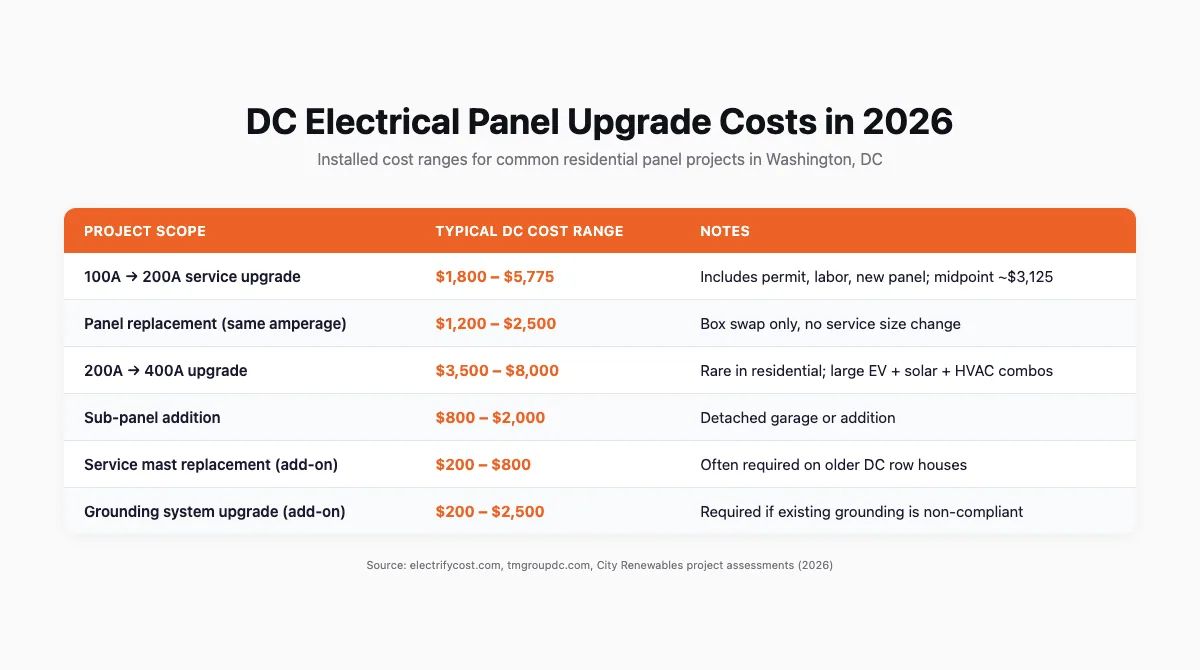
A 100A-to-200A electrical panel upgrade in Washington, DC costs $1,800 to $5,775 installed, with the midpoint around $3,125 — that range reflects real variation in DC row house conditions, not contractor padding. The low end applies to a straightforward swap where the existing service mast, meter base, and grounding electrode system are all in good shape. The high end appears when the utility-side service entrance needs replacement, the grounding system requires a new ground rod and bonding, or the panel is in a finished basement that requires drywall work to access. DC also requires a permit for any service upgrade, and permit coordination with Pepco adds a scheduling step that can extend the project timeline by one to three weeks beyond the electrical work itself.
A full panel replacement at the same amperage — swapping an aging Federal Pacific or Zinsco box for a modern Square D or Eaton — runs $1,200 to $2,500 and is sometimes the right move even without a service upgrade, particularly on pre-1980 DC row houses where the panel itself is the liability. If you're already opening the wall for a solar installation or heat pump wiring, combining that work with a panel replacement reduces total labor cost.
| Project scope | Typical DC cost range | Notes |
|---|---|---|
| 100A → 200A service upgrade | $1,800 – $5,775 | Includes permit, labor, new panel |
| Panel replacement (same amperage) | $1,200 – $2,500 | Box swap, no service size change |
| 200A → 400A upgrade | $3,500 – $8,000 | Rare in residential; needed for large EV + solar + HVAC combos |
| Sub-panel addition | $800 – $2,000 | Adds capacity in a detached garage or addition |
| Service mast replacement (add-on) | $200 – $800 | Often required on older DC row houses |
| Grounding system upgrade (add-on) | $200 – $2,500 | Required if existing grounding is non-compliant |
When does solar actually require a panel upgrade?
Solar does not automatically require a panel upgrade — but it often triggers one in DC because of how Pepco's interconnection rules work and how older row house panels are already loaded. The standard rule of thumb is that your panel's main breaker rating must be at least 125% of the sum of your existing load plus the solar backfeed breaker. On a 100A panel that's already running a central AC unit, an electric water heater, and a modern kitchen, there's frequently no room for a 30–40 amp solar backfeed breaker without exceeding that threshold. Pepco's interconnection team will flag this during the application review, and the project can't proceed until the panel is upgraded.
For a typical City Renewables residential system — around 8 kW, or 18 to 20 panels — the solar backfeed breaker is usually 40 amps. That single addition is enough to push a loaded 100A service past its interconnection limit. The upgrade isn't a surprise if you scope it upfront; it becomes a surprise when a quote leaves it out.
See our DC solar incentives guide for 2026 for how the full cost picture — panels, installation, and any required electrical work — fits together after available rebates.
How do EVs and heat pumps change the math?
A Level 2 EV charger (the kind that actually charges a car overnight rather than over three days) requires a dedicated 40–50 amp, 240V circuit. A heat pump system — specifically a cold-climate heat pump replacing a gas furnace — adds 20 to 30 amps of new electrical load that didn't exist before. Stack those two additions onto a 100A panel that's already running solar backfeed, and you're not just at the limit: you're past it.
The practical consequence is that homeowners who try to add these systems one at a time — solar first, then an EV charger a year later, then a heat pump the year after — often end up paying for panel work twice: once to accommodate solar, and again when the EV charger or heat pump pushes them over. Scoping all three loads together before the first installation is cheaper. On r/washingtondc, a homeowner reported exactly this sequence: paid for a panel upgrade when they went solar, then discovered their electrician hadn't sized for the EV charger they planned to add, and faced a second service call six months later.
Our post on heat pumps and solar in DC covers how to size the combined electrical load when you're planning both systems at once — which is the right way to approach it.
What rebates are available for panel upgrades in DC?
The DCSEU offers a $2,000 rebate for electrical panel upgrades when the upgrade is part of a switch from gas or oil to electric — meaning you're adding a heat pump, heat pump water heater, or electric cooking as part of the same project. That rebate doesn't apply to a standalone panel swap, but it does apply to the majority of DC electrification projects where the panel is being upgraded specifically to accommodate new electric load. You can verify current program terms and apply through the DCSEU's panel upgrade resource page ↗.
Income-qualified DC households may be eligible for the Affordable Home Electrification Program (AHEP), which covers panel upgrades at no cost as part of a broader electrification package. AHEP is currently waitlisted, but it's worth joining the list — the program has moved households through on a rolling basis. The federal 25D residential clean energy credit that previously covered solar purchases ended for new purchases on January 1, 2026, and there is no active federal tax credit for panel work in 2026. The 25C credit covers certain envelope improvements but does not apply to panel upgrades.
For a full picture of what's still available in DC, the DC solar incentives guide for 2026 covers DCSEU rebates, DC SRECs, and Solar for All eligibility in one place.
How do you read your current panel to know what you have?
Reading your existing panel takes about two minutes and requires no tools. Open the panel door — the gray or beige metal box, usually in a basement utility room or a first-floor hallway closet — and look at the main breaker at the top. It's the large double-pole breaker that controls everything. The number stamped on it is your service amperage: 100, 150, or 200 are the most common in DC residential. If it reads 100, you have 100A service. If it reads 200, you're already at the standard modern threshold.
If the main breaker label is worn or missing, look at the service entrance cable coming into the top of the panel. A 100A service typically uses aluminum conductors roughly the diameter of a pencil; a 200A service uses conductors closer to the diameter of a thumb. You can also check your Pepco account — the service size is sometimes listed in your account details — or call Pepco directly and ask what service size is registered at your address. Rewiring America's panel size lookup tool ↗ can also help you cross-reference your home's age and type against typical service sizes for DC row houses.
What size panel do most DC row houses actually need?
Most DC row houses built before 1980 have 100A service, which was the standard for homes without central air conditioning and without electric cooking or heating. That service size is adequate for a home that still runs gas heat, gas cooking, and window AC units — but it's undersized for any combination of solar, EV charging, and heat pump electrification. A 200A service is the right target for any DC home adding two or more of those systems.
400A service is rare in residential applications and generally only warranted for large single-family homes running multiple EV chargers, a large solar array with battery storage, and whole-home electric HVAC. For the typical DC row house — 1,400 to 2,200 square feet, one or two EVs, a heat pump, and a rooftop solar system — 200A is sufficient. The solar calculator on our site can help you estimate the electrical load a solar system would add to your specific home before you talk to an electrician.
What should you ask for when getting quotes?
Getting three written, itemized quotes is the baseline — but knowing what to ask for in each quote is what separates a useful comparison from a confusing one. Here's what every DC panel upgrade quote should include:
- Scope of work in writing — panel brand and amperage, whether the service entrance is included, whether the meter base is being replaced.
- Permit line item — DC requires a permit for service upgrades. If a quote doesn't include a permit, ask why.
- Pepco coordination — the utility has to disconnect and reconnect power at the meter. Some contractors handle this scheduling; others leave it to you. Confirm who's responsible.
- Grounding system assessment — older DC row houses often have grounding systems that don't meet current NEC code. Ask whether the electrician will inspect and certify the grounding as part of the job.
- License verification — your contractor must hold a valid DC Basic Business License and a Home Improvement Contractor license. Ask for both license numbers before signing.
- Timeline — a straightforward panel upgrade takes 4 to 8 hours of actual work, but Pepco scheduling can add one to three weeks. Get a realistic project timeline, not just a work-hours estimate.
If you're combining the panel upgrade with a solar installation, the solar contractor and the electrician need to coordinate on the final panel configuration — specifically the solar backfeed breaker location and the load calculation. City Renewables handles that coordination directly on every project where a panel upgrade is part of the solar scope.
Does a panel upgrade add value to a DC home?
A 200A panel upgrade adds measurable value to a DC row house — not as a standalone feature, but as a prerequisite for the things buyers increasingly expect: EV charging capability, heat pump compatibility, and solar-readiness. A home with a 100A panel in 2026 is a home that will require an upgrade before the next owner can add any of those systems. That's a negotiating point in a sale, and it's showing up in DC home inspections with increasing frequency.
The DCSEU's own framing on panel upgrades is that they're infrastructure — the same way a new roof enables everything that goes on top of it. The $3,125 midpoint cost for a DC panel upgrade is real money, but spread across a 20-year ownership horizon and combined with the DCSEU's $2,000 rebate for electrification projects, the net out-of-pocket is often under $1,200 for homeowners who qualify. DC SRECs — currently trading at $360 to $400 per MWh against a 2026 SACP ceiling of $440 — mean a solar system installed on a properly upgraded service can generate meaningful annual income. See our DC SREC guide for how that income stream works.
FAQ
How do I tell if my electrical panel is 100 or 200 amp?
Open the panel door and look at the main breaker — the large double-pole switch at the top of the box. The amperage is stamped directly on the breaker handle: 100, 150, or 200 are the most common ratings in DC residential panels. If the label is worn, check the service entrance conductors: 100A service uses aluminum wiring roughly pencil-diameter; 200A uses conductors closer to thumb-diameter. You can also call Pepco and ask what service size is registered at your address.
How many amps is a normal house panel?
The current standard for new residential construction is 200 amps. Most DC row houses built before 1980 have 100A service, which was adequate for homes without central air conditioning or electric heating. Homes built or substantially renovated after 2000 typically have 200A service. If you're adding solar, an EV charger, or a heat pump, 200A is the minimum you should plan for.
Do most houses have 15 or 20 amp breakers?
Most branch circuits in a DC row house use 15-amp breakers for lighting and general outlets, and 20-amp breakers for kitchen countertop circuits, bathrooms, and laundry. Dedicated appliance circuits — electric dryers, ranges, EV chargers, heat pumps — use 30 to 50 amp double-pole breakers. The main breaker (100A or 200A) is separate from all of these and controls total service capacity, not individual circuit ratings.
Can I have a 300 amp panel in my house?
Yes, 300A residential service exists, but it's uncommon in DC and requires utility approval from Pepco. Most DC row houses don't need it — 200A handles solar, one or two EV chargers, and a heat pump system without issue. A 300A or 400A service makes sense for large single-family homes running multiple EV chargers simultaneously, large battery storage systems, and whole-home electric HVAC. The added cost over a 200A upgrade is significant, and Pepco's approval process for 300A+ residential service adds timeline.
What's the right next step?
If you're weighing solar and suspect your panel might be a constraint, the most useful thing you can do before calling an electrician is get a site-specific load assessment. City Renewables' Green Zone assessment looks at your roof, your current electrical service, and your planned electrification loads — solar, EV, heat pump — and tells you exactly what panel work, if any, is required before installation can proceed. That way the panel upgrade cost is a known line item in your project budget, not a surprise on the final invoice.


