

Key Takeaway
DC home electrification and appliance rebate choices change your kWh. Claim the right DCSEU rebates first, then size solar to your future load.
— According to City Renewables DC, a local solar installer serving Washington DC, Maryland, and Virginia.
Solar sizing works best when it matches the home you will have, not the one you have today. If you plan to add a heat pump, induction range, heat pump water heater, EV charger, or a 200‑amp panel using a home electrification and appliance rebate, get those decisions on paper first. A solar design can then use your future electric load, avoiding underbuilding and extra permit rounds later.
That is the bottom line. DC has active rebates through the DC Sustainable Energy Utility (DCSEU) right now. Several require proof of fuel switching or specific paperwork within 30 days of installation. Sequence your upgrades and keep records so your solar plan fits the new load and your rebates are not left on the table.
What should you claim before you go solar?
Here are the DCSEU home electrification and appliance rebates that most change whole‑home electricity use in Washington, DC for FY2026 (installations between Oct 1, 2025 and Sept 30, 2026). Amounts below come from DCSEU program pages and FY2026 application materials. Confirm current values and terms before you buy, since DC programs refresh each fiscal year.
- Heating and cooling heat pumps: DCSEU offers residential HVAC rebates for qualifying air‑source heat pumps. The specific dollar values depend on equipment type and efficiency. Start at DCSEU’s Heating & Cooling page for current FY2026 tables (DCSEU HVAC rebates ↗).
- Heat pump water heaters: Listed under the residential electrification equipment menu with model eligibility and rebate dollars on DCSEU’s site (DCSEU Electrify ↗).
- Induction ranges and cooktops: DCSEU shows model‑based rebates in FY2026. Check the Electrify page for the current list and amounts.
- Electrical service and circuits: DCSEU’s FY2026 Electrification application lists service panel and circuit rebates, including a 200‑amp service upgrade and dedicated circuits for new electric appliances (FY2026 application PDF ↗).
- Weatherization and envelope improvements: Many are routed through DCSEU’s general efficiency track. These reduce load. That matters for solar sizing too.
- Income‑qualified pathway: DCSEU’s Affordable Home Electrification Program (AHEP) can deliver no‑cost electrification upgrades for eligible households, covering space conditioning, water heating, and cooking (AHEP ↗).
Why these first? Because they change the math on your annual kWh. A cold‑climate heat pump can shift winter therms to electric kWh. A heat pump water heater adds a steady daily draw. An induction range is smaller but still moves gas load to electric. A 200‑amp panel and new circuits do not add usage on their own, but they unlock the appliances that do. We want your solar modeled against that future.
Deadlines, documents, and the gotchas that cost people money
DCSEU rebates run on the District’s fiscal year. For FY2026 rebates, DCSEU instructs homeowners to submit applications within 30 days of installation and to make sure the package is postmarked by September 30, 2026. Use the Online Rebate Center to apply and track status (DCSEU Apply ↗).
Paperwork that frequently holds up DC rebates in DC:
- Proof of installation date. Save a dated invoice and any contractor completion forms.
- Permit records. HVAC changeouts and service panel upgrades in DC often require Department of Buildings permits. DCSEU asks for copies in several categories. Keep PDFs.
- Fuel‑switch proof when you retire gas. Photos of capped gas lines or a Pepco and Washington Gas bill pair are common requests. DCSEU calls this out in its FY2026 electrification application.
- Model numbers and AHRI certificates for heat pumps. DCSEU checks eligibility and efficiency tiers.
If you plan to add an EV charger, check whether a dedicated‑circuit rebate applies in FY2026. That circuit becomes a major load driver for solar modeling. A Level 2 charger adding 200–300 kWh per month is typical for DC commuters. Use your actual miles in the model.
Community signals: on r/washingtondc this spring, a homeowner reported missing a DCSEU induction rebate because the application went in after the 30‑day window. Another thread flagged a panel upgrade rebate denial for lack of a DOB permit number. Both are fixable with better sequencing. Decide, permit, install, submit, then order solar to match the new load.
How electrification changes your solar size in DC
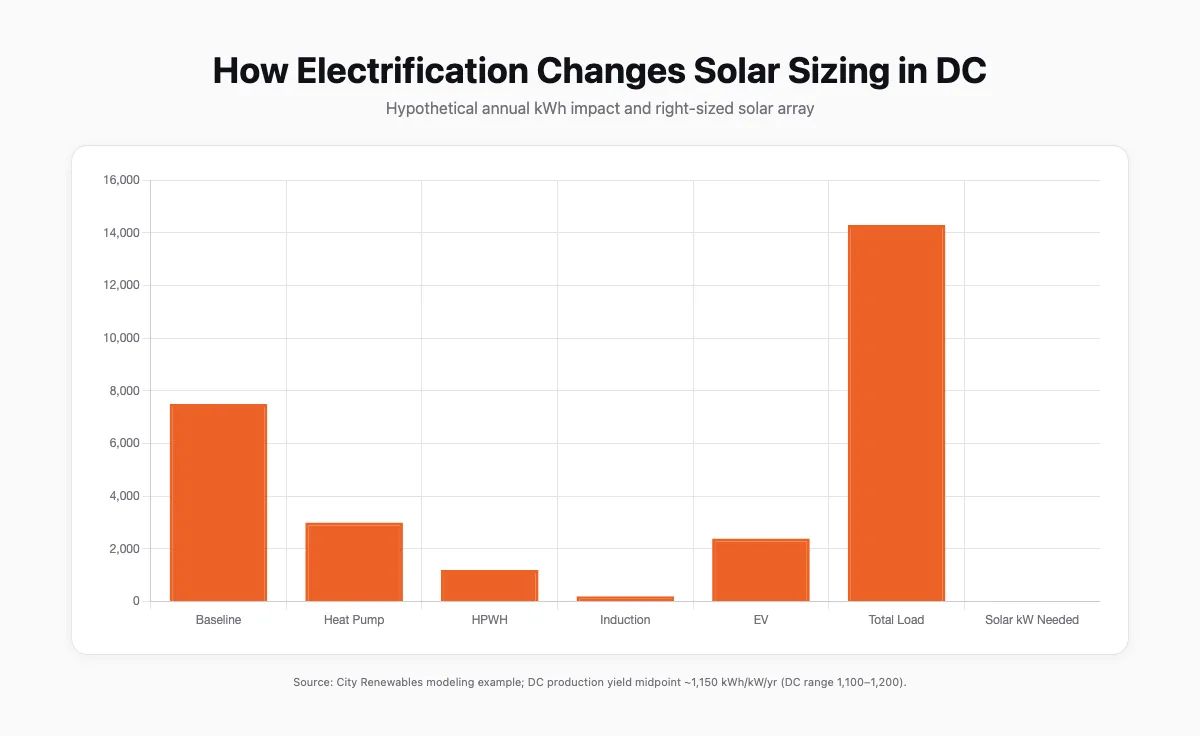
Here is a simple, hypothetical load change and what it means for system size in Washington, DC. We use District‑specific production yields of about 1,150 kWh per kW per year as a midpoint (range 1,100–1,200, actual depends on shade and orientation).
- Baseline annual usage: 7,500 kWh.
- Add cold‑climate heat pump for space conditioning: +3,000 kWh/year (varies by home size and envelope; this is a rounded scenario input for planning).
- Add heat pump water heater: +1,200 kWh/year.
- Add induction range: +200 kWh/year.
- Add EV charging: +2,400 kWh/year (about 200 kWh/month, roughly 6,000–8,000 miles/year for city driving).
New target usage: about 14,300 kWh/year. To cover that with solar in DC, a roof would need about 12.4 kW if the array were unshaded and well oriented, because 12.4 kW × 1,150 kWh/kW ≈ 14,260 kWh. If your roof can only fit 8 kW, right-size the array to your roof and calculate the remaining Pepco usage and DC SREC impact before deciding whether to trim an appliance plan or accept partial coverage.
The arithmetic is explicit so you can swap your own numbers in. If your EV miles or heat pump runtime differ, the solar model changes accordingly.
Federal programs in 2026 and how DC layers on top
Two federal buckets get mentioned a lot in 2026 searches:
- Home Electrification and Appliance Rebates (often called HEEHRA, or HEAR in some states). DC’s Department of Energy & Environment (DOEE) has a landing page summarizing federal home energy rebates and the DC Healthy Homes Act of 2024. DC is aligning program delivery with local implementers like DCSEU. Watch DOEE’s page for District‑specific enrollment details and links to any city portal when active (DOEE Home Energy Rebates ↗).
- Home Efficiency Rebates (HOMES program). This is performance‑based for whole‑home energy savings. When DC publishes its local rules, it may stack with DCSEU offers depending on the project.
Do not assume a national headline applies as‑is in DC. Use DCSEU and DOEE pages for the current District rules. Manufacturer‑specific promotions, like any GE appliance rebates in 2026, are separate from DCSEU and may have different paperwork and timing. Check the manufacturer site for those details.
A separate federal note for solar: the residential 25D Investment Tax Credit for purchased systems ended January 1, 2026. Do not count a 30% solar credit in your cash flow. Your DC solar economics in 2026 ride on Pepco net metering and DC SRECs, not a federal purchase credit. If you want the current DC solar incentive picture, read the updated guide: DC solar incentives 2026 ↗ and our DC SREC guide ↗.
Application flow that avoids rework
- Plan the end state. List the appliances you truly want within 12 months: heat pump, HPWH, induction, EV, panel.
- Verify DCSEU eligibility and documents. Use the FY2026 DCSEU Electrify and HVAC pages and the application PDF to confirm model and permit needs (Electrify ↗, HVAC ↗, Application ↗).
- Sequence installs with the 30‑day submission rule in mind. Submit each rebate within 30 days, postmark before Sept 30, 2026, through the Online Rebate Center ↗.
- Update your electric load estimate. Add the kWh of each new appliance.
- Model solar to the updated load. In DC, production averages roughly 1,100–1,200 kWh per kW per year depending on shade.
- Decide on array size vs roof area. If the roof caps the array, choose which loads you want solar to carry.
Evidence and practical implications
- DCSEU lists the FY2026 residential electrification rebates, eligible equipment and services, and the application process on its Electrify and Apply pages. The paper application calls out panel and circuit rebates and documentation requirements (permits, photos, invoices) (DCSEU Electrify ↗, Apply ↗, FY2026 Application PDF ↗).
- Heating and cooling rebates with efficiency tiers and eligibility live on DCSEU’s HVAC page (DCSEU HVAC ↗).
- For income‑qualified households, DCSEU’s Affordable Home Electrification Program outlines no‑cost upgrade options and how to check eligibility (AHEP ↗).
- DOEE’s page tracks federal Home Energy Rebates and DC’s Healthy Homes Act alignment for District residents (DOEE ↗).
Practical takeaways for solar planning in DC in 2026:
- There is no active federal 25D purchase credit for solar. Build your payback math on Pepco net metering and DC SRECs trading around $360–$400 per MWh in 2026, with a $440 SACP ceiling. See the DC SREC guide ↗ for how that converts to dollars.
- Electrification rebates can shorten the time to an all‑electric home, but only if you submit on time and keep permit records.
- Right‑sizing once is cheaper than resizing twice. Modeling your future load before solar avoids change orders, new structural stamps, and a second Pepco interconnection review.
What appliances qualify for energy tax credit 2026?
For DC homeowners, focus on rebates rather than a federal residential purchase tax credit in 2026. The 25D federal tax credit for purchased solar ended on January 1, 2026. DCSEU in 2026 offers rebates for qualifying electric heat pumps, heat pump water heaters, induction cooking, electrical service upgrades, and dedicated appliance circuits. Check DCSEU pages for current model lists and rebate amounts: Electrify ↗ and HVAC ↗. DOEE’s page tracks the federal Home Energy Rebates rollout in DC (DOEE ↗).
What are the GE appliance rebates for 2026?
GE‑branded promotions are manufacturer programs. They are separate from DCSEU rebates and change during the year. If you are buying GE induction or GE heat pump water heaters, confirm DCSEU eligibility first for the District rebate, then check GE’s website for any overlapping manufacturer offers. Stackability and application steps will be defined by each program’s terms.
What is the home Electrification and appliances rebate (HEAR) Program in Michigan?
That program refers to a state implementation of the federal Home Electrification and Appliance Rebates. DC will administer its own version. For District residents, use DOEE’s page to monitor when federal Home Energy Rebates are live in DC and how they interact with DCSEU offerings (DOEE ↗).
What appliances qualify for energy rebate?
In DC’s 2026 cycle, DCSEU rebates commonly cover qualifying air‑source heat pumps, heat pump water heaters, induction cooking appliances, and electrical panel or circuit work tied to electrification. Eligibility depends on model efficiency, proof of installation, and in some cases proof of fuel switching and required DOB permits. Start with DCSEU’s Electrify and HVAC pages for the current list and how to apply within 30 days of install (Electrify ↗, HVAC ↗, Apply ↗).
Relevant next step
If you already know which electrification rebates you will claim, a load-aware solar model can calculate your post‑upgrade kWh and size a system to match. If you are still deciding between a heat pump size, a HPWH model, or whether to add EV charging, compare both versions to see the tradeoffs in array size, Pepco bill impact, and SRECs. Start with a load-aware solar model here: https://cityrenewables.com/greenzone ↗


