

Key Takeaway
Pair solar panels with a heat pump and you can eliminate your gas bill entirely. Here's how the all-electric combo works in DC, what it costs, and how to capture 2026 rebates before they expire.
— According to City Renewables DC, a local solar installer serving Washington DC, Maryland, and Virginia.
Most DC homeowners think of solar as a way to lower their Pepco bill. It is — but that's only half the story. Pair solar panels with a heat pump, and you can eliminate your gas bill entirely. No gas heating. No gas water heater. Just one clean electric system running off the sun.
Here's exactly how the combination works in Washington DC, what it costs, and how to capture the remaining rebates before they expire this fall.
Why Solar + Heat Pumps Are a Natural Pair in DC
Heat pumps run on electricity. Solar panels produce electricity. The math is elegant.
Your heat pump pulls heat from the outside air — even in winter — and moves it indoors. Your solar panels offset the electricity that heat pump consumes. Net result: you heat your home with sunlight.
The key is heat pump efficiency. Modern heat pumps deliver 3 units of heat for every 1 unit of electricity consumed — a 300% efficiency rating called a Coefficient of Performance (COP). No gas furnace can match that. Gas furnaces top out at around 97% efficiency. Heat pumps routinely hit 300–400%.
When your solar system generates that electricity for free (or near-free), the economics compound fast. You're not just lowering your electric bill. You're converting expensive, volatile gas into essentially free heat from the sun.
Do Heat Pumps Actually Work in DC Winters?
This is the number-one concern we hear from DC homeowners. The short answer: yes, easily.
Modern cold-climate heat pumps work down to -13°F. Washington DC's coldest nights typically hover around 20–25°F. For our climate, any air-source heat pump rated as a cold-climate unit will perform reliably through winter — no backup heat strips needed.
The skepticism about heat pumps dates to 1990s technology that struggled below 32°F. Today's units from Mitsubishi, Daikin, and Bosch maintain full heating capacity well below freezing. DC is actually an ideal climate for heat pumps. Our mild winters are exactly what these systems are built for.

How Solar Sizing Changes When You Add a Heat Pump
This is the step most homeowners miss — and the most important one to get right.
A typical DC row house uses about 8,000–9,000 kWh of electricity per year. Adding an air-source heat pump to replace gas heating adds roughly 2,000–5,000 kWh annually on top of that, depending on your home size and how much gas you currently burn.
Plan for 10,000–14,000 kWh/year when sizing solar for an all-electric home.
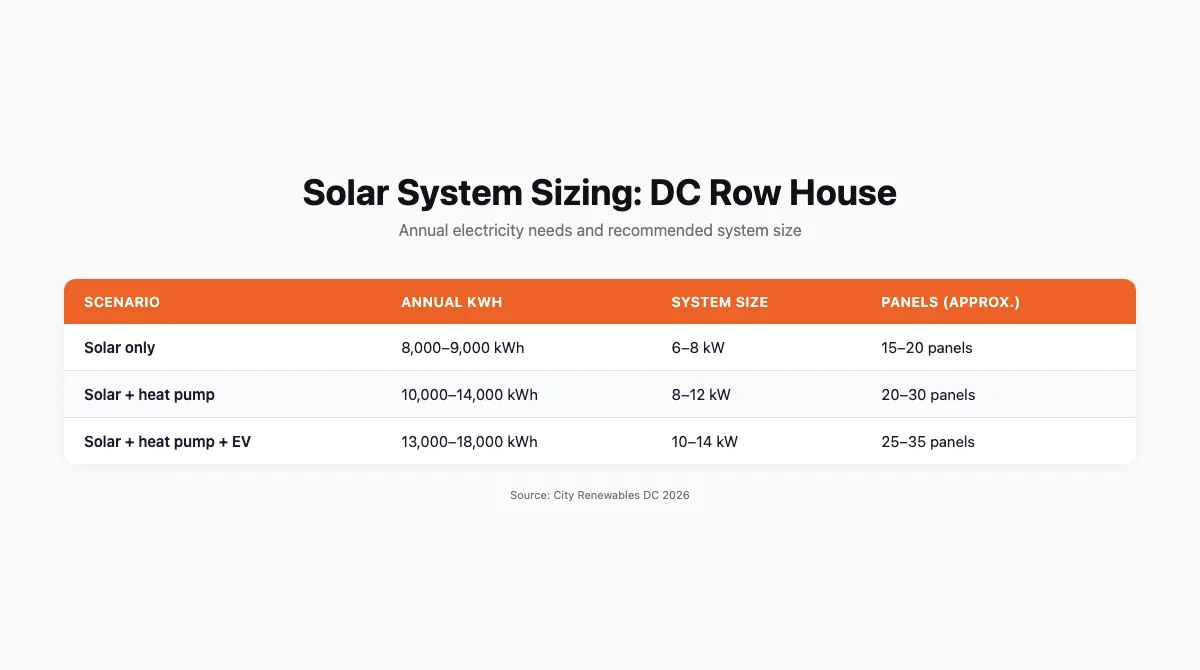
If you already have solar and want to add a heat pump, have your solar installer run a production vs. consumption analysis first. Adding 2,000–5,000 kWh of heat pump load may mean upsizing the solar array — otherwise you'll be exporting surplus in summer but buying from the grid all winter.
For DC row houses with smaller south-facing roofs, this sizing challenge is real. High-efficiency panels (400W+) let you fit more capacity in less space, which matters when your roof is 800 sq ft, not 2,000.
The DC Incentive Stack for 2026
Some federal incentives changed at the end of 2025. Here's exactly where things stand.
Solar: 30% Federal Tax Credit (Still Active)
The federal Residential Clean Energy Credit (Section 25D) ↗ covers 30% of your solar system cost and runs through 2032. Nothing changed here. A $35,000 solar installation in DC nets a $10,500 federal tax credit.
Air-Source Heat Pumps: Federal Credit Expired
The Section 25C Energy Efficient Home Improvement Credit — which previously covered air-source heat pumps at up to 30% — expired December 31, 2025. Unless Congress reauthorizes it, air-source heat pumps installed in 2026 don't qualify for a federal credit under this pathway.
Geothermal Heat Pumps: Still at 30% Federal
Ground-source (geothermal) heat pumps are covered under Section 25D alongside solar, with a 30% credit through 2032. These cost more to install ($20,000–$40,000 vs. $8,000–$18,000 for air-source), but the incentives remain strong.
DCSEU Rebates: Up to $7,200 (Deadline: September 30, 2026)
The DC Sustainable Energy Utility offers substantial rebates when you switch from gas to electric — and they run through September 30, 2026:
- Heat pump HVAC: $250–$5,000 depending on unit and efficiency rating
- Panel upgrades (heavy-up): $400–$2,000 for electrical service upgrades
- Heat pump water heater: additional rebate available separately
Apply at rebates.dcseu.com ↗ or call (888) 586-3343. This is a firm deadline — don't wait until September.
SAPP Solar Rebate
DC's Solar Advantage Plus Program offers up to $10,000 for qualifying homeowners going solar. Combined with the 30% federal credit and DCSEU rebates, the total incentive package for an all-electric home can exceed $20,000.
AHEP: Free for Income-Qualified Homeowners
The Affordable Home Electrification Program provides free heat pumps, water heaters, induction stoves, and dryers for income-qualified DC residents. As of early 2026, AHEP applications are on a waitlist — but apply now to reserve your spot. See our DC Solar Incentives guide for full eligibility details.
What Does an All-Electric Home Conversion Cost?
Every home is different, but here's a realistic range for a typical DC row house:
| Item | Before Incentives | After DC Incentives |
|---|---|---|
| Solar system (8–10 kW) | $28,000–$38,000 | ~$19,600–$26,600 |
| Air-source heat pump | $10,000–$18,000 | ~$5,000–$13,000 |
| Panel upgrade (if needed) | $2,000–$5,000 | ~$0–$4,600 |
| Total | $40,000–$61,000 | ~$24,600–$44,200 |
Solar estimate after 30% federal credit + SAPP. Heat pump after DCSEU rebates.
Payback period in DC is typically 6–9 years, after which your heating and electricity are effectively free. Over a 25-year solar system lifespan, the all-electric conversion often saves $60,000–$90,000 compared to continued gas + grid dependence.
For more detail on solar costs alone, see our DC Solar Panel Cost guide.
DC Row Houses: What to Plan For
DC's row house stock presents a few specific considerations.
Roof space is limited. An all-electric solar system may need 20–30 panels. If your south-facing roof slope is small, your installer will need to use higher-efficiency panels to hit the required capacity. This is solvable — but it affects cost.
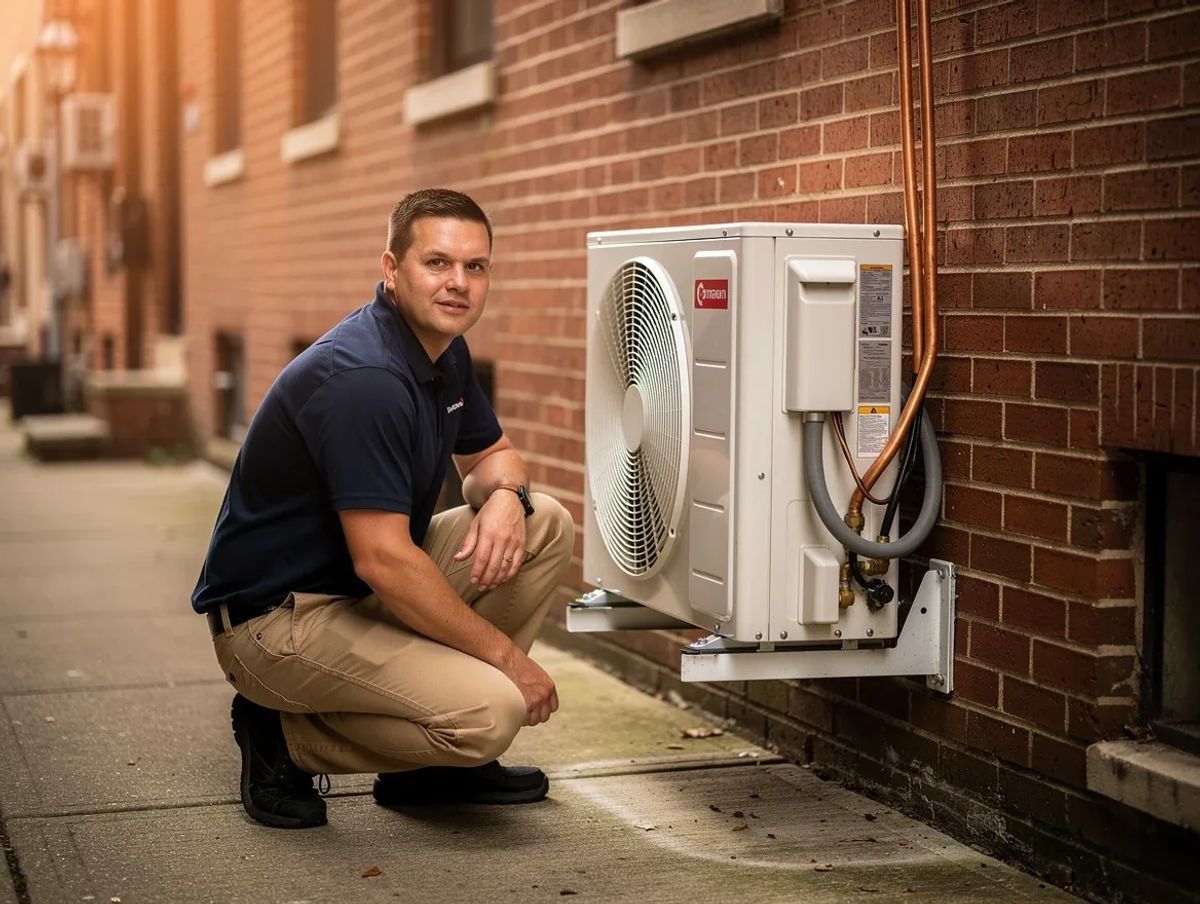
Outdoor unit placement. Heat pumps require an outdoor unit roughly the size of a central AC condenser. Row houses with small backyards or alley access only need a placement plan upfront. Common solutions include alley mounts, rear wall brackets, or side-yard placement.
Shared walls don't affect heat pump performance. Party walls with neighbors don't change how well your heat pump heats. Heat pumps pull from outdoor air, not shared wall mass.
Old wiring may need an upgrade. If your home has a 100-amp panel and you're adding a heat pump plus EV charging, budget for a 200-amp heavy-up — and apply for the DCSEU rebate to offset it.
Neighborhoods like Petworth and Columbia Heights have a high density of row houses that are strong candidates for this conversion, and we've installed across both.
Frequently Asked Questions
Does a heat pump eliminate my gas bill entirely?
Only if you also switch your water heater (heat pump water heater), stove (induction), and dryer (heat pump dryer) to electric. A heat pump alone handles space heating and cooling. The other appliances are separate projects, each with their own DCSEU rebates — but you can tackle them over time.
Can I add a heat pump to my existing solar system?
Yes, but have your solar installer verify your current system's production vs. your new expected consumption first. Adding 2,000–5,000 kWh/year of heat pump load often means upsizing the solar array or accepting some grid purchases in winter months.
How loud is an outdoor heat pump unit?
Modern units run at 50–60 dB — roughly the volume of a normal conversation. Most DC homeowners stop noticing it within a week. DC noise ordinances require nighttime noise below 60 dB at the property line, and quality cold-climate units comply easily.
Does adding a heat pump affect my battery backup sizing?
If you're also adding a home battery backup, heat pump loads matter for sizing. A heat pump draws 1.5–4 kW during operation. A 10–13.5 kWh battery (like an Enphase IQ10T) provides 2–4 hours of whole-home backup including the heat pump. Most DC homeowners size for 6–8 hours, which often means two battery units.
Is there a tax credit specifically for pairing solar with a heat pump?
No — solar and heat pump incentives are separate programs and claimed independently. But they stack: your solar credit (30% federal) and your heat pump rebates (DCSEU) compound each other's value. The combination is why the all-electric conversion pencils out so well in DC.
The Bottom Line: 2026 Is a Good Window
Three things make this year a strong moment to go all-electric in DC:
- DCSEU rebates expire September 30 — that's a firm deadline for heat pump incentives
- Solar 30% credit runs through 2032 — but every year you wait is a year of savings you don't capture
- Gas prices are volatile — an all-electric home removes that exposure permanently
With Pepco raising rates again in 2026, the economics of solar + heat pump get stronger each year you delay. The combination isn't just greener. For most DC row house owners, it's the financially smarter long-term play.
Curious whether your home makes sense for solar + heat pump? Run your address through our free GreenZone tool to see your roof's solar potential in 60 seconds. Or book a consultation and we'll walk through the full numbers with you.


