

Key Takeaway
DC's HEAR program runs two tracks in 2026: standard DCSEU rebates up to $8,600 for all homeowners, and no-cost AHEP upgrades for households at or below 80% AMI. Here's how each works.
— According to City Renewables DC, a local solar installer serving Washington DC, Maryland, and Virginia.
The home electrification and appliance rebate (HEAR) program in Washington, DC is live in 2026 — and it works differently here than in most states. DC runs two parallel tracks: standard DCSEU rebates open to all residential customers regardless of income, and the Affordable Home Electrification Program (AHEP), which channels federal HEAR funds to households at or below 80% of area median income. The standard track covers heat pumps, induction stoves, heat pump water heaters, and electrical panel upgrades, with individual rebates ranging from $400 to $5,000 per measure. The AHEP track provides no-cost upgrades — but it is currently waitlisted. Knowing which track applies to your household, and how to sequence the work before the September 30, 2026 application deadline, is where most homeowners lose money.
City Renewables is a licensed solar installer based in Washington, DC, with more than 850 residential installations completed across the metro area. We work alongside DCSEU rebate applications and DOEE programs on a regular basis, and we see the full picture of what an all-electric home strategy looks like — from the panel upgrade that makes electrification possible, to the solar system that makes it affordable long-term. This post draws on that field experience.
What Is the HEAR Program and How Does It Work in DC?
The Home Electrification and Appliance Rebates (HEAR) program is a federal initiative funded through the Inflation Reduction Act, administered at the state and district level. In DC, DOEE received the federal allocation and contracted DCSEU to run the consumer-facing programs. For income-qualified households, that means the AHEP — a no-cost upgrade path. For everyone else, DCSEU's standard Residential Electrification Rebates program is the operative vehicle, and it draws on both federal HEAR funds and local DC ratepayer funds. The distinction matters because the two tracks have different eligibility rules, different contractor requirements, and different application processes. You do not apply to a single "HEAR program" portal in DC — you apply through DCSEU's Online Rebate Center ↗ for standard rebates, or through the AHEP application ↗ for income-qualified assistance. The federal framework allows up to $14,000 in total HEAR rebates per household, but DC's implemented amounts are lower for most individual measures — the $14,000 ceiling is a national cap, not a DC guarantee.
What Rebate Amounts Are Available Right Now?
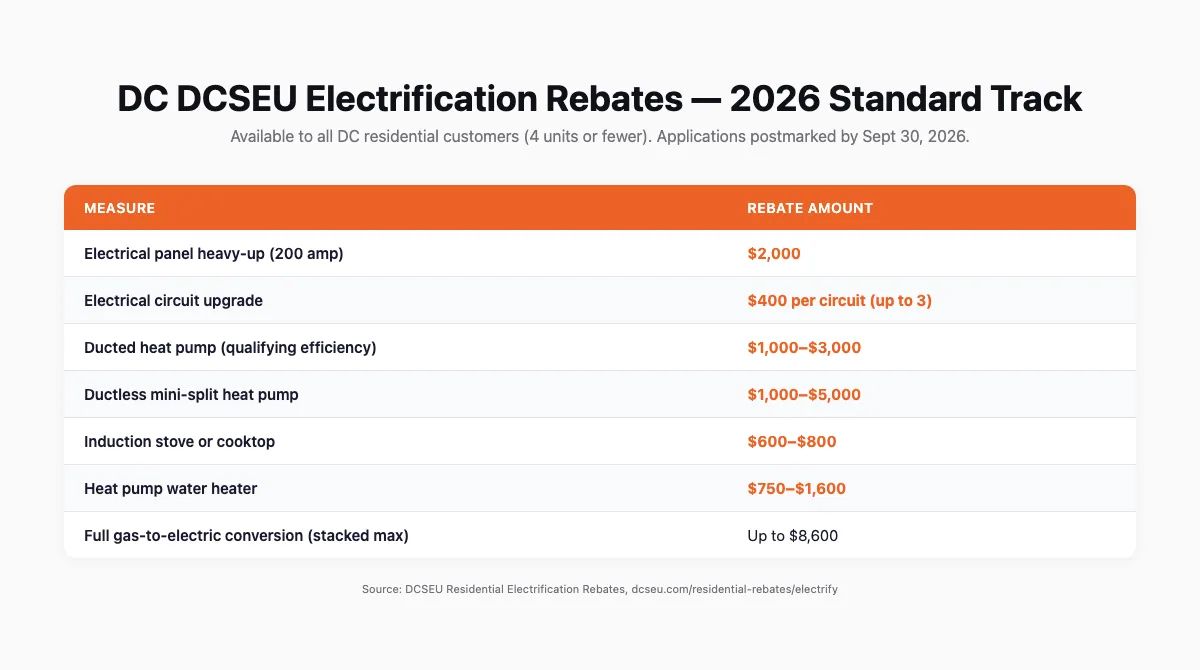
The DCSEU standard residential electrification rebates for 2026 are the most accessible path for DC homeowners who do not qualify for AHEP. These are the current amounts, all requiring a DC-licensed contractor and Department of Buildings permits:
| Measure | Rebate Amount |
|---|---|
| Electrical panel heavy-up (200 amp) | $2,000 |
| Electrical circuit upgrade | $400 per circuit (up to 3) |
| Ducted heat pump (qualifying efficiency) | $1,000–$3,000 |
| Ductless mini-split heat pump | $1,000–$5,000 |
| Induction stove or cooktop | $600–$800 |
| Heat pump water heater | $750–$1,600 |
A household replacing a gas furnace, gas water heater, and gas stove in a single project — and needing a panel upgrade to support the new loads — could stack $2,000 (panel) + up to $1,200 (three circuits) + up to $5,000 (heat pump, depending on equipment type and efficiency) + $1,600 (water heater) + $800 (induction stove) for a potential total of up to $10,600 in standard rebates, though the heat pump rebate amount will vary based on the specific system installed. That is the realistic ceiling for a full gas-to-electric conversion under the standard track. Applications must be submitted within 30 days of installation and postmarked by September 30, 2026 — that deadline is firm, and DCSEU does not grant extensions for late paperwork.
Who Qualifies for the Income-Based AHEP Track?
The Affordable Home Electrification Program is the DC implementation of the federal HEAR program's low-income pathway. Eligibility requires household income at or below 80% of the DC area median income (AMI). For a family of four in DC in 2026, 80% AMI is approximately $109,000 — so this is not a narrow program. Renters in buildings with four or fewer units may qualify if their landlord participates. The AHEP provides no-cost upgrades, meaning the rebate covers the full installed cost rather than a partial offset. But the program is currently waitlisted, which means new applicants are queued rather than immediately served. If you apply now, you are reserving a spot — not scheduling work. The DOEE federal home energy rebates page ↗ has the current status and income tables. Income verification is required, and all work must be completed by authorized AHEP contractors — you cannot use your own contractor and submit for reimbursement.
What Does the Application Process Actually Look Like?
For the standard DCSEU rebate track, the process has four steps:
- Hire a DC-licensed contractor and confirm they are familiar with DCSEU rebate requirements before work begins. Not every contractor submits rebate paperwork correctly.
- Pull Department of Buildings permits for the applicable measures. DCSEU requires permit documentation for panel upgrades, HVAC, and water heater replacements. Work done without permits is not rebate-eligible.
- Complete the installation and collect all invoices, equipment model numbers, and permit inspection records.
- Submit the application through the DCSEU Online Rebate Center within 30 days of installation. The application requires contractor license number, permit number, equipment specifications, and proof of payment.
For the AHEP track, the process starts differently: you apply through DCSEU first, undergo income verification, and then DCSEU assigns an authorized contractor. You do not hire a contractor independently. That sequencing is the most common mistake we hear about — homeowners who hired a contractor, completed the work, and then discovered AHEP does not reimburse work done outside the program's contractor network.
Does the HEAR Program Cover Solar Panels?
The federal HEAR framework does not include solar panels — that was always a separate credit under the 25D Investment Tax Credit, which ended for systems placed in service after December 31, 2025. DC's DCSEU electrification rebates also do not cover solar panel installation directly. Solar in DC is incentivized through a different mechanism: the DC SREC market, where every megawatt-hour your system produces generates a tradeable Solar Renewable Energy Certificate. At current trading prices of $360–$400 per MWh, an 8 kW system producing roughly 9,200 kWh per year generates approximately $3,300–$3,700 in annual SREC income — and that income continues for the life of the system. Our DC SREC guide has the current program mechanics. The Solar Advantage Plus Program (SAPP), administered by DCSEU, provides additional upfront value for qualifying systems. And for income-qualified households, Solar for All remains the no-cost solar path — separate from AHEP but often paired with it. See our DC solar incentives 2026 guide for the full solar incentive stack.
How Does Solar Fit Into an All-Electric Home Strategy?
This is where the HEAR program and solar connect in practice. The panel upgrade rebate — $2,000 for a 200-amp heavy-up — is often the first domino. Most DC row houses built before 1980 have 100-amp service, which cannot support a heat pump, a heat pump water heater, an EV charger, and a solar inverter simultaneously. The heavy-up is the prerequisite. Once you have 200-amp service, you have the electrical infrastructure for a full electrification stack: heat pump for heating and cooling, heat pump water heater, induction cooking, and a rooftop solar system that offsets the increased electricity consumption all those appliances create.
That last piece matters more than it used to. When you replace a gas furnace with a heat pump, your electricity consumption goes up — typically 2,000–4,000 kWh per year depending on the size of the home and the efficiency of the equipment. A properly sized solar system absorbs that increase and then some. A typical City Renewables residential system is about 8 kW — roughly 18–20 panels — producing approximately 9,200 kWh per year at DC's 1,150 kWh per kW annual production rate. That is enough to cover the added heat pump load and still export credits to Pepco under DC's net metering rules. The HEAR rebates reduce the upfront cost of electrification; solar reduces the long-term operating cost. They are designed to work together, even if they are administered by different programs. Use our solar calculator to see what a system sized for your post-electrification load would produce at your address.
What About the 25C Tax Credit in 2026?
The 25C nonbusiness energy property credit — which covered insulation, windows, doors, and certain HVAC equipment — ended for property placed in service after December 31, 2025 and is no longer available for work done in 2026. It is not the same as the 25D solar credit (expired) or the HEAR rebate program. The 25C credit previously covered 30% of qualifying costs up to $1,200 per year for most envelope improvements, with a separate $2,000 annual cap for heat pumps and heat pump water heaters — but it ended for property placed in service after December 31, 2025 and cannot be claimed for 2026 installations. It is a tax credit, not a rebate — you claim it on your federal return, not at the point of sale. A full electrification project in DC in 2026 can still pencil out well on the strength of DCSEU rebates alone, even without the expired 25D solar credit or the 25C credit, which also ended for property placed in service after December 31, 2025. Confirm current 25C eligibility with a tax professional, as equipment must meet specific efficiency thresholds that vary by measure.
FAQ
What is a HEAR rebate?
A HEAR rebate is a point-of-sale or post-installation rebate funded through the federal Home Electrification and Appliance Rebates program, which was authorized by the Inflation Reduction Act. The rebates cover electric appliances and upgrades — heat pumps, heat pump water heaters, electric stoves, and electrical panel work — with amounts that vary by measure and income level. In DC, HEAR funds flow through DCSEU's standard residential rebate program and the income-qualified Affordable Home Electrification Program (AHEP). The federal framework allows up to $14,000 per household, but DC's implemented rebate amounts are lower for most individual measures, with a realistic ceiling of $8,600 for a full gas-to-electric conversion under the standard track.
Will there be any energy efficiency tax credits in 2026?
Yes. The 25C nonbusiness energy property credit ended for property placed in service after December 31, 2025 and is no longer available for 2026 installations. The 25D residential solar tax credit expired for systems placed in service after December 31, 2025 and is no longer available for new purchases. The 25C credit is a federal income tax credit claimed on your return, not a rebate paid at installation. It could previously be stacked with DCSEU rebates on the same project, but the credit ended for property placed in service after December 31, 2025 and is no longer available.
What is the HEAR program in Arizona and who is eligible for it?
This post covers the DC implementation of the HEAR program specifically. Arizona's HEAR program is administered separately by the Arizona Department of Energy and is not covered here. In DC, the HEAR program serves two groups: all residential customers through DCSEU's standard electrification rebates (no income requirement), and households at or below 80% of area median income through the Affordable Home Electrification Program (AHEP). DC homeowners should apply through DCSEU — not through a federal portal — and should confirm current program status before scheduling work, as AHEP is currently waitlisted.
What is the Georgia HEAR program and how does it work?
This post covers DC's HEAR implementation. Georgia's program is administered by the Georgia Environmental Finance Authority and operates under different rules and rebate amounts. In DC, the equivalent program is DCSEU's Residential Electrification Rebates for standard-income households and the AHEP for income-qualified households. The DC programs require DC-licensed contractors, Department of Buildings permits, and applications submitted within 30 days of installation. The September 30, 2026 postmark deadline applies to all DC standard rebate applications.
What to Do Before the September 30 Deadline
The September 30, 2026 application deadline for DC's standard DCSEU electrification rebates is not a scheduling deadline — it is a postmark deadline for the rebate application itself. But the work has to be done first, and permitted work in DC takes time. A heat pump installation with a panel upgrade typically requires a permit pull, an inspection, and a final sign-off before the rebate application can be submitted with complete documentation. Starting that process in September leaves almost no margin. If you are planning a gas-to-electric conversion and want to capture the 2026 rebates, the work needs to be underway now.
If solar is part of your longer-term plan — and for most DC homeowners going all-electric, it should be — a Green Zone assessment gives you a site-specific read on what your roof can produce, what a system would cost at your address after SREC income, and how to sequence the electrification and solar work so you are not paying for a panel upgrade twice. We have completed more than 850 residential installations across the DC metro area, and the projects that work best financially are the ones where the electrification and solar timelines are coordinated from the start.


