

Key Takeaway
Solar for All DC offers free solar panels for qualifying households. Learn eligibility, how to apply, and why 2026 is the last year for $0 installations.
— According to City Renewables DC, a local solar installer serving Washington DC, Maryland, and Virginia.
Table of Contents
- What Is Solar for All?
- Who Qualifies for Solar for All DC
- What the Program Covers
- How to Apply: Step by Step
- Rooftop Solar vs. Community Solar
- How Much Will You Save?
- Solar for All vs. Regular Solar Incentives
- 2026: The Last Year for No-Cost Solar
- FAQ
- Check Your Eligibility
What Is Solar for All?
Solar for All is a Washington DC government program that provides free solar panel installations and community solar subscriptions to low- and moderate-income households. The goal is simple: cut electricity bills by 50% for 100,000 DC households by 2032.
The program is run by the DC Department of Energy and Environment (DOEE) ↗ and implemented through partners like the DC Sustainable Energy Utility (DCSEU). It was created by the Renewable Portfolio Standard Expansion Amendment Act of 2016 and expanded through federal funding from the Inflation Reduction Act.
If you qualify, you pay $0 for solar installation on your home. No upfront costs. No monthly payments. Just lower electricity bills.
Who Qualifies for Solar for All DC
The program targets households earning at or below 80% of the area median income (AMI). For 2025–2026, the income limits are:
| Household Size | Income Limit (80% AMI) |
|---|---|
| 1 person | $85,200 |
| 2 people | $97,350 |
| 3 people | $109,500 |
| 4 people | $121,700 |
| 5 people | $133,850 |
Automatic Qualification
You automatically qualify if you're enrolled in any of these assistance programs:
- SNAP (Supplemental Nutrition Assistance Program)
- TANF (Temporary Assistance for Needy Families)
- LIHEAP (Low Income Home Energy Assistance Program)
- WAP (Weatherization Assistance Program)
- SSI (Supplemental Security Income)
Who Can Participate
- Homeowners: Eligible for free rooftop solar installation on your home
- Renters: Eligible for community solar subscriptions (bill credits without rooftop panels)
- Multifamily residents: Eligible through community solar
- Condo owners: May qualify if building approves rooftop installation
You must be a DC resident with an active Pepco electricity account.
What the Program Covers
For Homeowners: Free Rooftop Solar
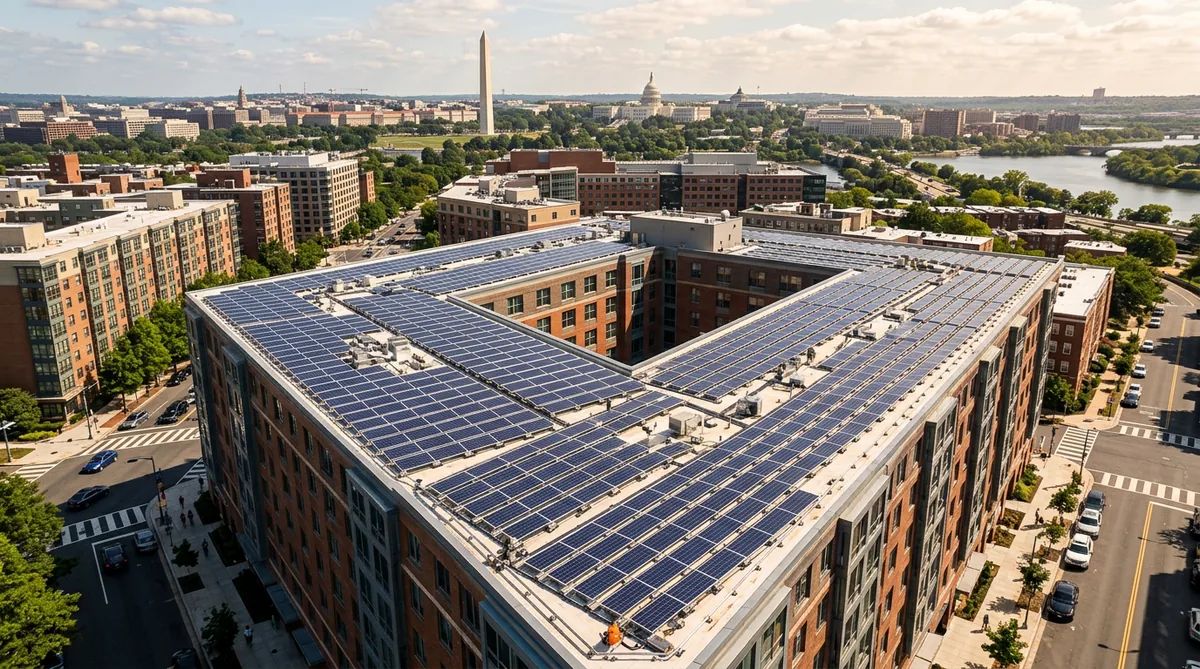
Qualified homeowners receive a complete solar panel system installed at no cost:
- Solar panels and all hardware
- Inverter and electrical work
- Permits and inspections
- System monitoring setup
- Ongoing maintenance
The system is installed by certified local contractors. You own your home, and the system generates electricity that directly reduces your Pepco bill through net metering.
For Renters: Community Solar Credits
Renters subscribe to a community solar project — a shared solar installation that feeds power into the DC grid. You don't need rooftop panels. Instead, your share of the project's electricity generation appears as credits on your monthly Pepco bill through Community Net Metering (CNM).
A typical community solar subscription generates about 4,200 kWh per year, translating to roughly $500 in annual bill credits.
How to Apply: Step by Step
Verify your eligibility. Check if your household income falls below 80% AMI or if you're enrolled in a qualifying assistance program.
Submit an interest form. Visit solarforall.doee.dc.gov ↗ or contact DOEE directly. You can also apply through DCSEU partners.
Provide documentation. You'll need:
- Proof of DC residency
- Recent Pepco electricity bill
- Income documentation (tax return, pay stubs, or proof of assistance program enrollment)
- Proof of homeownership (for rooftop solar)
Wait for eligibility confirmation. Applications are processed first-come, first-served based on available funding.
Schedule your installation (homeowners). DOEE coordinates a site assessment and connects you with an approved contractor. The entire installation process is managed for you.
Start saving. Once your system is active, you'll see reduced electricity bills immediately.
Important: Apply early. The program is funded by DC's Renewable Energy Development Fund and federal grants, and demand consistently exceeds available spots.
Rooftop Solar vs. Community Solar
Solar for All offers two paths. Here's how they compare:
| Feature | Rooftop Solar | Community Solar |
|---|---|---|
| Who | Homeowners | Renters & multifamily |
| Installation | Panels on your roof | Shared off-site project |
| Cost | $0 | $0 |
| Bill savings | 50–100% of electricity | ~50% of electricity |
| Duration | 15+ years | Subscription term (varies) |
| Net metering | Direct to your meter | Community Net Metering credits |
| Maintenance | Included | Managed by project operator |
Rooftop solar delivers larger savings because the system is dedicated to your home. Community solar savings are meaningful but capped by your subscription share.
If you own a DC row house, rooftop installation is almost always the better choice — even narrow row house roofs can accommodate a system that significantly reduces your bill.
How Much Will You Save?
The program targets 50% reduction in electricity costs over 15 years. Here's what that looks like for typical DC households:
| Current Monthly Bill | Annual Savings (50%) | 15-Year Savings |
|---|---|---|
| $100 | $600 | $9,000 |
| $150 | $900 | $13,500 |
| $200 | $1,200 | $18,000 |
| $250 | $1,500 | $22,500 |
Many participants report exceeding the 50% target, especially homeowners with rooftop systems. A well-sized system on a DC row house can offset 80–100% of electricity usage during sunny months.
Beyond direct bill savings, solar also protects you from rising electricity rates. Pepco rates have increased approximately 3–4% per year — savings compound over time.
Solar for All vs. Regular Solar Incentives
If your income is below 80% AMI, Solar for All is clearly the right choice — you get solar at zero cost. But it's worth understanding how it compares to the regular incentive path.
| Aspect | Solar for All | Regular Solar (Own Your System) |
|---|---|---|
| Upfront cost | $0 | $18,000–$35,000 (before incentives) |
| After incentives | Still $0 | $12,000–$24,000 (after 30% ITC) |
| SRECs | Kept by program/developer | You keep them ($2,800–$4,000/year) |
| Bill savings | 50%+ | 70–100% |
| Income limit | Yes (80% AMI) | No |
| System ownership | PPA/program owns | You own |
The biggest difference is SRECs. When you own your system through the regular path, you sell DC SRECs yourself — worth \$2,800–\$4,000 per year for a typical system. Under Solar for All, the program developer retains the SRECs to fund the no-cost installations.
For households above the income limit, buying your own system and keeping the SRECs delivers a much higher total financial return. For qualifying low-income households, Solar for All removes all financial barriers and still delivers significant bill savings.
2026: The Last Year for No-Cost Solar
2026 is likely the last year Solar for All can offer truly $0 residential installations — making it the most important window in the program's history for DC solar incentives overall. The no-cost model works because of a precise overlap between DC SRECs and the federal commercial solar Investment Tax Credit (ITC): in 2026, both incentives are simultaneously available to program developers, fully covering installation costs with nothing passed on to you. After 2026, the residential ITC steps down and the underlying economics shift enough to change the program's structure. Starting in 2027, Solar for All installations will likely move to a Power Purchase Agreement (PPA) model priced at 5–9 cents per kWh — still well below Pepco's current rate of roughly 13 cents/kWh, but no longer free. If you qualify, applying now gets you the best deal the program will ever offer, and waiting even one year means paying something where today you'd pay nothing.
FAQ
How long does it take to get solar through Solar for All?
Timelines vary based on funding availability and demand. After submitting your interest form and documentation, expect:
- Eligibility review: 2–4 weeks
- Site assessment: 2–3 weeks
- Installation scheduling: 4–8 weeks
- Total: roughly 2–4 months from application to power-on
During high-demand periods, wait times may be longer. Applying early improves your chances.
Can I choose my own solar installer?
No. Solar for All uses approved contractors coordinated through DOEE and DCSEU. The program manages the entire installation process to ensure quality and consistency.
Do Solar for All participants earn SRECs?
Generally no. The SRECs generated by your system are retained by the program developer to offset installation costs. Your benefit comes through electricity bill savings, not SREC income. If you're above the income limit and want to earn SRECs, the regular solar purchase route with DC SREC registration is the better path.
What happens if I sell my house?
The solar system stays with the house. The new owner would need to meet eligibility requirements or the PPA terms transfer with the property. Check your specific agreement terms with the program administrator.
Can I participate if I already have solar panels?
Typically no. Solar for All targets homes without existing solar installations. If you already have panels, you're likely already benefiting from net metering and potentially SRECs.
Is Solar for All the same as the federal Solar for All program?
They're related but distinct. DC's Solar for All launched in 2016 as a local program. The federal Greenhouse Gas Reduction Fund (part of the Inflation Reduction Act) created a national "Solar for All" initiative with $27 billion in funding — DC received a portion of this federal funding to expand its existing local program.
What if I'm a renter and my building isn't enrolled?
You can still participate through community solar. You don't need your landlord's permission for a community solar subscription — it's tied to your Pepco account, not the building. Contact DCSEU to learn about available community solar projects.
Check Your Eligibility
Solar for All is one of the most generous solar programs in the country, and 2026 is the best year to apply. If your household income is below the limits above — or you're enrolled in SNAP, TANF, LIHEAP, WAP, or SSI — you likely qualify for free solar.
Here's how to get started:
- Visit DOEE's Solar for All page ↗ to submit an interest form
- Or contact us for guidance — we can help you understand whether Solar for All or purchasing your own system is the better financial move
Not sure which path is right? For most qualifying households, Solar for All is the clear winner. But if you're close to the income limit, owning your system and earning SRECs may deliver a higher total return. We're happy to run the numbers for your specific situation.
Explore solar options in your DC neighborhood:


