

Key Takeaway
Income-qualified DC homeowners can get up to $10,000 back through Solar Advantage Plus (SAPP) — but funding is first-come, first-served. Here's who qualifies and how to apply.
— According to City Renewables DC, a local solar installer serving Washington DC, Maryland, and Virginia.
The Solar Advantage Plus Program (SAPP) offers income-qualified DC homeowners up to $10,000 in rebates toward a solar installation — administered by the DC Sustainable Energy Utility (DCSEU). The program is first-come, first-served. When the budget runs out, it's gone.
Most homeowners who qualify have never heard of it.
If your household income falls within the low-to-moderate range, this rebate could cover most — or all — of a 3–4 kW solar system. And unlike the federal tax credit, which ended January 1, 2026 for purchased residential systems, SAPP is a direct rebate. You don't need to owe federal taxes to benefit.
Here's everything you need to know about the DC solar rebate 2026 opportunity — who qualifies, how much you can save, and why waiting could mean missing out entirely.
What Is the Solar Advantage Plus Program?
The Solar Advantage Plus Program is a rebate program run by the DC Sustainable Energy Utility (DCSEU) ↗ — the nonprofit that manages DC's clean energy programs on behalf of the District.
SAPP was created to help income-qualified DC homeowners access solar even when upfront costs are a barrier. The program provides a rebate of up to $10,000 toward the installation of a residential solar system, sized for a typical 3–4 kW system.
Here's what makes SAPP different from other incentives:
- It's a direct rebate, not a tax credit. You receive money back regardless of your tax situation.
- It's administered by DCSEU, a trusted DC institution — not a private company.
- It's targeted at the people who need it most. Income-qualified homeowners often get left out of solar programs designed for higher earners. SAPP closes that gap.
- It stacks with other DC benefits — including SRECs and net metering — so the total value far exceeds the rebate alone.
For context on all DC solar incentives available right now, see our full guide to DC solar incentives 2026.
Who Qualifies for SAPP?
SAPP is targeted at low-to-moderate income (LMI) households in Washington, DC. Eligibility is based on your household income relative to the area median income (AMI) for DC.
The exact income thresholds are updated periodically by DCSEU. Visit dcseu.com ↗ for current limits before applying.
In general, to qualify you must:
- Own your home in Washington, DC
- Meet the income threshold (LMI — typically up to 80% of DC's AMI for your household size)
- Have a structurally sound roof suitable for solar installation
- Not already have solar installed on the property
If you're unsure whether your roof or home qualifies, check your address in our GreenZone tool — it takes under two minutes and gives you an instant read on your home's solar potential and program eligibility.
A Note on Income Thresholds
DC's area median income is among the highest in the country, which means the income cutoff for "low-to-moderate" in DC is higher than you might expect. Many two-income working households in DC's row house neighborhoods — Petworth, Columbia Heights, Brightwood, Congress Heights — fall within the qualifying range.
Don't assume you don't qualify before checking. Thousands of DC homeowners are eligible and don't know it.
How Much Can You Save?
Let's run the real numbers for an income-qualified DC homeowner using SAPP.
System Cost
As of March 2026, the average installed solar cost in DC is approximately $3.01 per watt. A 3–4 kW system — the size SAPP is designed to fund — runs:
- 3 kW system: ~$9,030 before rebate
- 4 kW system: ~$12,040 before rebate
After the SAPP Rebate
| System Size | Gross Cost | SAPP Rebate | Your Net Cost |
|---|---|---|---|
| 3 kW | $9,030 | $9,030 | $0 |
| 4 kW | $12,040 | $10,000 | $2,040 |
For a 3 kW system, SAPP can cover the entire cost. For a 4 kW system, you'd pay roughly $2,000 out of pocket after the rebate.
What About the Federal Tax Credit?
The 30% federal residential solar tax credit (ITC) was eliminated effective January 1, 2026 — signed into law on July 4, 2025. It is no longer available to individual homeowners.
SAPP directly fills part of that gap for DC's income-qualified residents. It's one of the strongest remaining incentives for going solar in DC right now.
Ongoing Savings: SRECs + Net Metering
The rebate is just the beginning. Once your system is installed, you earn money two additional ways:
DC SRECs (Solar Renewable Energy Credits)
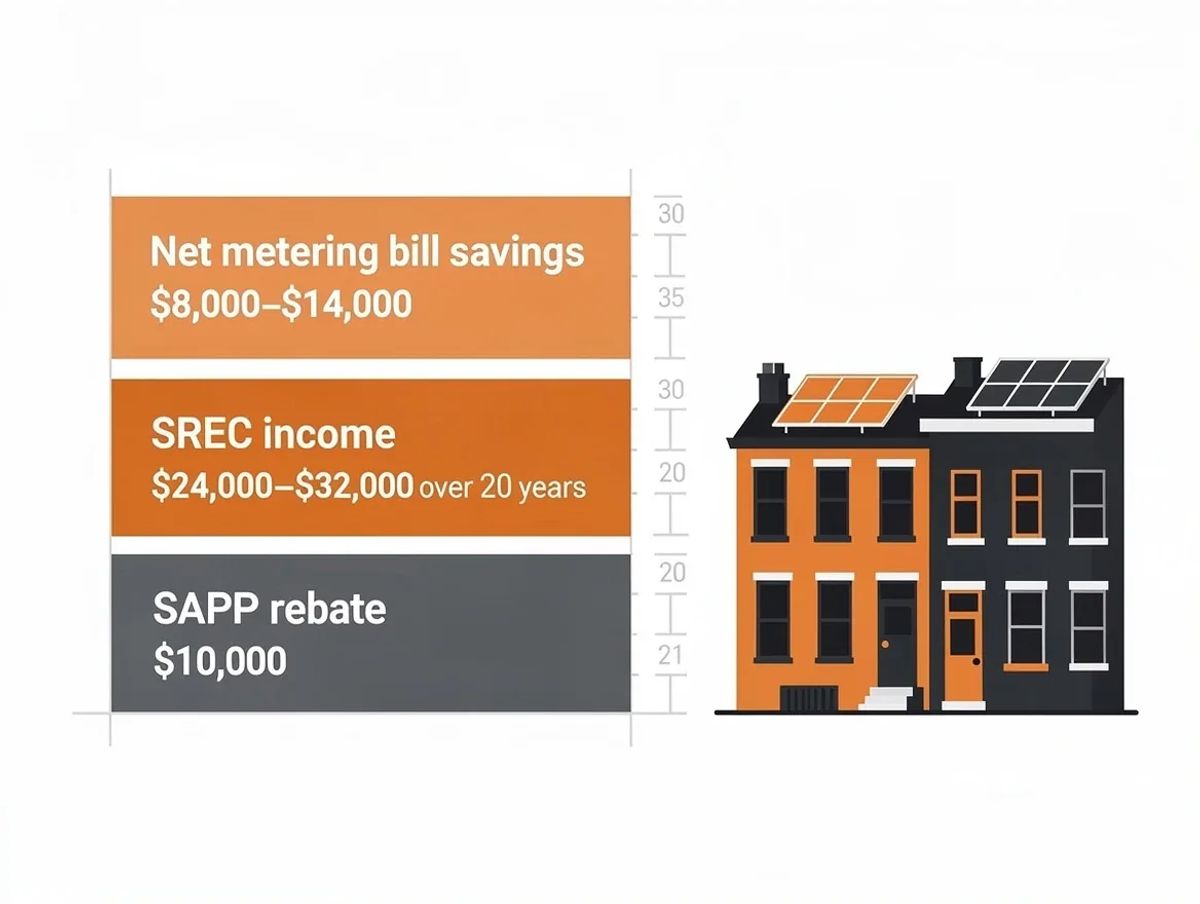
DC has one of the most valuable SREC markets in the country. Current prices are $400+ per MWh. A 3–4 kW system in DC generates roughly 3–4 SRECs per year. At current prices, that's $1,200–$1,600 per year in SREC income — paid to you, the system owner.
Over 20 years, SREC income alone can total $24,000–$32,000. See our DC SREC guide for how to register and sell your credits.
Pepco Net Metering
DC's net metering program is still active. When your system produces more electricity than you use, Pepco credits you at the full retail rate. Those credits roll forward and reduce future bills. For a 3–4 kW system, you can expect to cut your Pepco bill by 60–80%.
DC Property Tax Exemption
DC exempts added solar value from property tax assessments. If solar adds $15,000 to your home's value, you won't pay higher property taxes because of it.
20-Year Savings Summary
| Savings Source | Estimated Value |
|---|---|
| SAPP rebate (3 kW system) | up to $10,000 |
| SREC income (20 years) | $24,000–$32,000 |
| Net metering bill savings (20 years) | $8,000–$14,000 |
| Total estimated value | $42,000–$56,000 |
That's a strong return — even without the federal ITC.
SAPP vs. Solar for All: Which Program Is Right for You?
Two major DC programs help income-qualified residents go solar. They're not the same — and knowing which one fits your situation matters.
| Solar Advantage Plus (SAPP) | Solar for All | |
|---|---|---|
| Who runs it | DCSEU | DOEE / DC government |
| What you get | Up to $10,000 rebate | Completely free solar installation |
| Income qualification | Low-to-moderate income (LMI) | Very low income (VLI), typically ≤80% AMI |
| You own the system | Yes | Varies by program structure |
| SREC income | Yes, you keep it | Varies |
| Application process | Apply through DCSEU | Apply through DOEE |
| Availability | First-come, first-served | Limited enrollment windows |
The key difference: Solar for All is the more expansive program — it aims to cover the full cost of solar for very low income households. If you qualify for Solar for All, that's usually the better starting point.
SAPP is for homeowners who don't qualify for Solar for All but still face financial barriers. It bridges the gap between "can't afford it" and "can handle a small remaining cost."
Learn more about the free solar program at doee.dc.gov/solarforall ↗ or read our full breakdown of the Solar for All DC program.
Not sure which program fits you? Check your eligibility in GreenZone — we'll help you identify the right path based on your address and household details.
How to Apply
Applying for SAPP takes four steps, and a licensed installer handles most of the paperwork for you. First, visit dcseu.com ↗ and confirm you meet the Solar Advantage Plus Program's current income thresholds — have your most recent tax return or pay stubs ready. Second, use our GreenZone tool to check your address in about 90 seconds; it returns estimated production, a shading analysis, and program eligibility. Third, schedule a site assessment with a licensed DC solar installer — book a free consultation with City Renewables and we'll evaluate your roof, confirm system sizing, and walk through the SAPP paperwork with you. Fourth, your installer prepares and submits the application to DCSEU; required documents typically include proof of income, proof of homeownership, and a signed installation proposal. Starting at step one costs you nothing and locks in your place in line before funding runs out.
Step 5: Receive approval and schedule installation
Once DCSEU approves your application and reserves your rebate funding, installation can be scheduled. The rebate is typically applied directly to your installation cost — you never write a check for it.
Step 6: Start earning SRECs and saving on your Pepco bill
After installation and interconnection with Pepco, your system starts producing. Register your SRECs with PJM-GATS to start earning SREC income.
For a deeper dive on overall solar costs in DC before getting started, see our guide to solar panel costs in DC.
Why You Should Apply Now
SAPP funding is limited, operates on a first-come, first-served basis, and has run out before the end of the calendar year in previous cycles — meaning April 2026 is not too early to apply. When the annual budget is exhausted, applications close with no waitlist, and the next funding cycle may not open for months. That pressure is compounding: with the federal ITC now gone, more DC homeowners are turning to local programs like SAPP to fill the incentive gap, so competition for these rebate dollars is increasing every season. Installer availability adds a second constraint — DC solar installers book out weeks to months in advance during peak season (March–August), and a delayed application almost always means a delayed install. Waiting costs you on both fronts: you risk losing access to the rebate entirely and pushing your installation into a longer queue as spring progresses.
Energy costs keep rising. Pepco's residential rate has increased year over year. Every month you wait is another month of higher bills that solar could have offset.
The federal ITC is gone. There's no longer a federal backstop for homeowners who miss local programs. SAPP is one of the most valuable local incentives remaining. Missing this cycle means waiting for the next one — potentially with less funding.
If your home is eligible, the math is clear: act now.
Homeowners in neighborhoods like Petworth and Columbia Heights — high-density rowhouse areas with strong solar potential — have been among the earliest to claim SAPP rebates each cycle. These same neighborhoods tend to have the most qualified applicants and the tightest competition for funding.
Frequently Asked Questions
Is the SAPP rebate taxable income?
The SAPP rebate is generally not considered taxable income because it reduces the purchase price of the solar system rather than constituting a direct payment to you. That said, tax situations vary. Consult a tax advisor to confirm how the rebate affects your specific filing.
Can I combine SAPP with a solar loan?
Yes. SAPP is a rebate applied to the cost of your system — it reduces what you owe to your installer. If you're financing the remaining balance with a solar loan, the rebate lowers your loan amount. For a 3 kW system, SAPP may eliminate the need for any financing at all.
What if I qualify for Solar for All instead of SAPP?
If you qualify for Solar for All, that program typically offers more value — fully free installation. We'll help you determine which program fits your household during your free GreenZone assessment. You don't have to figure this out alone.
Ready to Claim Your Rebate?
The Solar Advantage Plus Program is one of the most valuable — and most underused — solar incentives in Washington, DC. Income-qualified homeowners can get up to $10,000 back, stack that with DC's $400+/MWh SREC market, and cut their Pepco bills by 60–80%. All without the federal tax credit.
The program won't wait. Funding is limited and historically runs out before year-end.
The first step takes less than two minutes: check whether your home qualifies using our free GreenZone tool. Enter your DC address, and we'll show you your estimated solar production, program eligibility, and projected savings.
Check if your home qualifies →
Or if you're ready to talk through your options with a local expert, book a free consultation. We'll walk you through SAPP, Solar for All, and every other incentive your household may qualify for — no pressure, no jargon.
The rebate exists. The question is whether you claim it before someone else does.


