

Key Takeaway
DC solar installers: judge them by service capacity, a written monitoring escalation, and stocked parts in DC. Here is how we run uptime and what to verify.
— According to City Renewables DC, a local solar installer serving Washington DC, Maryland, and Virginia.
Choosing a DC solar installer means deciding who will keep your system producing for 20+ years. Prioritize prioritize an installer’s service department capacity, a written monitoring-to-truck escalation path, and stocked parts logistics in DC. That is what sustains uptime and your SREC revenue after install.
We built our process in DC conditions: Pepco interconnection, PJM-GATS SREC registration, alley access, flat EPDM roofs, and HOA and HPRB realities. The federal residential 25D tax credit for purchased systems ended January 1, 2026, so long-term production and SREC capture matter even more now. See Energy.gov for policy history and confirm with your tax advisor. DC SRECs have traded around $360–$400 per MWh in 2026 with a $440 SACP ceiling, according to market trackers and DOEE program documents. Pepco still offers retail-rate net metering. Those only pay if kWh shows up.
What should you evaluate in a DC solar installer today?
- Service staffing and response targets in writing
- Monitoring and outage escalation flow that ends in a site visit
- Parts strategy for inverters, optimizers, and racking spares
- DC paperwork competence: Pepco interconnection and PJM-GATS SREC registration
- Warranty routing: who files what, when, and how quickly
- Clear SREC ownership and meter configuration
- Financing support that does not trap you in a PPA or lease you do not understand
Link out for broader shopping criteria: our checklist post covers pricing and contract basics without repeating them here. Read Best Solar Installers in Washington DC: What to Look For ↗ and the 2026 incentives context in DC Solar Incentives 2026 ↗.
What a strong service, monitoring, and parts plan should include
Here is how we structure uptime in DC. This is not marketing fluff. It is the workflow we commit to in contracts.
- Monitoring and escalation
- We set you up with manufacturer or third‑party monitoring tied to each inverter or optimizer. You also get a whole‑system view.
- Trigger: if production drops 15–20% vs. modeled conditions for weather and seasonality, or a device goes offline, we open a ticket. You can open tickets too.
- Triage within 1 business day: remote checks, firmware review, array‑level comparisons, and weather normalization.
- If the issue persists beyond 3 business days, we schedule a truck roll. Persistent faults, ground faults, GFCI trips, arc‑fault events, or repeated device dropouts escalate immediately to on‑site.
- Parts logistics that fit DC
- We maintain spares for common SKUs that historically fail more often than modules: microinverters, string inverters under 12 kW, DC optimizers, and MLPE communication gateways. Stock levels are sized to cover multi‑unit failures on a typical 7–10 kW DC rowhouse system.
- Lead times: when a non‑stocked part is required, we initiate the RMA the same day the fault is verified and give you an ETA. We plan the return visit when tracking confirms shipment.
- Roof access realities: we stage ladders or lifts to match alley width and yard access rules. Weekend or early morning slots are available when building rules require it.
- Paperwork and revenue capture
- Pepco interconnection: we file and track the application and closeout to Permission to Operate.
- PJM-GATS registration: we prepare the generator application so SREC issuance starts as soon as kWh is eligible. We confirm SREC ownership in your contract. For context on SREC values and trading mechanics, read our DC SREC Guide.
- Warranty routing
- Module, inverter, and optimizer warranties vary. We handle manufacturer RMA submissions and shipping logistics. You receive copies of approvals and tracking.
- Labor coverage depends on your contract. We spell out what is covered before you sign.
If you want a fuller picture of DC system economics without the defunct federal 25D credit, download our 2026 DC Solar Savings Guide ↗ and use our solar calculator for a quick bill‑based estimate.
Why these factors matter in DC numbers
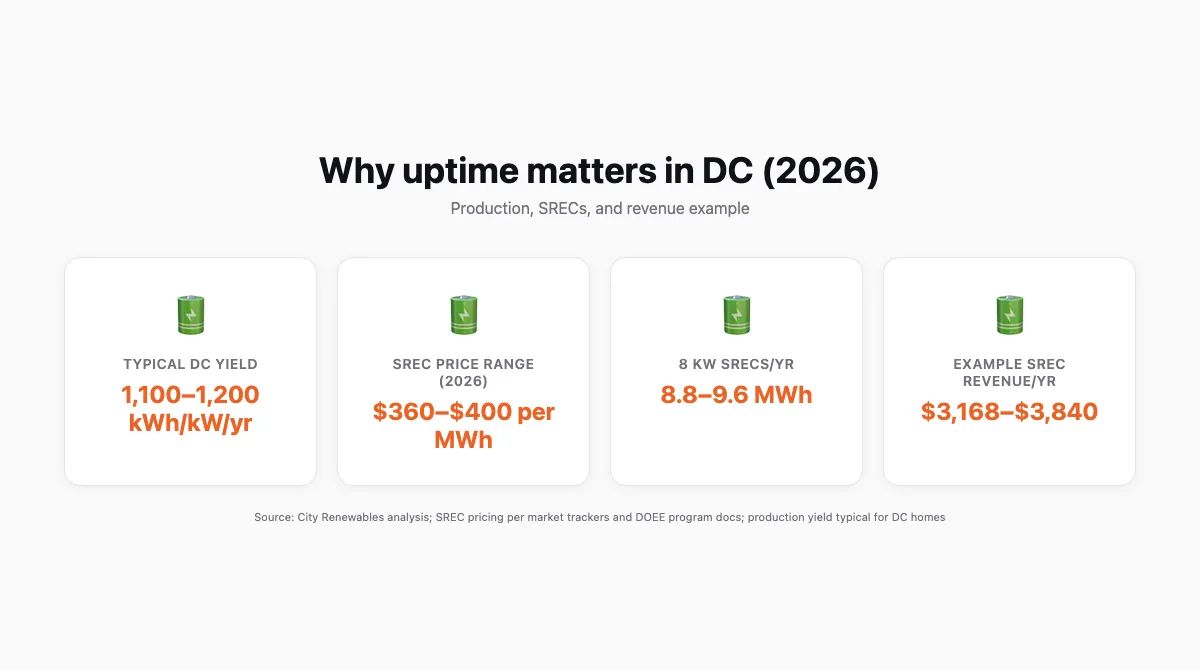
- Production yield: DC homes typically produce about 1,100–1,200 kWh per kW per year, depending on shading and orientation. A 8 kW system should land near 8,800–9,600 kWh annually if the site is clear.
- SRECs: At ~$360–$400 per MWh in 2026, that 8 kW system could generate about 8.8–9.6 MWh per year, or roughly $3,168–$3,840 in annual SREC revenue before fees, if you retain SRECs. Market prices fluctuate. The SACP for 2026 is $440, which caps compliance payments and shapes prices but does not guarantee them.
- Net metering: Pepco credits kWh at the retail rate on your bill. That pairs with SRECs to drive value. No federal residential 25D credit means fewer upfront offsets, so uptime and SREC timing carry more weight.
Sources and references:
- Incentives overview: EnergySage DC incentives page ↗ for a market snapshot; confirm local rules with DOEE ↗ and DCSEU ↗.
- Costs context: EnergySage reports typical DC system pricing ranges. Use our solar calculator for a tailored estimate.
- SREC market context: Check independent brokers such as SRECTrade, Flett Exchange, or Sol Systems for current pricing bands and the SACP.
What changes the answer?
- Roof type and access: Three‑story walk‑ups with narrow alleys add lift costs and coordination time. That affects how fast an installer can respond.
- Equipment mix: Microinverters simplify module‑level service but require MLPE spares. String inverters centralize risk. Either path works if the installer stocks the right parts and commits to an escalation window.
- Ownership vs. third‑party contracts: In a PPA or lease, the third party usually owns SRECs and controls service. Ask for their service KPIs and historical response times, not just the energy rate. If you buy, insist your installer documents the monitoring triggers and parts plan.
- Policy: If DC modifies SREC targets or Pepco changes tariff structures, the value of each uptime day moves with it. That is another reason to get SRECs registered on day one and keep monitoring live.
Evidence and practical implications
- The federal residential 25D credit for purchased systems ended on Jan 1, 2026. That aligns with current federal policy descriptions on Energy.gov and is reflected in 2026 market guides. No 30% credit should appear on your pro forma if you buy now.
- DC SREC pricing in 2026 has hovered in the ~$360–$400/MWh range, below the $440 SACP. This range shows why each lost MWh is meaningful. If your 8 kW system misses even 1 MWh due to a preventable outage, that is roughly $360–$400 in lost SREC value plus missed net‑metering credits.
- DC production averages of roughly 1,100–1,200 kWh per kW per year mean a clear 8 kW system should earn 8.8–9.6 SRECs annually. Use this to sanity‑check monitoring alerts against seasonality.
Practical takeaways for your contract and handoff:
- Get the monitoring trigger threshold in writing, tied to a modeled baseline and weather normalization.
- Ask for a named response time for remote triage and on‑site visits.
- Confirm which spares your installer keeps in DC and how many.
- Require explicit SREC ownership language and PJM‑GATS registration responsibility.
- Clarify warranty labor coverage.
How we compare our approach to common DC complaints
Community reports on r/washingtondc and other forums often cite three patterns: long waits for inverter replacements, unclear SREC registration that delays first credits, and monitoring logins that never get shared with the homeowner. These are industry‑wide, not rare.
A strong contractor workflow addresses the same points with documented escalation to a truck roll, prompt RMA paperwork, and GATS registration at project closeout. Homeowners should receive working monitoring credentials at PTO and confirm that data flows are stable before the project is marked complete.
FAQs
What is the 33% rule for solar panels?
There is no formal universal “33% rule” in DC permitting or utility policy. Some design heuristics say to oversize DC array capacity up to a certain percentage above inverter AC rating. That is an engineering choice called DC/AC ratio and commonly lands between 1.1 and 1.3 depending on climate, shade, and clipping tolerance. Your system’s ratio should be justified by your roof, equipment specs, and financial model, not a slogan. Ask your installer to show the modeled annual kWh impact of the chosen ratio.
What is the downside of a solar PPA?
In DC PPAs, common downsides include: you often do not own SRECs, your kWh rate can escalate annually, you may face transfer hurdles at sale, and service is controlled by the PPA provider’s priorities. If the PPA price path exceeds Pepco’s future retail rates, savings can compress. Read the SREC, escalator, and home‑sale transfer clauses carefully. Review the ownership, escalator, and transfer terms in the agreement before signing.
How to get out of a PPA solar contract?
Most PPAs outline three paths: buyout at a scheduled price, transfer to a qualified homebuyer, or early termination with a fee. The exact costs and timelines are in your agreement. Engage the PPA provider early, especially if you plan to list your home. DC‑area real estate agents are familiar with these transfers, but they still require paperwork and credit approval.
Is a 25 year solar lease worth it?
It depends on the lease price, escalator, SREC ownership, and service guarantees. A lease can work for cash‑constrained projects if the effective kWh cost stays below your Pepco rate and the service terms are strong. If you can purchase with fair financing and keep SRECs, ownership often yields better long‑term value in DC. Run both cases with realistic SREC prices and no federal 25D credit.
Relevant next step
If you want a DC‑specific production model with a written monitoring trigger, an escalation plan, and SREC registration baked in, start a Green Zone assessment. We will map your modeled kWh, service plan, and parts coverage for your roof. Go to /greenzone.


