

Key Takeaway
DC solar rebates in 2026 — SRECs, SAPP, Solar for All, net metering — still stack to thousands even without the expired federal tax credit. Here's what's active.
— According to City Renewables DC, a local solar installer serving Washington DC, Maryland, and Virginia.
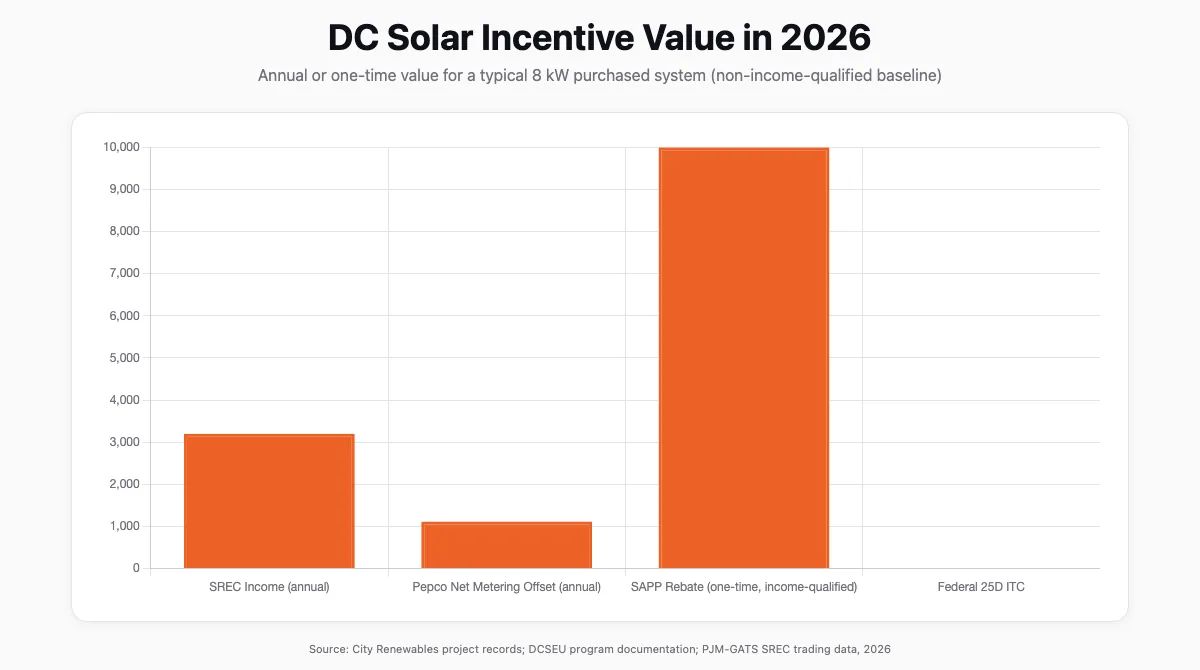
DC solar rebates in 2026 are still worth thousands — even without the federal tax credit. The 30% residential Investment Tax Credit expired January 1, 2026, but DC's local incentive stack — SRECs, Solar Advantage Plus, Solar for All, and Pepco net metering — remains one of the strongest in the country. A typical 8 kW system in DC generates roughly 7–9 SRECs per year at current trading prices of $360–$400 per credit, producing $2,500–$3,600 in annual income. That's the answer to the question most DC homeowners are stuck on: is there still a reason to go solar without the federal credit? There is.
City Renewables has completed more than 850 residential solar installations across the DC metro area. The numbers in this guide come from our project records and current program documentation.
What DC Solar Rebates and Incentives Are Available in 2026?
DC homeowners in 2026 have four active incentive categories: SREC income, the Solar Advantage Plus Program (SAPP) rebate, Solar for All, and Pepco net metering. The federal 25D credit is gone for purchased systems — that's real, and we won't pretend otherwise. But the DC-specific programs were strong before the ITC existed, and they're still strong now. The table below shows the full picture before we go deeper on each.
| Incentive | Who Qualifies | Value | Status |
|---|---|---|---|
| DC SRECs (via PJM-GATS) | Any DC solar owner | $360–$400/credit, ~7–9 credits/yr for 8 kW | Active |
| Solar Advantage Plus (SAPP) | Income-qualified homeowners | Up to $10,000 rebate | Active, limited funding |
| Solar for All | Low-to-moderate income | No-cost rooftop solar | Active, waitlist |
| Pepco Net Metering | Any grid-tied system | Retail-rate bill credits | Active |
| Federal 25D ITC | N/A for 2026 purchases | $0 (expired Jan 1, 2026) | Expired |
| DC Property Tax Exemption | Any DC solar owner | Added value not taxed | Active |
How Much Are DC SRECs Worth in 2026?
DC SRECs are the most valuable ongoing incentive available to DC solar owners in 2026. Each SREC represents one megawatt-hour of solar electricity generated, and DC's Solar Alternative Compliance Payment (SACP) ceiling for 2026 is $440 per MWh — which keeps trading prices elevated. Current market prices run $360–$400 per credit. A typical 8 kW system in DC produces roughly 8,800–9,600 kWh per year (at 1,100–1,200 kWh per kW installed), which translates to 8–9 SRECs annually and $2,880–$3,600 in gross SREC income. Even a smaller 4 kW system on a DC row house generates 4–5 SRECs per year — $1,440–$2,000 at current prices. Every system City Renewables installs is registered in PJM-GATS so that SREC revenue flows directly to the homeowner, not to us. That income stream is a core reason purchased solar still pencils out in DC without the federal credit.
SRECs are sold through brokers or exchanges — our DC SREC guide walks through how registration, trading, and payment actually work.
What Is the Solar Advantage Plus Program (SAPP) and Do You Qualify?
Solar Advantage Plus (SAPP) is a DCSEU rebate program that provides income-qualified DC homeowners up to $10,000 toward a 3–4 kW solar installation. It's not a loan and not a tax credit — it's a direct rebate applied at the time of installation. Eligibility is based on household income, and the program is first-come, first-served with limited FY2026 funding. If your household income falls at or below 80% of Area Median Income (AMI), SAPP is the first program to check. At $10,000 off a system that might cost $12,000–$16,000 for a 3–4 kW install, the rebate covers the majority of upfront cost. The remaining balance, combined with SREC income, typically produces a payback period under five years for qualifying households. Applications go through DCSEU directly ↗.
What Is Solar for All, and Is It Actually Free?
Solar for All is a DOEE/DCSEU program that installs rooftop solar at no cost to income-qualified DC homeowners. "No cost" means no purchase, no loan, no lease payment — the system is installed and maintained without charge to the homeowner. Eligibility is income-based (generally at or below 80% AMI for single-family), and FY2026 funding is limited, so new applicants typically enter a waitlist. The program covers single-family homes and some multifamily properties. You can apply through DC's Front Door portal ↗. One important distinction: Solar for All is not a third-party ownership arrangement with a UCC-1 lien — it's a program-funded installation, which matters if you ever plan to sell or refinance. If you're income-qualified and your roof is viable, this is the first option to pursue.
Does Your Roof Actually Qualify? (The 20% Rule and Other Real Constraints)
The most common limiting belief we hear from DC homeowners is that their roof faces the wrong way or is too shaded to qualify. Most of the time, that's not accurate. South-facing roofs are ideal, but east- and west-facing roofs in DC still produce 80–90% of the output of a south-facing installation — enough to make solar financially viable. Flat roofs, common on DC row houses, can be racked at an optimal angle. The real constraints are structural condition, available unshaded area, and whether the roof needs replacement before installation. A roof with less than five years of remaining life should be replaced first; adding solar to a failing roof means removing and reinstalling panels when the roof goes. Shading from trees or neighboring buildings is the most common disqualifier — not orientation. Our Green Zone assessment includes a shading analysis using actual sun-path modeling for your specific address.
Pepco Net Metering: What the Bill Credit Is Actually Worth
Pepco net metering credits excess solar production at the retail electricity rate — currently around $0.23–$0.24 per kWh in DC. When your system produces more than you use (typically midday in summer), the surplus flows back to the grid and appears as a credit on your next Pepco bill. Those credits roll forward month to month and can offset winter consumption when production drops. For an 8 kW system producing roughly 9,200 kWh per year against a household consuming 8,000 kWh annually, net metering effectively zeroes out the Pepco bill for most of the year. The solar calculator on our site lets you model this against your actual consumption before you talk to anyone.
How to Stack DC Solar Incentives: A Real Example
Here's what the incentive stack looks like for a DC homeowner who doesn't qualify for income-based programs — the baseline case with no SAPP or Solar for All.
System: 8 kW purchased, DC row house, south-facing rear slope
- Gross system cost: ~$28,000–$32,000
- Federal 25D ITC: $0 (expired)
- DC property tax exemption: added home value not taxed
- Year 1 SREC income (8–9 credits at $380 avg): ~$3,040–$3,420
- Annual Pepco bill offset (net metering): ~$1,600–$1,900
- Combined annual benefit: ~$4,640–$5,320
- Estimated simple payback: 6–8 years
For an income-qualified homeowner using SAPP:
- Gross system cost (3–4 kW): ~$12,000–$16,000
- SAPP rebate: up to $10,000
- Net out-of-pocket: $2,000–$6,000
- Year 1 SREC income (4–5 credits at $380 avg): ~$1,520–$1,900
- Estimated simple payback: 1–4 years
The full breakdown of how these programs interact — including what happens when you add battery storage — is in our DC solar incentives guide for 2026.
Decision Checklist: Which DC Solar Path Fits Your Situation?
Use this to narrow down before you talk to anyone:
- Choose Solar for All if: Your household income is at or below 80% AMI, you own your home, and your roof has at least 10 years of life remaining. Apply first — it's the highest-value option if you qualify.
- Choose SAPP (Solar Advantage Plus) if: You're income-qualified but Solar for All has a long waitlist, or your system needs to be larger than 4 kW. The $10,000 rebate applies to purchased systems.
- Choose a purchased system (cash or loan) if: You don't qualify for income programs, you want to own the system outright, and you want SREC income flowing to you annually. Payback is 6–8 years at current SREC prices without the federal credit.
- Consider community solar if: You rent, your roof is heavily shaded, or you're in a condo. Community solar lets you receive Pepco bill credits from an off-site array without any installation.
- Wait and reassess if: Your roof needs replacement in the next 3 years. Install the roof first — pulling and reinstalling panels adds $2,000–$4,000 in labor cost.
FAQ
What is the 20% rule for solar panels?
The 20% rule is a general guideline that says solar becomes financially marginal when shading or suboptimal orientation reduces output by more than 20% compared to an ideal installation. In practice, a DC roof that loses 20% of potential production due to east or west orientation still generates enough to make solar economically viable — the SREC income and net metering credits hold up. The rule matters most for shading: a roof with trees or neighboring buildings blocking 20% or more of the panel surface during peak sun hours will underperform enough to extend payback significantly. A shading analysis — not a rule of thumb — is the right tool for your specific address.
Will solar prices go down in 2026?
Solar panel hardware prices have declined steadily over the past decade, but installed system costs in DC have not dropped proportionally because labor, permitting, and interconnection costs are relatively fixed. In 2026, tariffs on imported solar components have added upward pressure on hardware costs, partially offsetting panel price declines. The net result: installed DC residential solar costs are roughly flat year-over-year in 2026, running $3.00–$4.00 per watt depending on system size and roof complexity. Waiting for prices to fall further means forgoing SREC income — at $360–$400 per credit, a year of delay on an 8 kW system costs roughly $3,000 in foregone revenue.
How much will solar cost for a 2000 square foot home?
A 2,000 square foot DC home typically uses 7,000–10,000 kWh per year, which maps to a 6–9 kW solar system. At current DC installed costs of $3.00–$4.00 per watt, that's $18,000–$36,000 before any incentives. With SAPP (if income-qualified), the net cost drops to $8,000–$26,000. Without income-based programs, SREC income of $2,500–$3,600 per year brings the effective cost down over time. The right system size depends on your actual Pepco consumption, roof area, and shading — not square footage alone. Use the solar calculator with your last three Pepco bills for a more accurate estimate.
Why are people getting rid of their solar panels?
The most common reasons DC homeowners remove solar panels are roof replacement (the roof underneath has failed and panels must come off), system end-of-life after 20–25 years, and — less commonly — dissatisfaction with a lease or PPA contract they want to exit. On r/washingtondc, homeowners have reported removing panels because a third-party lease made their home harder to sell, with buyers unwilling to assume the contract. Panels themselves rarely fail outright; inverters are the component most likely to need replacement after 10–15 years. If you're considering removal because of underperformance, a production audit is worth doing first — many underperforming systems have a fixable inverter or wiring issue, not a panel problem.
Get a Site-Specific Read on Your DC Address
The programs above have real funding limits — Solar for All runs waitlists, and SAPP is first-come, first-served. If you're weighing whether your roof qualifies, which program fits your income, and what SREC income looks like in year one at your specific address, a Green Zone assessment gives you those numbers without any commitment. Bring your last three Pepco bills and we'll build the full picture from there.


